

Club championship mental preparation to manage pressure and anxiety

Pressure doesn’t have to disappear before you compete. You need a plan for where to direct your attention when it rises. Effective club championship mental preparation builds that plan through consistent routines, steady self-talk, and a focus on the next controllable action. It can help experienced competitors and players entering a championship for the first time.
It’s natural to care about the result, especially after working hard to reach the event. But focusing only on winning can make each mistake feel bigger and pull your attention away from the shot in front of you. A deliberate mental routine helps you return to the process, trust your preparation, and respond more calmly when the round doesn’t unfold as expected.
This guide explains how to manage pressure and anxiety, build confidence through preparation, and use focus cues, imagery, breathing, and practical self-talk around competition. You’ll also learn how to practise these tools so they feel familiar when the championship begins.
- Build focus by choosing a controllable task for each shot and returning your attention to it when distractions arise.
- Use a repeatable pre-competition routine to steady your attention and respond to pressure with greater composure.
- Strengthen confidence by identifying your preparation, recognizing your strengths, and setting process-focused goals.
- Practise imagery and mindfulness so you can rehearse responses to mistakes and settle your attention before play.
- Replace harsh self-criticism with specific, useful cues that help you commit to the next action.
1. Managing focus and decompression around competition
At a club championship, attention can drift from the shot in front of you to the scorecard, other players, or the consequences of a mistake. Give your mind one immediate task: choose a target, commit to the shot, then assess the result after it lands. This sequence directs attention to a controllable action rather than an outcome you can’t dictate.
Focus is trained before competition, too. During practice, make each shot a deliberate repetition instead of hitting balls while thinking about unrelated tasks. Choose a target, picture the intended flight, and notice whether you committed fully. If your attention wanders, pause and restart the sequence. Practising the return to focus matters: mental toughness isn’t never losing concentration, but noticing the lapse and choosing the next useful action.
Build a repeatable anchor that brings you back to the present. It might be a breath, a clear target, or a short cue such as “smooth tempo.” Use the same anchor in practice and competition so it feels familiar when pressure rises. The Race Club recommends that swimmers rehearse their pre-race anchor during training, including race-pace efforts and timed swims. The transferable principle is to practise a mental routine under realistic demands, rather than saving it for the championship.
Separate preparation from recovery. Before a round, use a consistent sequence to settle your attention and prepare for the first shot. After practice, deliberately shift away from golf instead of replaying every swing for the rest of the day. The Race Club advises swimmers to switch off from swimming after leaving the pool deck. For a golfer, that could mean putting equipment away, changing activities, and returning to analysis during a planned practice session.
Pressure often draws attention to factors outside your control: an opponent’s record, the weather, officials, or the demand to play perfectly. Name what you can influence instead. You can choose a target, follow your pre-shot routine, and decide how to respond after a poor shot. When a result disappoints, reset briefly: acknowledge what happened, take one steady breath, then identify the next decision. This shifts your effort back to the process.
Club championship mental preparation becomes more reliable when you rehearse these actions throughout the season. Practise focus during ordinary sessions, use the same anchor when the stakes rise, and create a clear boundary between golf and recovery. The mental game isn’t about forcing calm or eliminating pressure. It’s about noticing where your attention has gone and bringing it back to the next controllable step.
2. Managing competitive pressure and performance anxiety
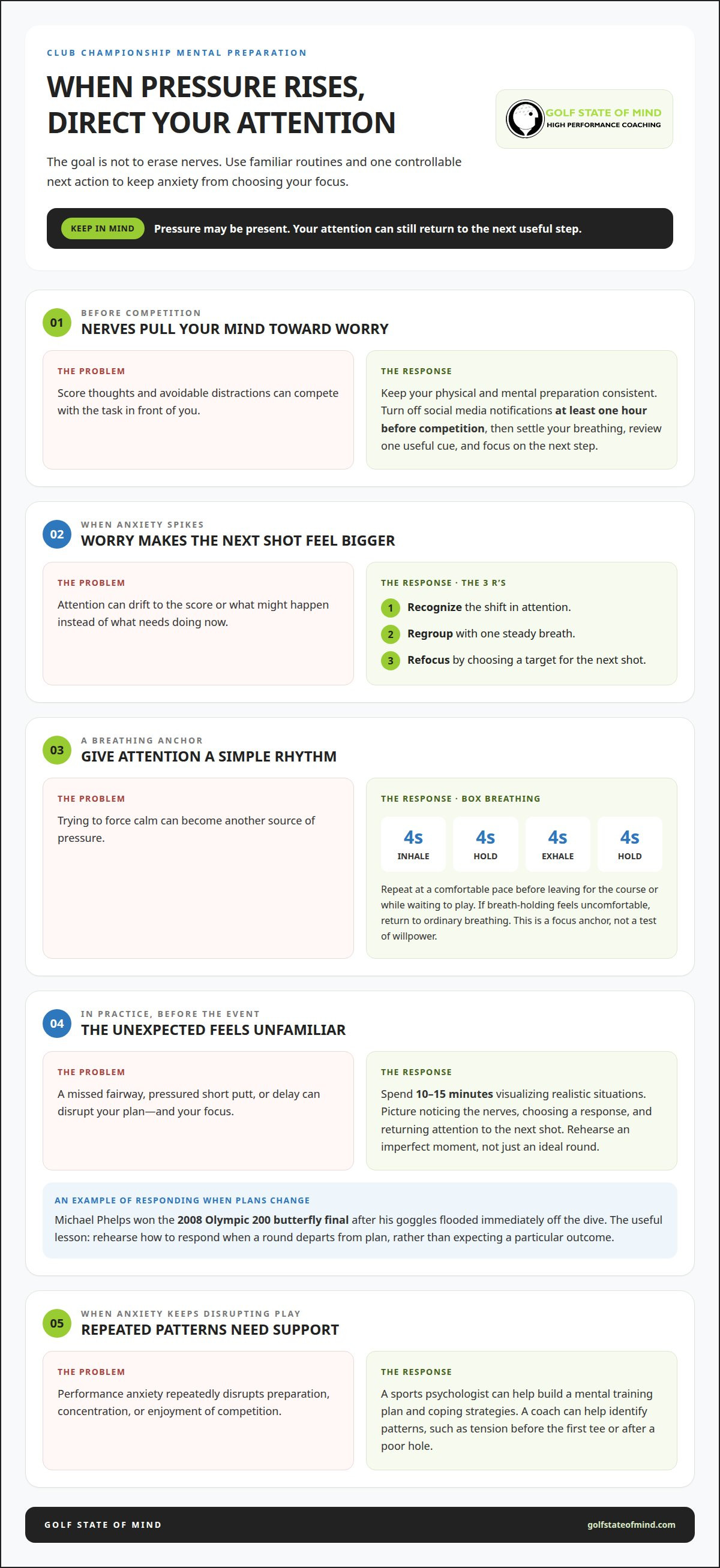
Before a club championship, manage nerves with a familiar routine, steady breathing, and a clear first task. For example, use box breathing, picture your opening shot, and commit to its target. The goal isn’t to erase pressure, but to keep anxiety from deciding where your attention goes.
Seek support when performance anxiety repeatedly disrupts preparation, concentration, or enjoyment of competition. A sports psychologist can help build a mental training plan and coping strategies for high-pressure situations. Coaches can also help identify patterns, such as tension rising before the first tee or after a poor hole.
Keep your pre-competition routine consistent, including both physical and mental preparation. Turn off social media notifications at least one hour before competition to reduce avoidable distractions. Then use a short sequence you’ve practised: settle your breathing, review one useful cue, and focus on the next step. Familiar actions give your mind something to do when worries compete for attention.
Try box breathing before leaving for the course or while waiting to play. Inhale for 4 seconds, hold for 4 seconds, exhale for 4 seconds, then hold again for 4 seconds. Repeat the sequence at a comfortable pace. If breath-holding feels uncomfortable, return to ordinary breathing. The technique is a focus anchor, not a test of willpower.
Visualization can make preparation more specific. Spend 10-15 minutes imagining realistic game situations, including a missed fairway, a short putt under pressure, or a delay before your turn. Picture yourself noticing the nerves, choosing a response, and returning attention to the next shot. Rehearsing an imperfect moment gives you a response to draw on if it happens during competition.
Use the 3 R’s when anxiety pulls your attention away: recognize the shift, regroup, and refocus on what needs to be done now. For instance, notice that you’re worrying about your score, take a steady breath, then choose a target for the next shot. This sequence works during a round because it turns a broad concern into one immediate action.
Unexpected problems can challenge even experienced competitors. Michael Phelps won the 2008 Olympic 200 butterfly final after his goggles flooded immediately off the dive. The useful lesson for golfers isn’t to expect a particular outcome; it’s to rehearse how you’ll respond when a round departs from plan. Mental preparation can make that response more deliberate.
For a structured way to develop these skills, explore a mental game training system. Use it to build repeatable tools for pressure, then practise those tools before the championship rather than waiting for nerves to appear.
3. Building confidence through preparation and self-assessment
Confidence is easier to draw on when it rests on evidence. Before the season, write down specific strengths you can demonstrate, such as steady course management, a reliable putting routine, or recovering well after a poor hole. Read the list before each competition. This doesn’t mean every shot will go well; it reminds you of skills you’ve already practised.
Make preparation concrete by asking, “If the championship were two weeks away, what would I do now?” Identify the work that matters most, then plan your practice around it. A player seeking more confidence on approach shots might choose a clear target for each session and record what they learned. This turns a distant goal into actions to take today.
Set process goals alongside outcome goals. The Race Club recommends writing down at least three event goals for the season and displaying them somewhere visible each day. In golf, goals might focus on committing to the target, following a pre-shot routine, or responding constructively after a mistake. These goals describe choices you can make, rather than results you can’t fully control.
A “buffer below qualifying times” applies most directly to timed events, where athletes seek a performance with room beneath a qualifying limit. The transferable idea is to prepare beyond the minimum needed for entry: build dependable skills instead of relying on confidence around one narrow performance. For a golfer, that could mean practising a routine in varied conditions rather than treating one strong round as proof of readiness.
Coaches can support mental preparation by helping athletes set realistic process goals, recognize strengths, and connect feedback to specific actions. For example, a coach might point out that a player chose a clear target and stayed committed, even after missing the green. That feedback links confidence to behaviour the player can repeat, rather than praise based only on a score.
Use self-assessment to make mental toughness practical. After practice, record one decision that worked, one situation that challenged you, and one adjustment for next time. A school team player might note how they handled nerves in a match, then rehearse a useful response before the next event. Honest reflection separates a difficult result from a judgment of your overall ability.
Visualization can add another layer to preparation. Picture a strength in a realistic championship moment, such as choosing a safe target after an errant drive and committing to the next shot. Keep the scene specific: see the situation, choose your response, and imagine carrying it out. Confidence builds through repeated evidence, clear preparation, and trust in actions you can control.
4. Mindfulness, imagery, and customized routines
The night before a club championship, prepare what you need and settle on a simple morning plan. On the day, follow familiar steps, such as arriving with time to warm up, taking a quiet moment, and reviewing one process cue before play.
A pre-performance routine works best when each action has a purpose. For golf, that might mean checking your equipment, completing a physical warm-up, and choosing a short focus cue. At the first tee, use a separate pre-shot sequence: assess the lie, select a target, picture the shot, and commit. Keep the sequence practical enough to use throughout the round.
Mindfulness helps you notice where attention has gone without immediately following every thought. Practise for 5-10 minutes daily by sitting quietly, noticing your breathing, and returning attention when it wanders. Then apply the same skill during ordinary situations, such as waiting to play or walking between shots. The aim is to notice distraction and deliberately return to the present task.
Imagery adds rehearsal to physical preparation. Picture a realistic moment in detail: the first tee, a challenging approach, or a putt after a previous mistake. Imagine the setting, your decision, and the action you want to take. Include a response to disruption, such as pausing after a poor shot and beginning your routine again. This makes the rehearsal specific, rather than simply picturing a successful score.
Adapt your routine to situations that affect your focus. If you feel rushed, use a deliberate pause before starting the pre-shot sequence. If a long wait distracts you, reset briefly and begin the routine only when you’re ready to play. Keep the core steps consistent, but make practical adjustments for weather, delays, or changes in pace.
Build these strategies into training instead of introducing them for the first time at the championship. Rehearse your pre-start routine before practice rounds, and notice which steps help you feel prepared without adding unnecessary complexity. If a cue is hard to remember or interrupts your decisions, simplify it. Familiarity comes from repeating a routine in realistic situations, including when a shot doesn’t go to plan.
After each practice session, make a short review: note which routine steps you followed, when your attention wandered, and what helped you return. This record can show whether a strategy works across different skills and course conditions. Consistent preparation doesn’t mean performing a rigid script. It means having a reliable structure you can adapt while staying attentive to the shot in front of you.
5. Positive self-talk
Self-talk is the language you use to interpret a situation and guide your next action. During a club championship, “I always ruin this hole” can turn one poor shot into a judgment about your whole round. Replace it with a precise observation, such as “That shot missed left; choose a clear target now.” This acknowledges what happened without letting frustration direct your next decision.
Develop useful self-talk by noticing your common reactions in practice. After a missed putt, do you criticize your ability, rush the next shot, or become cautious? Name the pattern, then prepare a short response that directs your attention to an action. For example, “Read the break, pick a pace, commit” gives you a sequence to follow. A practical cue is specific, believable, and connected to a skill you can use.
Positive self-talk doesn’t mean pretending every outcome is good. It means choosing words that support a deliberate response. “I must make this” raises the pressure around one putt; “See the line and roll it with commitment” directs attention to the process. Affirmations work best when they reinforce preparation or effort, rather than promise a result. Choose language you can trust under pressure.
Use affirmations before competition and during warm-up to reinforce confidence. Swimmers, for example, can repeat positive statements before races and while warming up. A golfer might adapt this practice with a phrase grounded in personal preparation, such as “I know my routine” or “I can return to the next shot.” Repeat your chosen words at a consistent point, then connect them to a physical action, such as settling your grip before a practice putt.
When an emotional reaction arrives, keep the reset brief. First, notice the thought without arguing with it. Then replace it with a useful cue and act on that cue. After a bunker shot leaves a difficult putt, for instance, you might say, “Assess the slope, choose the pace, make a committed stroke.” You don’t have to feel calm immediately. The cue gives your attention a task while the emotion settles.
Review your self-talk after practice by recording one phrase that helped and one that distracted you. Keep the helpful cue, and rewrite the unhelpful one into a clear instruction. With repetition, that language becomes a familiar part of your preparation rather than a phrase you have to invent under pressure. For structured guidance in developing mental skills and performance cues, explore the mental game training system.
Golf State of Mind
Golf State of Mind helps golfers strengthen the mental skills behind preparation, focus, confidence, and performance under pressure. If you want a structured approach to applying these strategies, The Ultimate Mental Game Training System offers mental game training, while 1:1 Mental Coaching provides a more individual path. Mental Game Audios can also support focused preparation, and How to Cure the Yips addresses a specific performance challenge.
Turn to Golf State of Mind when nerves, self-doubt, or recurring mental obstacles make it difficult to trust your process on the course. The right next step depends on whether you want guided training, individual coaching, or support for a particular challenge. Contact Golf State of Mind to discuss your mental game goals.
Carry your preparation into the next round
A championship gives you a chance to practise more than shot-making. It asks you to respond to uncertainty, reset after setbacks, and stay committed to decisions you can control. Treat each round as an opportunity to learn how your attention and habits hold up under pressure. That knowledge can guide your next practice, whether you’re preparing for another event or building a steadier approach to the game.
Club championship mental preparation can help beyond a single competition when you turn it into a repeatable process. Choose one mental skill to keep developing, then make space for it in your regular training. Progress can start with a small commitment, such as practising a cue or reviewing how you responded to a difficult moment.
If you want a structured way to continue developing your mental game, explore the mental game training system. Keep your attention on the process, trust the work you put in, and take your next step with purpose.
Frequently Asked Questions Who Can Benefit?
Any golfer preparing for a club championship can benefit, whether it’s your first event or a regular part of your season. Mental skills can help you manage expectations, return after a difficult stretch, or build consistency when you already compete comfortably. A newer competitor might focus on feeling settled on the first tee, while an experienced player might work on responding constructively to a late-round error.
How should you mentally prepare for a club championship?
Prepare by identifying the situations most likely to test your composure, then decide how you want to respond. If a tight opening hole makes you cautious, rehearse your decision process during a practice round. Keep a brief note of what helps you settle and what tends to pull you off task. This gives your preparation a personal focus, rather than relying on generic advice or trying to change everything before competition.
What pre-competition mental routines help athletes perform their best?
A useful routine is a sequence you can repeat without rushing, such as reviewing your plan for the opening holes, checking that you have what you need, and taking a quiet moment before warm-up. Keep it practical and allow for normal changes, such as a delayed start. Practise the routine in training so you can follow it without making new decisions when competition-day activity feels busy.
What visualization techniques can improve championship performance?
Make imagery specific by picturing a decision, not just a successful result. Imagine standing over a shot with a narrow landing area: notice the view, select a target, and picture your preparation and commitment to the swing. You can also visualize a manageable response to an imperfect outcome, such as taking time to reassess after missing the green. Rehearsing choices gives the image a practical purpose and makes it relevant to play.
How should you set realistic goals for a club championship?
Choose goals that reflect your preparation and describe actions within your control. For example, aim to make thoughtful decisions on unfamiliar holes or stay patient when your group is waiting. A result goal can still matter, but it shouldn’t be your only measure of a successful day. Afterward, assess whether you followed your plan and identify one lesson to carry into your next competition.
How can you stay focused and recover mentally after mistakes during competition?
After a mistake, avoid carrying its meaning into the next decision. If a missed putt leaves you frustrated, acknowledge the reaction, let the previous hole end, and turn your attention to the next shot. Don’t spend the walk to the next tee repeatedly judging your ability. A short, neutral description of what happened can help separate the shot from your overall performance.
What breathing exercises help reduce pre-game anxiety?
The 4-7-8 technique uses an inhale lasting 4 seconds, a breath hold lasting 7 seconds, and a slow exhale lasting 8 seconds. Try it before warm-up while seated comfortably, and keep the breathing controlled rather than forced. If the holds feel uncomfortable, stop and breathe normally. The purpose is to give your attention a steady pattern before play, not to make yourself perform a breathing exercise perfectly.
The post Club championship mental preparation to manage pressure and anxiety appeared first on Instruction For The Mental Game of Golf.
Source: https://golfstateofmind.com/club-championship-mental-preparation-to-manage-pressure-and-anxiety/
Anyone can join.
Anyone can contribute.
Anyone can become informed about their world.
"United We Stand" Click Here To Create Your Personal Citizen Journalist Account Today, Be Sure To Invite Your Friends.
Before It’s News® is a community of individuals who report on what’s going on around them, from all around the world. Anyone can join. Anyone can contribute. Anyone can become informed about their world. "United We Stand" Click Here To Create Your Personal Citizen Journalist Account Today, Be Sure To Invite Your Friends.
LION'S MANE PRODUCT
Try Our Lion’s Mane WHOLE MIND Nootropic Blend 60 Capsules
Mushrooms are having a moment. One fabulous fungus in particular, lion’s mane, may help improve memory, depression and anxiety symptoms. They are also an excellent source of nutrients that show promise as a therapy for dementia, and other neurodegenerative diseases. If you’re living with anxiety or depression, you may be curious about all the therapy options out there — including the natural ones.Our Lion’s Mane WHOLE MIND Nootropic Blend has been formulated to utilize the potency of Lion’s mane but also include the benefits of four other Highly Beneficial Mushrooms. Synergistically, they work together to Build your health through improving cognitive function and immunity regardless of your age. Our Nootropic not only improves your Cognitive Function and Activates your Immune System, but it benefits growth of Essential Gut Flora, further enhancing your Vitality.

Our Formula includes: Lion’s Mane Mushrooms which Increase Brain Power through nerve growth, lessen anxiety, reduce depression, and improve concentration. Its an excellent adaptogen, promotes sleep and improves immunity. Shiitake Mushrooms which Fight cancer cells and infectious disease, boost the immune system, promotes brain function, and serves as a source of B vitamins. Maitake Mushrooms which regulate blood sugar levels of diabetics, reduce hypertension and boosts the immune system. Reishi Mushrooms which Fight inflammation, liver disease, fatigue, tumor growth and cancer. They Improve skin disorders and soothes digestive problems, stomach ulcers and leaky gut syndrome. Chaga Mushrooms which have anti-aging effects, boost immune function, improve stamina and athletic performance, even act as a natural aphrodisiac, fighting diabetes and improving liver function. Try Our Lion’s Mane WHOLE MIND Nootropic Blend 60 Capsules Today. Be 100% Satisfied or Receive a Full Money Back Guarantee. Order Yours Today by Following This Link.


| Visits: | 1,837,856,871 |
| Stories: | 8,734,252 |
Whistler Blowers, Insiders

