

Fear of success in golf and how to manage course anxiety

What if the pressure you feel when a good round is within reach is not a sign that you’re unprepared, but a cue to return to your routine? Fear of success in golf can pull your attention toward what a score might mean, while fear of failure can make every shot feel like a test. Either may show up as shaky hands, rapid breathing, or a rushed, jerky swing.
It makes sense to want certainty when a round matters. But trying to control the final score can increase tension. You have more influence over how you prepare for the shot in front of you than over the outcome of the round.
You’ll learn how fear of success and fear of failure can affect your decisions and performance, what course anxiety may look like, and how to respond instead of reacting. The focus is a steady process: notice what’s happening, settle your attention, and commit to the next shot rather than trying to force a result.
- Shift attention from the final score to the preparation and decision for the shot in front of you.
- Recognize how anxiety can show up physically and influence your swing or choices on the course.
- Notice how fear of success and fear of failure can pull focus in different ways, then return to what you can control.
- Make room for both strong and disappointing outcomes; accepting that some shots will be missed can ease pressure.
- Use a deliberate pause, steady breathing, and a clear next-shot focus to respond to fear rather than react to it.
Focusing on the process rather than results
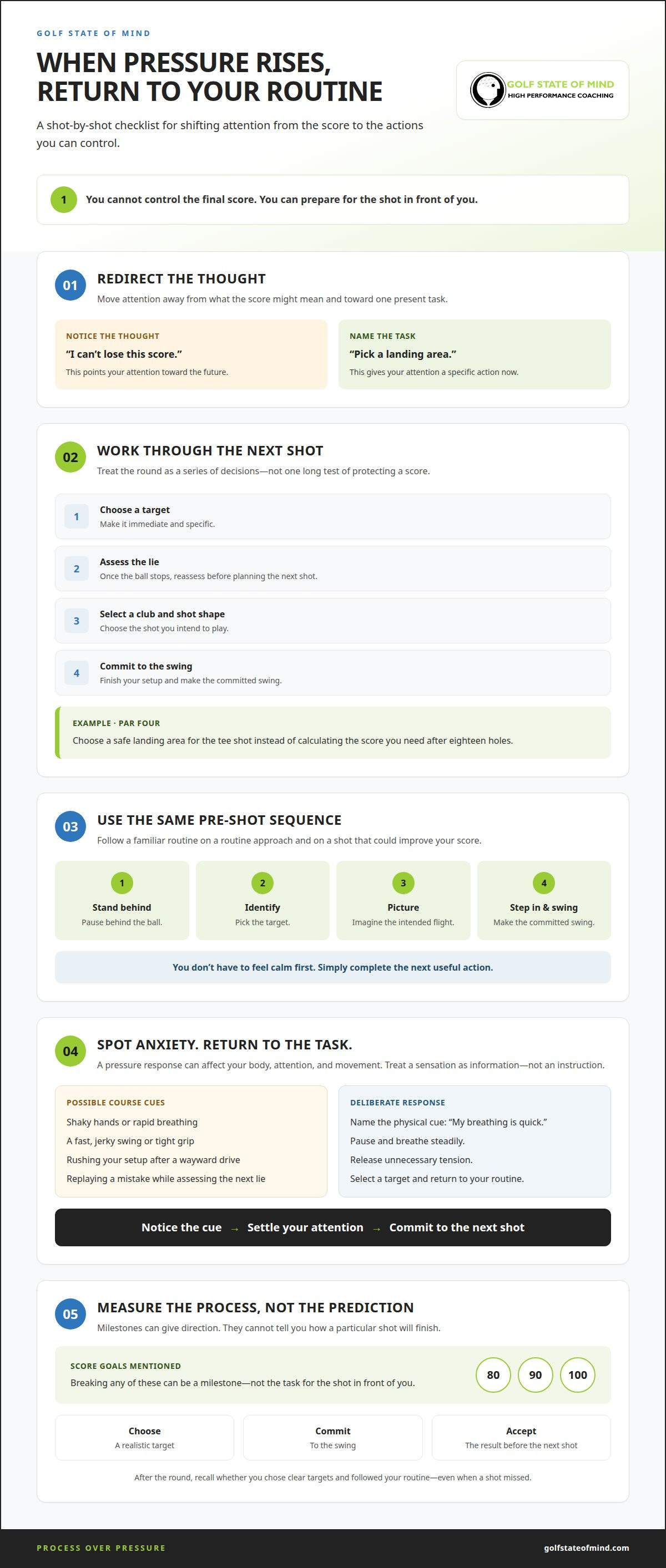
A score is an outcome; your routine is a sequence of choices you can make on the course. When fear of success or failure pulls your attention toward the final card, bring it back to the next shot. Choose a target, assess the lie, select a club, and commit to a shot shape. These actions give your attention a present task instead of letting it rehearse what a birdie, bogey, or tournament finish might mean.
Keep the target immediate and specific. On a par four, for example, choose a safe landing area for your tee shot rather than calculating the score you need after eighteen holes. Once the ball stops, reassess the lie and select your next target. This turns the round into a series of decisions, not one long test of whether you can protect a score.
A process focus also gives you a steadier response under pressure. Use the same pre-shot routine for a routine approach and a shot that could improve your score. Stand behind the ball, identify the target, picture the intended flight, then step in and swing. A familiar sequence gives your mind something concrete to follow. You don’t have to feel calm first; simply complete the next useful action.
- Notice the thought: “I can’t lose this score” points toward the future.
- Name the task: “Pick a landing area” gives your attention a present action.
- Return to routine: Finish your setup and make the committed swing.
Immediate goals should reflect what you can influence, not what you hope the scorecard will show. A golfer working toward breaking 80, 90, or 100 can set a goal for each shot: choose a realistic target, make a committed swing, and accept the result before planning the next one. The milestone provides direction, but it cannot tell you how a particular shot will finish. Your routine can guide the decision you make now.
Examples from tournament golf reinforce the value of trusting preparation. After the third round of the 2009 Masters, Shingo Katayama said he believed in his practice and was doing his best. That response directs attention toward preparation and effort, rather than predicting the final result. The useful lesson is not to imitate a professional’s score, but to trust the work behind your own next shot.
Make the process measurable through actions, not predictions. After a round, recall whether you chose clear targets and followed your routine, even when a shot missed. If your routine keeps breaking down under score pressure, a focused mental-game conversation can help identify which on-course cues need attention. Then carry one cue into your next round, such as “choose the target,” and return to it before each shot.
How golf anxiety can affect performance
Anxiety can narrow attention, increase physical tension, and make a familiar shot feel harder to execute. To build confidence under pressure, practise a specific shot with a clear target, use your usual pre-shot routine, and pause deliberately before swinging.
Anxiety Symptoms on the Course
Course anxiety is a pressure response that can affect both your body and attention. You might notice shaky hands, rapid breathing, or a fast, jerky swing when a shot feels important. Recognizing these signs matters: they may appear before a poor shot, giving you a chance to pause and return to a deliberate routine.
Notice what changes in your own play. You might grip the club more tightly over a short putt, rush your setup after a wayward drive, or replay a previous mistake while assessing the next lie. Naming the response helps separate a feeling from a decision: “My breathing is quick” describes a sensation, while “I’ll miss this” predicts an outcome. Treat the sensation as information, not an instruction.
Pressure, Tension, and Performance
Anxiety can increase tension, and excess tension can make a practiced movement feel less fluid. On the course, a tight grip or hurried transition may disrupt your rhythm. This matters because trying to force a better result can add effort when a smoother, committed swing would serve you better.
At the 2009 Masters, Kenny Perry said he tried to channel his energy and calm himself under pressure. His response points to a useful distinction: pressure brings energy, but your next action determines where attention goes. During practice, rehearse a tee shot as if the fairway narrows, then step back, breathe steadily, select a target, and follow your normal routine. The challenge is to practise the response, not merely repeat the swing.
Use pressure drills to make routine choices more familiar. Pick a target on the range, complete your full pre-shot sequence, and judge each attempt by whether you committed to the target. If your attention jumps to the result, step away and reset before hitting another ball. On the putting green, choose a putt and practise reading the line, settling your stance, and making one deliberate stroke. These exercises train focus under a chosen challenge without requiring you to predict your score.
When tension keeps disrupting practice, structured mental-game work can help you examine the patterns behind it. Mental-game training exercises can offer a framework for practising focus and preparation alongside your golf routine. On the course, keep the response simple: notice the physical cue, release unnecessary tension, and return attention to the shot you intend to play.
Fear of success and fear of failure in golf
Fear can attach to either outcome: you may worry about missing a goal or about the expectations that follow reaching it. Consider support from a sports psychologist if fear repeatedly disrupts your preparation, decisions, or enjoyment despite your efforts to address it.
Fear of Failure and Golf Pressure
Fear of failure is concern about the consequences of playing poorly, and pressure can magnify it. A golfer protecting a personal best, for example, may treat each missed fairway as proof that the round is slipping away. That interpretation shifts attention from the shot to the feared score. Recognizing the pattern helps distinguish a disappointing result from a judgment about your ability.
Causes of Fear of Success
Fear of success can arise when a golfer connects achievement with new expectations, added scrutiny, or pressure to repeat the result. Breaking 90, for example, might feel less like a milestone and more like a standard that must be maintained. The anticipated change can make a good position feel threatening. Identifying what success seems to demand helps clarify what is driving the tension.
Effects on Performance and Scoring
Fear of success can affect scoring when concern about preserving a strong round changes your choices or movement. You might steer a shot away from trouble instead of committing to a familiar target, or rush a putt while thinking about the scorecard. Shaky hands, rapid breathing, and fast, jerky swings can also appear, making execution less consistent.
Even an exceptional score doesn’t silence every doubt. Golfers who have shot 59 may still believe they could have hit some shots better and scored lower. That example shows how comparison with an imagined perfect round can keep dissatisfaction alive. Judge a round by what happened, not by every hypothetical shot that might have improved it.
Fear of failure becomes easier to work with when you treat a poor round as information rather than a verdict. Consider the consequences of shooting ten strokes worse than normal: the score may disappoint, but it doesn’t define your capacity to learn. If you’re pursuing a goal, allow room for mistakes. A challenging shot can reveal what needs practice, even when it doesn’t produce the result you wanted.
Seek help from a sports psychologist if recurring fear continues to affect your decisions, confidence, or enjoyment of playing, and self-directed strategies haven’t helped. A useful conversation can focus on triggers, such as a lead late in a round or a chance to reach a personal milestone. If fear of failure is also tied to a swing or putting problem, targeted instruction may address that skill while psychological support focuses on your mental response.
Accepting both positive and negative outcomes
Acceptance means allowing a shot to be what it is, then choosing how to respond. A birdie on the first hole doesn’t guarantee a strong round, just as a bogey doesn’t decide the final score. Treat either result as information, not a promise or verdict, and keep your next decision separate from the last one.
Positive outcomes can create pressure too. After a long putt drops, you may start thinking about protecting your score or repeating the feeling. Notice that reaction, acknowledge the putt, and return your attention to the next task. A good result deserves recognition, but it doesn’t have to become a new standard for every hole. Accept the success without demanding that the next shot confirm it.
Disappointing outcomes call for the same discipline. If an approach finishes in a bunker, identify the lie and the shot required instead of replaying your swing during setup. The miss has happened; the recovery is still yours to play. This doesn’t mean ignoring a pattern. Review it between shots or after the round, when analysis can inform practice without taking over your next decision.
- Name the result: “That putt dropped” or “That drive missed right.”
- Notice the thought: Identify predictions or criticism without treating them as facts.
- Choose the next task: Assess the lie, select a target, and prepare to play.
Acceptance also means expecting to miss some shots whenever you play. You can make a committed swing and still find the rough; effort doesn’t control every bounce or lie. If you demand perfect execution, an ordinary mistake can feel like proof that the round is failing. Allowing for misses makes it easier to respond to the actual situation, such as choosing a safe route back into play.
Letting go of outcome expectations can take time. The author describes needing the better part of 25 years to understand its importance in golf. That reflection points to a gradual shift, not an instant fix: notice when score-based thoughts take over, then return to the shot at hand. You can still value a personal goal while accepting that each round contains outcomes you won’t choose.
After the round, record one positive outcome, one difficult moment, and one response you want to repeat. For example, note a well-judged recovery and a rushed decision after a missed fairway. This review recognizes both success and disappointment without reducing the day to a single score. The aim isn’t to feel pleased with every result. It’s to face each result honestly, learn from it, and continue playing the next shot.
Responding rather than reacting to fear on the golf course
Responding means noticing fear without letting it choose your next action. During a round, return to one controllable cue, such as a steady breath or a clear target.
Overcoming Fear During a Round
When a strong score makes you afraid of losing ground, pause before your next shot. Name the thought, such as “I need to protect this lead,” then redirect your attention to the target and the shot you intend to play. This interrupts automatic reactions and gives you a deliberate choice. The goal isn’t to erase fear, but to keep it from setting your strategy.
Use a simple reset after a poor shot or a sudden surge of pressure. Step back from the ball, exhale slowly, and identify one practical solution. If your drive lands near a hazard, for example, choose a safe route before thinking about how the score might change. This helps you respond to the lie in front of you rather than a feared outcome.
Butterflies can reflect adrenaline; they don’t have to mean you’re incapable of playing well. Treat the sensation as a cue to begin your routine, not proof that something will go wrong. The Spotlight Effect, the tendency to assume others notice you more than they do, can also make a missed shot feel public. Bring your attention back to your next decision.
Mental Techniques for Pressure
Useful techniques give your thinking a clear direction. Slow your breathing, write down a recurring fear before a round, or visualise choosing a target and completing your routine. Pair the image with a concise phrase, such as “I’ve made this shot before.” A specific cue can counter negative self-talk without asking you to predict the result.
Practise these responses in realistic situations. On the range, imagine a narrow landing area, pause, breathe, and commit to your chosen target. If anxiety rises, shift your attention from the feared miss to a solution, such as choosing a safer line. Rehearsing this sequence helps make your response more familiar for the course.
A golf coach can help you identify pressure triggers, shape a repeatable mental routine, and review how your decisions change during a round. For example, a coach might help you notice that you rush after a missed putt, then practise a reset for that moment. Mental coaching addresses attention and response, while swing-mechanics instruction addresses movement technique.
To build a more consistent response under pressure, work through structured mental-game training. Use the ideas to practise noticing fear, choosing a useful cue, and returning to the shot in front of you.
Golf State of Mind
Golf State of Mind helps golfers work on the mental patterns that can make success feel difficult to accept or failure unusually threatening. Its mental game training and 1:1 coaching focus on the psychological side of performance, helping golfers develop steadier routines, confidence, and responses to pressure.
If you recognize the same anxiety recurring around a personal milestone, a strong round, or a particular shot, structured support can help you examine the pattern and practise a more useful response. The Ultimate Mental Game Training System and Mental Game Audios offer ways to work on these skills, while 1:1 Mental Coaching provides an individual coaching option. To discuss support for your mental game, contact Golf State of Mind.
Carry a steadier mindset into your next round
Let your next round be a chance to practise how you respond, not a test of whether you can control every outcome. Before playing, choose one useful mental cue and notice when you apply it. Afterward, reflect on what helped you stay engaged, regardless of the score. This turns course anxiety into information you can use to shape future preparation.
Fear of success in golf may not disappear simply because you understand it. Progress comes from meeting the feeling with a deliberate choice, then repeating that response until it becomes part of your approach. If you want a more structured way to develop your mental game, explore mental-game training. Keep the next step manageable: bring one clear intention to the course and build from there. A steady process gives you something meaningful to practise, whatever the scorecard says.
Frequently Asked Questions What Does Fear Look Like?
Fear can affect your decisions as well as your physical sensations. You might keep changing clubs after choosing one, delay starting a familiar routine, or avoid a target you usually trust. Notice when your choice changes: it may show that your attention has shifted from playing the shot to avoiding a possible outcome. Treat that as a cue to pause, not a diagnosis.
What is fear of success in golf?
Fear of success in golf is anxiety about what achieving a goal might bring, not just concern about missing it. A golfer close to a personal milestone might worry about having to repeat the performance or meet other people’s expectations. Doing well can then feel pressuring instead of motivating. Identifying the specific expectation behind that feeling helps clarify what the golfer is reacting to.
What are common signs of fear of success on the golf course?
Possible signs include becoming unusually cautious when a good score is within reach, second-guessing a normal strategy, or feeling uneasy after a strong hole. You might focus on protecting a lead rather than choosing the next shot for its own demands. Look for changes from your usual approach, such as abandoning a trusted target late in a round, rather than treating one difficult shot as proof of a pattern.
How can golfers distinguish fear of success from fear of failure?
Listen for the outcome each thought is trying to prevent. Fear of failure centers on missing a goal, such as worrying that a poor finish will spoil a personal-best attempt. Fear of success centers on what achievement might require, such as pressure to keep performing after reaching that goal. Both can arise in one round, so notice whether your concern is about falling short or what might follow success.
The post Fear of success in golf and how to manage course anxiety appeared first on Instruction For The Mental Game of Golf.
Source: https://golfstateofmind.com/fear-of-success-in-golf-and-how-to-manage-course-anxiety/
Anyone can join.
Anyone can contribute.
Anyone can become informed about their world.
"United We Stand" Click Here To Create Your Personal Citizen Journalist Account Today, Be Sure To Invite Your Friends.
Before It’s News® is a community of individuals who report on what’s going on around them, from all around the world. Anyone can join. Anyone can contribute. Anyone can become informed about their world. "United We Stand" Click Here To Create Your Personal Citizen Journalist Account Today, Be Sure To Invite Your Friends.
LION'S MANE PRODUCT
Try Our Lion’s Mane WHOLE MIND Nootropic Blend 60 Capsules
Mushrooms are having a moment. One fabulous fungus in particular, lion’s mane, may help improve memory, depression and anxiety symptoms. They are also an excellent source of nutrients that show promise as a therapy for dementia, and other neurodegenerative diseases. If you’re living with anxiety or depression, you may be curious about all the therapy options out there — including the natural ones.Our Lion’s Mane WHOLE MIND Nootropic Blend has been formulated to utilize the potency of Lion’s mane but also include the benefits of four other Highly Beneficial Mushrooms. Synergistically, they work together to Build your health through improving cognitive function and immunity regardless of your age. Our Nootropic not only improves your Cognitive Function and Activates your Immune System, but it benefits growth of Essential Gut Flora, further enhancing your Vitality.

Our Formula includes: Lion’s Mane Mushrooms which Increase Brain Power through nerve growth, lessen anxiety, reduce depression, and improve concentration. Its an excellent adaptogen, promotes sleep and improves immunity. Shiitake Mushrooms which Fight cancer cells and infectious disease, boost the immune system, promotes brain function, and serves as a source of B vitamins. Maitake Mushrooms which regulate blood sugar levels of diabetics, reduce hypertension and boosts the immune system. Reishi Mushrooms which Fight inflammation, liver disease, fatigue, tumor growth and cancer. They Improve skin disorders and soothes digestive problems, stomach ulcers and leaky gut syndrome. Chaga Mushrooms which have anti-aging effects, boost immune function, improve stamina and athletic performance, even act as a natural aphrodisiac, fighting diabetes and improving liver function. Try Our Lion’s Mane WHOLE MIND Nootropic Blend 60 Capsules Today. Be 100% Satisfied or Receive a Full Money Back Guarantee. Order Yours Today by Following This Link.


| Visits: | 1,838,939,623 |
| Stories: | 8,739,406 |
Whistler Blowers, Insiders

