

Will Congress Keep Putting Duct Tape On America’s Farm Bill?

There is a date sitting on Washington’s calendar this month that most Americans will never hear about on the evening news. But if you grow food, raise livestock, sell at a farmers market, depend on rural programs — or simply like knowing how many political gears are turning behind the grocery-store shelf — September 30 is worth watching.
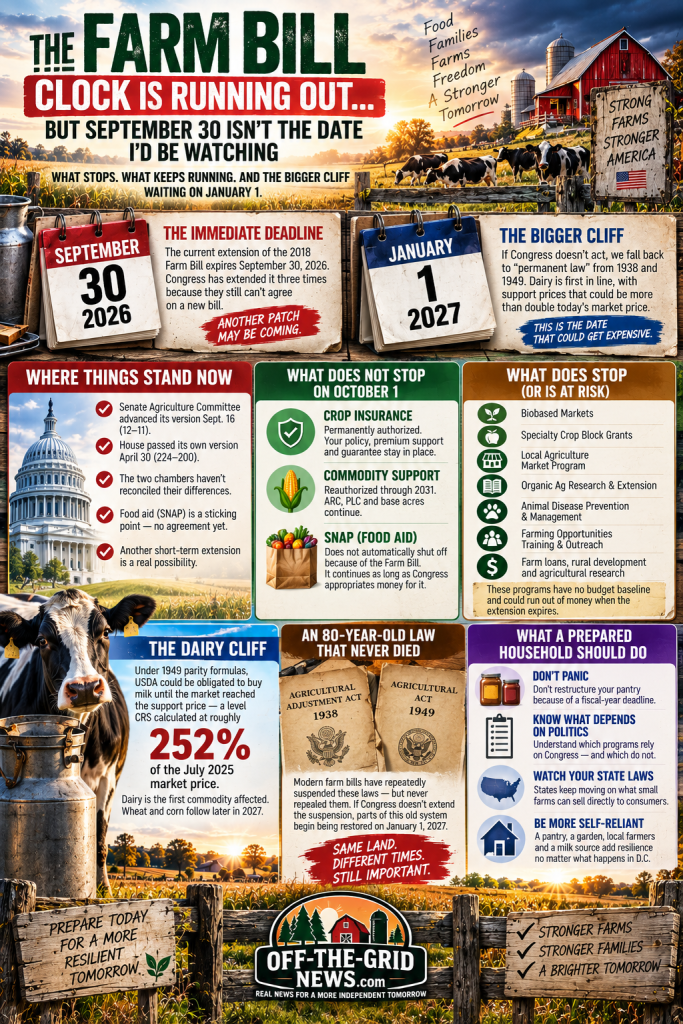
That is the day the current extension of the 2018 Farm Bill expires. USDA says the Continuing Appropriations and Extensions Act of 2026 extended the Agriculture Improvement Act of 2018 for one year, through September 30, 2026.
And here is where things get interesting.
The Farm Bill is normally rewritten roughly every five years. Instead, Congress has repeatedly stretched the 2018 framework forward with temporary extensions, while other legislation has separately extended or changed some of its largest programs. The USDA Economic Research Service lays out that strange legislative patchwork here.
Think of it like an old tractor that was supposed to be traded in three seasons ago. Instead, Washington keeps wiring the muffler back on, pouring another quart of oil into the crankcase and saying, “There. That ought to get us through another year.”
Maybe it will.
But eventually you have to ask what happens when everybody stops kicking the decision down the road. For homesteaders, farmers and prepared households, that is where this story becomes a lot more interesting than another Washington budget fight.
The Farm Bill Is Stuck Between Two Barn Doors

Congress is not starting from scratch. The House passed its version — the Farm, Food, and National Security Act of 2026 — on April 30 by a vote of 224–200, with 14 Democrats joining Republicans in voting for the measure, according to the House Agriculture Committee.
Meanwhile, the Senate Agriculture Committee moved its own Agricultural Act of 2026, commonly called “Farm Bill 2.0,” on September 16. The Senate Agriculture Committee describes it as an effort to update farm programs, rural-development provisions, research, conservation and other pieces of federal agricultural policy.
But getting through committee and getting through the Senate are two different chores. The Senate committee’s September 16 action moved the legislation another step down the road, but it did not send a finished Farm Bill to the president.
Then comes the other problem: the House and Senate have passed or advanced different legislation. Eventually, those differences have to be reconciled into language both chambers can pass.
So the calendar keeps moving, September 30 keeps getting closer, and another temporary extension remains one possible congressional response.
Patch the old tractor one more time.
But Here’s What Won’t Suddenly Disappear October 1
This is where we ought to put the pitchfork down for a minute, because an expiring Farm Bill does not mean the entire American agricultural system turns into a pumpkin at midnight September 30. Different programs rest on different statutory and funding foundations, and some of the biggest programs have already been extended through other legislation.
Take crop insurance.
The Congressional Research Service explains that the Federal Crop Insurance Program is permanently authorized and funded under the Federal Crop Insurance Act. In plain English, the expiration of the 2018 Farm Bill extension does not itself make federal crop insurance disappear.
That matters if you are standing beside a combine looking at a sky that has forgotten how to rain. September 30 does not suddenly make your federal crop-insurance policy evaporate.
Then there are the big commodity programs. USDA notes that the 2025 reconciliation law extended the authority of major programs including Agriculture Risk Coverage (ARC) and Price Loss Coverage (PLC) through 2031, creating the peculiar situation where large pieces of modern farm policy can continue even while other Farm Bill authorities reach another expiration date.
In other words, this isn’t one giant electrical breaker marked FARM BILL.
It is an old farmhouse breaker box with wires running everywhere.
Some circuits remain hot. Some depend on annual appropriations. Some have permanent authority. Some have already been extended by other laws.
And some are about to lose power.
And No… SNAP Doesn’t Automatically Shut Off Either
This distinction may be the most important one for ordinary households. Expiration of the Farm Bill does not automatically mean SNAP benefits disappear October 1.
SNAP’s legal authority and its actual funding are related but distinct issues. Congressional Research Service explanations of Farm Bill expiration note that nutrition programs can continue when Congress provides the necessary appropriations, meaning a Farm Bill expiration and a government-funding lapse are not the same event.
Think of it as two clocks hanging on the kitchen wall.
One is the Farm Bill clock. The other is the government-funding clock, and although the gears sometimes touch, they are not the same clock.
That distinction is worth understanding because a prepared household ought to know which wire connects to which switch. A disruption caused by Congress failing to fund the government is different from a program losing authority because a Farm Bill provision expires.
And that brings us to the programs standing much closer to the edge.
The Smaller Programs Can Be The Ones Closest To The Cliff
Washington budgets have a funny way of protecting the big machinery while leaving smaller tools sitting outside in the rain. Some Farm Bill programs have what budget writers call a baseline — essentially a built-in assumption of future mandatory funding — while others do not.
Those without a continuing baseline are sometimes called “orphan programs.” When an extension expires without Congress supplying new authority or funding, these smaller programs can face a very different future than permanently authorized or separately extended programs.
And the names can sound like Washington alphabet soup until you walk through a farmers market on Saturday morning.
These programs have included efforts involving local agricultural markets, specialty crops, organic research, beginning farmers and animal-health work. Suddenly we are not talking about some dusty binder sitting on a congressional staffer’s bookshelf.
A local food program can help connect the tomatoes, eggs, beef and honey from small producers with customers. Beginning-farmer programs can help somebody figure out how to turn that first 20 acres into a working farm, while animal-health programs can help build surveillance and prevention systems designed to catch trouble before disease walks from one barn to the next.
Those aren’t abstractions when you have chickens scratching beside the machine shed.
They are part of the plumbing underneath local agriculture.
Rural Development, Farm Credit And Research Get More Complicated Too
Then there is another category that rarely makes cable television: farm credit, rural development and agricultural research. Many programs in these areas rely on discretionary appropriations, meaning Congress must continue supplying money even when the underlying program has statutory authority.
That makes October 1 more complicated than either side of the usual argument suggests. It isn’t necessarily a giant red switch that shuts every rural program down, but neither is expiration meaningless.
Authority, appropriations and mandatory funding all run on slightly different tracks. The effect of Farm Bill expiration can therefore vary dramatically from one program to another, which is why anybody waiting on a USDA loan, rural-development project or specialized agricultural program should pay attention to the fine print rather than just the headline.
Because Washington rarely closes the whole barn.
Sometimes it just quietly locks one stall.
But September 30 Isn’t The Date That Fascinates Me
January 1 is.
Because buried underneath modern American farm policy is something that sounds almost too strange to be true. If Congress fails to continue suspending certain old statutes, America does not simply enter a legal wilderness where no farm law exists.
Instead, portions of agricultural policy can fall backward.
Way backward — to laws written when Franklin Roosevelt and Harry Truman were president.
Meet The Farm Laws That Refuse To Die
The laws are the Agricultural Adjustment Act of 1938 and the Agricultural Act of 1949. They contain what Washington calls “permanent law,” and CRS explains the history of those still-existing provisions in its report on Farm Bill expiration.
Congress never completely repealed those old commodity-support provisions. Instead, modern Farm Bills have repeatedly suspended them while newer agricultural programs operate in their place.
It is a little like discovering that underneath your modern breaker panel is an old cloth-wrapped electrical system from Grandpa’s farmhouse. Nobody has been using it, nobody particularly wants to use it, but nobody ever completely tore it out of the wall.
And if Congress fails to keep the suspension in place, parts of that old system can become relevant again.
The permanent-law provisions use agricultural policies radically different from today’s programs, including parity-price concepts tied to the purchasing relationships of farmers during the 1910–1914 period. CRS notes that these provisions are generally considered inconsistent with modern agricultural practices and could require USDA to purchase commodities to support statutory prices.
Yes, you read that correctly.
We could be talking about agricultural price-support machinery built around economic relationships from an era when a Model T was high technology.
And The First Cow Through The Gate Is Dairy
Dairy comes first for a wonderfully simple reason: cows don’t wait for planting season. They get milked every day, which means dairy operates on a calendar-year cycle while crops such as wheat and corn operate on different crop and marketing years.
CRS has repeatedly identified dairy as the first commodity affected when a Farm Bill’s suspension of permanent law expires. Its broader history of Farm Bill legislation explains why the January 1 date matters particularly for dairy.
That is where this stops being merely a fascinating bit of legislative archaeology.
Permanent law bases support partly on the old concept of parity, using relationships rooted in agricultural prices and purchasing power from 1910–1914. Because farming productivity, technology and markets have changed beyond recognition since then, applying those formulas today can produce support prices far removed from modern market prices.
USDA could then face obligations to purchase commodities to support those statutory prices. CRS warns that such intervention could be expensive for the federal government and consumers and disruptive to normal supply-and-demand relationships.
Picture the federal government walking into the dairy aisle carrying a pricing manual whose roots reach back before commercial radio.
That is essentially the problem.
January 1, 2027 Is The Date Hidden Behind September 30
This is why the end-of-year calendar deserves as much attention as the September deadline. Modern commodity programs and the old permanent-law provisions can operate on different statutory timelines.
Congress has historically avoided letting permanent law fully return. The old provisions have instead served as something of a legislative backstop — a powerful incentive for lawmakers to extend or replace modern Farm Bill policy before the dormant machinery starts moving again.
So if Congress passes another temporary fix, don’t stop reading at the words “Farm Bill extended.”
Look for what happens to permanent law.
Does the legislation continue its suspension into the relevant 2027 crop years? Does it merely extend certain expiring authorities? Which orphan programs receive funding? Which programs are left outside the fence?
That is where the real story may be buried.
So What Should A Prepared Household Actually Do?
Probably not what the panic merchants will tell you.
I wouldn’t fill three shopping carts with powdered milk simply because Congress is arguing about agricultural legislation. And I certainly wouldn’t reorganize the pantry because somebody on television discovers the phrase “dairy cliff.”
Instead, the first lesson is simple: learn which pieces of the food system depend upon Congress renewing authority or funding — and which do not.
Crop insurance is permanently authorized. Some major commodity programs have already been extended through 2031, while other agricultural programs rely on temporary Farm Bill authority, mandatory funding or annual appropriations.
Those are very different foundations.
And a homesteader ought to know the difference between a concrete footing and a fence post stuck six inches into mud.
Never Forget The Statehouse
The second lesson is that while everybody watches Washington, state governments keep writing rules that can touch small farms much more directly. Cottage-food rules, raw-milk laws, meat-processing regulations, farm-stand rules, zoning, poultry exemptions and direct-to-consumer sales can determine what a family farm can actually produce and sell.
For the fellow selling eggs at the end of the driveway or beef from a chest freezer, those rules can matter every bit as much as a thousand-page bill being argued over in Washington.
The closer government gets to your barn door, the more closely you should watch it.
And Finally… Pay Attention To What All These Patches Are Telling Us
There is a larger lesson hiding underneath all of this. America has an enormous food system resting partly on legislation Congress is supposed to revisit periodically, yet lawmakers have repeatedly kept the 2018 framework operating through temporary extensions while separately changing other portions of farm policy.
Even House Agriculture Committee Chairman Glenn Thompson described producers this year as operating under the “third consecutive farm bill extension”.
That does not mean the grocery stores empty October 1. It doesn’t mean crop insurance disappears, SNAP automatically shuts down or you need to dig a bunker behind the chicken coop.
But it does tell us something useful about complicated systems.
Complicated systems depend upon a lot of little things continuing to work.
A vote and an appropriation. A USDA office and a processing plant. A trucking route, disease-surveillance program, state regulation or a few lines buried on page 900 of legislation almost nobody outside Washington will ever read.
The prepared household doesn’t have to predict which link eventually gives trouble. The whole point of preparedness is building enough slack into your own little corner of the world that one broken link doesn’t break you.
That means a pantry with some depth and a freezer with something in it. It means a garden that produces more than decoration, a farmer whose first name you know, a local butcher, a neighbor with chickens, a milk source, seeds in a jar and enough margin that Washington missing another deadline becomes interesting news rather than a household emergency.
So yes, watch September 30 for the headline.
But keep one eye on January 1.
Because that’s when an agricultural law written nearly 80 years ago could start knocking on the barn door again.
Source: https://www.offthegridnews.com/current-events/will-congress-keep-putting-duct-tape-on-americas-farm-bill/
Anyone can join.
Anyone can contribute.
Anyone can become informed about their world.
"United We Stand" Click Here To Create Your Personal Citizen Journalist Account Today, Be Sure To Invite Your Friends.
Before It’s News® is a community of individuals who report on what’s going on around them, from all around the world. Anyone can join. Anyone can contribute. Anyone can become informed about their world. "United We Stand" Click Here To Create Your Personal Citizen Journalist Account Today, Be Sure To Invite Your Friends.
LION'S MANE PRODUCT
Try Our Lion’s Mane WHOLE MIND Nootropic Blend 60 Capsules
Mushrooms are having a moment. One fabulous fungus in particular, lion’s mane, may help improve memory, depression and anxiety symptoms. They are also an excellent source of nutrients that show promise as a therapy for dementia, and other neurodegenerative diseases. If you’re living with anxiety or depression, you may be curious about all the therapy options out there — including the natural ones.Our Lion’s Mane WHOLE MIND Nootropic Blend has been formulated to utilize the potency of Lion’s mane but also include the benefits of four other Highly Beneficial Mushrooms. Synergistically, they work together to Build your health through improving cognitive function and immunity regardless of your age. Our Nootropic not only improves your Cognitive Function and Activates your Immune System, but it benefits growth of Essential Gut Flora, further enhancing your Vitality.

Our Formula includes: Lion’s Mane Mushrooms which Increase Brain Power through nerve growth, lessen anxiety, reduce depression, and improve concentration. Its an excellent adaptogen, promotes sleep and improves immunity. Shiitake Mushrooms which Fight cancer cells and infectious disease, boost the immune system, promotes brain function, and serves as a source of B vitamins. Maitake Mushrooms which regulate blood sugar levels of diabetics, reduce hypertension and boosts the immune system. Reishi Mushrooms which Fight inflammation, liver disease, fatigue, tumor growth and cancer. They Improve skin disorders and soothes digestive problems, stomach ulcers and leaky gut syndrome. Chaga Mushrooms which have anti-aging effects, boost immune function, improve stamina and athletic performance, even act as a natural aphrodisiac, fighting diabetes and improving liver function. Try Our Lion’s Mane WHOLE MIND Nootropic Blend 60 Capsules Today. Be 100% Satisfied or Receive a Full Money Back Guarantee. Order Yours Today by Following This Link.


| Visits: | 1,836,079,534 |
| Stories: | 8,726,747 |
Whistler Blowers, Insiders

