

DMSO And Vitamin C Beat A Prescription Cream In This New Skin Cancer Trial… So Why Aren’t More People Talking About It?

A farmer’s neck. A gardener’s forearms. The back of a hand that’s spent forty summers grabbing fence posts and steering tractors. The sun keeps a running account, and sooner or later, the bill may come due.
Maybe it starts with a little shiny bump. Maybe it’s a scaly patch that keeps coming back, or a sore that scabs over and then opens again. It’s easy to tell yourself you’ll have somebody look at it after harvest. But basal cell carcinoma—the most common type of skin cancer—is exactly the kind of trouble that can begin with a spot you almost ignore. American Cancer Society: basal cell skin cancer
Now here’s the interesting part. In a small randomized clinical trial, a carefully prepared vitamin C solution cleared a higher percentage of biopsy-confirmed basal cell cancers after eight weeks than a prescription cream did. That deserves a hard look. It does NOT mean you should head for the pantry and start mixing up a cancer treatment.
The Little Trial With a Big Number
In 2022, researchers Briant Burke and Jon-Eric Bailie published a randomized trial in Biomedicine & Pharmacotherapy. They enrolled 25 people with a total of 29 basal cell carcinomas. These weren’t mysterious spots diagnosed over a kitchen table: the lesions were confirmed by biopsy before treatment began. Read the published study on PubMed
One treatment used 30% ascorbic acid—vitamin C—in 95% dimethyl sulfoxide, better known as DMSO. The solution was applied twice daily for eight weeks. The comparison treatment was imiquimod, a prescription cream already used for certain low-risk basal cell cancers. The investigators then checked whether cancer remained in the treated lesions.
And the eight-week results were enough to make a fellow put down his coffee.
Thirteen Out of Fifteen. Read That Again.
At eight weeks, follow-up biopsy results showed clearance in 13 of 15 lesions treated with vitamin C and DMSO. That’s 86.7%. In the imiquimod group, 8 of 14 lesions had cleared—57.1%. Those are the reported numbers, and they’re striking. Study DOI
But don’t stop reading at the flashy number. The imiquimod group received additional treatment for lesions still present at eight weeks. By week twelve, 11 of 14 lesions—78.6%—had cleared. So this was not an eight-week head-to-head followed by identical treatment schedules forever.
The authors characterized the vitamin C mixture favorably at eight weeks. Still, with only 29 lesions altogether, the trial was too small to settle which approach is best for patients generally. A promising result is not the same thing as a settled medical verdict.
Then Came the Part Nobody Wants to Talk About: The Skin Itself
If you’ve ever had a chemical burn from a cleaner or spent a long day with chapped hands in cold wind, you know skin can make you miserable in a hurry. In this trial, the imiquimod group experienced more pain and skin erosion. Six patients in that group had to interrupt treatment briefly because of discomfort.
The vitamin C–DMSO group reported itching and brief stinging. That doesn’t make the mixture harmless, and it doesn’t mean everyone would tolerate it. But tolerability is a serious consideration when the treatment is going on visible skin day after day. Read the full research article
The researchers also reported follow-up findings roughly two and a half years later among 20 patients they could contact. Lighter-colored treated patches were reported in 70% of the imiquimod group and none in the vitamin C group. One recurrence was reported in the imiquimod group and none in the vitamin C group. With so few people followed, those figures are observations—not reliable proof of better long-term cancer control.
DMSO Was the Delivery Truck, Not the Whole Farm

Here’s where the story gets more interesting than “vitamin C fights cancer.” The researchers didn’t sprinkle vitamin C powder on a lesion or squeeze a lemon over it. They used a specific formulation with DMSO, a solvent known for penetrating skin and changing how some substances pass through it.
Think of vitamin C as the load and DMSO as the truck that carried it down the lane. That’s a useful picture, though it’s still a hypothesis about how the mixture worked. This trial did not include a DMSO-only group, so it cannot tell us precisely how much of the effect came from the vitamin C, the solvent, or their combination.
There’s another reason not to improvise. DMSO can also carry unwanted substances through the skin, and home mixing introduces questions about purity, concentration, contamination, and dosing. A study done under medical supervision is not a recipe card.
Which Skin Cancers? That’s the Question That Changes Everything
This was a trial involving selected low-risk basal cell carcinomas, including superficial and nodular lesions in eligible locations. It did not test melanoma. It did not test every kind of squamous cell cancer. And it did not establish that a topical solution can safely replace surgery for dangerous, aggressive, or high-risk tumors.
Basal cell carcinoma often grows slowly and rarely spreads to distant parts of the body. But it can invade and damage nearby tissue when neglected. A spot on the nose, around the eye, or in another sensitive location is no place to gamble on an unproven home experiment. American Academy of Dermatology: basal cell carcinoma
That’s why the biopsy really matters. Two marks can look alike from the bathroom mirror and be very different under the microscope. The diagnosis comes first; the treatment decision comes after.
What This Trial Did NOT Prove
It didn’t prove that vitamin C and DMSO cure “skin cancer” as a broad category. It didn’t compare the mixture with surgical removal, which remains a standard and highly effective treatment for many basal cell cancers. And it didn’t provide the large, independently replicated evidence needed to make this formulation routine care.
There’s also a statistical trap here. A handful of lesions can move a percentage in a hurry. Change the outcome of one or two cases and those impressive-looking figures shift. That’s why the authors called for larger trials rather than declaring the matter closed.
Still, this is exactly the kind of finding worth investigating. If a non-invasive treatment eventually proves effective and safe in larger studies, it could give patients and doctors another useful option. That’s a reason to study it—not a reason to skip the dermatologist.
Forty Miles From the Clinic, This Hits Home
If you homestead or farm, appointments have a way of getting shoved behind everything else. The cows need feeding. The beans are ready. The truck is making a noise you don’t like. And if the dermatologist is forty miles away, that funny little spot can wait until next week. Then next month.
That’s the real-world appeal of researching treatments that might be used at home after proper diagnosis. But remember: imiquimod is already a take-home prescription treatment, and this trial didn’t prove that the vitamin C mixture would save money or eliminate office visits. Biopsies, follow-up, and checking for recurrence still matter.
Country independence is a fine thing. Country stubbornness, when it keeps a suspicious cancer growing, is not.
Your Best Skin-Cancer Tool Is Already Hanging in the Bathroom
You don’t need a fancy machine to begin paying attention. Once a month, take ten minutes and check the places the sun has worked hardest: ears, scalp, face, neck, forearms, hands, and shoulders. Don’t forget the rest of your skin, either. Ask somebody to look at your back if you can’t see it yourself.
Watch for a sore that won’t heal, a shiny or pearly bump, a rough patch, or a scar-like mark with no injury to explain it. New, changing, bleeding, or repeatedly crusting spots deserve a professional look. And while you’re at it, put on a broad-brimmed hat, cover exposed skin, and use sunscreen when you work outside. AAD: skin cancer warning signs and prevention
Here’s the bottom line: a small 2022 trial produced an eye-opening result—86.7% clearance at eight weeks for a carefully formulated vitamin C–DMSO treatment in selected basal cell carcinomas. That’s real research worth following. It is not permission to treat a suspected cancer yourself.
Check your fence before the cattle get out. Check your roof before the storm comes through. And check your skin before a little spot turns into a big problem. That’s not fear. That’s good stewardship.
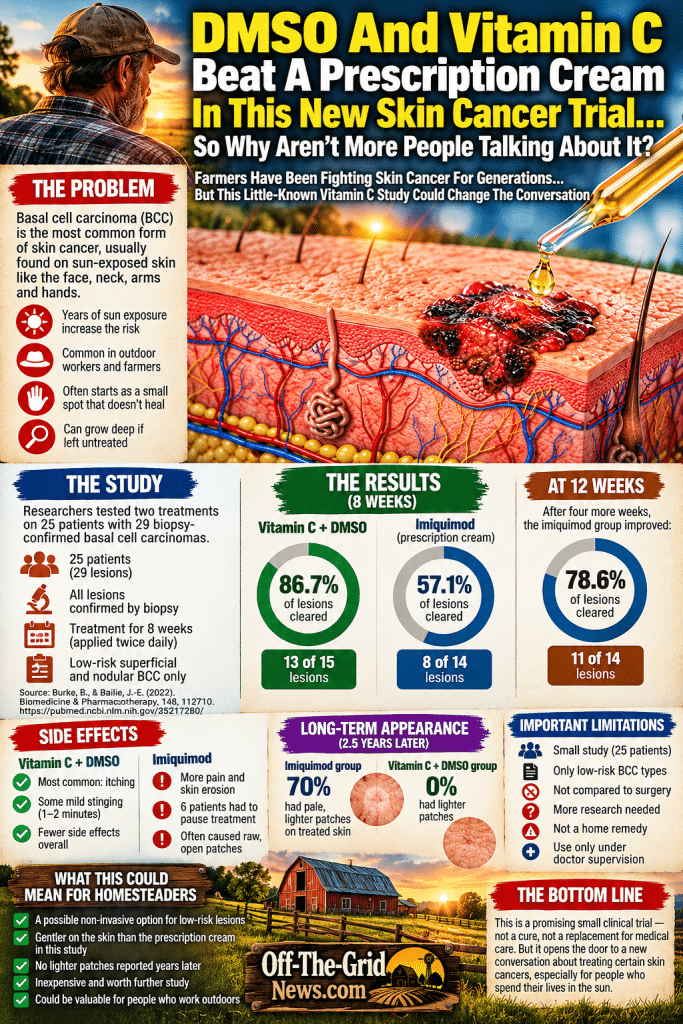
Caption: Forty summers on a tractor leave their mark. Now a surprising vitamin C study is giving researchers another reason to investigate new treatments for certain skin cancers.
Source: https://www.offthegridnews.com/alternative-health/dmso-and-vitamin-c-beat-a-prescription-cream-in-this-new-skin-cancer-trial-so-why-arent-more-people-talking-about-it/
Anyone can join.
Anyone can contribute.
Anyone can become informed about their world.
"United We Stand" Click Here To Create Your Personal Citizen Journalist Account Today, Be Sure To Invite Your Friends.
Before It’s News® is a community of individuals who report on what’s going on around them, from all around the world. Anyone can join. Anyone can contribute. Anyone can become informed about their world. "United We Stand" Click Here To Create Your Personal Citizen Journalist Account Today, Be Sure To Invite Your Friends.
LION'S MANE PRODUCT
Try Our Lion’s Mane WHOLE MIND Nootropic Blend 60 Capsules
Mushrooms are having a moment. One fabulous fungus in particular, lion’s mane, may help improve memory, depression and anxiety symptoms. They are also an excellent source of nutrients that show promise as a therapy for dementia, and other neurodegenerative diseases. If you’re living with anxiety or depression, you may be curious about all the therapy options out there — including the natural ones.Our Lion’s Mane WHOLE MIND Nootropic Blend has been formulated to utilize the potency of Lion’s mane but also include the benefits of four other Highly Beneficial Mushrooms. Synergistically, they work together to Build your health through improving cognitive function and immunity regardless of your age. Our Nootropic not only improves your Cognitive Function and Activates your Immune System, but it benefits growth of Essential Gut Flora, further enhancing your Vitality.

Our Formula includes: Lion’s Mane Mushrooms which Increase Brain Power through nerve growth, lessen anxiety, reduce depression, and improve concentration. Its an excellent adaptogen, promotes sleep and improves immunity. Shiitake Mushrooms which Fight cancer cells and infectious disease, boost the immune system, promotes brain function, and serves as a source of B vitamins. Maitake Mushrooms which regulate blood sugar levels of diabetics, reduce hypertension and boosts the immune system. Reishi Mushrooms which Fight inflammation, liver disease, fatigue, tumor growth and cancer. They Improve skin disorders and soothes digestive problems, stomach ulcers and leaky gut syndrome. Chaga Mushrooms which have anti-aging effects, boost immune function, improve stamina and athletic performance, even act as a natural aphrodisiac, fighting diabetes and improving liver function. Try Our Lion’s Mane WHOLE MIND Nootropic Blend 60 Capsules Today. Be 100% Satisfied or Receive a Full Money Back Guarantee. Order Yours Today by Following This Link.


| Visits: | 1,836,110,288 |
| Stories: | 8,726,952 |
Whistler Blowers, Insiders

