

The Devil Hates A Good Laugh… So Why Are Some Christians A Bit Nervous On Halloween?

Every October, it shows up like the first hard frost. A letter comes home from the Christian school, folded into a backpack next to a spelling test. It warns parents about the evils of Halloween. And every October, just as surely, folks start asking me what I think about it.
So here’s my answer. It might surprise you, because the real story of Halloween isn’t the one most of us have been told. To get to it, we need to start with the name.
What’s in a Name
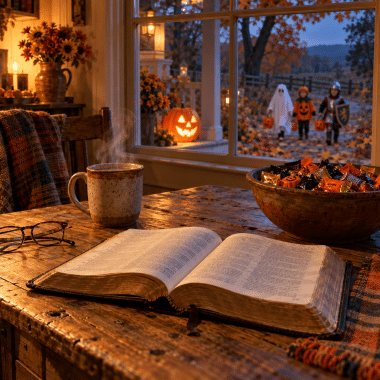
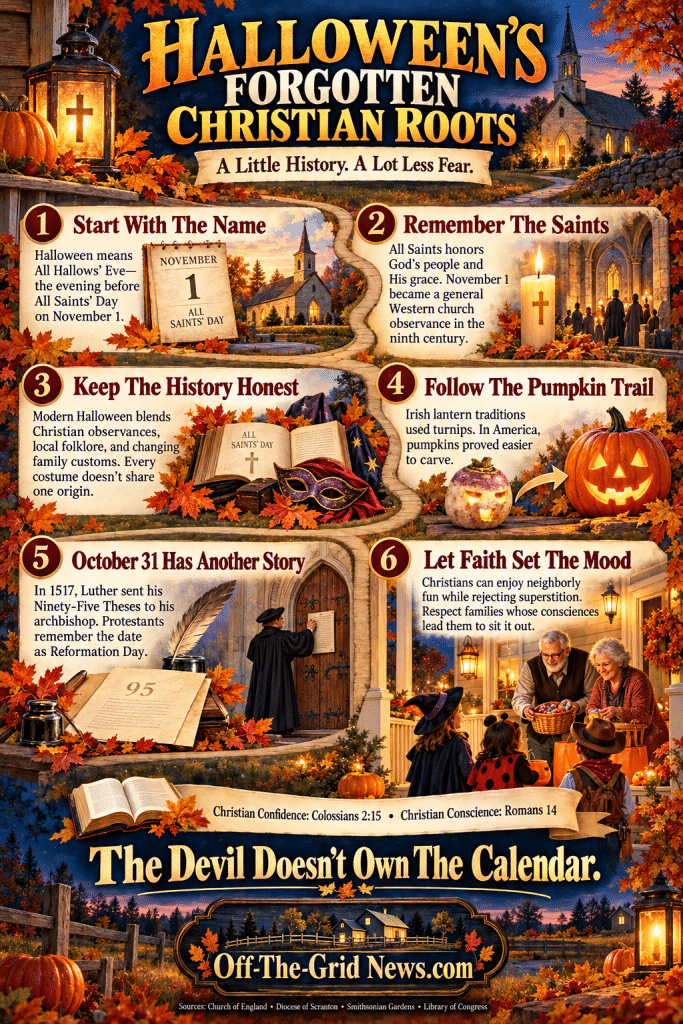
“Halloween” is just a shortened way of saying All Hallows’ Eve. The word “hallow” is an old form of the word “holy.” You say it every time you pray, “Hallowed be Thy name.” In this case, a “hallow” is a holy one, a saint.
All Saints’ Day falls on November 1. It’s the day the church celebrates the victory of the saints, joined to Christ. Christians started holding different All Saints feasts in the late 300s. By the 700s, those feasts had been pulled together and fixed on November 1.
Here’s the part that matters most. All Saints’ Day and All Saints’ Eve grew up in Mediterranean Christianity, around Rome. They had nothing to do with Celtic Druids, and nothing to do with some church campaign against them. In fact, much of the spooky “Druid” lore you see repeated every fall was dreamed up in the 1800s by people who wanted paganism to look older and grander than it was.
So if Halloween didn’t come from the Druids, where did its meaning come from? To answer that, we’ve got to step back and look at the big war that runs through the whole Bible.
A Different Kind of War
In the Old Covenant, God’s people fought flesh-and-blood enemies. They stood against Egyptian chariots and Assyrian spears. Their battles were fought in dusty valleys, with real blood on real ground.
When the New Covenant came, though, the front lines moved. Now, we’re told, our main fight is against principalities and powers. It’s against fallen angels who chain men’s hearts and minds with ignorance and fear. It’s a war you can’t see, but you can sure feel it.
Still, we’re not left guessing how it ends. Through faith, prayer, and plain obedience, the saints win. The Spirit promises it in Romans 16:20: “The God of peace will crush Satan under your feet shortly.”
That promise is exactly what All Saints is about. And it raises a question every farmer understands: if the big job’s done, why are we still out in the field?
The Mopping Up
Alright, now think about harvest time. The combine can roll through and take the corn, but somebody still has to walk the rows. Somebody’s got to pick up what was missed and haul it to the crib.
That’s where we are. Jesus has finished His work. He struck the decisive blow at the cross and the empty tomb. But we haven’t finished ours. We get the privilege of working the mopping up operation.
And century by century, that work has gone forward. The Christian faith has pushed back the dark kingdom of fear and superstition, one village and one heart at a time. Sure, things look bad in the Western world right now. Even so, the work keeps moving across Asia, Africa, and Latin America.
Now, you might wonder why this celebration starts the night before. The answer is tucked inside the way the Bible counts time.
Why the Night Comes First
In the Bible, the day starts at evening. Go back to Genesis: “And the evening and the morning were the first day.” Because of that, in the church calendar, the eve of a feast isn’t a warm-up. It’s the actual start of the holiday.
You already know this better than you think. Christmas Eve is the obvious example. There’s also the Easter Vigil on Holy Saturday, held in the dark before Easter morning. In the same way, All Saints’ Eve comes right before All Saints’ Day.
So the idea, as Christian custom acted it out, was pretty simple. On October 31, the devil’s realm makes one last grab for victory. Then it gets chased off by the joy of the Kingdom.
But that leaves the biggest question of all. How exactly do you run off the devil?
The Weapon of Mockery
The answer, in a word, is mockery. Satan’s great sin was pride. It’s our great sin too. And nothing punctures pride faster than a good laugh at its expense.
That’s why folks started painting the devil in a silly red suit with little horns and a pointy tail. Nobody actually believed he looked like that. The Bible tells us he’s a fallen arch-cherub, a creature of terrible beauty gone bad. The cartoon costume was the point. It said, “You lost. Jesus beat you. You don’t own us anymore.”
A while back, Ray Bradbury understood this. In his Halloween classic, Something Wicked This Way Comes… evil isn’t beaten by guns or muscle. It’s beaten by joy and laughter. It shrivels when it’s laughed at.
Once you see that, you start noticing it in odd places. Look up at the roof of an old stone church sometime.
Faces on the Church Roof
Those were gargoyles perched up there, and they meant the same thing. They’re carved with bulging eyes, stretched-out tongues, and ugly faces aimed outward. Picture them dripping rainwater in a storm, sneering at the night.
They aren’t demons. They’re the church making faces at the enemy. They’re believers, set in stone, sticking their tongues out at a beaten army that wants to attack God’s house.
So Halloween came to be tied to the defeat of evil and the dark powers. Then, in 1517, one German monk picked that very night to strike a blow of his own.
A Monk, a Hammer, and a Date
Martin Luther nailed his 95 Theses to the door of the Castle Church in Wittenberg on October 31. That door worked like the town bulletin board. His theses challenged the wicked practices that had crept into the church.
He didn’t pick that date by accident. He chose it with care. Ever since, Halloween has also been Reformation Day.
And that same spirit of fearless defiance shows up in something much smaller. It shows up on your front porch, in a pillowcase full of candy.
Kids in Costumes
On All Hallows’ Eve (say it fast, Hallow-Even, Hallow-E’en, Halloween) a custom grew up of dressing children in costumes. The idea was to mock the dark kingdom. Since Satan’s power has been broken once and for all, our kids can poke fun at him. They can go out as ghosts, goblins, and witches.
Think about what that says. When we dress our children that way, we’re showing total confidence that Jesus Christ has crushed the devil. We have no fear.
Now, I can’t trace where every Halloween custom came from. No doubt they’ve shifted over time and from one Christian land to another. Trick-or-treat probably started simply enough, as something fun for kids. Then again, like anything good, it can get twisted.
Candy and Common Sense
There were times when “tricking” turned mean. Teenagers did real damage, and some towns banned it outright. That’s fair enough.
Even so, it’s hard to complain about kids collecting candy from friends and neighbors. Today that might not seem like much. We’re so well off that candy sits in a bowl on the counter year-round. In earlier generations, though, people didn’t have much. A popcorn ball or a few pieces of hard candy was a real treat, something a kid would remember all winter.
There’s no reason to pour cold water on an innocent custom like that. And the same goes for that grinning orange face glowing on the porch rail.
The Humble Jack-O’-Lantern
Nobody really knows where the jack-o’-lantern came from. Honestly, it doesn’t take a genius. Hollow out a gourd, carve a face, and set a light inside. That idea has surely popped into the heads of ordinary people in hundreds of cultures for centuries.
Back when homes were lit by candles, people dressed up their candles and holders as a normal part of life. It made a dark house pretty, or at least interesting. They carved potatoes, turnips, beets, and just about anything else they had in the root cellar.
Writer Wynn Parks once described a friend of his from England. The man peeled a tangerine in two perfect halves. He carved eyes and a nose in one half and a mouth in the other. Then he poured cooking oil over the pith poking up from the bottom and lit it like a wick. With the top set back on, it made a tiny jack-o’-lantern. But when Parks called it that, his friend looked puzzled. “What would I call it? Why a ‘tangerine head,’ I suppose.”
Over here in the New World, folks quickly found that pumpkins worked best of all. And that’s a homesteader’s kind of decoration. When the candle burns out, you scrape it again, roast it, and turn it into pies and muffins. Nothing wasted.
Words Change Over Time And So Do Symbols
It’s true that in some cultures a carved head stood for a dead person, with the soul supposedly living on inside. But that has nothing to do with our Halloween. Did your mother ever tell you, while she carved the pumpkin, that it was a dead man’s head with his soul trapped inside? Of course not.
Symbols, like words, mean different things in different places and times. The only question that matters is what it means now. And right now, it’s just a decoration.
Besides, even if some long-ago folks did link the pumpkin to a soul in a head, so what? They didn’t take it seriously. It was part of the same joking, Christian mockery of heathen ideas. That brings us to who’s been telling the story all these years.
Don’t Let Pagans Do Your Thinking
Many articles in books, magazines, and encyclopedias are written by secular humanists or by New Age pop-pagans. Parks, whose tangerine story I just borrowed, is one example. Writers like that tend to bury the Christian side of old customs and play up anything pagan. They’re trying to make paganism look respectable and push Christianity to the margins. That’s why you keep hearing that Halloween, Christmas, and Easter are “really” pagan. It isn’t true.
Oddly enough, some fundamentalists have swallowed this slanted history. They’d never accept a humanist rewrite of Western history, American history, or science. Yet they’ll accept the pagan rewrite of Halloween, Christmas, and the Christmas tree. Hopefully, in time, these brothers will take a second look. We shouldn’t let the pagans do our thinking for us.
Join the Holy Laughter
These days, kids are more likely to dress as superheroes, and the Christian meaning has been soaked up by pop culture. On top of that, with “designer paganism” all the rage, some Christians feel uneasy putting their kids in spooky costumes. That’s fine. So be it.
Still, we shouldn’t forget that Halloween started as a Christian custom. And there’s no solid reason Christians can’t enjoy it that way today.
Psalm 2 puts it plainly: “He who sits in the heavens laughs; Yahweh ridicules them.”
So this October 31, light the pumpkin, open the door, and join His holy laughter. The devil’s already beaten. Go ahead and laugh at him.
Source: https://www.offthegridnews.com/religion/the-devil-hates-a-good-laugh-so-why-are-some-christians-a-bit-nervous-on-halloween/
Anyone can join.
Anyone can contribute.
Anyone can become informed about their world.
"United We Stand" Click Here To Create Your Personal Citizen Journalist Account Today, Be Sure To Invite Your Friends.
Before It’s News® is a community of individuals who report on what’s going on around them, from all around the world. Anyone can join. Anyone can contribute. Anyone can become informed about their world. "United We Stand" Click Here To Create Your Personal Citizen Journalist Account Today, Be Sure To Invite Your Friends.
LION'S MANE PRODUCT
Try Our Lion’s Mane WHOLE MIND Nootropic Blend 60 Capsules
Mushrooms are having a moment. One fabulous fungus in particular, lion’s mane, may help improve memory, depression and anxiety symptoms. They are also an excellent source of nutrients that show promise as a therapy for dementia, and other neurodegenerative diseases. If you’re living with anxiety or depression, you may be curious about all the therapy options out there — including the natural ones.Our Lion’s Mane WHOLE MIND Nootropic Blend has been formulated to utilize the potency of Lion’s mane but also include the benefits of four other Highly Beneficial Mushrooms. Synergistically, they work together to Build your health through improving cognitive function and immunity regardless of your age. Our Nootropic not only improves your Cognitive Function and Activates your Immune System, but it benefits growth of Essential Gut Flora, further enhancing your Vitality.

Our Formula includes: Lion’s Mane Mushrooms which Increase Brain Power through nerve growth, lessen anxiety, reduce depression, and improve concentration. Its an excellent adaptogen, promotes sleep and improves immunity. Shiitake Mushrooms which Fight cancer cells and infectious disease, boost the immune system, promotes brain function, and serves as a source of B vitamins. Maitake Mushrooms which regulate blood sugar levels of diabetics, reduce hypertension and boosts the immune system. Reishi Mushrooms which Fight inflammation, liver disease, fatigue, tumor growth and cancer. They Improve skin disorders and soothes digestive problems, stomach ulcers and leaky gut syndrome. Chaga Mushrooms which have anti-aging effects, boost immune function, improve stamina and athletic performance, even act as a natural aphrodisiac, fighting diabetes and improving liver function. Try Our Lion’s Mane WHOLE MIND Nootropic Blend 60 Capsules Today. Be 100% Satisfied or Receive a Full Money Back Guarantee. Order Yours Today by Following This Link.


| Visits: | 1,836,542,171 |
| Stories: | 8,729,074 |
Whistler Blowers, Insiders

