

The First Hard Frost Is Coming… And You’re Living On Borrowed Time Whether You Know It Or Not

There’s a hard frost out there somewhere with your name on it. You don’t know whether it’ll arrive next Tuesday, two weeks from Friday, or in the middle of a perfectly pleasant night when you forgot to cover the tomatoes. But you know it’s coming, and when it does, October’s little gifts will disappear mighty fast.
Right now, the whole homestead is living on something most folks never stop to appreciate. The tomatoes are still hanging on the vine, the last hay cutting is either safely stacked or still making you nervous, and the woodpile is either tall enough to make you smile or short enough to make you reach for the splitting maul.
Every warm afternoon gives you another chance to finish something you should have finished yesterday. Every frost-free morning is another opportunity to fix a problem before Mother Nature rearranges your schedule.
And all of it is borrowed time.
That’s something we’ve nearly forgotten in this age of next-day deliveries, automatic thermostats, and grocery stores stocked with strawberries in January. We’ve grown accustomed to believing that peace, comfort, and convenience are the natural conditions of life.
But anyone who’s lived through a serious winter storm, a failed harvest, or a week without electricity knows better.
Peace isn’t something we can simply take for granted. It’s something previous generations worked, sacrificed, and sometimes suffered to preserve. And every ordinary day we’re given is another opportunity to strengthen the things that make our lives worth living.
Most of us assume tomorrow will look pretty much like today. The electricity will work, the water will run, and the grocery store will have groceries. Then an ice storm knocks down the lines, a pump quits, or a medical emergency turns an ordinary Tuesday upside down.
Suddenly, we discover that the peaceful life we took for granted was never quite as permanent as we imagined.
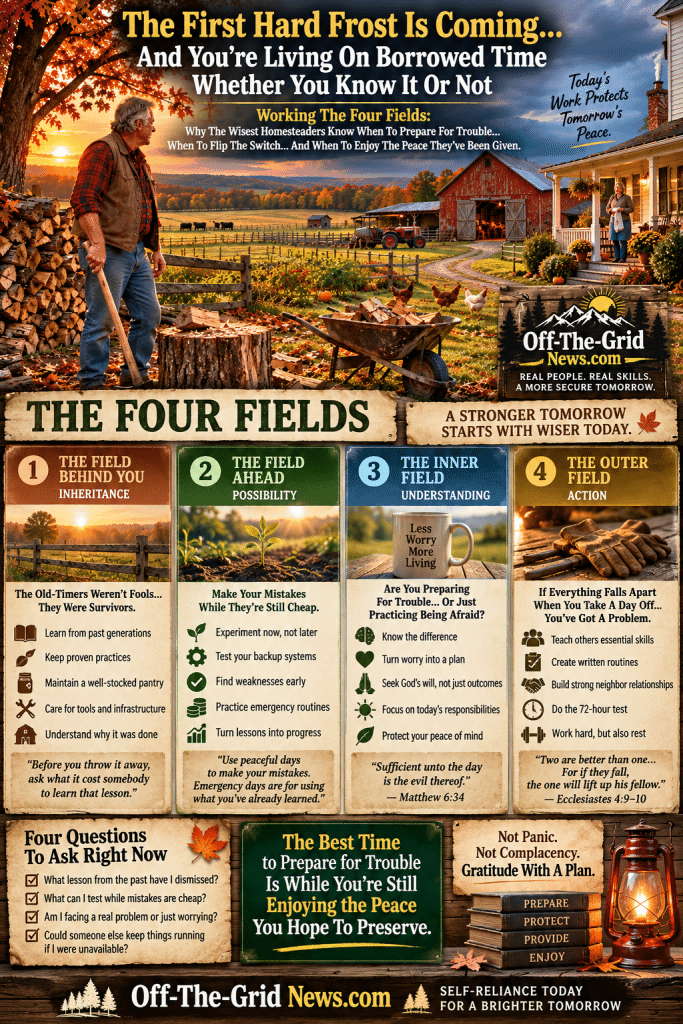
That’s where our Four Fields come in. Because the difference between a household that handles trouble and one that falls apart often comes down to what its people did before trouble showed up at the gate.
The Field Behind You: The Old-Timers Weren’t Fools… They Were Survivors

Start with the fence line. Somebody put those posts in the ground long before you came along, and chances are, they didn’t choose their locations by throwing darts at a map.
Somebody learned where the spring thaw sends the water. Somebody figured out which side of the barn takes the worst January wind. Somebody discovered that a root cellar built in the wrong place becomes a swimming pool every April.
And somebody probably learned those lessons the expensive way.
That’s the first field: inheritance.
Much of what allows a family, community, or nation to live peacefully was learned during periods when peace was nowhere to be found. The customs, responsibilities, and practical habits handed down through generations often grew from bitter experience rather than clever theories.
That’s why I get suspicious whenever somebody dismisses an old practice simply because it’s old.
Before you throw it away, ask what it cost somebody to learn that lesson.
Grandpa’s habit of keeping extra seed might look peculiar to someone who orders everything online. Grandma’s pantry, with its rows of home-canned beans, peaches, and tomatoes, might look like an unnecessary collection of dusty jars.
But when the roads close or the delivery truck doesn’t come, those supposedly outdated habits start looking like common sense.
And there’s another lesson the old-timers understood. Surviving the emergency isn’t the same thing as being ready for what comes afterward.
The storm blows through, the livestock are safe, and the generator has been running for two days. Everybody is exhausted, but who refills the fuel cans, repairs the fencing, and puts the emergency supplies back where they belong?
The danger may be gone, but recovery has barely started.
Inheritance means understanding why the old-timers did what they did… and knowing when their lessons need to be put back to work.
The Field Ahead: Make Your Mistakes While They’re Still Cheap
Now turn around and look toward the open ground. This is the field of possibility, where the future is still something you can influence through today’s decisions.
And here’s a truth every farmer and homesteader ought to understand.
Experimenting requires the luxury of surviving your mistakes.
Consider a scientist working in a laboratory and a shepherd caught in a Montana blizzard. The scientist might try 605 experiments before discovering that number 606 finally works. Each failure teaches him something, and he can afford to keep trying.
But the shepherd is standing in a blizzard with sheep depending on him. If he guesses wrong about the weather or where to find shelter, there may not be another experiment.
Every homesteader lives in both worlds.
In August, you can try a new bean variety, experiment with a different trellis, or graft an apple branch and see whether it takes. If it fails, you’ve lost some time, maybe a little money, and perhaps a bit of pride.
Now picture that same homestead during a January ice storm. The electricity has been out since midnight, the wind is howling around the barn, and the water lines are threatening to freeze.
That’s not the time to start experimenting with a stove you’ve never fired. Nor is it the ideal moment to discover that the generator you bought three years ago won’t start.
A generator you’ve never tested isn’t a backup plan. It’s a hopeful-looking machine with a gas can sitting beside it.
Find Your Weaknesses Before They Find You
Here’s where the borrowed-time idea earns its keep. When the weather is mild and the consequences are small, you can afford to discover what’s wrong.
Test the generator under a proper load, following the manufacturer’s instructions and operating it safely outdoors. Check the battery bank, arrange for a chimney inspection, and make sure your emergency lighting works. The CDC’s generator safety guidance explains why generators must remain outdoors, well away from building openings.
And don’t just admire those neatly stacked water containers. Check whether they’re clean, properly stored, and ready to use. The CDC recommends storing at least one gallon per person per day for emergencies.
Then pretend the power is out for an afternoon. Can you cook supper, find your supplies, and keep essential systems operating?
You might discover something embarrassing, and that’s good. Better to discover it on a pleasant October Saturday than at two in the morning with freezing rain rattling against the kitchen window.
Use peaceful days to make your mistakes. Emergency days are for using what you’ve already learned.
The Inner Field: Are You Preparing For Trouble… Or Just Practicing Being Afraid?
Now we come to the field that may be the hardest to cultivate.
The field between your ears.
One of the clearest signs of maturity is knowing the difference between something that deserves serious attention and something that doesn’t. Some people treat every inconvenience like the end of civilization, while others treat solemn responsibilities as though they can be discarded whenever something more entertaining comes along.
But life isn’t one long experiment. Marriage, raising children, keeping your word, and caring for people who depend on you require something more substantial than trying whatever feels good this week.
Some things require faithfulness rather than experimentation.
A Real Emergency Is Different From An Imaginary One
Consider two homesteaders.
The first hears a terrible commotion from the calving barn at two in the morning. He pulls on his boots, grabs a flashlight, and heads into the cold because a cow may need help.
The second lies awake imagining everything that might go wrong next winter. The generator could fail, feed prices could double, and the truck could break down. By sunrise, he’s exhausted, and nothing has happened.
Thinking ahead is valuable, but there’s a difference between identifying a risk and endlessly rehearsing your fear of it.
The first produces a plan. The second just steals your sleep.
The same distinction applies to prayer. It’s easy to pray frantically when we’re frightened by something that might happen, only to forget about prayer the moment the frightening possibility disappears.
But real prayer isn’t merely asking God to make our fears go away. It’s learning to trust His wisdom, seek His will, and faithfully handle the responsibilities He’s placed before us.
Christ taught His disciples to pray, “Thy will be done in earth, as it is in heaven.” — Matthew 6:10
He also reminded them, “Sufficient unto the day is the evil thereof.” — Matthew 6:34
In plain country language, tomorrow has enough trouble of its own. You don’t need to borrow all of it tonight.
So when worry comes knocking, ask whether you’re facing an actual problem or merely imagining one. Then ask whether there’s something useful you can do before supper.
Sometimes the answer is simple. Fill the fuel cans, check the medicine cabinet, or repair the chicken-coop latch. Other times, there’s nothing useful to do today, and a mature person learns to put the worry down.
That’s the inner field: knowing which troubles deserve your attention and refusing to give every passing fear the keys to your mind.
The Outer Field: If Everything Falls Apart When You Take A Day Off… You’ve Got A Problem
Now we come to the fourth field. The one with muddy boots, cold fingers, and chores that don’t particularly care whether you’re tired.
There’s something deeply reassuring about repetition. Milking at the same hour, checking livestock water, feeding chickens, walking the fence, and bringing in firewood before dark are the ordinary rhythms that make a homestead work.
None of it makes thrilling television. But miss enough of those jobs, and you’ll eventually get more excitement than you wanted.
Nobody Can Stand Guard Forever
Nature never takes a holiday. Water keeps running downhill, fire keeps burning, and hungry animals keep getting hungry.
Somebody has to keep watch.
But nobody can stand guard forever.
Even soldiers standing guard are relieved from duty. They sleep, eat, and recover so they can return with clear eyes and steady hands.
Now imagine a fellow raising livestock who works seven days a week, from morning until ten at night, because the animals need attention every day. He can’t take Sunday off, enjoy an evening with his wife, or leave town without worrying about what might happen.
He’s built himself a successful little operation, perhaps. But he’s also become a prisoner of it.
And I suspect more than a few homesteaders know exactly what that feels like.
Maybe you’re the only person who knows how to start the generator, repair the water system, or operate the wood furnace. It feels good to be indispensable until you get sick, break an ankle, or need to leave town.
Suddenly, the independence you’ve worked so hard to build becomes a trap.
The 72-Hour Test That Reveals A Hidden Weakness
Here’s a simple question.
If you disappeared for 72 hours, could your household keep functioning without calling you every fifteen minutes?
Could somebody feed the animals, keep the heat going, find emergency supplies, and shut off the water? If not, you’ve discovered a weakness worth fixing.
Teach another adult how essential systems work. Let older children learn appropriate chores under supervision, write down feeding schedules, and label shutoff valves.
And don’t forget your neighbors. A dependable neighbor who knows where the livestock feed is stored may be worth more during an emergency than another expensive piece of equipment.
As Ecclesiastes 4:9–10 reminds us, “Two are better than one… For if they fall, the one will lift up his fellow.”
A homestead shouldn’t depend entirely on one exhausted person holding everything together.
That’s not resilience. That’s a single point of failure wearing work boots.
The Switch That Separates A Prepared Household From A Perpetual Emergency
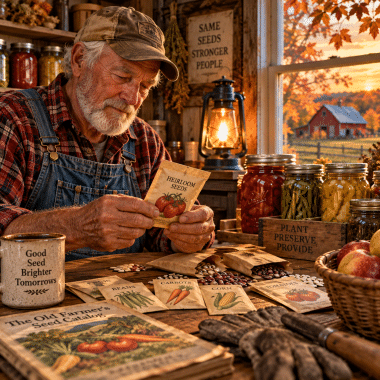
Some old-fashioned habits weren’t born out of fear. They were learned the hard way… and passed down so we wouldn’t have to learn them again.
Here’s where all four fields come together.
A healthy household must be able to move from peace into emergency and then back into peace. It needs the discipline to respond when trouble arrives and the wisdom to return to ordinary life when trouble passes.
Think about the household living in permanent emergency mode. Every problem is a crisis, every news headline brings fresh panic, and every Saturday disappears into preparations for something that may never happen.
Nobody rests, nobody laughs much, and nobody sits on the porch long enough to notice the sunset. The family may have impressive supplies, but they’ve forgotten what those supplies were supposed to protect.
Now consider the opposite household. Everything is comfortable, the generator hasn’t been started in three years, and the pantry contains enough food for two days and half a bag of stale crackers.
The first serious interruption finds everyone scrambling. Neither household has learned to throw the switch.
A healthy homestead knows when to prepare for trouble… and when to stop living as though trouble has already arrived.
When the storm approaches, everybody gets busy. Firewood comes inside, animals get secured, water containers are filled, and equipment is checked.
But when the storm passes, the family repairs what needs repairing, restocks what was used, and returns to ordinary life. Preparedness isn’t supposed to become a permanent state of alarm.
It’s supposed to make ordinary life more secure.
And remember, rest isn’t laziness. The rhythm of labor and rest is woven into creation itself, and Exodus 20:8–10 reminds us that work has its place, and so does laying it down.
If you’ve built a life where you cannot stop working without everything falling apart, perhaps you don’t need to work harder.
Perhaps you need a better system.
Four Questions To Ask Before The Frost Comes
So here’s your October assignment. No fancy equipment required, and it won’t cost you a nickel.
Look behind you. What lesson from the old-timers have you dismissed because it seemed unnecessary? Maybe it’s keeping extra seed, preserving food, or maintaining tools before they break.
Look ahead. What can you test now while mistakes are cheap? Run the backup system, practice cooking without electricity, and find out whether your emergency plan actually works. Ready.gov’s family emergency planning resources offer a useful starting point.
Look inward. Are you dealing with a genuine problem or simply feeding your imagination another disaster? Turn legitimate concerns into practical action instead of giving imaginary emergencies your best hours.
Look outward. Could somebody else keep the homestead running if you were unavailable? If not, start teaching that second pair of hands.
Four fields, four questions, and one important lesson.
The best time to prepare for trouble is while you’re still enjoying the peace you hope to preserve.
Use The Loan Well… And Don’t Forget To Enjoy What You’re Protecting
There’s something remarkable about the ordinary peace we enjoy. We can experiment with new crops, build things that may last generations, raise our families, and make plans for tomorrow without constantly fighting for survival.
That’s a blessing previous generations didn’t always enjoy. And it’s one we ought to appreciate rather than casually assume will always be there.
Which brings us back to that October frost.
The right attitude isn’t panic, and it certainly isn’t complacency.
It’s gratitude with a plan.
So take that warm afternoon and split another load of wood. Test the backup system, show somebody else how to handle the evening chores, and fix the gate that’s been dragging since July.
Then, when the work is finished, put the tools away. Sit down at the supper table with the people who worked beside you. Enjoy the smell of something good cooking, listen to the grandchildren laughing, and watch the last light settle across the pasture.
Because those ordinary moments are what all this preparation is supposed to protect.
The first hard frost is coming, and so are other troubles you cannot predict or control. But today, the sun is shining, the tools are within reach, and there’s work worth doing and a life worth enjoying.
You’ve been given another day.
Don’t waste it worrying about every storm that might come, and don’t waste it pretending storms never come.
Use the loan well. And when the day’s work is done, don’t forget to enjoy the peace you’ve been given.
Source: https://www.offthegridnews.com/extreme-survival/the-first-hard-frost-is-coming-and-youre-living-on-borrowed-time-whether-you-know-it-or-not/
Anyone can join.
Anyone can contribute.
Anyone can become informed about their world.
"United We Stand" Click Here To Create Your Personal Citizen Journalist Account Today, Be Sure To Invite Your Friends.
Before It’s News® is a community of individuals who report on what’s going on around them, from all around the world. Anyone can join. Anyone can contribute. Anyone can become informed about their world. "United We Stand" Click Here To Create Your Personal Citizen Journalist Account Today, Be Sure To Invite Your Friends.
LION'S MANE PRODUCT
Try Our Lion’s Mane WHOLE MIND Nootropic Blend 60 Capsules
Mushrooms are having a moment. One fabulous fungus in particular, lion’s mane, may help improve memory, depression and anxiety symptoms. They are also an excellent source of nutrients that show promise as a therapy for dementia, and other neurodegenerative diseases. If you’re living with anxiety or depression, you may be curious about all the therapy options out there — including the natural ones.Our Lion’s Mane WHOLE MIND Nootropic Blend has been formulated to utilize the potency of Lion’s mane but also include the benefits of four other Highly Beneficial Mushrooms. Synergistically, they work together to Build your health through improving cognitive function and immunity regardless of your age. Our Nootropic not only improves your Cognitive Function and Activates your Immune System, but it benefits growth of Essential Gut Flora, further enhancing your Vitality.

Our Formula includes: Lion’s Mane Mushrooms which Increase Brain Power through nerve growth, lessen anxiety, reduce depression, and improve concentration. Its an excellent adaptogen, promotes sleep and improves immunity. Shiitake Mushrooms which Fight cancer cells and infectious disease, boost the immune system, promotes brain function, and serves as a source of B vitamins. Maitake Mushrooms which regulate blood sugar levels of diabetics, reduce hypertension and boosts the immune system. Reishi Mushrooms which Fight inflammation, liver disease, fatigue, tumor growth and cancer. They Improve skin disorders and soothes digestive problems, stomach ulcers and leaky gut syndrome. Chaga Mushrooms which have anti-aging effects, boost immune function, improve stamina and athletic performance, even act as a natural aphrodisiac, fighting diabetes and improving liver function. Try Our Lion’s Mane WHOLE MIND Nootropic Blend 60 Capsules Today. Be 100% Satisfied or Receive a Full Money Back Guarantee. Order Yours Today by Following This Link.


| Visits: | 1,835,166,594 |
| Stories: | 8,721,843 |
Whistler Blowers, Insiders

