

Before You Stockpile Light Bulbs… Read The Fine Print On Washington’s New 2028 LED Rules

Walk into the kitchen before daylight, flip the switch, and there it is: enough light to find the coffee, read the weather, and discover somebody left muddy gloves beside the breadbox. A light bulb seems like a small thing until you start asking who decides what goes into it—and what your family needs from it.
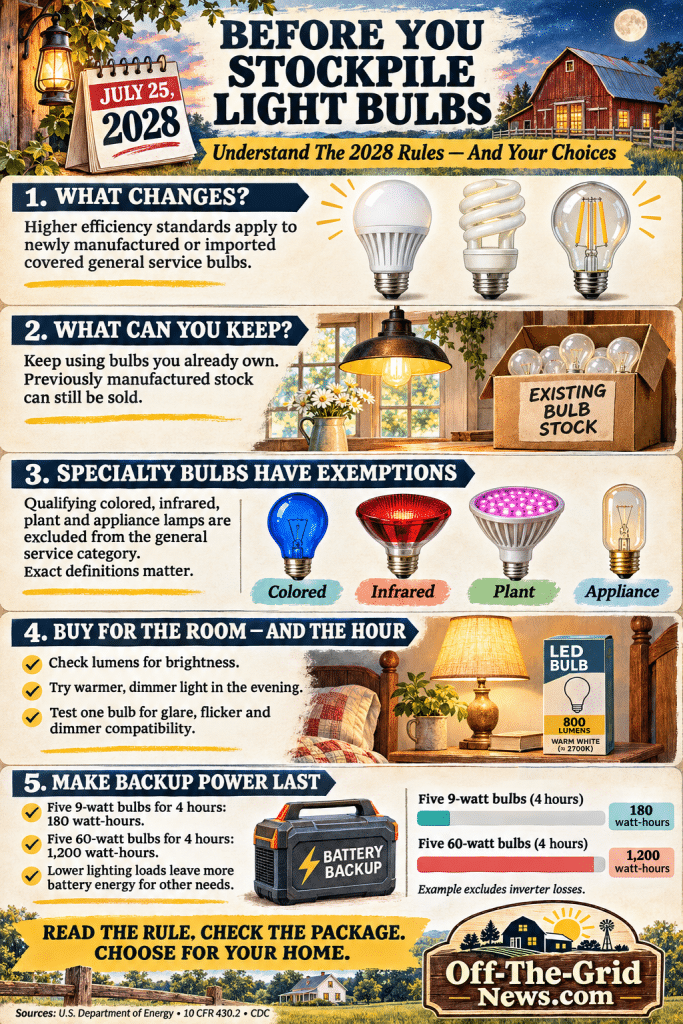
Now there’s another change coming to the hardware store. Federal efficiency standards adopted in 2024 set a July 25, 2028, compliance date for newly manufactured or imported general service light bulbs, according to the Department of Energy’s explanation.
That matters if you care about electricity costs, backup battery life, comfortable evenings, and getting a decent night’s sleep. But before we load the pickup with spare bulbs, let’s sort out the facts and clear away the fog.
Because here’s the crucial question: Will the bulb you buy deliver the goods where you actually need it?
The Coming Rule in Plain English
First, let’s get past the government mumbo-jumbo. “General service lamps” is Washington’s name for a broad category of everyday bulbs. Under the 2024 final rule, covered products face tougher efficiency requirements beginning July 25, 2028, with thresholds that vary by lamp class and characteristics.
For the most common bulbs, the Energy Department describes the shift as moving from 45 lumens per watt to more than 120. That’s a substantial jump, and it can affect which designs manufacturers offer.
However, this isn’t an order to unscrew the bulbs already lighting your house. The department says the standards apply to newly produced or imported covered lamps; consumers can keep using existing bulbs and purchasing previously manufactured stock.
In other words, you don’t need to scramble up a stepladder at midnight before the deadline.
Still, tighter standards deserve a good looking-over. A homesteader knows that a tool can score beautifully on one measurement and disappoint at the job you actually bought it for.
The Overlooked Detail on the Bulb Box
Now, what’s a lumen? It measures visible light output, while watts measure the electrical power a bulb uses. Put them together—lumens per watt—and you’ve got a way to gauge how much light you get for your electricity.
Here’s the overlooked detail: That measurement gives more weight to the colors our eyes see most easily. Under bright conditions, that’s around the yellow-green part of the spectrum. Red and blue light contribute too, although they’re weighted differently; infrared and ultraviolet sit outside visible light and don’t count as lumens.
That’s a useful yardstick for illumination. It just doesn’t tell you everything about glare, color quality, flicker, comfort, or how a light fits the hour of the day.
Picture buying a tractor by fuel economy alone. You’d still want to know whether it can pull the implement, start in January, and fit through the shed door.
Likewise, efficiency deserves a place in the decision. But don’t let one impressive number make the decision for you.
Sunshine Delivers More Than Meets the Eye
Meanwhile, daylight delivers visible light along with ultraviolet and infrared radiation. The mix changes with weather, time of day, and other conditions, which is one reason a winter morning at the woodpile feels different from a July afternoon in the garden.
An incandescent bulb gives off visible light and a great deal of infrared radiation. But calling it bottled sunshine stretches the comparison: its spectrum differs from daylight, and it doesn’t recreate the sun’s full package.
Conventional white LEDs generally emit very little infrared or ultraviolet in their light beam. They still produce heat, though; the Energy Department’s technical explanation of LED heat management describes how heat must be carried away through the bulb’s components rather than simply radiated forward like an incandescent’s infrared output.
Also, those three letters—L-E-D—describe a technology, not one fixed recipe for light. Infrared LEDs exist, and white lighting products can differ considerably in their output.
So the claim that every LED strips away exactly the same wavelengths is too broad. You have to look at the actual product, the same way you read the seed packet instead of planting whatever came in a green envelope.
Don’t Let the Kitchen Light Hijack Bedtime
Now, here’s where this gets up close and personal. Your body responds to the daily rhythm of light and darkness, and a brightly lit room late at night can send the wrong signal when you’re trying to wind down.
The National Institute of General Medical Sciences explains that these circadian rhythms influence sleep, hormone release, digestion, and body temperature. Light reaching the eyes helps coordinate that internal clock.
In addition, guidance on light color from the Centers for Disease Control and Prevention says blue light has a strong effect on circadian rhythms and can suppress melatonin during sensitive periods. Daytime white light, on the other hand, can support alertness and mood.
So timing is crucial. Brightness matters too, along with how long you’re exposed and the mix of wavelengths. You can’t figure all that out from the word “LED” on the box.
After all, the light you want over a workbench while repairing a pump may be a poor choice beside your pillow. The henhouse settles down when evening comes, and there’s something to be said for letting the farmhouse settle down too.
Exciting Research Still Needs a Good Reality Check
Meanwhile, scientists are studying how particular red and near-infrared wavelengths affect biological processes, including activity associated with mitochondria—the tiny energy-producing structures inside cells. That’s an interesting field, and it deserves careful attention.
For example, a 2024 study in the Journal of Biophotonics tested 670-nanometer red light in healthy adults. In plain English, the small study found a smaller rise in blood sugar after a glucose drink when participants had received a carefully controlled dose of light.
But that experiment didn’t establish that ordinary household LEDs cause diabetes. Nor did it prove that replacing a kitchen bulb treats disease or that every home needs an infrared lighting system.
The distinction matters because a measured treatment dose and an everyday lamp are different things. Wavelength, intensity, duration, and the body area exposed all affect what researchers are actually testing.
By all means, keep an open mind and follow the research. Just don’t turn an exciting early result into a promise that a new kitchen bulb will fix your health.
Clear Away the Fog About What Gets Banned
Next, let’s tackle a confusing claim you may have heard. The rule doesn’t automatically outlaw every red bulb, infrared lamp, or specialty lighting product. The federal definition of general service lamps specifically excludes categories including qualifying colored lamps, infrared lamps, plant lights, and appliance lamps.
Those definitions have conditions, so a manufacturer can’t necessarily sidestep a standard by putting “wellness” on a carton. Whether a particular product is covered depends on its actual design and the regulatory language.
Still, the fine print matters. Before anybody tells you that every nighttime red bulb disappears in 2028, ask them to prove it with the actual rule.
And a higher efficiency requirement doesn’t prove that every bulb meeting it must be harsh or unhealthy. Manufacturers face design tradeoffs, but predicting the entire future shelf requires more evidence than a single lumens-per-watt number.
There’s room to challenge narrow standards and ask better questions. There’s no need to build the argument on a fence post that won’t hold.
Give That New Bulb a Test Drive
Fortunately, you can make useful changes without waiting for Washington. Start by deciding what each light needs to do: illuminate a sharp tool, help you read, guide a nighttime trip down the hall, or light the porch steps.
For living rooms and bedrooms, look at warmer color options and adjustable brightness. The Energy Department’s consumer lighting guide explains that lower Kelvin numbers generally look warmer, while higher numbers look cooler or bluer.
However, color temperature alone doesn’t reveal a bulb’s full spectrum or guarantee a particular sleep response. A warm bulb blazing at full strength above your face can still be a poor bedtime companion.
Instead, try a shaded lamp with enough light for the task, then reduce unnecessary room lighting as bedtime approaches. Keep safe footing in mind, especially on stairs and in homes where somebody gets up frequently at night.
Best part? You can give one bulb a test drive before you shell out for a whole case. Check whether it glares, buzzes, flickers with your dimmer, or makes the supper table look like the waiting room at a tire shop.
Stop Wasting Precious Backup Power
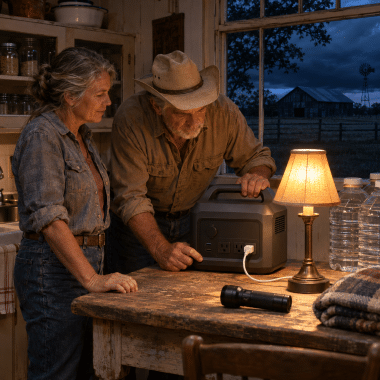
Meanwhile, here’s a valuable advantage for an off-grid household: Use less battery power on lighting, and you’ve got more left for other needs. The arithmetic is straightforward, even when the weather forecast isn’t.
Suppose you run five 9-watt bulbs instead of five 60-watt bulbs for four hours. Over those four hours, the old bulbs use twelve hundred watt-hours. The lower-wattage bulbs use just one hundred eighty. That saves a little over one kilowatt-hour before you account for inverter losses and other system details.
That’s a meaningful difference when batteries are your nighttime power supply. How long your setup actually runs still depends on the battery’s usable capacity, what else you’re powering, equipment losses, and operating conditions.
So build a lighting plan around occupied rooms and necessary tasks. There’s little sense lighting an empty barn like the county fair while wondering where the battery charge went.
Ask Tough Questions and Keep Your Choices
Finally, if this rule concerns you, take a closer look. Read the official rulemaking docket and contact your elected representatives with specific questions. Ask how standards account for color quality, specialty products, consumer choice, and the evidence on lighting and circadian health.
Be equally careful with sweeping dollar claims. Comparing projected energy savings with broad estimates of illness costs doesn’t establish that particular bulbs caused those illnesses or that changing this rule would prevent them.
The cold, hard facts make a stronger argument than a frightening number that doesn’t fit the question. Households need affordable illumination, sensible choices, and clear information about the light they bring indoors.
Meanwhile, take advantage of ordinary daylight when your schedule and conditions allow, and let the house grow quieter and dimmer toward bedtime. You don’t need a federal announcement to start paying attention to the rhythm of your own home.
The bulb above the kitchen table may be small. Choosing it with your eyes open is still your business.
Source: https://www.offthegridnews.com/extreme-survival/before-you-stockpile-light-bulbs-read-the-fine-print-on-washingtons-new-2028-led-rules/
Anyone can join.
Anyone can contribute.
Anyone can become informed about their world.
"United We Stand" Click Here To Create Your Personal Citizen Journalist Account Today, Be Sure To Invite Your Friends.
Before It’s News® is a community of individuals who report on what’s going on around them, from all around the world. Anyone can join. Anyone can contribute. Anyone can become informed about their world. "United We Stand" Click Here To Create Your Personal Citizen Journalist Account Today, Be Sure To Invite Your Friends.
LION'S MANE PRODUCT
Try Our Lion’s Mane WHOLE MIND Nootropic Blend 60 Capsules
Mushrooms are having a moment. One fabulous fungus in particular, lion’s mane, may help improve memory, depression and anxiety symptoms. They are also an excellent source of nutrients that show promise as a therapy for dementia, and other neurodegenerative diseases. If you’re living with anxiety or depression, you may be curious about all the therapy options out there — including the natural ones.Our Lion’s Mane WHOLE MIND Nootropic Blend has been formulated to utilize the potency of Lion’s mane but also include the benefits of four other Highly Beneficial Mushrooms. Synergistically, they work together to Build your health through improving cognitive function and immunity regardless of your age. Our Nootropic not only improves your Cognitive Function and Activates your Immune System, but it benefits growth of Essential Gut Flora, further enhancing your Vitality.

Our Formula includes: Lion’s Mane Mushrooms which Increase Brain Power through nerve growth, lessen anxiety, reduce depression, and improve concentration. Its an excellent adaptogen, promotes sleep and improves immunity. Shiitake Mushrooms which Fight cancer cells and infectious disease, boost the immune system, promotes brain function, and serves as a source of B vitamins. Maitake Mushrooms which regulate blood sugar levels of diabetics, reduce hypertension and boosts the immune system. Reishi Mushrooms which Fight inflammation, liver disease, fatigue, tumor growth and cancer. They Improve skin disorders and soothes digestive problems, stomach ulcers and leaky gut syndrome. Chaga Mushrooms which have anti-aging effects, boost immune function, improve stamina and athletic performance, even act as a natural aphrodisiac, fighting diabetes and improving liver function. Try Our Lion’s Mane WHOLE MIND Nootropic Blend 60 Capsules Today. Be 100% Satisfied or Receive a Full Money Back Guarantee. Order Yours Today by Following This Link.



| Visits: | 1,839,073,113 |
| Stories: | 8,740,303 |
Whistler Blowers, Insiders


D.C. is a foreign Territory and not part of the Republic. Only morans and pussies listen to what they say.