

5 Warning Signs That America’s Systems Are Under Strain

Authored by Madge Waggy via ‘A lot will happen in 2026!’,
Most people carry a mental image of collapse that looks like a movie scene. Tanks rolling through streets. Banks locking their doors overnight. Crowds panicking in front of empty stores. These dramatic moments do happen, but they’re usually the endpoint of a much longer process, not the beginning. By the time things get visibly chaotic, the foundations have already shifted in ways that are harder to see but easier to prepare for.

Real change tends to move slowly. It accumulates in the spaces between news cycles, in the gradual adjustment of expectations, in the slow realization that the systems we counted on have changed their nature without announcing the shift. You don’t usually get a memo when your society enters a transitional phase. You just notice, gradually, that things that used to work smoothly now require more effort, more patience, more improvisation.
If you look carefully at the American landscape right now, you can spot patterns that suggest we are living through one of these transitional periods. Not a sudden collapse, but a gradual reconfiguration of how things work. The signs are there for those willing to see them, though they require looking past the noise of daily politics and economic headlines.
Here are the key observations that frame what follows:
-
Debt has become a permanent feature, not a temporary bridge – Federal obligations now exceed $34 trillion, with annual interest payments consuming resources that once funded actual services. This isn’t a projection of future danger; it’s the current reality that shapes every budget decision.
-
Emergency guidance has shifted from “we will help” to “prepare to help yourself” – Federal agencies now routinely advise citizens to maintain 72-hour emergency supplies, not as supplemental caution but as acknowledgment that immediate response may not arrive.
-
Supply systems function on razor-thin margins – The efficiency that brings us cheap goods has eliminated the redundancy that ensures those goods remain available when conditions strain. Our logistical infrastructure assumes nothing goes seriously wrong, which is a risky assumption.
-
Trust in major institutions has entered freefall – Polling data across decades shows consistent decline in confidence toward government, media, corporations, and educational establishments. This isn’t partisan dissatisfaction; it’s structural delegitimation.
-
Local services are quietly degrading – Cities and counties face fiscal pressures that manifest in slower emergency response, deferred maintenance, and reduced staffing in essential functions. These failures hit home immediately and personally.
-
What comes next is uncertain, but preparation is possible – Recognition of vulnerability doesn’t require surrender to fear. Understanding these patterns allows for prudent adaptation without panic.
These observations aren’t predictions of doom. They’re diagnostic markers, like checking the oil in a car or reading blood pressure. They tell us something about the current condition of the systems we navigate daily.
Sign One: When Money Buys Less Every Week
There’s a moment in every inflationary cycle that people miss because it doesn’t look like crisis. It looks like ordinary life getting slightly harder. Your grocery bill creeps up five dollars, then ten. The gas pump shuts off a few dollars earlier than it used to. The rent increase notice arrives, and you negotiate a compromise that leaves you with less discretionary income than before.
These moments feel personal. They feel like individual financial management challenges. You tell yourself you need to budget better, pick up extra shifts, or find a side hustle. What you don’t recognize – what most people miss – is that these personal moments are actually signals of systemic monetary stress. Your shrinking purchasing power isn’t a reflection of your work ethic or intelligence. It’s the visible surface of a much deeper process.
Federal Reserve data puts the national debt at over thirty-four trillion dollars. That number is so large it becomes abstract, like trying to visualize the distance to distant galaxies. But the meaning becomes concrete when you look at where federal spending actually goes. An increasing percentage of the budget doesn’t build roads, fund schools, or maintain infrastructure. It services interest on money borrowed years ago. It pays for past consumption with present revenue, leaving less available for current needs.
This creates a feedback loop that’s difficult to escape. When interest payments consume budget space, governments face unpopular choices. They can raise taxes, which slows economic activity and angers voters. They can cut services, which angers voters and reduces quality of life. Or they can expand the money supply, which feels painless in the moment but shows up later as rising prices.
Historically, governments almost always choose the third option. It’s the path of least immediate resistance. Roman emperors debased their coinage, mixing copper into silver denarii until the currency became worthless. Weimar Germany printed marks until the paper was worth more than the purchasing power printed on it. More recently, Venezuela and Zimbabwe provided object lessons in how quickly monetary confidence can evaporate when governments treat currency as an unlimited resource.
American monetary policy operates through more sophisticated mechanisms than ancient coin-clipping, but the underlying dynamic remains similar. Quantitative easing, stimulus packages, and deficit spending all expand the money supply. When more dollars chase the same amount of goods and services, prices rise. This isn’t conspiracy theory; it’s basic economics that predates modern politics by centuries.
What makes this sign particularly insidious is how slowly it unfolds and how quickly people normalize it. Inflation doesn’t arrive as a sudden shock that triggers immediate response. It arrives as a series of small disappointments that accumulate over years. You adjust your expectations downward. You learn to do without. You tell yourself this is just how things are now.
But historical patterns suggest that monetary deterioration follows predictable trajectories. Early stages involve steady price increases that outpace wage growth. Middle stages see savings losing value and fixed-income populations falling into hardship. Late stages can involve rapid currency collapse, though that’s not inevitable and depends on policy responses.
Right now, we’re somewhere in the early-to-middle phase. You can see it in the way people talk about housing costs, in the proliferation of “side hustle” culture as people scramble to cover basic expenses, in the way grocery shopping has become a strategic exercise in cost comparison that previous generations didn’t need to practice.
The people who feel this pressure first are usually those without assets to appreciate alongside currency depreciation. Retirees on fixed incomes watch their purchasing power erode monthly. Renters see housing costs absorb increasing percentages of their wages. Workers in industries without strong bargaining power find their raises lagging behind price increases.
Meanwhile, those with tangible assets – property, productive equipment, commodity reserves – often weather monetary instability better because these things retain utility regardless of what happens to currency values. A house provides shelter whether dollars are strong or weak. A fruit tree produces food regardless of exchange rates. This isn’t investment advice; it’s historical observation about what happens when monetary systems stress.
The response from authorities typically involves reassurance that inflation is “transitory” or “manageable,” accompanied by statistical measurements that exclude the categories rising fastest. Official inflation metrics often don’t capture the reality of grocery bills or rent increases because they’re designed to measure something different – general price levels across the entire economy, including categories like electronics that tend to decrease in price due to technological advancement.
This creates a disconnect between official narrative and lived experience. You hear that inflation is two percent while your grocery bill has increased twenty percent over three years. Both can be true simultaneously, but only one matches your daily reality.
What’s happening beneath the surface is a slow transfer of wealth from those holding currency to those holding debt, since debt can be repaid in devalued dollars. It’s a quiet redistribution that never appears on ballots or in legislative debates, yet it shapes economic outcomes more profoundly than many explicit policy choices.
Understanding this sign doesn’t require predicting collapse. It simply requires noticing that the relationship between work and purchasing power has shifted in ways that make life harder for millions of people simultaneously. When that happens across an entire economy, it’s not a personal failing – it’s a systemic signal worth recognizing.
Sign Two: When Officials Start Suggesting You Handle It Yourself
Language matters. Not just in poetry or literature, but in the dry prose of government documents and emergency guidelines. When official messaging changes, it often reveals shifts in institutional thinking that aren’t announced in press conferences.
Consider how emergency preparedness guidance has evolved over the past two decades. Previously, the implicit message from federal agencies was: “We have this covered.” Emergency management existed to coordinate response, mobilize resources, and restore normalcy. Citizens might be advised to have basic supplies, but the underlying assumption was that professional systems would handle serious crises.
Contemporary guidance tells a different story. FEMA now routinely recommends that households maintain seventy-two hours of self-sufficiency – food, water, medications, emergency supplies. The Red Cross suggests two weeks of preparation for certain scenarios. Local emergency management offices increasingly emphasize “community resilience” and “neighbor helping neighbor” rather than centralized response capabilities.
On the surface, this looks like sensible caution. Preparation is good. Self-reliance is virtuous. But the shift in emphasis matters. A system confident in its capacity doesn’t need to constantly remind citizens that help might not arrive immediately. The frequency and urgency of these messages suggests something beyond standard precaution.
Look at the lessons drawn from recent disasters. Hurricane Katrina in 2005 revealed that federal logistics couldn’t quickly reach everyone who needed help. Thousands waited on rooftops and in overcrowded shelters while supplies sat undistributed in warehouses. The system didn’t just move slowly; in places it broke entirely under the weight of demand.
Hurricane Maria in 2017 showed similar patterns in Puerto Rico. Months passed before full electrical restoration. Clean water access remained problematic for extended periods. Medical supply chains failed. These weren’t remote historical events; they happened within recent memory and involved territories under federal jurisdiction.
The Texas winter storm of 2021 provided perhaps the clearest demonstration of infrastructure fragility. A modern American state, rich in energy resources, saw its electrical grid collapse under weather conditions that other regions handle routinely. Millions lost power during freezing temperatures. Water treatment plants failed. People died in their homes from hypothermia, a cause of death that shouldn’t occur in a developed nation with functioning infrastructure.
After each of these events, official messaging adjusted. Not dramatically, not through announced policy changes, but through gradual recalibration of expectations. The new normal involves acknowledging that help may be delayed, that citizens should prepare for initial self-sufficiency, that systems have limits.
This represents a significant psychological shift in the relationship between governed and governing. For most of the modern era, the social contract in developed nations included an assumption that serious emergencies would trigger institutional response. Police, fire departments, medical services, and logistical support would arrive. The question was when, not if.

Current messaging suggests a more qualified understanding. Response will come, but perhaps not immediately. Systems will function, but perhaps not completely. Help is available, but citizens should be prepared to bridge gaps.
For individuals, this shift has practical implications. It changes how people think about their relationship to systems. When you internalize the possibility that you might be on your own for seventy-two hours or longer, your behavior changes. You stock supplies. You learn basic emergency skills. You build relationships with neighbors that might prove crucial if external support is delayed.
Historically, when governments begin emphasizing citizen self-reliance, it often signals institutional capacity constraints. Late Soviet emergency protocols increasingly emphasized local organization as central capacity contracted. Pre-revolutionary French provincial administrations distributed self-help guides as royal authority weakened. These weren’t admissions of failure in those contexts either; they were adaptations to reality.
The modern American version involves “resilience” as a buzzword. Community resilience. Infrastructure resilience. Economic resilience. The word sounds positive, but its prevalence suggests awareness that brittleness exists and needs mitigation.
What’s striking is how quickly populations adapt to these lowered expectations. Within a few years, having emergency supplies shifts from “prepper” eccentricity to mainstream prudence. Discussing grid failure possibilities moves from conspiracy theory to dinner table conversation. The normalization happens gradually enough that people don’t notice their expectations have shifted.
This sign matters because it changes the psychology of crisis. When people assume help will arrive quickly, they wait. When they assume delays are possible, they act. This affects everything from evacuation compliance to resource hoarding behavior. It can make communities more resilient in some ways – better prepared, more connected – but also more fragmented in others, as trust in institutional response diminishes.
The shift also reflects fiscal reality. Maintaining emergency response capacity sufficient for simultaneous major disasters is expensive. As municipal and federal budgets face pressure from pension obligations, debt service, and deferred infrastructure maintenance, emergency preparedness often faces cuts. It’s easier to advise citizens to prepare themselves than to maintain the stockpiles and personnel for comprehensive response.
Understanding this sign means recognizing that the safety net has developed holes, and official guidance now implicitly acknowledges those holes. It doesn’t mean abandonment – emergency services still exist and still respond. But the assumption of comprehensive coverage has given way to a more qualified understanding that individuals bear initial responsibility for their own safety.
Sign Three: Supply Chains That Assume Perfect Weather
Walk through any major retailer and you’ll see the miracle of modern logistics. Thousands of products from around the world, arranged in neat rows, available for immediate purchase at prices that would have seemed miraculous to previous generations. Fresh produce in winter. Electronics from Asia. Clothing from multiple continents. The abundance feels permanent, inevitable, natural.
But this abundance rests on a specific set of conditions: stable energy prices, functioning ports, available trucking capacity, international trade agreements, and complex software systems coordinating movement across thousands of miles. When these conditions hold, the system delivers efficiency that previous eras couldn’t imagine. When they falter, the system reveals its fragility.
The 2021 supply chain disruptions provided a glimpse of this brittleness. During the pandemic’s peak disruption, Americans encountered empty shelves, delayed deliveries, and shortages of basic goods. Baby formula became scarce enough to constitute a crisis for families with infants. Automobile production halted due to semiconductor shortages despite adequate assembly facilities and labor. Construction projects stalled as lumber prices tripled.
Official explanations attributed these disruptions to pandemic-specific factors: factory closures, labor shortages, shipping bottlenecks. The implied promise was that once conditions normalized, the system would restore itself. To some extent, this happened. Shelves restocked. Shipping resumed. Prices stabilized, though often at higher levels than before.
What didn’t happen was fundamental structural change. The supply chain architecture that created those vulnerabilities remains largely intact. If anything, efficiency pressures have made systems even leaner, removing buffer inventory that might provide resilience against future shocks.
Modern supply chains operate on “just-in-time” principles. Inventory is expensive to store, so companies minimize stockpiles, coordinating delivery to arrive precisely when needed. This works beautifully in stable environments. It fails catastrophically when disruptions occur, because there’s no slack in the system. A delay in one component halts entire production lines. A port closure ripples through continental distribution networks.
Geographic concentration creates additional vulnerability. Critical manufacturing for pharmaceuticals, electronics, and industrial components is concentrated in specific regions, often in East Asia. Rare earth elements essential for batteries and renewable energy technology come from limited sources. Major ports handle percentages of national imports that suggest dangerous centralization.
Climate volatility increasingly tests these systems. Drought conditions on the Mississippi River recently reduced barge traffic, threatening agricultural exports and domestic commodity movement. Canadian wildfires disrupted air freight across North America. Texas freeze events affected chemical production facilities whose outputs serve national manufacturing.
Cyber vulnerabilities present another attack surface. The Colonial Pipeline ransomware attack demonstrated how digital infiltration translates immediately into physical shortage – fuel distribution ceasing across entire regions not from mechanical failure but from software compromise. Similar attacks against meatpacking facilities, port operating systems, and agricultural processors suggest adversaries have identified these logistical vulnerabilities.
What makes this sign particularly concerning is the interconnection between different supply systems. Energy shortages affect fertilizer production, which affects agricultural yields, which affects food prices, which affects social stability. Financial stress triggers credit contraction, which triggers inventory reduction, which triggers employment reduction. These connections create cascade risks where problems in one sector amplify across others.
The margin between abundance and absence has narrowed to invisibility. Grocery stores typically maintain about three days of inventory under normal consumption patterns. Hospital pharmaceutical supplies increasingly depend on daily deliveries rather than stockpiled reserves. Electrical grids operate without surge capacity sufficient for demand spikes that previously would have been considered within normal variation.
Historical parallels are instructive. Pre-industrial societies maintained local food reserves because they understood harvests could fail. Modern societies have traded this redundancy for efficiency, assuming that global markets will always provide. This assumption holds until it doesn’t.
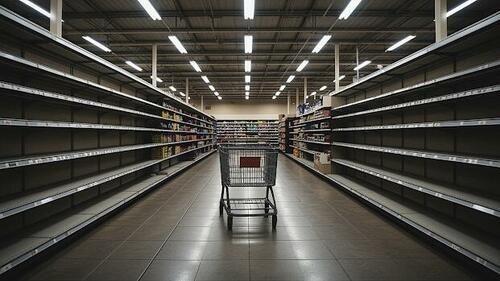
The psychological impact of supply disruption shouldn’t be underestimated. Populations accustomed to immediate availability experience empty shelves as existential threats even when actual hunger isn’t imminent. The sight of bare grocery cases triggers panic buying, which creates further shortages in self-fulfilling cycles.
Understanding this sign means recognizing that apparent abundance masks structural fragility. It means understanding that “just-in-time” is also “just-barely” and that the system assumes nothing goes seriously wrong in multiple places simultaneously. When those assumptions fail, the transition from abundance to scarcity can happen faster than institutional responses can manage.
Sign Four: Institutions Running on Fumes of Trust
Trust is the invisible infrastructure of modern society. It doesn’t appear on balance sheets or infrastructure maps, but without it, complex systems simply stop working. When people trust institutions – courts, media, scientific bodies, electoral mechanisms – they cooperate with decisions they might not fully understand or support. When that trust erodes, cooperation becomes grudging or absent, and systems that looked stable suddenly require constant enforcement.
Long-term polling data from Gallup and other survey organizations reveals a steady, decades-long decline in public confidence across virtually every major American institution. Congress, the presidency, the Supreme Court, banks, big business, newspapers, television news, organized religion – all have experienced significant drops in public trust since the mid-twentieth century.
This isn’t a recent phenomenon tied to any particular administration or scandal. It’s a structural trend that spans generations and political alignments. The decline has been gradual enough that it doesn’t generate headlines, but the cumulative effect is profound. Institutions that once commanded automatic respect now face automatic skepticism.
The consequences extend beyond political inconvenience. Modern societies depend heavily on voluntary compliance. Laws alone can’t regulate every interaction; systems assume people will generally follow rules because they believe the system is legitimate. When that belief weakens, coordination becomes harder even if the formal structure remains intact.
You can see this in how people respond to public health guidance, financial advice, or educational recommendations. When institutional trust is high, people follow guidance even when it requires sacrifice. When trust is low, people filter information through suspicion, looking for hidden agendas or incompetence behind official statements.
The causes of this erosion are complex and debated. Some point to the Vietnam War and Watergate as moments when establishment credibility suffered lasting damage. Others cite the democratization of information through the internet, which eliminated elite monopoly over narrative construction. Still others note that institutional performance has, in some cases, genuinely declined, with failures in financial regulation, military intervention, and public health response providing evidence for skepticism.
Whatever the causes, the effects are visible in daily life. Conspiracy theories flourish not because people are stupid, but because they no longer trust official sources to provide accurate information. Partisan polarization increases as people retreat into information ecosystems that confirm their existing suspicions. Voluntary associations decline as people withdraw from civic engagement that feels futile or corrupt.
Historical parallels suggest this is a dangerous trajectory. Pre-revolutionary France experienced similar fragmentation, with Enlightenment philosophy undermining religious authority while court culture maintained aristocratic pretensions increasingly disconnected from rural reality. Late-stage Soviet society operated through official narratives that virtually no citizen believed, yet everyone publicly affirmed – creating a society of pure performance where reality existed only in whispered kitchens.
The American version involves parallel information ecosystems where identical events receive contradictory interpretation. Climate change, election integrity, medical guidance, economic data – all become contested territories where “truth” depends on tribal affiliation rather than empirical evidence. This makes coordinated response to shared problems nearly impossible, since there’s no agreement on what the problems actually are.
What makes this sign particularly concerning is how it affects crisis response. During emergencies, systems rely on rapid population compliance: evacuation orders, emergency instructions, resource rationing. If large portions of the population no longer trust the sources issuing these instructions, compliance becomes unpredictable. People may reject legitimate warnings based on previous false alarms, or conversely panic based on misinformation that official sources lack credibility to correct.
The breakdown also affects economic behavior. Financial systems depend on confidence – hence the term “confidence game.” When people lose faith in banking institutions, they withdraw deposits, which can trigger the very failures they feared. When investors doubt regulatory oversight, they demand higher returns to compensate for perceived risk, which raises capital costs throughout the economy.
Rebuilding trust is difficult because it requires both institutional reform and cultural shift. Institutions must demonstrate competence and integrity over extended periods to earn back credibility. Populations must remain open to the possibility that institutions can improve, despite accumulated evidence of failure. Both requirements face significant headwinds in current conditions.
Understanding this sign means recognizing that the social fabric is fraying in ways that make collective action harder. It means understanding that even accurate information from official sources may be rejected simply because of its source. And it means recognizing that this skepticism, while often justified by genuine institutional failures, creates vulnerabilities when coordinated response is actually necessary.
Sign Five: Local Services Reaching Breaking Points
National politics dominates headlines and attention, but daily life happens locally. The water that comes from your tap, the roads you drive on, the police and fire protection available in emergencies, the schools your children attend – these are municipal functions. When local systems degrade, the impact is immediate and personal in ways that abstract federal debates rarely achieve.
Across the United States, cities and counties face fiscal pressures that increasingly force hard choices between competing necessities. Pension obligations incurred during more prosperous decades consume growing percentages of operating budgets. Infrastructure maintenance deferred across generations now requires attention that crowds out current services. Tax bases erode as commercial real estate values decline and residents migrate to lower-tax jurisdictions.
Chicago provides a stark example. Decades of structural deficits have produced credit ratings approaching junk status despite the city’s economic significance. Basic services – street maintenance, snow removal, public lighting – experience visible degradation. Police response times have extended to durations that render emergency calling functionally symbolic for crimes in progress. The city’s fiscal situation constrains options in ways that affect daily life for millions of residents.
Detroit’s municipal bankruptcy in 2013 provided a template for potential futures. Streetlights extinguished across neighborhoods. Emergency services operated with skeleton crews. Assets were privatized to satisfy creditor demands. While Detroit has since stabilized, the experience demonstrated how quickly major American cities can reach breaking points under sustained fiscal pressure.
Similar pressures manifest in smaller jurisdictions. Harrisburg, Pennsylvania; Stockton, California; and dozens of other municipalities have faced insolvency requiring state intervention or bankruptcy proceedings. These aren’t isolated failures; they’re early indicators of widespread structural stress affecting local government across the country.
Rural areas experience parallel but distinct deterioration. County sheriff departments cover territories requiring hours for emergency response. Volunteer fire departments face recruitment crises as demographic shifts reduce available personnel. Hospital closures eliminate emergency medical access across entire regions, requiring ambulance transport across county lines for basic trauma care.
Staffing shortages in essential services have reached critical thresholds. Police departments nationwide report recruitment deficits that force overtime dependency, accelerating burnout and retirement. Nursing shortages close hospital wings regardless of capital availability. Teaching vacancies force classroom consolidation that degrades educational outcomes, producing generational capability deficits.
Infrastructure maintenance backlogs grow geometrically. Water main breaks flood intersections with increasing frequency. Bridge weight restrictions force commercial detours that increase transportation costs. Electrical grid components operate beyond designed lifespans, increasing failure probability during stress periods.
What distinguishes current local deterioration from previous cyclical downturns is its systemic nature. Post-industrial urban decline previously occurred within functioning national contexts – individual cities struggled while federal transfers and regional adaptation provided cushions. Contemporary fiscal stress manifests simultaneously across diverse jurisdictions, suggesting macro-economic causes rather than local policy failures.
The psychological impact of local service degradation proves more profound than abstract national concerns. When streetlights extinguish and remain dark, when 911 calls receive automated apologies rather than dispatched assistance, when water quality degrades visibly from taps – citizens encounter government failure in immediate, visceral ways. These experiences erode social contract foundations more effectively than any political rhetoric.
Local systems are also where early warning signs tend to appear first. When resources become limited, central systems often remain stable for longer while local systems absorb pressure. But over time, that pressure builds downward. When local systems begin to fail in multiple regions simultaneously, it signals not isolated inefficiency but widespread strain.
The response from residents typically involves private adaptation. People install generators when grid reliability declines. They hire private security when police response times lengthen. They drill private wells when municipal water quality degrades. Each adaptation represents rational individual response to collectively experienced system failure.
Understanding this sign means recognizing that the infrastructure of daily life is showing wear in ways that affect safety, convenience, and quality of life. It means understanding that “government” isn’t just the federal institutions that dominate news coverage; it’s the local systems that handle waste, water, safety, and streets. And it means recognizing that these systems are under stress that manifests in delayed response, deferred maintenance, and reduced capacity.
Living With Uncertainty: What These Patterns Mean Together
Taken individually, each of these signs can be explained away or dismissed as temporary. Monetary stress is just inflation. Emergency guidance is just prudent caution. Supply chain fragility is just pandemic aftermath. Trust erosion is just partisan politics. Local fiscal stress is just specific mismanagement.
Together, they form a pattern that appears historically whenever systems move from stability toward strain. The pattern doesn’t predict specific outcomes – history is too contingent for that – but it suggests that current conditions involve structural pressures that won’t resolve without significant adaptation or transformation.
What’s important is maintaining clarity without surrendering to either panic or denial. Panic paralyzes useful action and destroys quality of life before any crisis actually arrives. Denial prevents preparation and leaves people vulnerable when pressures actually materialize. The middle path involves recognition and prudent preparation.
This means different things for different people depending on circumstances. For some, it means building financial resilience through diverse assets and reduced debt. For others, it means developing practical skills – gardening, basic repair, emergency medical knowledge – that increase self-sufficiency. For many, it means strengthening local community relationships that provide mutual aid when systems falter.
It also means participating in civic life to advocate for the changes that might address these structural issues. Monetary policy, infrastructure investment, emergency preparedness, and institutional reform are all subject to democratic influence, however imperfect. Abandoning the field to those with narrower interests guarantees worse outcomes.
Historical experience suggests that systems rarely collapse completely and suddenly. More often, they transform, with some functions continuing while others degrade. The transition period can last years or decades, during which people adapt to new normals gradually enough that they don’t notice how much has changed.
The goal of recognizing these signs isn’t to predict catastrophe but to navigate uncertainty with eyes open. Those who understand the patterns can make better decisions about where to live, how to structure their finances, what skills to develop, and how to build communities that can weather stress. Those who ignore the signs risk being caught unprepared when the systems they assumed would always function begin to falter.
The future remains unwritten. These signs suggest vulnerability and pressure, but they don’t determine outcomes. Human societies have faced similar pressures before and emerged transformed but intact. They’ve also sometimes collapsed into darker periods. The difference often lies in whether enough people recognized the patterns early enough to make adjustments.
Awareness is the first step. What follows depends on choices – individual and collective – that haven’t been made yet.
Tyler Durden Tue, 09/01/2026 – 23:25
Source: https://freedombunker.com/2026/09/01/5-warning-signs-that-americas-systems-are-under-strain/
Anyone can join.
Anyone can contribute.
Anyone can become informed about their world.
"United We Stand" Click Here To Create Your Personal Citizen Journalist Account Today, Be Sure To Invite Your Friends.
Before It’s News® is a community of individuals who report on what’s going on around them, from all around the world. Anyone can join. Anyone can contribute. Anyone can become informed about their world. "United We Stand" Click Here To Create Your Personal Citizen Journalist Account Today, Be Sure To Invite Your Friends.
LION'S MANE PRODUCT
Try Our Lion’s Mane WHOLE MIND Nootropic Blend 60 Capsules
Mushrooms are having a moment. One fabulous fungus in particular, lion’s mane, may help improve memory, depression and anxiety symptoms. They are also an excellent source of nutrients that show promise as a therapy for dementia, and other neurodegenerative diseases. If you’re living with anxiety or depression, you may be curious about all the therapy options out there — including the natural ones.Our Lion’s Mane WHOLE MIND Nootropic Blend has been formulated to utilize the potency of Lion’s mane but also include the benefits of four other Highly Beneficial Mushrooms. Synergistically, they work together to Build your health through improving cognitive function and immunity regardless of your age. Our Nootropic not only improves your Cognitive Function and Activates your Immune System, but it benefits growth of Essential Gut Flora, further enhancing your Vitality.

Our Formula includes: Lion’s Mane Mushrooms which Increase Brain Power through nerve growth, lessen anxiety, reduce depression, and improve concentration. Its an excellent adaptogen, promotes sleep and improves immunity. Shiitake Mushrooms which Fight cancer cells and infectious disease, boost the immune system, promotes brain function, and serves as a source of B vitamins. Maitake Mushrooms which regulate blood sugar levels of diabetics, reduce hypertension and boosts the immune system. Reishi Mushrooms which Fight inflammation, liver disease, fatigue, tumor growth and cancer. They Improve skin disorders and soothes digestive problems, stomach ulcers and leaky gut syndrome. Chaga Mushrooms which have anti-aging effects, boost immune function, improve stamina and athletic performance, even act as a natural aphrodisiac, fighting diabetes and improving liver function. Try Our Lion’s Mane WHOLE MIND Nootropic Blend 60 Capsules Today. Be 100% Satisfied or Receive a Full Money Back Guarantee. Order Yours Today by Following This Link.


| Visits: | 1,830,814,470 |
| Stories: | 8,697,787 |
Whistler Blowers, Insiders

