

Futures Rise As Warsh Stays Mum, Tesla “Flying Car” Interrupts AI Liquidation

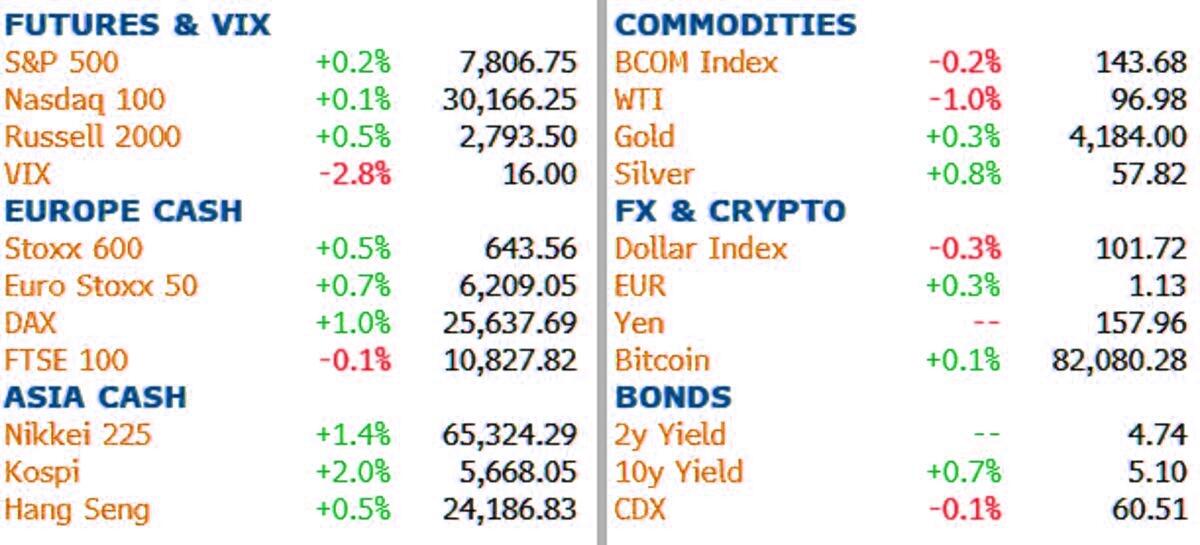
US futures are higher, and small caps are leading, as the crowded-trade unwind that hammered chips, momentum and AI baskets all week takes a breather: Fed Chair Kevin Warsh said nothing about rates at the IMF gathering in Bangkok overnight (traders took the silence as a dovish gift, cutting October hike odds to 14% from 26%), Tesla jumped 5% after Musk unveiled his “flying” Roadster, and oil slipped after Trump said Iran had asked for a halt to US attacks but then it rebounded when the market realized Trump is just lying; as a result haven demand faded and the global bond rally stalled, with 10Y yields rising 6bps to 5.12%. As of 8:00am ET, S&P futures are 0.1% higher at 7,800, Nasdaq futures are down -0.2% and Dow futures are -0.2%; Russell 2000 contracts are up 0.5%. Yesterday the S&P rose 0.3% and closed within 1% of its record high after Jensen Huang rode to CoreWeave’s rescue, even as the SOX fell for a 7th straight day and the Nasdaq barely eked out a gain. Premarket, all Mag 7 names except Amazon are higher led by Tesla, while CoreWeave (-3.9%), Strategy (-2.9%) and Netflix (-2.5%) lag and the AI baskets (semis and memory) remain in the red per JPM. The day’s driver is Warsh (or rather what he didn’t say): with the blackout starting Saturday, the Fed chair declined to push back on rate expectations and instead talked up a “massive investment surge” from AI. In rates, Treasuries slide with a mild bear steepening (2s flat, 10s +4bps, 30s +3bps per JPM) as the rebound in global stocks clips the haven bid; bunds and gilts are also lower by about 15 ticks with UK banks in focus after reports Chancellor Healey will raise their taxes. In FX, the Bloomberg Dollar Spot Index drops 0.4%, down a second day, with the kiwi and Aussie leading G10 and the euro set to end a five-week losing run. In commodities, WTI is down 1% near $97 and Brent trades around $105 but is still headed for a second weekly gain; gold is up 0.3% at $4,184, silver gains 0.8% and copper rises 1% in London. Crypto is mixed: Bitcoin is little changed around $82,000 while Ether bounces. US economic data slate includes September import/export prices (8:30am), industrial production and capacity utilization (9:15am), the federal budget balance (2pm) and August TIC flows (4pm); Fed speaker slate includes Goolsbee on Bloomberg TV at 6pm, the last word before the blackout. There are no coupon auctions, but Treasury’s primary dealer questionnaire (noon ET) ahead of the Nov. 4 refunding is worth watching.
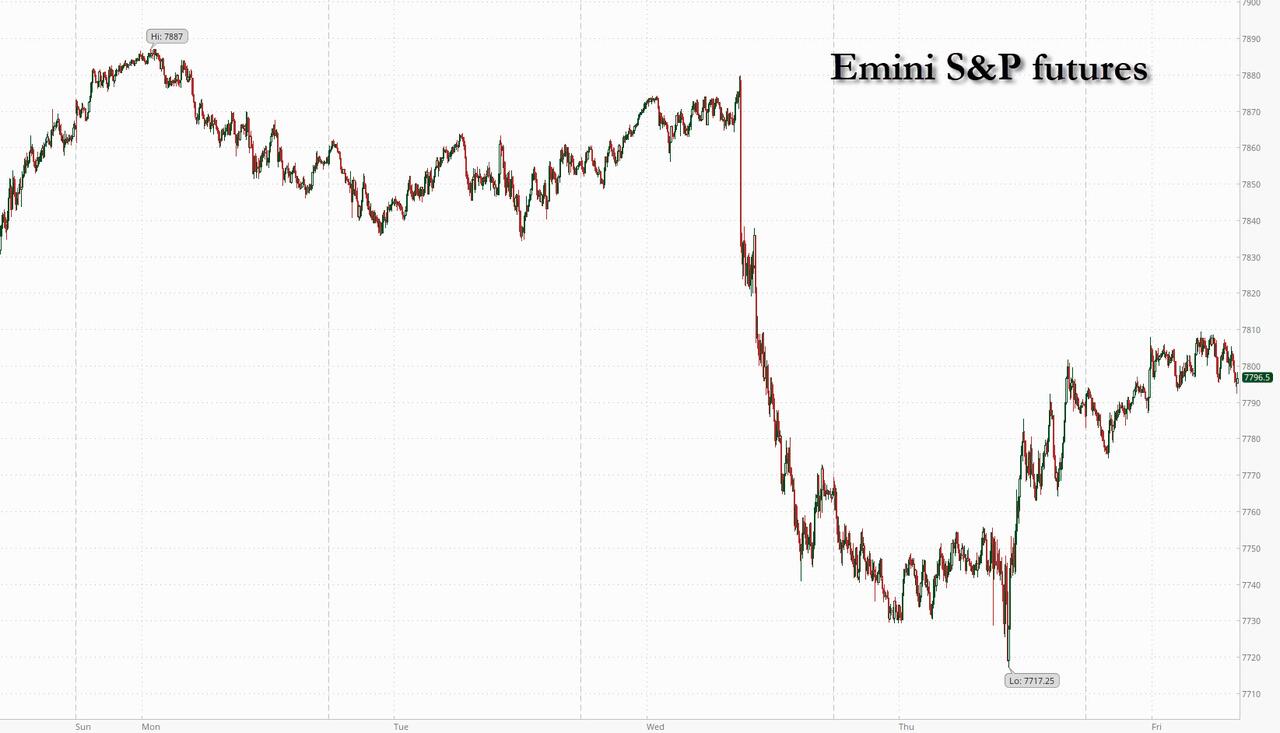
In premarket trading, Magnificent Seven stocks are mostly higher: Tesla rises 3.6% after the EV maker unveiled its long-delayed Roadster sports car (Meta Platforms (META) +0.5%, Microsoft (MSFT) +0.5%, Alphabet (GOOGL) +0.3%, Amazon (AMZN) +0.3%, Apple (AAPL) +0.3%, Nvidia (NVDA) -0.1%)
- Fox Corp. (FOXA) gains 3.9% after BofA upgraded the media company by two notches, to buy from underperform, citing Fox’s deal to buy Roku.
- Mobileye Global (MBLY) climbs 4% as Citi starts coverage on the maker of software and hardware technology for automobiles with a buy rating, expecting the company to benefit from growth in autonomous driving technology.
- Semtech Corp. (SMTC) rises 4.4% after Northland Securities upgraded the company to outperform from market perform, a move that comes in the wake of its analyst day event, where it raised its third-quarter forecast.
- Omeros (OMER) is down 4.1% after the drug developer said an advisory committee of the European Medicines Agency issued a negative opinion on the company’s application for its narsoplimab therapy.
- Travelers (TRV) drops 4.6% after the insurance company reported net premiums written for the third quarter that met the average analyst estimate. Revenue declined modestly year on year, while catastrophe losses rose.
- Truist Financial (TFC) falls 2.1% after the financial services company reported third quarter taxable equivalent net interest income that came in just short of expectations.
- Wise (WSE) falls 2.3% after the payments firm reported cross-border volumes that missed analyst expectations.
Zeta Global (ZETA) is up 4.6% after Goldman Sachs upgraded the software company to buy from neutral, seeing potential for it to gain market share.
In other corporate news, Tesla unveiled its long-delayed new Roadster sports car (yes, the one that “flies”: Newsquawk reports it uses thrusters to land after a ramp jump, does 0-60mph in under a second and enters production in 2028), sending shares of its Chinese suppliers Ningbo Xusheng, Wencan Group and Ningbo Joyson Electronic up 10% each. Thoma Bravo-backed Proofpoint agreed to buy cybersecurity company Varonis Systems for about $6.3 billion, prompting six brokers to cut Varonis to hold-equivalent. Some Anthropic investors discussed a more tempered $1.5 trillion valuation on the back of slowing revenue growth, according to Reuters, confirming our article from yesterday. Netflix is replacing its chief creative officer with veteran TV and film executive Peter Rice, Meta made one of its new AI models available for developers to download and modify, Mercedes-Benz and Nvidia extended their automated driving partnership, and City Therapeutics raised $200 million in a US IPO priced at the mid-point of its range. Meanwhile, three CoreWeave co-founders have sold $3.3 billion in shares since last year’s IPO, which may explain why they look so relaxed.
After a brutal few sessions for crowded pockets of the market, including chips, momentum stocks and popular thematic baskets, futures point to a mild recovery in the final trading day of the week, Bloomberg’s Before the Bell notes. Europe is on track for its biggest weekly outperformance over the S&P 500 since March as investors rotate out of the AI trade, and Asian stocks rebounded as dip buyers returned to chipmakers after a four-day selloff. The relief comes after quants suffered their worst day since August and hedge funds dumped AI stocks at the second fastest pace in a year.
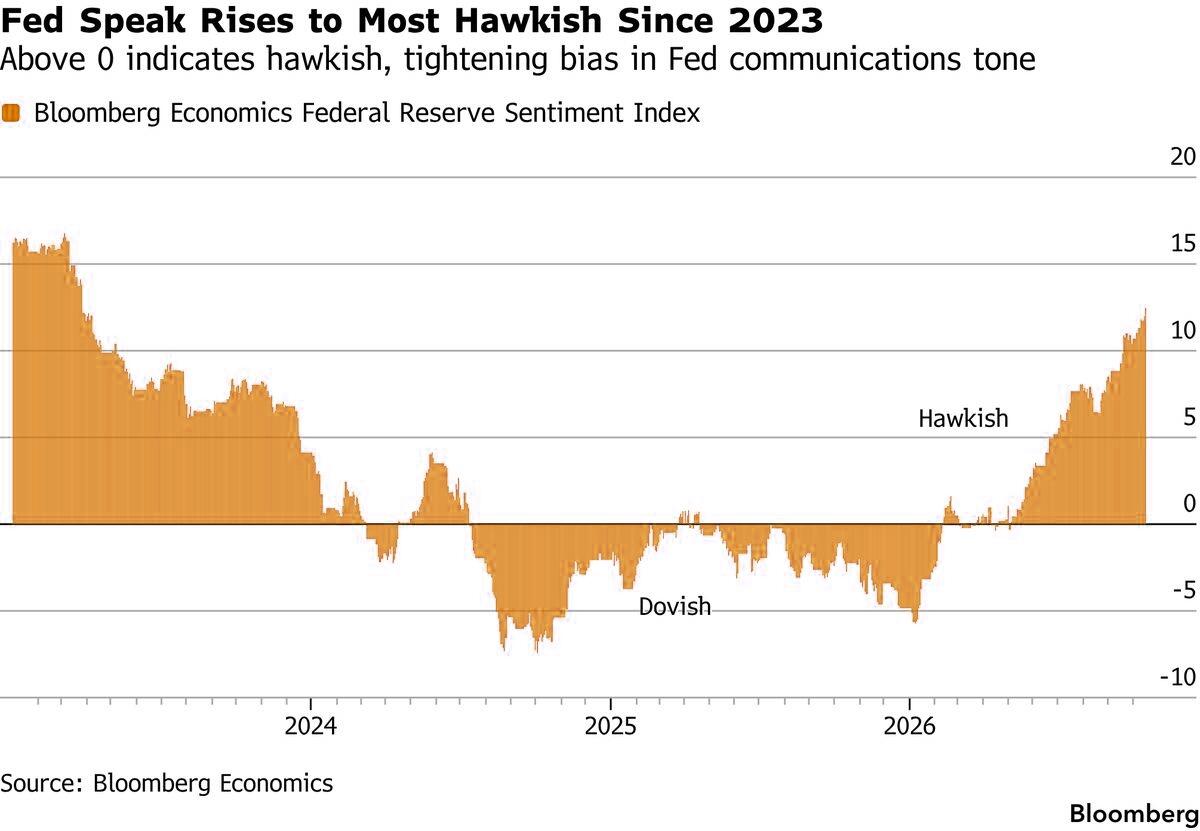
The overnight catalyst was Warsh, and the most important thing was what he didn’t say. With the Fed about to enter its blackout ahead of the Oct 27-28 FOMC, the Chair declined to push back on market pricing despite this week’s hot CPI and PPI, saying only that since September “the world has broadly conformed to our expectations.” Goldman’s economists read this as a signal that the FOMC is set to pause in October, while still expecting a second and final hike in December. That is the punchline even though Bloomberg Economics’ Fed Sentiment Index, which tracks the tone of Fed communications, continues to rise and is now at its most hawkish level since 2023 after Daly and Hammack warned about overlapping, long-lived supply shocks.
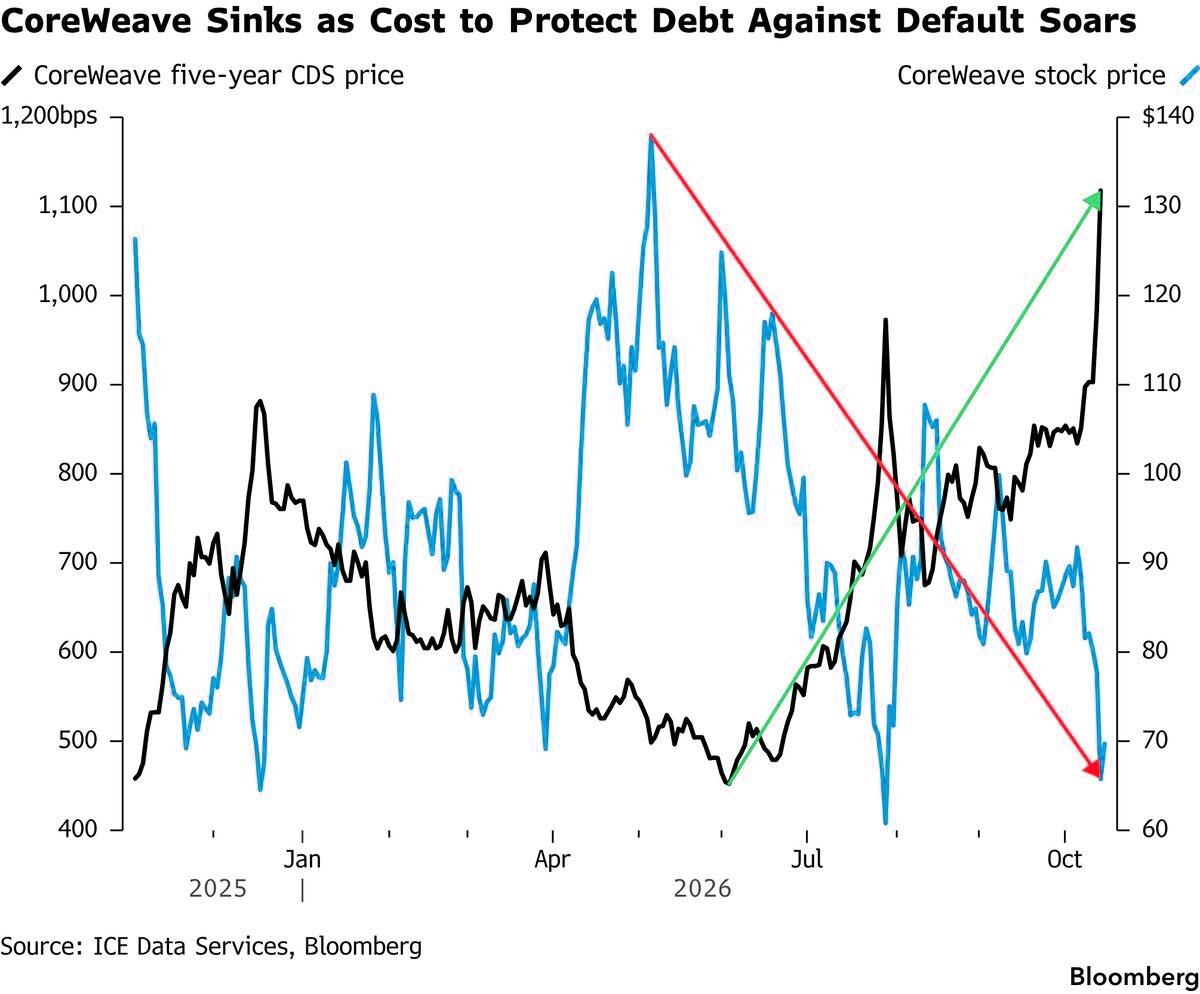
Then there is CoreWeave, which has become ground zero in a tug of war between investors who see rising bond yields as a potential rally killer for the AI trade and those who think compute demand will outweigh such concerns. As DB’s Jim Reid recaps, CoreWeave’s 5Y CDS initially widened another 76bps to 1194bps, its widest level yet, before ending 30bps tighter at 1086bps once Jensen Huang declared that “CoreWeave’s strength is improving every day” (we discussed the credit fallout here and here). The stock is down another 3.9% premarket.
“Today’s rebound is partly a relief rally,” said Billy Leung, an investment strategist at Global X Management. “I’d be cautious about extrapolating today into a straight-line recovery. The fundamental AI/semiconductor story in Asia remains strong, but oil and US yields remain important constraints, so the market probably stays volatile and increasingly earnings-driven.”
The flow data shows a variety of trends: cumulative flows into tech funds are tracking a record year, according to BofA citing EPFR data, and leveraged ETF AUM is off its highs but still elevated, while the long-dated Treasury ETF has seen consecutive $1 billion outflows for the first time ever. And for those worried about narrow leadership, Bloomberg’s historical analysis suggests thinner, leader-driven advances have often been followed by gains, particularly over the subsequent six to 12 months.
JPM’s Market Intel desk under Andrew Tyler stays Tactically Bullish and sees “stabilization in price action” with RTY leading. The team argues that this week’s price action looks more like rotation than broad-based deterioration, flagging the resilience of the equal-weight S&P, and expects the rotation to slow rather than end abruptly; it remains focused on selective dip-buying, likes Financials after generally positive large-cap bank earnings, and says all eyes are on next week’s META earnings and Nvidia’s GTC event. JPM’s ETF desk (Jonathan Rogerson) notes the retail dip-buying impulse is “in full force”: SOXL has taken in $3.2 billion over two sessions (16% of AUM created), while heavy supply in Ethereum ETFs carries “a strong scent of profit-taking.”
Over at Goldman, Delta One head Rich Privorotsky calls the Asian bounce “a little lackluster relative to the scale of the selloff” and warns that “the problem remains oil, which is stubbornly high.” He adds that “rates are finally beginning to reflect the same AI capex growth shock that equities have spent the week repricing.” Sean Vogel’s flows and positioning note puts it more bluntly: “In hindsight, the pain trade was long AI/ short bonds. Now we’re watching both sides unwind.” The data back that up: GS Prime’s AI long/short ratio has fallen to 3.27 from a 4.34 peak (7th percentile over the past year), and NDX forward P/E is down to about 21x, the lowest since the AI cycle began in 2023. Sam Dunn on the US desk sums it up: “The AI trade is still long but now a 6 out 10 in terms of length and much cleaner than it was in Jun/July.”
Elsewhere, China proposed adding advanced AI technologies to its export-control list, potentially restricting overseas transfers of AI models and chips, while Taiwan will curb AI chip exports to China as part of its US trade deal, and Beijing moved to prop up its own stock market by urging companies and state funds to buy shares while guiding some investors to curb selling. In the Gulf, CENTCOM confirmed that a container ship that sank in the Strait of Hormuz this week was struck by an Iranian projectile, Iran’s navy said a “violating” tanker caught fire in a restricted zone east of Hormuz, and Trump declined to rule out using the “Mother of all Bombs” on Iran after the midterms, even as he said Tehran had asked for a halt to US attacks.
In Europe, the Stoxx 600 rises 0.6% to 643.72 with 471 members up and 122 down, heading for a third day of gains; media and autos are the best performing sectors while health care is the only one in the red. The DAX leads with a 0.9% gain and cyclicals do the heavy lifting, while the FTSE 100 lags as UK banks slide after Bloomberg reported Chancellor Healey will raise taxes on banks (the Guardian says via a 3% increase to the bank surcharge): Lloyds is down 2.3% (also cut at RBC) and NatWest 2.1%, while HSBC and Barclays are little moved. JPM’s desk says Defense, Renewables, Software and Momentum Short are among the best performing baskets. Here are the biggest European movers:
- Nestle shares rise as much as 1.5% after JPMorgan upgrades the stock to overweight, saying FY27 could be a “vintage year” for the consumer goods company.
- Aixtron shares rise as much as 10% after the chip-equipment maker reported preliminary orders well above analyst expectations.
- Nordex shares rise as much as 15% after the wind turbine manufacturer posted third-quarter earnings that smashed expectations and raised its margin goal for the full year.
- Verbio shares rise as much as 11% as Jefferies upgrades the German biofuels manufacturer to buy from hold, saying the company is increasingly attractive now that its investment phase is largely behind it.
- Brunello Cucinelli shares rose as much as 6.2% after the Italian luxury firm reported third-quarter earnings that beat expectations and raised its growth guidance for the year.
- Man Group shares gain as much as 3.3% after the UK investment firm reported stronger-than-expected inflows for the third quarter, with growth across both alternative and long-only strategies.
- Avanza shares declined 5.3% after the lender reported operating income for the third quarter that missed the average analyst estimate.
- Wise shares drop as much as 2.7% after the payments firm reported cross-border volumes that missed analyst expectations.
- Lloyds Banking Group shares fall as much as 2.7% after RBC Capital Markets downgraded the UK lender to sector-perform from outperform, noting that competition in the regional deposit market threatens to erode the benefits of its structural hedge.
Asian stocks rebounded, led by chipmakers after a four-day selloff on concerns over the AI boom, with the MSCI Asia Pacific Index jumping as much as 1.8% (Samsung, SK Hynix, BHP and Alibaba the biggest contributors), though the gauge was still on track for its worst weekly loss in more than three months. Japan’s Topix and Nikkei both rose 1.9%, the Hang Seng gained 1.2% and the CSI 300 0.8% as state-backed buying returned with a record 18.8 billion yuan inflow into the E Fund CSI 300 ETF on Thursday, Taiwan’s Taiex added 0.7% and the ASX 200 1.1%. Korea’s Kospi, which tumbled nearly 8% on Thursday, climbed as much as ~4% and closed 2% higher at 5,668. TSMC slipped despite better-than-expected results and a strong outlook, a sign that tech sentiment remains fragile. The outlier was Indonesia, where the JCI plunged 11%, the most since January 1998, after MSCI proposed reclassifying the country from emerging-market to standalone-market status; Goldman’s GIR estimates outflows of $5.0 billion to $7.8 billion depending on the scenario, and IndoGBs sold off 30bps. Goldman’s Asia desk (Enna Hattori) dubbed it a “soft bounce”, with flows finishing only 1.2x better to sell, and cautioned that the market “will require some fundamental reassurance before being able to regain MTD losses.”
In FX, the Bloomberg Dollar Spot Index is down 0.4%, falling a second day, as traders pare bets on an October Fed hike after Warsh steered clear of any policy signals. Risk-sensitive currencies lead G10, with NZD/USD up 0.9% and AUD/USD up 0.6%; the euro rises 0.2% to around 1.1245 and is set to end a five-week losing run (ING’s Francesco Pesole sees it largely confined to a 1.10-1.15 range in the coming months), and the pound hit a three-week high of 1.3337 despite the bank tax story. The yen is flat around 157.9 per dollar. In EM, Bank Indonesia intervened to support the rupiah as the MSCI shock fuels bets on a rate hike, a few days after Asian central banks dumped dollars to defend their tech currencies.
In rates, Treasuries slide, led by the long end, as the rebound in global stocks reduces the appeal of haven assets and Warsh’s comments did little to alter the rate outlook; 10-year yields are up 5bps at 5.11%, with 2s little changed and the curve bear steepening, unwinding part of Thursday’s 12.7bp bull flattening rally which came in spite of a PPI print that was the hottest since March 2022 (because when AI capex gets wobbly, inflation apparently stops mattering). Money markets now price a 14% chance of an October hike, down from 26% earlier. European bonds are also weaker, with bunds and gilts down about 15 ticks; gilt traders are looking for clues on how Chancellor Healey will balance spending and revenue ahead of the Oct. 28 Budget, with a bank tax the latest idea. There are no coupon auctions today, but at noon ET Treasury releases its primary dealer questionnaire ahead of the Nov. 4 refunding, and some on the Street expect 20Y and 30Y auction sizes to be cut by $3 billion each (with speculation the 20Y could be cut altogether).
The short-lived nature of the Treasury rally suggests that the safe-haven status of US bonds is continuing to wane, said Steven Barrow, head of G10 strategy at Standard Bank.
In commodities, crude is on the back foot, with WTI Dec’26 down 1.2% near the bottom of a $95.29-96.39 range and Brent Dec’26 down 0.8% within $104.91-105.94, after Trump said Iran had asked for a halt to US attacks and that negotiations are ongoing; the IEA also said member countries agreed to complete the release of 100 million barrels still outstanding from the March intervention. Even so, oil is set for a second weekly advance as mounting Middle East supply risks outweigh the reserve release: Iran’s navy said a “violating” tanker caught fire east of Hormuz, Saudi Arabia and the Houthis continue to trade strikes, and Ukraine has resumed attacks on Russian refineries. Spot gold trades in a $4,147-4,189 range and eyes its 21-DMA near $4,200, silver is up 0.8% at $57.82, and LME copper gains 1% toward $14,500/t as sentiment improves.
US economic data slate includes September import/export prices (8:30am), industrial production and capacity utilization (9:15am), the federal budget balance (2pm) and August TIC flows (4pm). Fed speaker slate includes Goolsbee on Bloomberg TV (6pm) ahead of the communications blackout that begins Saturday. Travelers, Truist, M&T Bank, Citizens Financial and Regions report before the open.
Market Snapshot
Top Overnight News
- Federal Reserve chair Kevin Warsh has signaled that hotter-than-anticipated inflation has not swayed his views on the US economy, prompting traders to further scale back bets on a rate rise this month. FT
- Goldman economists say Warsh’s comments indicate the FOMC is set to pause in October; they continue to expect a second and final hike in December. GIR
- President Donald Trump said he would not use nuclear weapons against Iran, telling Newsmax that the U.S. “doesn’t have to.” Trump also said he did not foresee sending U.S. ground troops into Iran. CNBC
- Iran’s Navy identified a “violating” oil tanker “a few hours ago” that caught fire in a restricted zone east of the Strait of Hormuz, state-run IRIB News reports; the tanker had turned off its tracking systems. BBG
- US Central Command confirmed that a container ship that sank in the Strait of Hormuz this week was struck by an Iranian projectile; Trump declined to rule out using the “Mother of all Bombs” on Iran after the midterms. BBG
- The US is considering moves to ease restrictions on “shadow fleet” tankers linked to Russia and Iran as it struggles to bring down soaring diesel prices ahead of November’s midterm elections. FT
- The International Energy Agency said member countries agreed to complete the release of 100 million barrels of oil still outstanding from an intervention in March. BBG
- China moved to stabilize its equity market by urging companies and state funds to buy shares while guiding some investors to curb selling, people familiar with the matter said. Financial regulators held a meeting Thursday to discuss stabilization measures for the stock market. BBG
- Taiwan is preparing to tighten export controls on AI chips to further align with US restrictions, according to a senior official in Taipei, joining a Trump administration clampdown on the smuggling of cutting-edge semiconductors to China. BBG
- China proposed adding advanced AI technologies to its export-control list, potentially restricting overseas transfers of AI models and chips. BBG
- Indonesian stocks suffered their worst rout in nearly three decades after MSCI warned the country’s emerging-market status is at risk, stoking fears of removal from global indexes and foreign capital flight. BBG
- Ukraine’s resumption of strikes on Russian refineries is a ‘disgrace’ that keeps global energy prices elevated, US President Donald Trump said. Ukraine struck a Russian oil refinery after President Volodymyr Zelenskiy declared that Kyiv was abandoning a ceasefire covering energy sites that Trump had announced, and criticized his willingness to strike deals with Moscow. RTRS
- Progress toward a U.S.-Mexico tariff deal has stalled after opposition from Commerce Secretary Howard Lutnick, people familiar with the talks said, the second time that he has had a hand in upending advanced negotiations with a North American partner. WSJ
- PM Mark Carney urged Albertans to reject separatism in an Oct. 19 referendum, calling national unity critical. The province will vote on whether to remain in Canada or start a process that may lead to secession, subject to a second ballot. BBG
- UK Chancellor Healey will raise taxes on banks, likely by increasing the bank surcharge; UK lenders fell in early trading. BBG
- Three CoreWeave co-founders have sold $3.3 billion in company shares since last year’s IPO. BBG
- Some Anthropic investors discussed a more tempered $1.5 trillion valuation on the back of slowing revenue growth. RTRS via BBG
- JPM Econ (Abiel Reinhart) keeps its September core PCE forecast at 0.31% m/m (3.1% y/y) after PPI; GS raised its estimate to 0.34%. JPM/GIR
- US President Trump is to deliver remarks in Dalton, Georgia at 14:45 EDT/19:45BST on Friday.
- US President Trump said no real reason for him to go to Maine and thinks he will go to Minnesota, while he said he is not involved in that when asked regarding probe into Democrat Rep. Omar.
- Japan is to sidestep 3.5% defence spending target despite US pressure: Asahi
- US President Trump said he will be going to Iowa state on Thursday, October 22nd and Sunday, November 1st.
A more detailed look at global markets courtesy of Newsquawk
APAC stocks were mostly higher as global markets regained composure following the recent tech bloodbath. Elsewhere, Indonesian stocks are the outlier with double-digit percentage losses as the MSCI consults on a proposal to reclassify Indonesia from Emerging Market to a Standalone Market Status. ASX 200 gained with the upside led by tech and miners, while recent weak jobs data also supported the case for a pause from the RBA at the next meeting. Nikkei 225 recouped some of the losses from the prior day’s turmoil. KOSPI outperformed but still has far to go after falling by as much as 8% yesterday. Hang Seng and Shanghai Comp conformed to the broad recovery in risk assets, while PBoC Governor Pan also recently reiterated that China would maintain a moderately loose monetary policy.
Top Asian News
- South Korean Finance Minister and Central Bank Governor held a meeting with the Fed and US Treasury Department.
- China is reportedly moving to lift the stock market with selling curbs and buybacks, Bloomberg reported.
- Japan’s Finance Minister Katayama said can’t comment whether we would need extra budget or not, adds even if needed, the extra budget would be limited to urgent policy priorities.
European bourses (STOXX 600 +0.5%) have an upward bias to start the final trading session of the week, with cyclical-heavy indices outperforming as tech rebounds from this week’s losses. Sectors highlight the positive bias. Autos lead, with Media and Telecoms following closely behind. To the downside resides Health Care, as the only sector in the red. UK banks are under pressure this morning after Bloomberg reported that UK Chancellor Healey will raise taxes on banks. The report follows a Guardian source stating that the proposal includes a 3% increase to the bank surcharge. Lloyds (-2.3%) and NatWest (-2.1%) are under the most pressure, while Barclays (-0.2%) and HSBC (+0.5%) are little moved given its large international business. US equity futures follow their European peers. Tesla (+5%) is getting a boost pre-market as it unveils its flying car, while Strategy (-2.4%) falls after MSCI announces new screening methodology that targets companies holding digital assets. Tesla (TSLA) Roadster uses thrusters to land after ramp jump, while Roadster can accelerate 0-60Mph in less than 1 second, while it will enter production in 2028.
Top European News
- UK Ofcom proposes to cap Second Class stamp price for a further year, until March 2028.
- Chinese Finance Minister met with the EU Economy Commissioner Dombrovskis, ECB President Lagarde and Eurogroup President Pierrakakis. Chinese side is willing to give full play to the role of China-EU financial dialogue and other mechanisms with the EU side.
- Germany’s Finance Minister said he is not against China, China is an important partner, but is not playing by the rules and we should not be naive.
- Rio Tinto (RIO LN) CEO said that they are looking to build commodity trading capabilities.
FX
- Snapshot: G10s are firmer against the broadly lower USD this morning. Antipodeans lead, benefiting from the risk tone, whilst the JPY holds towards the bottom of the pile, but still remains flat.
- USD continues the prior day’s downside, which stemmed from AI-debt concerns and lower yields. Also fuelling the downside this morning is a speech from Fed Chair Warsh, where he ultimately provided no forward guidance ahead of the October meeting; as such, money markets pared back their bets of an October hike (now 14% vs 26% earlier). The docket for the remainder of the day remains exceptionally light aside from US Import/Export Prices and Industrial Production.
- GBP is a touch firmer this morning, benefiting from the softer USD a little more-so than peers. Focus remains on the looming UK Budget (Oct 28), where source reports have generally been welcomed by markets. The latest was via Bloomberg, which suggested that Chancellor Healey could raise taxes on banks. The source adds that the move will likely involve increasing the bank surcharge that it added on top of the standard corporation tax rate. It seems as if markets are taking the potential tax on banks as a reliable way to improve the fiscal situation, without having a significant impact on growth.
Central Banks
- Fed Chair Warsh said he may be over-scarred from the Global Financial Crisis, adds since September FOMC, world has broadly conformed to our expectations. Will be crystallising what is happening to output, employment and inflation. We will be meeting a couple more times this year, which will be the crystallising moment. Right now, we have structural growth and an investment surge. Obviously, the Fed’s policies spill over to the rest of the world, but their policies spill back to the US too. Will make judgements at the October and December meetings. At the Fed, we made clear that we would deliver price stability; I do not believe in prejudging meetings. Do not prejudge meetings. Do not believe in signalling what I might do at meetings for the rest of 2026. AI is going to hit the demand side of the economy before the supply shock. AI will help central banks have confidence in data and monetary policy. AI will change the real economy, but near-term impact on employment is uncertain. AI will make economy more productive, more wealth, but path to them will be a bumpy one.
- Fed’s Goolsbee (2027 voter) said it’s a discouraging month regarding inflation and still feel some optimism if drivers of inflation can go away in short order, if inflation is from overheating demand from AI, that’s more disturbing and have to address it.
- Fed’s Hammack (2026 voter) said hearing more from lower-income Americans struggling with inflation, adds anecdotal information provides important economic guidance. Businesses are seeing a lot of input cost price pressures. Worries about formation of inflation mentality. Formation of inflationary mindset might force more aggressive Fed policy action. Hard to know what a neutral rate is. Financial conditions do not appear restrictive right now.
- BoJ Governor Ueda said underlying inflation is approaching 2% and the BoJ will continue to raise policy rate in accordance with economic, price and financial developments. There is a risk of underlying inflation overshooting 2% price target.
- ECB’s Wunsch said further tightening would be reasonable given persistent inflation pressures and the resilient EZ economy. Inflation is running at almost 4%, domestic inflation stands at 3% and energy prices are likely to remain elevated for longer than previously expected. Not committing to anything due to the high degree of uncertainty. Market pricing of three rate hikes seems reasonable.
- ECB’s Nagel said Germany is getting fit for the challenges of the future and a fitness program of reforms is always important. Regarding bond market, Germany will remain the anchor of stability in Europe.
- ECB’s Rehn said growth outlook is better today than start of the year, adds not seeing second-round effects on inflation. Labour market not as tight, wage moderation ongoing. Must show vigilance on inflation outlook.
- BoE Governor Bailey said it’s too early to form strong views on strength of second round effects. So far signs of second round effects are subdued and businesses emphasizing cost cutting. UK economy is more resilient than we expected and not as strong as we need. News from Middle East is the biggest factor moving UK gilt yields. Second-round inflation pressures look subdued so far. More hopeful than a month ago that they will get more international alignment on AI testing.
- RBNZ Chief Economist Conway said there is reasonable confidence that inflation has not become broad-based and that rate hikes help contain spillovers from an energy shock.
- PBOC’s Pan said that the PBOC is to support offshore CNY markets development; to further expand liquidity management tools.
- PBoC injected CNY 60bln via 7-day reverse repos with rate kept at 1.40%.
- PBoC set USD/CNY mid-point at 6.7220 vs exp. 6.6947 (prev. 6.7253).
- Bank of Canada Governor Macklem said Canada hasn’t raised rates yet, but the longer it goes, the harder it is to look through increases in energy prices.
Fixed Income
- Fixed income benchmarks are a touch lower to start the final trading session of the week. USTs essentially flat, and look set to end with weekly gains despite a hotter CPI and PPI print this week, as Fed Chair Warsh fails to provide little guidance. As such, money markets pared back their bets of an October hike (now 14% vs 26% earlier).
- Focus will be on the US Treasury primary dealer questionnaire, expected at 17:00BST/12:00EDT, ahead of the QRA on November 4th. Some analysts expect the Treasury to cut both 20-year and 30-year auction sizes by USD 3bln each, and to be replaced by T-bills. To add, there has also been speculation that the 20-year could be cut altogether.
- Gilts and Bunds trade in tandem, posting losses of around 15 ticks.
- Focus for Gilts this morning, and heading into the Budget, is on any clues to how Chancellor Healey chooses to balance spending with income. The latest being focused on the banking sector, with Bloomberg reporting that UK Chancellor Healey will raise taxes on banks. The report follows a Guardian source stating that the proposal includes a 3% increase to the bank surcharge.
- Australia sold AUD 1bln in 3.25% April 2029 bonds, average yield is 4.8238%, bid to cover of 4.89.
Commodities
- Crude benchmarks are on the backfoot, with mild underperformance in the WTI Dec’26 (-1.2%) vs Brent Dec’26 (-0.8%). The former currently holds towards the bottom end of a USD 95.29-96.39/bbl range, whilst the latter sits within a USD 104.91-105.94/bbl range. The mild underperformance seen in WTI is likely a bit of an unwind following yesterday’s relative outperformance, on the back of large weekly US headline inventory and as the US Treasury extended a sanctions waiver allowing Lukoil petrol stations to operate within the US.
- The geopolitical environment remains tense on three major fronts: 1) The US-Iran situation remains unresolved, though President Trump did mention that Iran requested a halt to attacks and that negotiations are ongoing. A factor which is likely weighing on the complex this morning. 2) Saudi Arabia and the Houthis continue to strike each other, and 3) Russia and Ukraine have continued to strike energy facilities, despite Trump’s announcement of an energy ceasefire.
- Spot gold currently trades within a USD 4,147-4,189/oz range, continuing to build on the prior day’s gains; the yellow metal now eyes its 21-DMA at USD 4.2k/oz. Strength today is facilitated by a slightly softer USD, which comes after Fed Chair Warsh avoided any guidance surrounding the October confab, which saw a slight paring of tightening bets.
- Base metals are rebounding from recent losses as global sentiment improves. 3M LME Copper (+1%) currently trades at the upper end of a USD 14,296-14,482/t range, and now eyes USD 14.5k/t.
- South Korea is reportedly to extend oil fuel price cap for another four weeks.
- Russia and Iran is reportedly discussing gas pipeline route and pricing, TASS reported.
- Japanese Chief Cabinet Secretary Kihara said Japan expects October crude procurement to be at the same level as last year.
- China set 2027 corn import tariff quota at 7.2 mln tons and wheat import tariff quota at 9.64 mln tons.
Trade/Tariffs
- China’s MOFCOM is to revise the “Catalogue of Technologies Prohibited and Restricted from Export in China,” and temporary registration management will be implemented for the export of related technologies.
- Taiwan is to curb AI chip exports to China as part of the US trade deal, Bloomberg reported. Servers and high-end chips will be added to the controlled items list.
- France is said to have agreed to support UK inclusion in the bloc’s proposed “Made in Europe” legislation, although Britain would need to align with the EU’s approach to tariffs on Chinese EVs.
- Japan is to open anti-dumping probe on Chinese pigments and preparations made from Chinese rutile titanium dioxide.
- US Commerce Secretary Lutnick throws future of US-Mexico trade talks into further doubt as he has objected to significant reductions in tariffs on Mexican steel, aluminum and automobiles, according to WSJ.
Geopolitics: Iran
- US President Trump said wouldn’t use nuclear on Iran, while he is talking to Russia and China regarding denuclearisation, adds may have to go to Pickaxe Mountain and don’t see troops on the ground in Iran. Iran has asked for a halt to US attacks and negotiations are still ongoing.
- IRGC Brigadier General Akraminia said “we have introduced new equipment into our combat formations”, Al Mayadeen reported.
- IRGC Brigadier General Akraminia announces new operational plans to push back more American ships and flee ever further; reiterates that the Army Navy has complete operational control over the Sea of Oman, SNN reported.
- Iranian Army Commander Major General Amir Hatami said three ships entered the Sea of Oman and were fired upon by Iranian forces, severely restricting maritime traffic.
- Iranian Ambassador said that “The United States is not demonstrating serious political will to negotiate with Iran”, Tass reported. Iranian Ambassador to Moscow’s Kazem Jalali.
- US President Trump answered he doesn’t trust anyone when was asked if he trusts Israeli PM Netanyahu.
Geopolitics: Ukraine
- US President Trump said Ukrainian President Zelensky is not a good guy to deal with, adds Zelensky is more difficult than Putin to deal with. He is allowed to do a self-pardon. Plenty of other targets besides refineries to hit. Need an election in Ukraine.
- US President Trump said Ukraine’s resumption of strikes on Russian refineries is a disgrace.
- EU President of the European Commission Von Der Leyen said that they are working on the 22nd package of sanctions against Russia, adding that no sanctions will be lifted unless Russia stops its war.
- Russian forces struck a vessel sailing to Ukraine’s Odessa, according to IFX.
- Temporary restrictions introduced at Pulkovo Airport in St. Petersburg, Russia, according to TASS.
- Ukrainian drones are attacking Russia’s Moscow region and reportedly hitting industrial warehouse facilities.
- Massive fire breaks out in Ukraine’s Khmelnitsky region following a reported strike on a fuel depot.
- US senators are demanding an investigation into disruption of a satellite system supporting Ukraine, according to an Al Jazeera correspondent.
- Order to limit Ukraine’s access to Starshield system came from inside the White House, according to sources.
- Ukraine’s Air Force said jet drones spotted over Kirovohrad region heading west.
- Russian local governor said drones hit industrial facilities in Russia’s Rostov region.
- Russian President Putin said Ukraine failed to grasp consequences of returning to targeting refineries.
Geopolitics: Middle East
- Saudi army conducted missile attack on areas of Amran and Saada provinces in northern Yemen, according to IRNA.
- Yemen Houthi official said Saudi Arabia must answer for the massacre of civilians in Yemen and called for independent international probe into the Saudi war on Yemen.
- Saudi-led coalition noted there 20 Houthi attacks on Riyadh in October and that recent strikes included an attack on King Khalid International Airport that killed 12 on October 10th.
- Explosions reported in the city of Dammam, Saudi Arabia, SNN reported.
- Yemeni armed forces strike military positions in Aden, hitting military operation headquarters managed by Saudi officers which killed four.
- Saudi-led coalition said it intercepted and destroyed a drone launched towards Saudi Arabia’s Eastern Region.
Geopolitics: Other
- Chinese Foreign Minister told Israel’s President promoting peace and reconciliation in the region is the cornerstone of China’s Middle East policy, and China consistently held that the Palestinian question is greatest historical injustice of this century. Immediate priority is to fully open access to the Gaza Strip. Israel should stop and reverse its forced establishment of settlements in the West Bank.
- South Korea asks the US for a tax break for Alaska LNG project, according to Maeil.
- South Korea-US ties are said to be straining over intelligence sharing restrictions, trade disputes, and reduced military cooperation, raising concerns about Seoul’s ability to counter North Korea’s nuclear threat. South Korean President Lee Jae-myung is seeking to rebuild trust with Washington while improving ties with Beijing as trade tensions and potential Trump-Kim talks add uncertainty.
- US Secretary of State Rubio spoke with Israeli PM Netanyahu and spoke with Lebanon’s President Aoun regarding recent developments including the seizure of a truck carrying Hezbollah explosives. Rubio also urged direct military-to-military communication between Lebanese and Israeli forces for deconfliction.
Crypto
- Bitcoin (+1%) and Ethereum (+3%) attempts to rebound from recent losses as the risk tone improves.
US Event Calendar
- 8:30 am: Sep Import Price Index MoM, est. 1.0%, prior 0.7%
- 8:30 am: Sep Import Price Index YoY, est. 8.2%, prior 7.0%
- 8:30 am: Sep Export Price Index MoM, est. 0.9%, prior 0.6%
- 8:30 am: Oct NY Fed Services Business Activity
- 9:15 am: Sep Industrial Production MoM, est. 0.4%, prior 0%
- 9:15 am: Sep Capacity Utilization, est. 76.5%, prior 76.3%
- 12:00 pm: Treasury primary dealer questionnaire (ahead of Nov. 4 QRA)
- 2:00 pm: Sep Federal Budget Balance, est. -$30b, prior $197.94b
- 4:00 pm: Aug Total Net TIC Flows, prior $83.7b
- 4:00 pm: Aug Net Long-term TIC Flows, prior -$27.9b
Central Bank Speakers
- 6:00 pm: Fed’s Goolsbee Speaks on Bloomberg TV
DB’s Jim Reid concludes the overnight wrap
It’s been yet another fascinating 24 hours with CoreWeave 5yr CDS initially widening another 76bps intraday to 1194bps, its widest level yet, before turning around and ending -30bps tighter at 1086bps. This turn around was seemingly sparked by Nvidia CEO Jensen Huang coming to the AI computing company’s defense amid its sharp selloff in recent days. The comments likely contributed to a broad dip buying in Tech seen during the US trading session. The Philly Semi index was down over -4% in early trading before rebounding to closing down “just” -0.88% lower but still for its 7th consecutive loss. 10yr US Treasury yields were down -12.7bps due to the risk-off and yet 378 names in the S&P 500 were higher on the day and the index managed to end up with a +0.33% gain and stay within a percent of its record high. Even the NASDAQ itself pared back its losses, having hit an intraday low of -1.44% at the open, to scrape a slight +0.08% gain. The KOSPI is back up over 4% this morning as well.
Drilling deeper into the continued AI volatility, CoreWeave’s equity also recovered from being down -9.54% at the lows to close up +5.94% yesterday. In terms of other comments from Nvidia CEO Huang, which turned around the session, he noted that “CoreWeave’s strength is improving every day”, before adding “I’m optimistic. Their cost of capital is actually decreasing.” While that is true given when the company issued its current debt, the market is pointing to a higher cost of capital now and increased refinancing costs in the future, so it’s one to continue to watch. I explored some of these moves in more depth in my chart of the day yesterday (link here), which showed that for now at least, AI-linked financing costs aren’t excessive relative to the rest of the credit stack but there are outliers starting to emerge. Indeed, Oracle is the other main outlier and the stock was down -8.83% at the lows yesterday before recovering to close +2.02% higher.
Overnight, Kevin Warsh has just spoken at the IMF conference and perhaps the most important thing was what he didn’t say. With the Fed about to enter its blackout ahead of the October 27-28 meeting, Warsh declined to push back against rate expectations, saying he doesn’t “prejudge meetings”, despite this week’s hotter inflation numbers. Instead, he was strikingly upbeat about the US economy, talking about a “massive investment surge” and the potentially huge productivity benefits from AI. Markets took the lack of hawkishness as good news, with October hike pricing dropping to around 15% from roughly 30% as he spoke, while S&P and Nasdaq futures are both +0.15% higher having been negative for most of the session before he spoke. Stoxx futures are +0.68% higher.
A recovery in Asian equity markets had already been in full force before Warsh but has continued after. South Korea’s chip-heavy KOSPI (+4.28%) is leading gains after tumbling nearly 8% yesterday, a move that pushed the index to its lowest close since April. Elsewhere, the Nikkei (+1.83%) is also trading firmly higher, recovering a portion of Thursday’s steep losses as semiconductor stocks have regained ground. Chinese equities are likewise advancing, with the Hang Seng (+1.25%), CSI 300 (+0.75%) and the Shanghai Composite (+0.95%) all higher. In contrast, Indonesia’s Jakarta Composite is plunging nearly -11.0% in its steepest one-day decline since January 1998 after MSCI proposed reclassifying the country from emerging-market to standalone-market status.
Warsh’s comments overnight actually followed another hawkish round of Fed speakers ahead of the upcoming Fed blackout period. Federal Reserve Bank of San Francisco President Daly said that she had changed her view from earlier this year that the Fed should “look through” supply shocks, saying “Do the conventional pieces of wisdom — where our tool doesn’t really work for supply shocks and they dissipate on their own — does that really apply when the shocks are overlapping and they’re long-lived?” Federal Reserve Bank of Cleveland President Hammack joined her in these concerns, adding that “at some point businesses start building in an expectation that more of these are going to come, and that prices are just going to keep going up.”
However the theme of the day was a big global rate rally, as the prospect of slower AI growth pushed yields lower across the board. So, the 2yr yield (-5.9bps) fell to 4.74%, whilst the 10yr yield (-12.7bps) was down to 5.06%. And this was a global pattern as well, with yields on 10yr bunds (-5.3bps), OATs (-8.5bps) and BTPs (-6.7bps) all falling over the session.
But even as bonds were rallying, a striking feature was it took place despite another batch of hawkish US data. So in other words, AI growth concerns continued to outweigh the inflation impulse when it came to yields. Most notably, there was a huge upside surprise in PPI inflation, with headline inflation up +1.3% in September (vs. +0.6% expected). In fact, it was the strongest monthly jump in producer prices since March 2022, shortly after Russia’s invasion of Ukraine. Moreover, the core measures were also stronger than expected, with the measure excluding food, energy and trade services up +0.5% on the month (vs. +0.3% expected). So as with the CPI, the release helped to fuel concerns that inflation was broadening out beyond energy. Taking into account the PPI and CPI components, our US econ team is projecting a +0.37% monthly increase for PCE.
The hawkish data impulse was also clear in the labour market, as the weekly initial jobless claims also remained low in the week ending October 10, coming in at just 199k (vs. 200k expected). So that kept the 4-week moving average broadly steady at 198.5k, only up slightly from its 198.25k level the previous week. In addition, the retail sales number was also stronger than expected, rising +0.8% in September (vs. +0.3% expected). So with the latest data, that left the Atlanta Fed’s GDPNow estimate at an annualised pace of +3.6% for Q3.
Earlier in Europe, markets put in a relatively stronger performance, as they remained more insulated from the AI-related issues. So the STOXX 600 (+0.38%) actually put in a second consecutive gain, taking the index to a 3-week high. That included particularly strong gains for the FTSE 100 (+1.08%) and France’s CAC 40 (+0.78%), although Italy’s FTSE MIB (-0.72%) was a relative underperformer. In the meantime, gilts saw a relative underperformance, with the 10yr yield only down -5.0bps on the day which came as the UK GDP release for August was stronger than expected. That showed GDP up +0.1% (vs. -0.1% expected), which meant the rolling 3-month growth rate was at +0.7% compared to the previous three months (vs. +0.5% expected).
Looking at the day ahead, and it’s a quiet one ahead. However, we will get data on US industrial production and capacity utilization for September. In the Euro Area, there’s also the final CPI print for September.
Tyler Durden Fri, 10/16/2026 – 08:28
Source: https://freedombunker.com/2026/10/16/futures-rise-as-warsh-stays-mum-tesla-flying-car-interrupts-ai-liquidation/
Anyone can join.
Anyone can contribute.
Anyone can become informed about their world.
"United We Stand" Click Here To Create Your Personal Citizen Journalist Account Today, Be Sure To Invite Your Friends.
Before It’s News® is a community of individuals who report on what’s going on around them, from all around the world. Anyone can join. Anyone can contribute. Anyone can become informed about their world. "United We Stand" Click Here To Create Your Personal Citizen Journalist Account Today, Be Sure To Invite Your Friends.
LION'S MANE PRODUCT
Try Our Lion’s Mane WHOLE MIND Nootropic Blend 60 Capsules
Mushrooms are having a moment. One fabulous fungus in particular, lion’s mane, may help improve memory, depression and anxiety symptoms. They are also an excellent source of nutrients that show promise as a therapy for dementia, and other neurodegenerative diseases. If you’re living with anxiety or depression, you may be curious about all the therapy options out there — including the natural ones.Our Lion’s Mane WHOLE MIND Nootropic Blend has been formulated to utilize the potency of Lion’s mane but also include the benefits of four other Highly Beneficial Mushrooms. Synergistically, they work together to Build your health through improving cognitive function and immunity regardless of your age. Our Nootropic not only improves your Cognitive Function and Activates your Immune System, but it benefits growth of Essential Gut Flora, further enhancing your Vitality.

Our Formula includes: Lion’s Mane Mushrooms which Increase Brain Power through nerve growth, lessen anxiety, reduce depression, and improve concentration. Its an excellent adaptogen, promotes sleep and improves immunity. Shiitake Mushrooms which Fight cancer cells and infectious disease, boost the immune system, promotes brain function, and serves as a source of B vitamins. Maitake Mushrooms which regulate blood sugar levels of diabetics, reduce hypertension and boosts the immune system. Reishi Mushrooms which Fight inflammation, liver disease, fatigue, tumor growth and cancer. They Improve skin disorders and soothes digestive problems, stomach ulcers and leaky gut syndrome. Chaga Mushrooms which have anti-aging effects, boost immune function, improve stamina and athletic performance, even act as a natural aphrodisiac, fighting diabetes and improving liver function. Try Our Lion’s Mane WHOLE MIND Nootropic Blend 60 Capsules Today. Be 100% Satisfied or Receive a Full Money Back Guarantee. Order Yours Today by Following This Link.


| Visits: | 1,835,151,555 |
| Stories: | 8,721,742 |
Whistler Blowers, Insiders

