

People, Power And Politics: Morgan Stanley Maps The Three Ways AI’s $1.6 Trillion Capex Plan Can Collapse

Yesterday we walked through Morgan Stanley’s dollar-by-dollar map of AI’s $1.6 trillion 2027 capex bill, then asked who is going to finance it. Both pieces assume the money actually gets spent. The last part of the report (available to pro subs) asks what happens if it doesn’t.
MS’s public policy strategist Ariana Salvatore frames the main constraints on the AI infrastructure story as “people, power, and politics,” and the downside section works through all three. Spoiler alert: the bank still expects the buildout to happen, just with a growing list of asterisks attached.
The Midterm Wedge
Salvatore doesn’t mince words:
Political pushback, to be sure, has become the wedge issue in the midterm elections, which we think can present a catalyst with respect to this issue and broader AI sentiment.
Her framing has three key pieces:
- No federal pause. Given the national-security framing and a likely presidential veto of restrictive legislation, MS doesn’t expect Washington to stop the buildout. Instead, she sees the midterms laying “the groundwork for potential legislation toward that end in 2029.”
- The binding levers are local. Interconnection, large-load rate design, siting, permitting and tax abatements are all decided at the state level, “which is why governors and utility commissions matter more than Senate races.”
- Incumbents vs. challengers. Because non-incumbent candidates in key races tend to propose tougher restrictions, MS sees sentiment as most constructive under a Republican sweep, broadly neutral under divided government, and least constructive under a Democratic sweep (something we discussed previously).
That last point is worth holding up against what the market has been doing. On Friday we noted that JPMorgan’s “Democrat Factor” has soared 20% as Wall Street prices in a sweep, and we laid out last month what’s likely to be on the target list if Democrats win the House, data centers included. Put the two together and the market is pricing the scenario MS calls least constructive for AI sentiment, with barely two weeks to go.
“No Major Candidate… Is Running As Pro-Data-Center Without Qualifiers”
The report’s most useful contribution is a race-by-race scorecard of every contest that could tighten the rules, from governors to elected utility commissions:
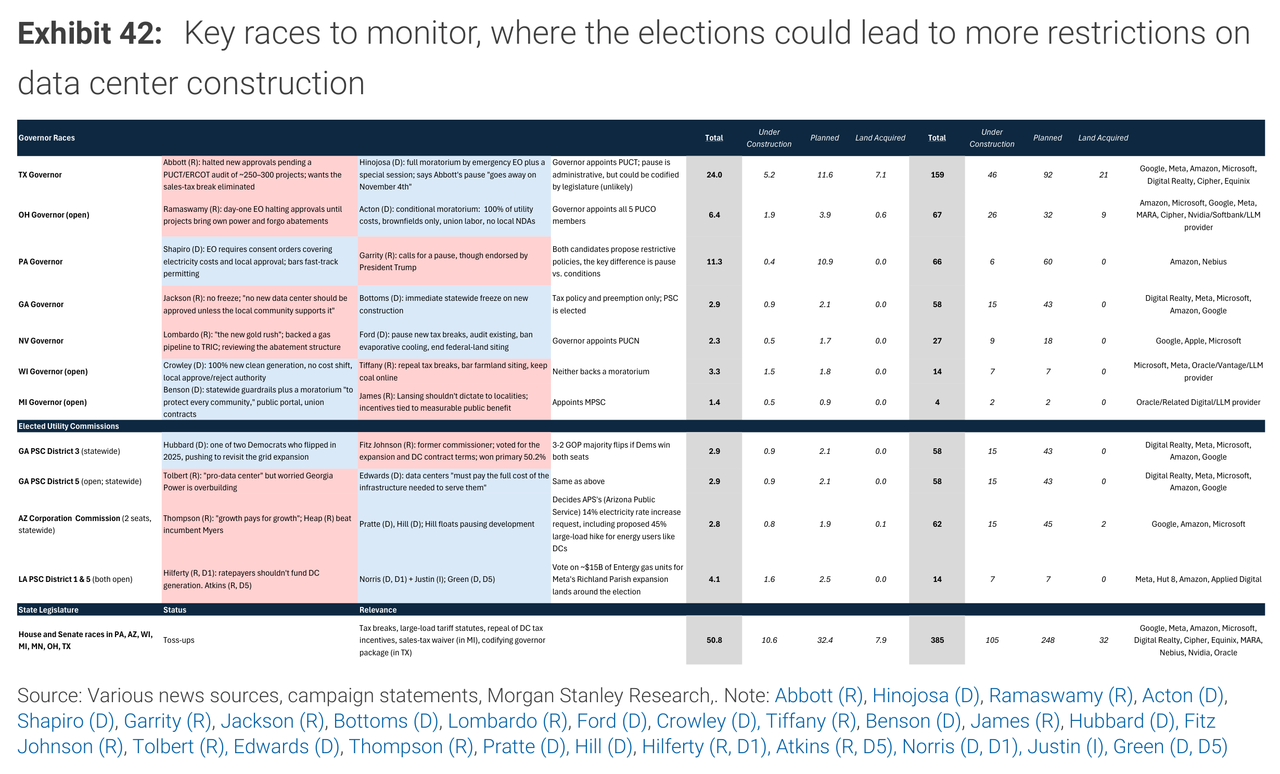
Three takeaways stand out.
- First, the debate has moved from whether to restrict data centers to how: in Salvatore’s words, “the remaining argument is whether to pause development outright or allow it to proceed subject to specific conditions.”
- Second, tax breaks are the consensus target regardless of who wins: Abbott, Tiffany, Ford, Nesbitt and Georgia Republicans have all called for repeal or rollback, and Arizona has already paused its exemption through June 2029.
- Third, the utility commissions may matter most of all, since they “decide the dockets that set cost allocation and approve generation, and those are legally durable.” In Georgia, the 3-2 GOP majority on the PSC flips if Democrats win both seats; in Louisiana, a vote on ~$15 billion of Entergy gas units for Meta’s Richland Parish expansion lands right around the election.
And the stakes are huge. Adding up the capacity in the states MS flags (counting Georgia once), we get almost 60 GW of data centers under construction, planned or on acquired land, with Texas alone at 24 GW and Pennsylvania at 11 GW:
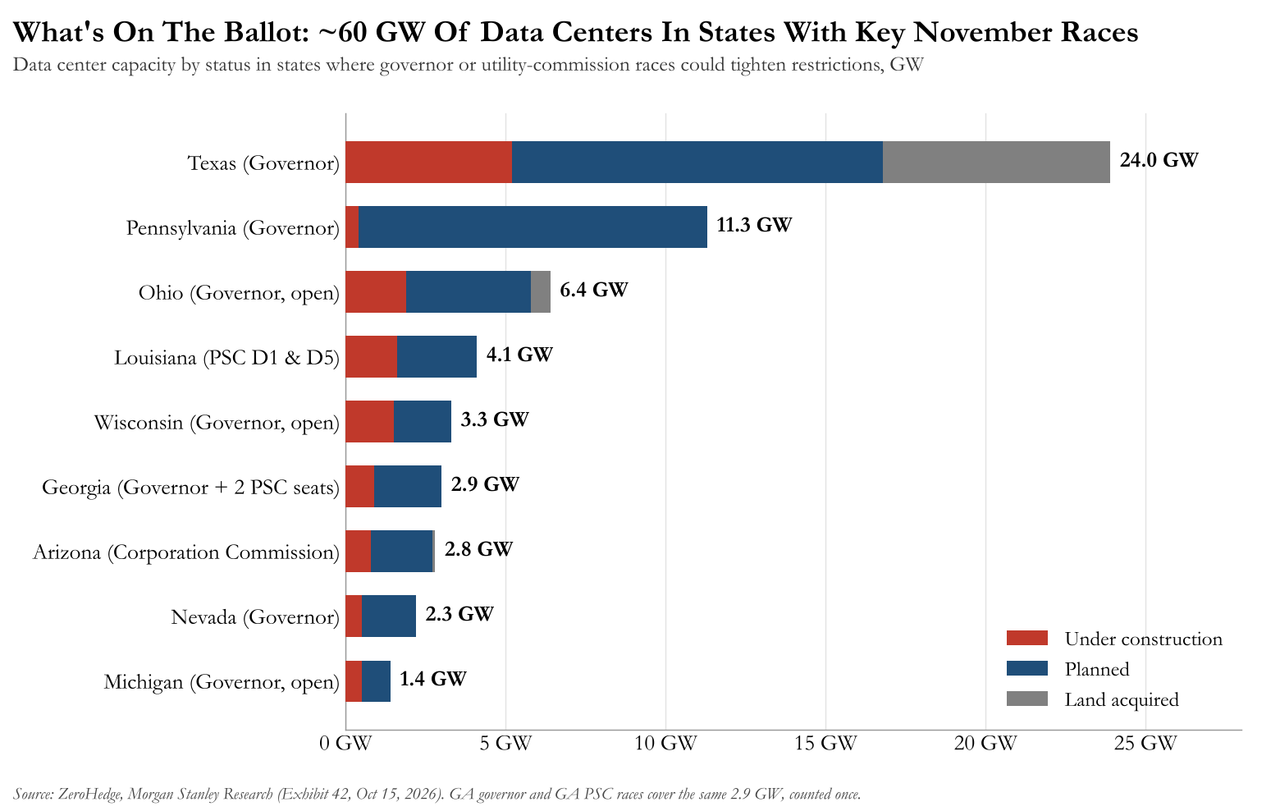
For context, MS’s own forecast has all hyperscalers and neoclouds adding 32 GW of compute capacity in 2027. Texas, where Governor Abbott paused new approvals in early August pending an audit of ~250-300 projects and then ordered a halt to new data centers in September, is a reminder that the incumbents aren’t exactly cheerleaders either. We flagged the math behind Abbott’s decision at the time:
How mathematically impossible is the energy math behind the data center rollout? Just Texas alone is facing 474GW of interconnection requests (ERCOT), of which 90% is data centers. Which is why gov Abbott froze rollout of new data centers in Texas. For context, ERCOT all-time peak demand record is 91.1GW on July 22, 2026, with normal demand between 40 and 80GW. Of course, that’s peak. In a more realistic scenario, Morgan Stanley sees the entire US short about 80-100GW through 2030, or a deficit of about 100 nuclear power plants.
— zerohedge (@zerohedge) August 8, 2026
Meanwhile Ohio, home to AWS, Meta, Google and Microsoft builds, is the cleanest example of both parties converging on restrictions, as we first noted last month:
Ohio is one of the top data center states: AWS, META, GOOGL, MSFT and SB Energy are all building here. Both leading governor candidates, Democrat Amy Acton and Republican Vivek Ramaswamy, said they want new restrictions on the industry. Acton said she supports what she’s calling a “conditional moratorium” on new data center construction. Developers must cover 100% of their own utility costs, build exclusively with union labor, operate with full transparency and meet Ohio’s existing air and water quality standards Ramaswamy also laid out his data center policy, which he calls his “Ohioans-First Data Center Pledge.” His campaign describes the plan as resting on three “non-negotiable” requirements: nearby residents must receive free electricity from data center developers, new facilities must pay their full property taxes with no abatements, with that revenue used to fund property tax rebates for homeowners, and developers must meet strict air and water quality standards while prioritizing brownfield sites over farmland. “If a project fails to meet any one of these three requirements, it will not be built. Period,” Ramaswamy’s campaign states.
— zerohedge (@zerohedge) September 23, 2026
Amusingly, all of this is happening even though only 7% of voters rank data centers as a top issue. It probably doesn’t matter: when it comes to electricity bills, 7% is plenty for a close race.
The Mitigation Playbook
MS remains “constructive on the buildout” because the industry is responding to each of the three pressure points with its own fix:
- Electricity prices: a number of hyperscalers signed the Ratepayer Protection Pledge, promising to build or buy their own generation, cover grid upgrade costs and pay separate large-load rates whether or not they use the power (just don’t ask them to do the math on how realistic it is to get all the pieces together). Congress is moving the same way, with the House passing a bill making data centers cover their own energy costs.
- Water: Google committed to returning more water to local systems than its data centers use by 2030, and Amazon disclosed global data center water use for the first time.
- Quality of life: Meta launched a $1 billion fund for host-community teachers, first responders and infrastructure.
MS’s base case is therefore a “conditional buildout,” preserving the capex but only in regions where community engagement or mitigation works. Translation: the $1.6 trillion still gets spent, but some of it costs more and lands later, which feeds straight into the next two risks.
Volume And Price: “A Compounding Risk”
The second downside risk is the one we think gets the least attention, and Morgan Stanley lays it out as a classic capital-cycle problem. Scarcity drives what the bank calls the “fear of missing procurement”: buyers assume tomorrow’s compute will cost more, so they pay up today, and suppliers stack margins on top. That’s why volume growth and pricing power have reinforced each other. Then the cycle turns:
Once capacity catches up or demand normalizes, the same forward-buying and urgency that inflated prices work in reverse, collapsing pricing power just as suppliers are stuck holding high-cost inventory. It’s the standard capital-cycle playbook, just compressed by how concentrated the hyperscaler customer base is.
Incidentally, that is precisely what we said a month ago:
The more data centers are lit, the faster this bubble pops
— zerohedge (@zerohedge) September 25, 2026
MS’s analog is the late-2022 memory downturn, when NAND shipments fell only ~5% but prices fell 20-30%, crushing supplier margins far faster than volumes alone implied. Applied to AI, “even a plateau (not a collapse)” in hyperscaler capex could leave volumes resilient while pricing and upstream margins evaporate. The bank’s conclusion is blunt: “We think the risk of both volumes and price falling at the same time is underappreciated in the current market.”
This connects directly to a point MS’s memory analysts make elsewhere in the report: Amazon attributed most of its 2026 capex increase to rising memory costs, with no change to its build plan. So a chunk of the capex “boom” is price, and memory is exactly where it would unwind first. Consumers are already feeling the other side of that trade, with global smartphone shipments crashing 22% as the memory crisis squeezes everyone not named Nvidia. And in memory (as in everything else), nothing cures record prices like record prices.
The 32 GW Power Wall
Finally, power, which MS calls “the most tangible risk that we see now.” The $1.6 trillion capex estimate assumes every chip ordered gets powered and put to work. MS’s own Powering AI model says that may not happen: even after time-to-power solutions (nuclear, turbines, engines and Bloom fuel cells), it still sees a 32 GW net US shortfall through 2028, or 34% of the 97 GW needed, and roughly 72 GW through 2029.
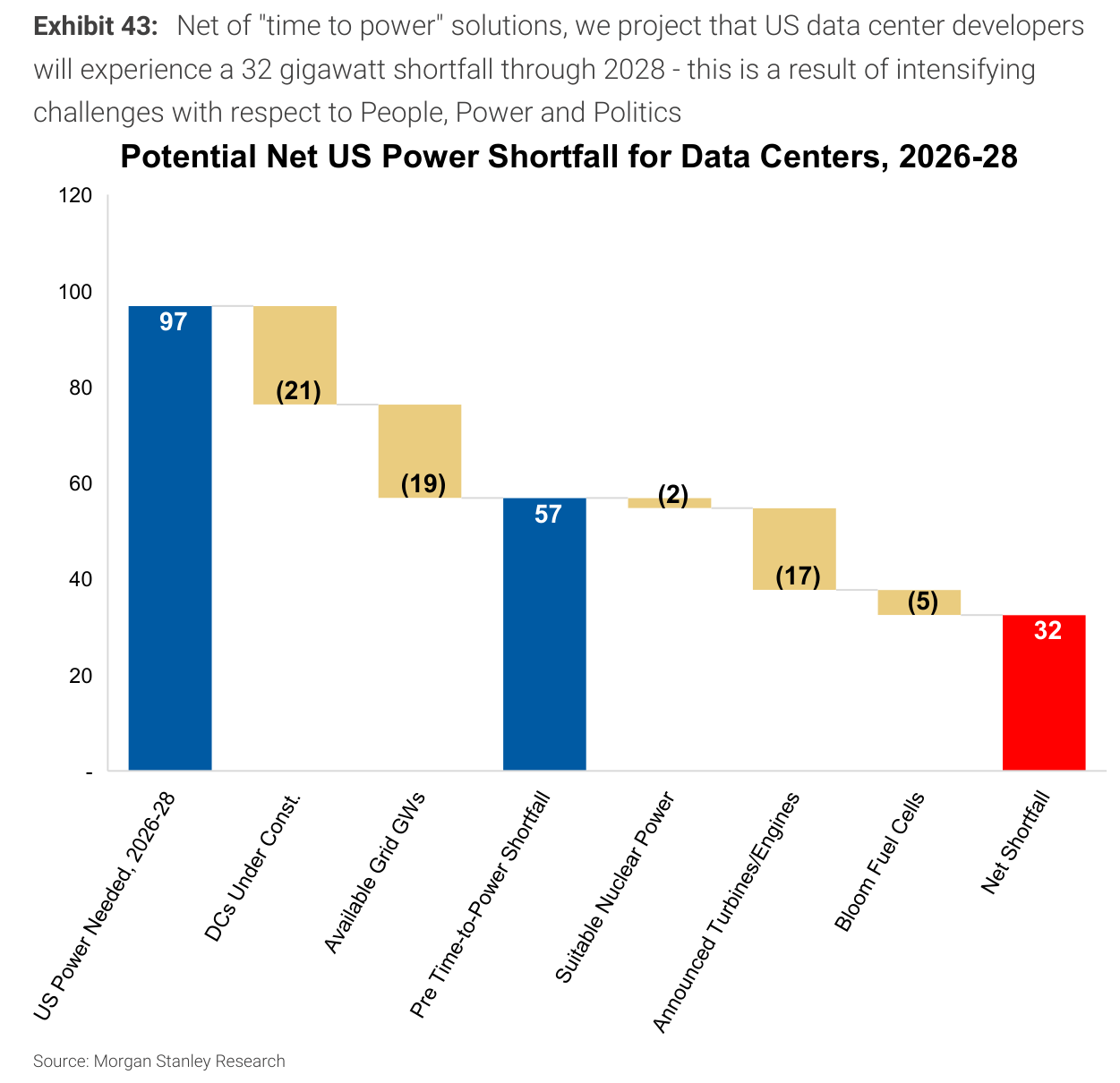
MS frames this as a timing mismatch rather than a demand collapse. Hyperscalers can keep buying scarce GPUs ahead of power (warehousing them as very expensive paperweights in dark and dusty data centers for years until they get “lit”, further pushing prices higher due to artificial scarcity), which certainly props up near-term chip revenue but “could produce hoarding and stranded inventory,” and eventually “buying power-dependent equipment that cannot be turned on is hard to sustain.” The risk is uneven across the chain:
- Most exposed: components bought ahead of need that ship with the rack (memory, networking, optical, ODM server builds), with memory the most sensitive because recent capex increases are partly price.
- Slower backlog conversion: electrical, cooling and construction equipment, where slower interconnection shows up as backlog conversion delays.
- Relative winners: behind-the-meter generation (such as gas turbines and, eventually, modular nuclear reactors), fuel cells and powered shell providers. MS also expects hyperscalers to build more capex outside the US if domestic power stays tight.
Having pounded the table on precisely this issue for much of the past year, we’ll repeat it once more: behind-the-meter generation should be mandatory for every new data center. It solves the ratepayer problem that is driving the politics and the grid problem that is driving the shortfall at the same time. Even PJM, the nation’s biggest grid, had to scrap its emergency data center power auction earlier this month after a FERC smackdown, which tells you how well the alternative is going.
Paying For It
MS lays out all three risks and still lands on a constructive base case: a conditional buildout, a power gap that delays rather than destroys demand, and a price cycle that can be managed by long-term agreements. Maybe. But the three risks feed each other, meanwhile the AI money monster needs to be fed constantly and anything that leads to even a hint of capex slowdown send the entire cycle into reverse with catastrophic consequences. No wonder last week the most important man on Wall Street, Blackrock’s Larry Fink, warned a data center ban would put the US in recession. Politics slows interconnection and siting, which widens the power gap, which strands chips that were bought at peak prices, which is exactly the “volumes and price falling at the same time” scenario MS says nobody is positioned for.
We’d add a fourth “P” to MS’s list: paying for it. As MS’s credit strategists showed in the same report, 2027 is also the year free cash flow hits its deepest hole and the lower-rated borrowers run out of cushion.
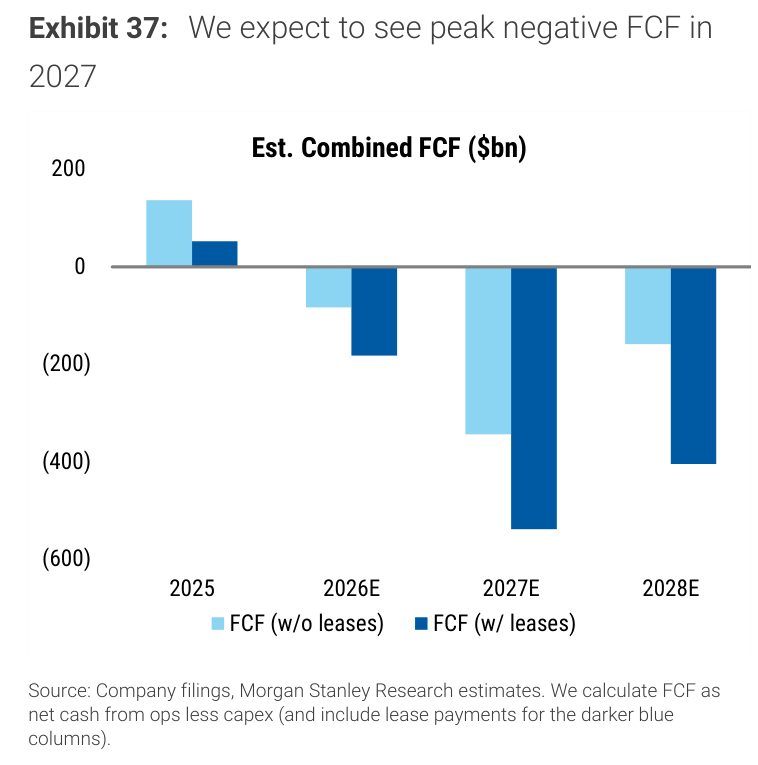
A buildout that has to clear the ballot box, the grid and the bond market all at once has a lot more ways to slip than the $1.6 trillion headline suggests. November 3 is the first test, and with the market already pricing the least constructive outcome for AI, we’d watch the utility commissions at least as closely as the governors.
Much more in the full Morgan Stanley “Following AI’s $1.6 trillion Money Trail” note, available to pro subs.
Tyler Durden Mon, 10/19/2026 – 20:30
Source: https://freedombunker.com/2026/10/19/people-power-and-politics-morgan-stanley-maps-the-three-ways-ais-1-6-trillion-capex-plan-can-collapse/
Anyone can join.
Anyone can contribute.
Anyone can become informed about their world.
"United We Stand" Click Here To Create Your Personal Citizen Journalist Account Today, Be Sure To Invite Your Friends.
Before It’s News® is a community of individuals who report on what’s going on around them, from all around the world. Anyone can join. Anyone can contribute. Anyone can become informed about their world. "United We Stand" Click Here To Create Your Personal Citizen Journalist Account Today, Be Sure To Invite Your Friends.
LION'S MANE PRODUCT
Try Our Lion’s Mane WHOLE MIND Nootropic Blend 60 Capsules
Mushrooms are having a moment. One fabulous fungus in particular, lion’s mane, may help improve memory, depression and anxiety symptoms. They are also an excellent source of nutrients that show promise as a therapy for dementia, and other neurodegenerative diseases. If you’re living with anxiety or depression, you may be curious about all the therapy options out there — including the natural ones.Our Lion’s Mane WHOLE MIND Nootropic Blend has been formulated to utilize the potency of Lion’s mane but also include the benefits of four other Highly Beneficial Mushrooms. Synergistically, they work together to Build your health through improving cognitive function and immunity regardless of your age. Our Nootropic not only improves your Cognitive Function and Activates your Immune System, but it benefits growth of Essential Gut Flora, further enhancing your Vitality.

Our Formula includes: Lion’s Mane Mushrooms which Increase Brain Power through nerve growth, lessen anxiety, reduce depression, and improve concentration. Its an excellent adaptogen, promotes sleep and improves immunity. Shiitake Mushrooms which Fight cancer cells and infectious disease, boost the immune system, promotes brain function, and serves as a source of B vitamins. Maitake Mushrooms which regulate blood sugar levels of diabetics, reduce hypertension and boosts the immune system. Reishi Mushrooms which Fight inflammation, liver disease, fatigue, tumor growth and cancer. They Improve skin disorders and soothes digestive problems, stomach ulcers and leaky gut syndrome. Chaga Mushrooms which have anti-aging effects, boost immune function, improve stamina and athletic performance, even act as a natural aphrodisiac, fighting diabetes and improving liver function. Try Our Lion’s Mane WHOLE MIND Nootropic Blend 60 Capsules Today. Be 100% Satisfied or Receive a Full Money Back Guarantee. Order Yours Today by Following This Link.


| Visits: | 1,835,420,815 |
| Stories: | 8,723,236 |
Whistler Blowers, Insiders

