
“Zero Hormuz”: Abu Dhabi Crown Prince Readies Tens Of Billions To Turn Fujairah Into Hormuz Bypass

On March 3, just days after the first US and Israeli strikes on Iran, when most of the market was still busy pricing the closure of the Strait of Hormuz as a temporary inconvenience, we pointed out something that seemed rather obvious (to us): the UAE’s oil port of Fujairah, which sits on the Gulf of Oman and bypasses the strait completely, was far too small for its strategic importance – and that would change.
Surprising Fujairah is not a bigger oil terminal: it bypasses the straits completely.
Expect major infrastructure push here after the war. https://t.co/Do1gK7KBDQ
— zerohedge (@zerohedge) March 3, 2026
Six days later we went one step further:
After this crisis, every Gulf pipeline has to end either in Yanbu or Fujairah alongside massive terminal infrastructure https://t.co/fNBywD3Wr1
— zerohedge (@zerohedge) March 9, 2026
Seven months later, the “major infrastructure push” has a name, a sponsor, and a checkbook. According to a new Bloomberg Big Take, Abu Dhabi Crown Prince Sheikh Khaled bin Mohamed Al Nahyan – who took the helm of the emirate’s $300 billion L’imad Holding sovereign fund weeks before the war began – is now the point man for what the UAE is officially calling its “Zero Hormuz” strategy (wonder if he was reading Zero Hedge at the time). And the centerpiece of that strategy is, you guessed it, Fujairah.
Follow the money (to the Gulf of Oman)
Here are the Bloomberg report highlights:
- L’imad has announced plans to take Abu Dhabi Ports Co. private at a valuation of nearly $9 billion, and people familiar say the fund is now likely to spend tens of billions of dollars more on new port infrastructure outside the strait.
- The crown prince and his inner circle are expected to be “particularly focused” on expanding ports in Fujairah, which sits just outside Hormuz and opens into the Gulf of Oman.
- In May, L’imad struck an agreement with BlackRock (via its Global Infrastructure Partners unit), Temasek and ADNOC to jointly target up to $30 billion of infrastructure investment in energy transportation, logistics and water. Abu Dhabi did not want such a large push funded solely by state money – which is a polite way of saying Larry Fink gets a toll road around Iran.
- Sheikh Khaled also chairs the executive committee of ADNOC’s board, which is building a second oil pipeline to double export capacity through Fujairah; at a May meeting he directed the company to accelerate delivery.
- Meanwhile Dubai’s DP World is separately pushing new container terminals in Fujairah – meaning that a relatively small stretch of coastline under the Al Hajar mountains is about to become some of the most crowded (and most valuable) real estate in the Gulf.
The UAE’s trade minister Thani Al Zeyoudi summed up the doctrine back in June: the country wants to move to Zero Hormuz dependency regardless of whether the strait is open or not. Translation: even if Tehran signs a peace deal tomorrow, the leverage it enjoyed over Gulf exports for decades is never coming back.
Regular readers will recognize every step of this progression. On April 2 we noted that Gulf states were dusting off costly bypass pipeline plans; on May 15 we reported that ADNOC would double its crude export capacity bypassing Hormuz with the new pipeline to Fujairah, due in 2027; and on July 13 we wrote that DP World’s plan for a new east coast port in Fujairah “signals the beginning of the end” of Iran’s Hormuz leverage. That same day, as peace talks went nowhere, we also offered an alternative engineering solution:
At this rate it will be faster to dig a canal through the UAE to bypass Hormuz than to wait for a peace deal
— zerohedge (@zerohedge) July 13, 2026
Abu Dhabi, it appears, has opted for the slightly less ambitious version: pipelines plus a lot of concrete.
Goldman: 60% of Gulf exports insulated from Hormuz by 2028
So how far can this go? Goldman’s commodity team (Alexandra Paulus, Yulia Grigsby, Daan Struyven and Filippo Cuscito) ran the numbers in a July note titled “Gulf Exports: Short-Term Uncertainty, Long-Term Pipeline Hedge“ (available here to pro subs), and the conclusion is that while Hormuz still dictates prices in the short run, the long run looks very different. The bank estimates that enough pipeline capacity will be added in the region to insulate over 45% of pre-war Persian Gulf exports by end-2027 and more than 60% by end-2028 from any future Hormuz shock.
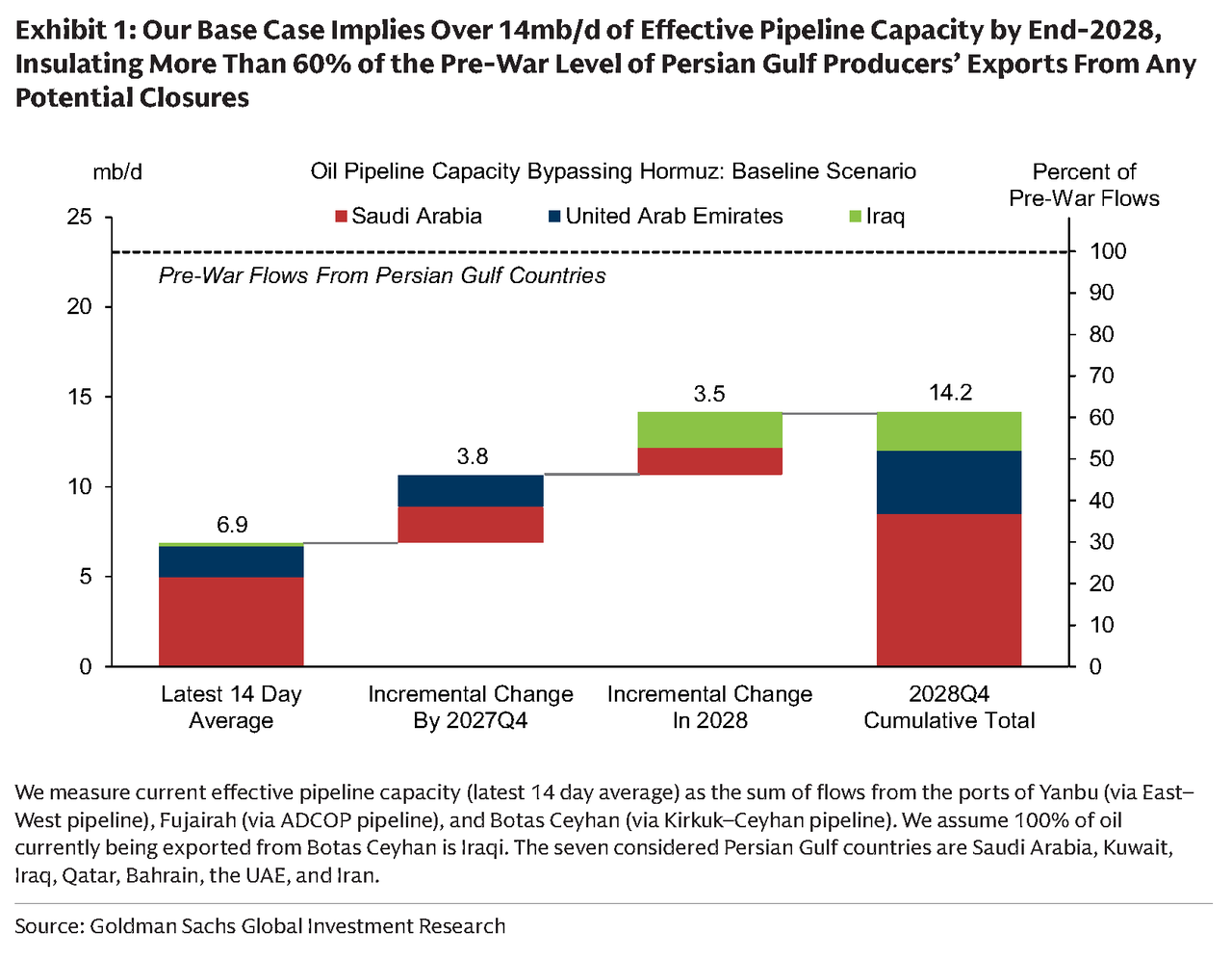
Some of the details:
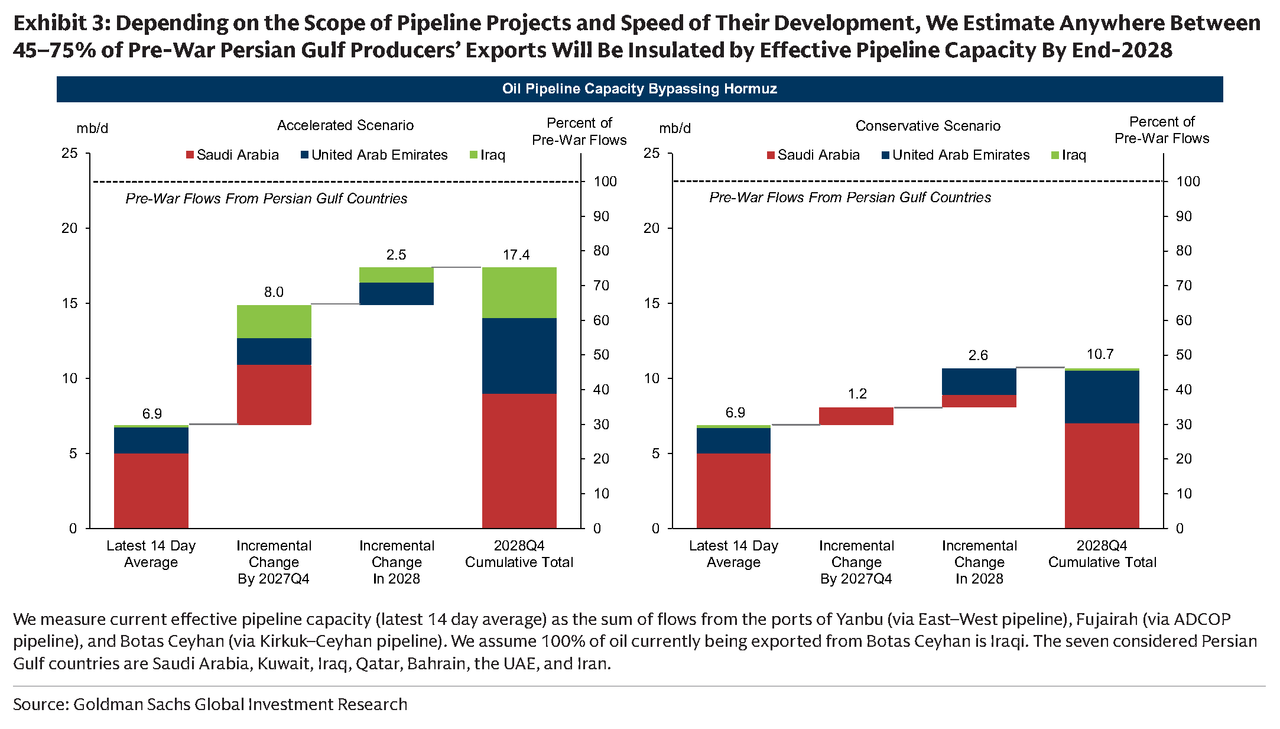
- Goldman measures current effective bypass capacity as the flows out of Yanbu (East-West pipeline), Fujairah (ADCOP pipeline) and Ceyhan (Kirkuk-Ceyhan). In its base case, that capacity rises by 3.8mb/d by end-2027 and 7.3mb/d cumulatively by end-2028, to over 14mb/d – versus ~23mb/d of pre-war exports from the seven Gulf producers that need pipelines to dodge Hormuz.
- The UAE features prominently: the West-East pipeline (ADNOC’s second line to Fujairah) is one of only two projects already under construction, while a Hamriyah-Fujairah pipeline sits in Goldman’s “Accelerated Scenario” – which would insulate 75% of exports by end-2028 (vs. just over 45% in the “Conservative Scenario”).
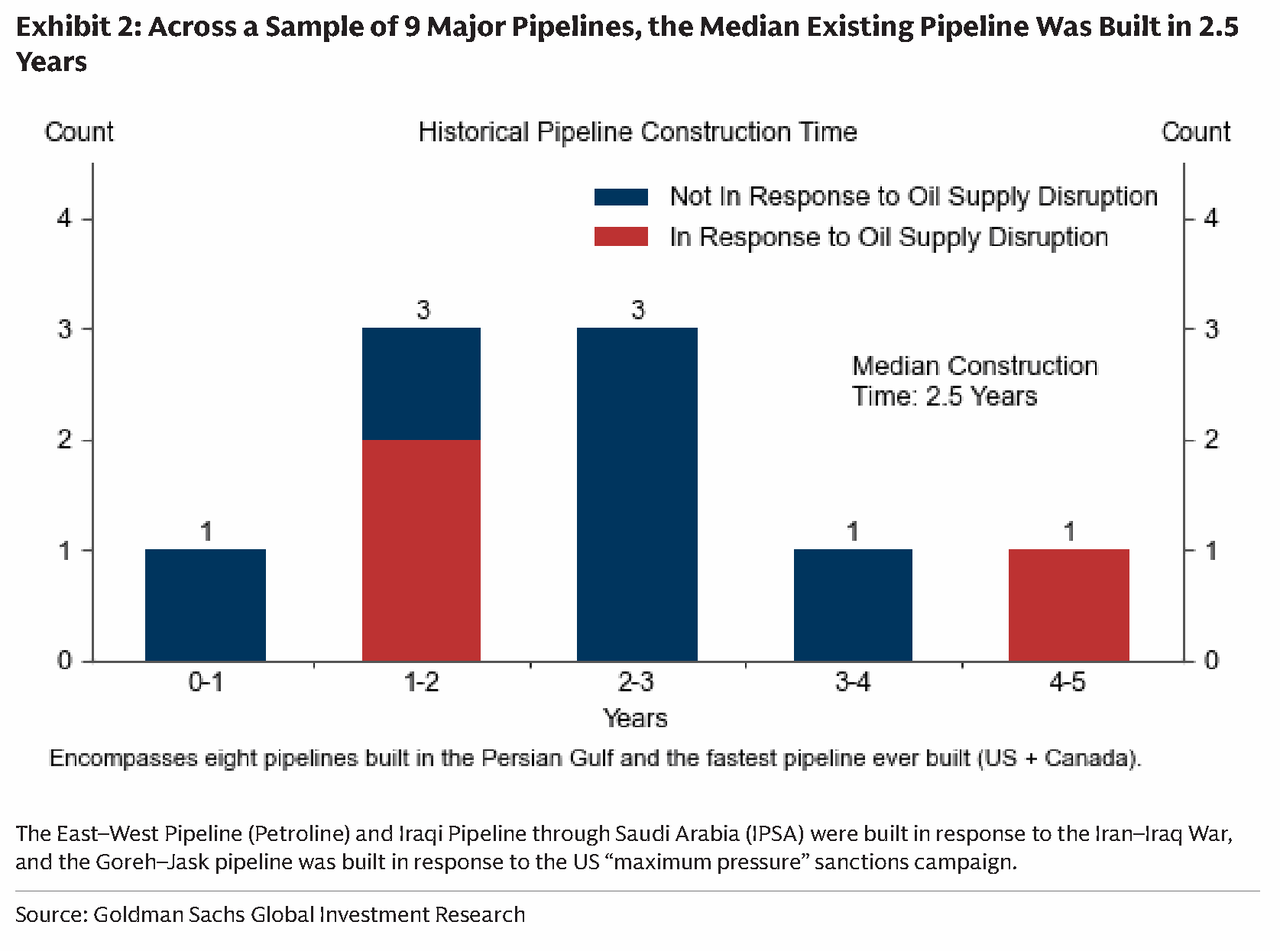
- History is on the builders’ side: across Goldman’s sample, the median construction time for Mideast pipelines was 2.5 years, and single-country projects get built faster, especially in response to supply disruptions. Multi-country projects (looking at you, Iraq-Syria) not so much.
- Total cost across the seven projects: roughly $30-48 billion – or, put differently, about one BlackRock/L’imad infrastructure platform.
And here is the punchline for oil bulls: Goldman raised its long-dated Brent assumption (3-year-ahead futures) by $9 to $76/bbl at the peak of the war, mostly on a higher structural security premium. But the bank warns that the eventual expansion of bypass capacity poses downside risk to that long-dated assumption. In other words, every barrel that Sheikh Khaled routes to Fujairah is a barrel of risk premium Iran can no longer charge the world.
The plumbing is already working
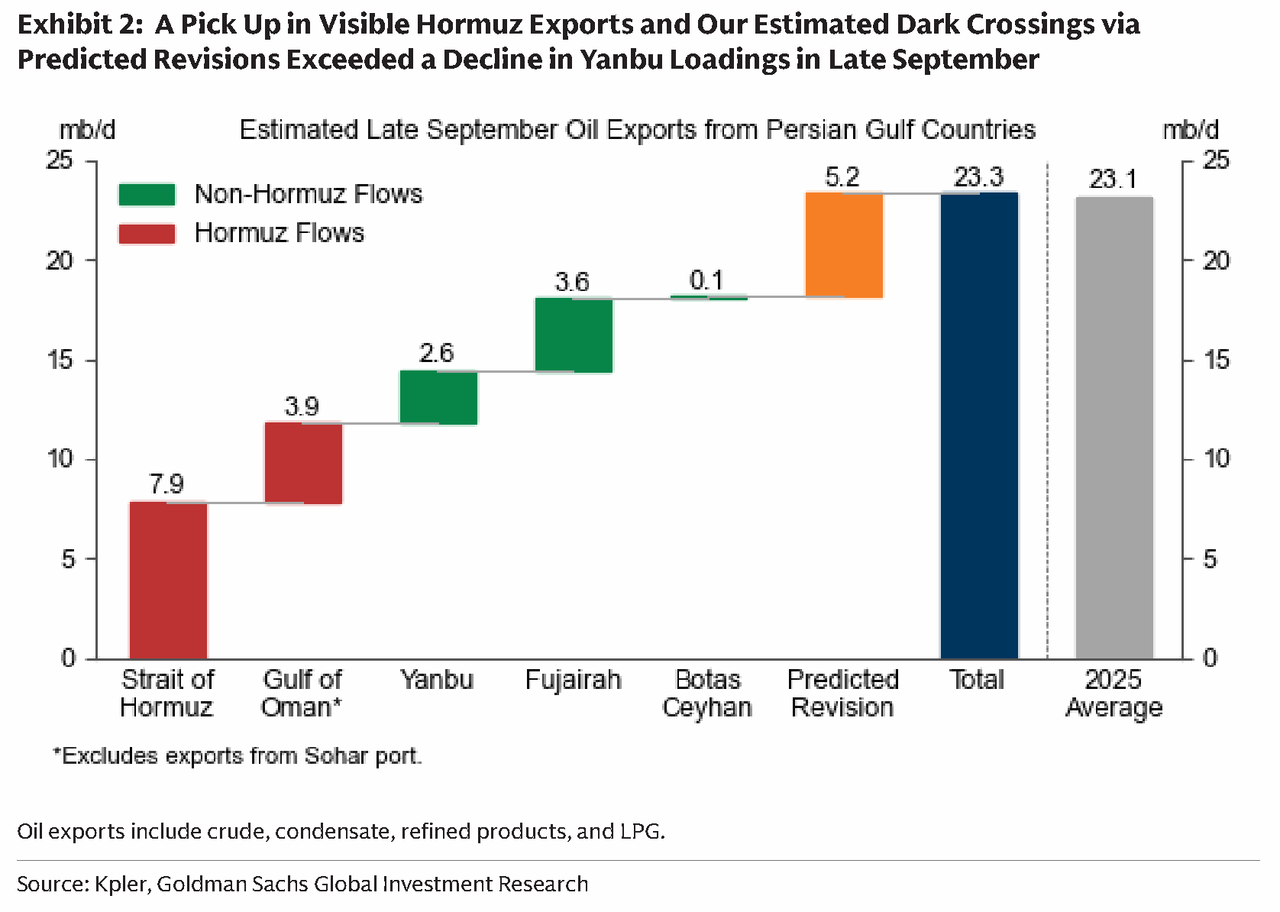
The “adaptation” is already visible in the export data. As we reported earlier today, Goldman estimates that Persian Gulf oil exports (including “dark exports”) recovered to 23.3mb/d over the past week, in line with their 2025 average, after doubling in September. Crude accounted for nearly 90% of the recovery, reaching 19mb/d (108% of the 2025 average), while refined product exports remain stuck at about half of normal. Crucially for this story, Goldman notes that oil exports from the UAE – which shockingly exited OPEC shortly after the Iran war started – are also above their 2025 average, “with likely further upside” – while Iran shipped no crude by sea at all in September.
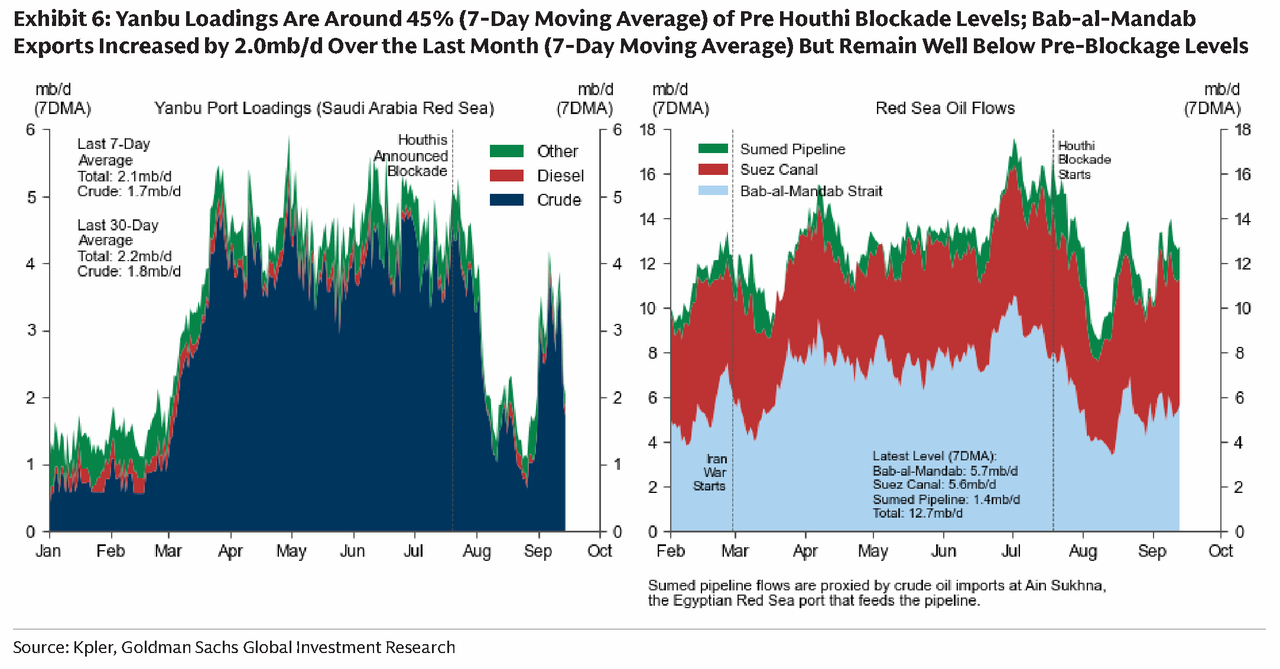
Drill down and Fujairah is doing a lot of the heavy lifting: Goldman’s late-September breakdown puts flows via Fujairah at 3.6mb/d (crude, products and LPG combined), more than Yanbu’s 2.6mb/d, and more than double the ~1.7mb/d Fujairah handled before the war.
And by country, the UAE is already running at 110% of its 2025 export average – second only to Saudi Arabia’s dark-transit-fueled surge – while Iran sits at 19%.
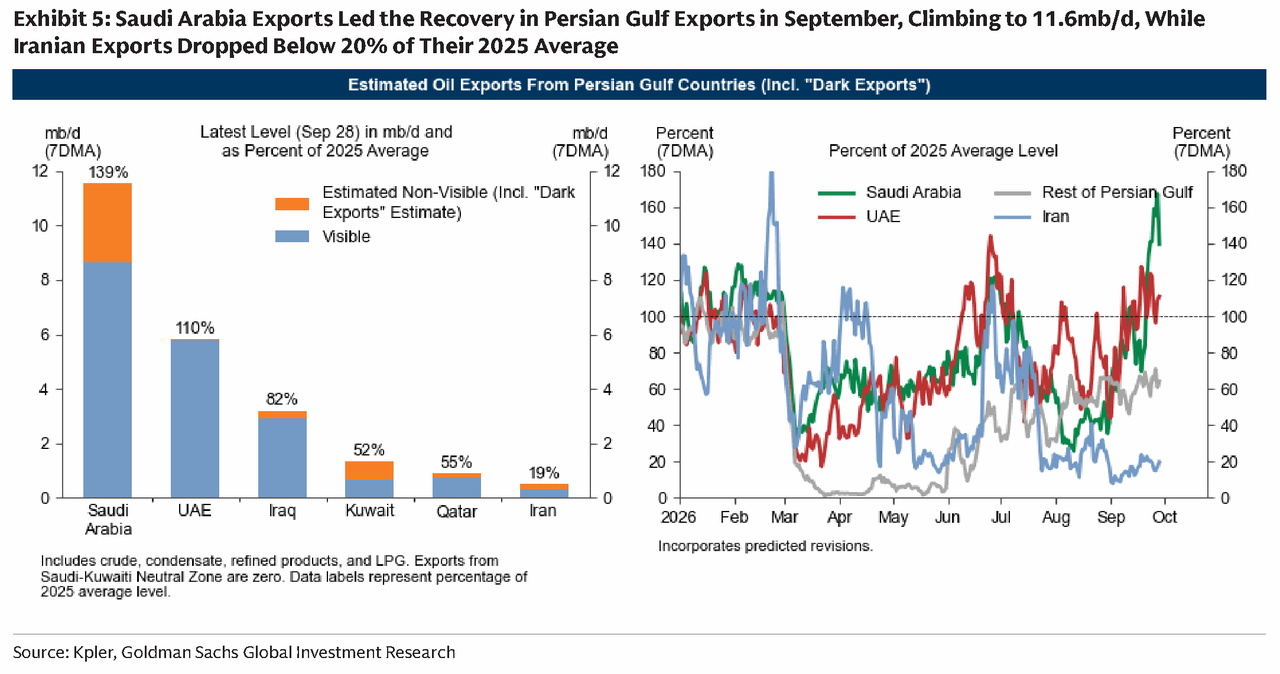
The UAE in particular has been the most creative workaround artist of the war: as we noted in July, its crude output hit an all-time high of 4.1mb/d in June after it quit OPEC, with ADNOC selling cargoes for loading off Fujairah and Sohar, outside the strait. Back in March, we reported that Fujairah crude loadings had already hit ~1.9mb/d – about the max the existing 1.5-1.8mb/d Habshan-Fujairah line can carry. The only real constraint was pipe. Which is exactly what Abu Dhabi is now paying to fix.
Bypassing the strait is not the same as bypassing the drones
None of this makes Fujairah safe. It is roughly 80 miles from Hormuz and well within range of Iranian drones and short-range missiles – a point LSE professor Steffen Hertog makes in the Bloomberg piece. Tehran knows exactly what Fujairah represents: the port was in flames on March 14, was attacked at least seven times in the first four weeks of the war, and on March 31 Iran explicitly threatened to target the port and its pipeline “in order to close the UAE’s route to bypass the Strait of Hormuz.” On May 4, another Iranian strike on Fujairah’s oil zone sent Brent above $114.
Saudi Arabia offers the cautionary tale. Its 7mb/d East-West pipeline to Yanbu – the region’s single biggest Hormuz bypass – was shut down on September 11 after drone attacks by pro-Iran militias, before restarting on September 28. Goldman’s September 14 Oil Tracker pointed out that an April strike on the same pipeline cut flows by just 0.7mb/d for four days, while the latest attack was far more severe and threatened the remaining ~2mb/d of Yanbu exports. The Saudis promptly pivoted back to shipping through… Hormuz. Meanwhile the Houthis are advancing on Bab el-Mandeb, threatening the other end of the Red Sea route.
Which brings us to Treasury Secretary Bessent, who predicted on September 1 that in two years Hormuz will be “a worthless piece of water.” Qatar’s energy minister promptly called that “completely wrong” – which is easy to understand when you are Qatar, have no geographic alternative route, and have watched your gas revenue drop sharply. The truth is somewhere in between: Hormuz won’t be worthless, but if Goldman’s math is right it will be worth a lot less to Iran – and a lot more to whoever owns the ports on the other side of the mountains.
As Chatham House’s Sanam Vakil puts it, a “No Hormuz” policy is now of utmost importance for the UAE – but with Iran’s proxies extending their reach, Abu Dhabi will also have to prepare for infrastructure targeting outside Hormuz too. Expect the next line item in the L’imad budget to be air defense.
For now, the bottom line is the one we flagged on day four of the war: the Gulf’s most important real estate is no longer inside the strait, it’s on the Gulf of Oman – and the crown prince of Abu Dhabi has just put tens of billions of dollars (and BlackRock’s money) behind that view.
Tyler Durden Wed, 09/30/2026 – 23:24
Source: https://freedombunker.com/2026/09/30/zero-hormuz-abu-dhabi-crown-prince-readies-tens-of-billions-to-turn-fujairah-into-hormuz-bypass/
Anyone can join.
Anyone can contribute.
Anyone can become informed about their world.
"United We Stand" Click Here To Create Your Personal Citizen Journalist Account Today, Be Sure To Invite Your Friends.
Before It’s News® is a community of individuals who report on what’s going on around them, from all around the world. Anyone can join. Anyone can contribute. Anyone can become informed about their world. "United We Stand" Click Here To Create Your Personal Citizen Journalist Account Today, Be Sure To Invite Your Friends.
LION'S MANE PRODUCT
Try Our Lion’s Mane WHOLE MIND Nootropic Blend 60 Capsules
Mushrooms are having a moment. One fabulous fungus in particular, lion’s mane, may help improve memory, depression and anxiety symptoms. They are also an excellent source of nutrients that show promise as a therapy for dementia, and other neurodegenerative diseases. If you’re living with anxiety or depression, you may be curious about all the therapy options out there — including the natural ones.Our Lion’s Mane WHOLE MIND Nootropic Blend has been formulated to utilize the potency of Lion’s mane but also include the benefits of four other Highly Beneficial Mushrooms. Synergistically, they work together to Build your health through improving cognitive function and immunity regardless of your age. Our Nootropic not only improves your Cognitive Function and Activates your Immune System, but it benefits growth of Essential Gut Flora, further enhancing your Vitality.

Our Formula includes: Lion’s Mane Mushrooms which Increase Brain Power through nerve growth, lessen anxiety, reduce depression, and improve concentration. Its an excellent adaptogen, promotes sleep and improves immunity. Shiitake Mushrooms which Fight cancer cells and infectious disease, boost the immune system, promotes brain function, and serves as a source of B vitamins. Maitake Mushrooms which regulate blood sugar levels of diabetics, reduce hypertension and boosts the immune system. Reishi Mushrooms which Fight inflammation, liver disease, fatigue, tumor growth and cancer. They Improve skin disorders and soothes digestive problems, stomach ulcers and leaky gut syndrome. Chaga Mushrooms which have anti-aging effects, boost immune function, improve stamina and athletic performance, even act as a natural aphrodisiac, fighting diabetes and improving liver function. Try Our Lion’s Mane WHOLE MIND Nootropic Blend 60 Capsules Today. Be 100% Satisfied or Receive a Full Money Back Guarantee. Order Yours Today by Following This Link.


| Visits: | 1,836,269,080 |
| Stories: | 8,727,541 |
Whistler Blowers, Insiders