

‘A Working Group For War And Peace’: Three Hours In The Kremlin

Authored by Larry C. Johnson via Sonar21
Vladimir Putin does not give three hours of his time to people who have nothing to say. On Thursday, he gave three hours to Mohsen Rezaei, the secretary of Iran’s Supreme National Security Council. Two days later, Israel’s president handed the job of forming the next government to Gadi Eisenkot instead of Benjamin Netanyahu.
Washington spent the week arguing about the midterms. Moscow, Tehran and Jerusalem spent it rearranging the board.
What the Kremlin said, and what it didn’t
The Kremlin’s account of the meeting was a masterpiece of saying nothing. Putin received Rezaei on November 5. The two discussed “the current state of bilateral relations” under the Comprehensive Strategic Partnership Treaty, and “the situation in the Gulf region and the Middle East as a whole.” A message from Iran’s Supreme Leader was delivered. Its contents were not disclosed. That was it.
The Kremlin is never chatty, but the brevity is itself a message. When Moscow wants the world to know it has promised something, it says so. When it wants room to bargain with Washington, it publishes three sentences.
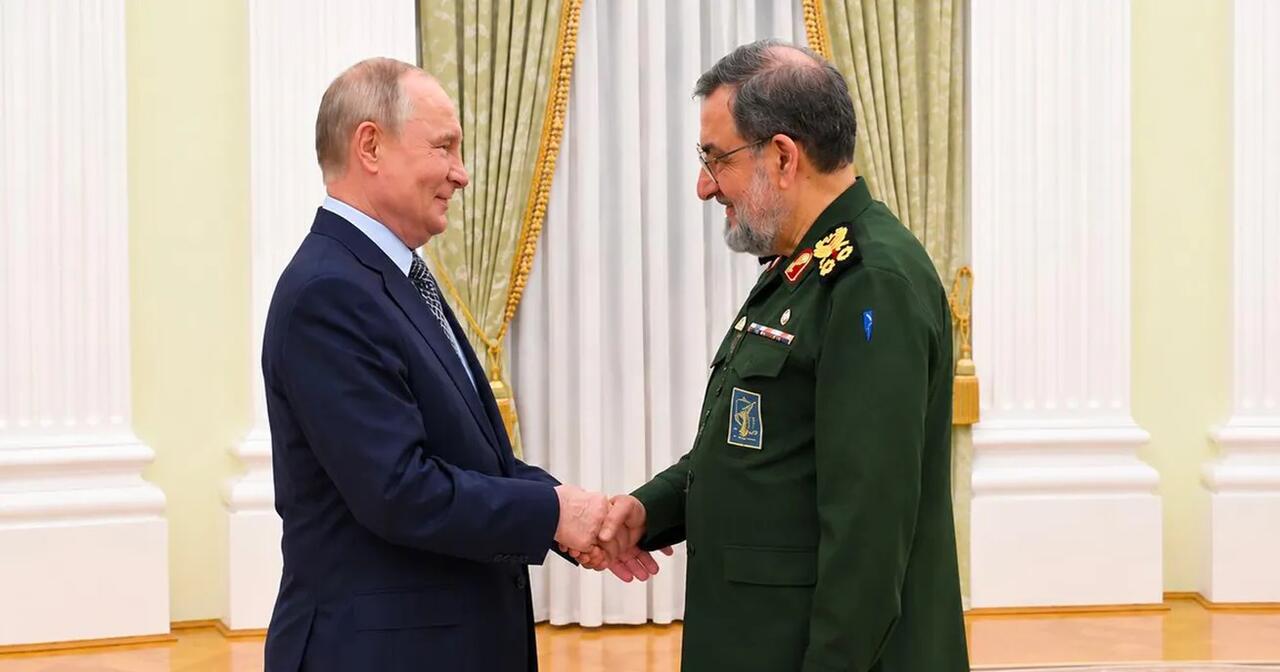
The photograph said more than the text. Sitting on the Russian side of the table were Yuri Ushakov, Putin’s senior foreign policy adviser, and Igor Kostyukov, the head of the GRU, Russia’s military intelligence service. You do not bring your top diplomat and your top military intelligence officer to a courtesy call. That is a working group for war and peace.
The Iranian side has been far more talkative. According to Kazem Jalali, Iran’s ambassador in Moscow, the meeting ran about three hours. Rezaei’s message from Mojtaba Khamenei covered the American and Israeli attacks on Iran, Tehran’s seven conditions for reopening the Strait of Hormuz, and nuclear cooperation. Jalali also described an agreement on gas. In the short term, Russian gas would be swapped through Azerbaijan. Over two to three years, a pipeline would be built with 110 billion cubic meters a year of capacity, starting at 55 billion.
Putin made no public promise of military help, and the 2025 treaty contains no mutual defense clause. But he did not need to say anything. Iran sent its top security official to walk Putin through its terms for ending the war, in person. Moscow brought its spy chief to hear them. That is how you prepare for a negotiation, not a photo op.
Bibi gets the pink slip, sort of
On Saturday, President Isaac Herzog asked Gadi Eisenkot to form Israel’s next government. It was not close. Sixty-seven members of the Knesset recommended Eisenkot, including the Arab-led parties. Only 46 recommended Netanyahu.
Now comes the hard part. Eisenkot’s bloc won 48 seats on October 27, and he has ruled out governing in coalition with the Arab-led parties that just helped him. That leaves him two roads. He can bring in the ultra-Orthodox parties, Shas and United Torah Judaism, to reach exactly 61. Or he can run a minority government that the Arab parties support from outside. He has 28 days, plus a possible 14-day extension. If he fails, Israel heads for another election, and Netanyahu stays on as caretaker.
Netanyahu, true to form, is not going quietly. He warned that a government “dependent on Islamists” would “dismantle the state of Israel from within.” He has also demanded an investigation into supposed foreign interference in the election. It is the political equivalent of declaring the referee biased after losing 67 to 46.
What changes if Bibi goes
Eisenkot is no dove. He is a former chief of staff of the Israel Defense Forces, and he lost a son and a nephew in the Gaza war. He still supports economic pressure on Iran and limited military action. But his approach differs from Netanyahu’s in three ways that matter.
- Iran. Netanyahu has spent this year campaigning for regime change in Tehran and lobbying Washington for more strikes. Eisenkot campaigned on “more diplomacy alongside any military steps” and told the Wall Street Journal he would back military action only against “direct and immediate threats to Israel.” Years ago, he called the US withdrawal from the 2015 nuclear deal a “strategic mistake.”
- Washington. Netanyahu tied Israel’s fortunes to the Republican Party and to Trump personally. Eisenkot calls the relationship “a partnership between peoples, built over generations” and promises to rebuild its bipartisan base. He also says he wants to work “closely and constructively” with the Trump administration. That is a man who wants Israel back on good terms with both parties, not one who wants to drag a lame-duck Congress into another war.
- Leverage. For eight months, the loudest voice urging Trump to “finish the job” in Iran has come from the Israeli prime minister’s office. Take that voice away, and the war party in Washington loses its most important foreign ally just as Republicans absorb a midterm verdict on the war.
Now put Moscow and Jerusalem side by side. Iran is laying out its terms to Putin, with Russia’s military intelligence chief in the room. Qatar and Pakistan are mediating to keep Washington and Tehran from going back to open war. And Israel is about to swap a prime minister who wanted the war widened for one who talks about diplomacy and alliance repair. For the first time since February, the people pushing for a settlement have more momentum than the people pushing for more bombs.
There is one dangerous window. Until Eisenkot forms a government, Netanyahu remains prime minister, and he has every incentive to create facts before he leaves. A caretaker with nothing to lose and a fondness for surprise strikes is not a comforting combination. If there is a moment of maximum risk in the next six weeks, it is now.
The odd man out
So here is the week in review. Iran sends its security chief to Moscow for three hours. Putin brings his spy chief and says almost nothing in public, which is how you keep your options open. Israel’s president hands Netanyahu’s job to a general who prefers diplomacy alongside force. American voters fire the Republican Congress over the war.
Everyone seems to have read the room except the man in the Oval Office. Donald Trump can treat these as separate stories, or he can see what the rest of the world already sees. The coalition for war is shrinking, the coalition for a deal is growing, and the window for a face-saving exit will not stay open forever. Three hours in the Kremlin and a 67-to-46 vote in Jerusalem are not the end of the war. But they may be the beginning of the end of the reasons to keep fighting it.
Source: https://freedombunker.com/2026/11/08/a-working-group-for-war-and-peace-three-hours-in-the-kremlin/
Anyone can join.
Anyone can contribute.
Anyone can become informed about their world.
"United We Stand" Click Here To Create Your Personal Citizen Journalist Account Today, Be Sure To Invite Your Friends.
Before It’s News® is a community of individuals who report on what’s going on around them, from all around the world. Anyone can join. Anyone can contribute. Anyone can become informed about their world. "United We Stand" Click Here To Create Your Personal Citizen Journalist Account Today, Be Sure To Invite Your Friends.
LION'S MANE PRODUCT
Try Our Lion’s Mane WHOLE MIND Nootropic Blend 60 Capsules
Mushrooms are having a moment. One fabulous fungus in particular, lion’s mane, may help improve memory, depression and anxiety symptoms. They are also an excellent source of nutrients that show promise as a therapy for dementia, and other neurodegenerative diseases. If you’re living with anxiety or depression, you may be curious about all the therapy options out there — including the natural ones.Our Lion’s Mane WHOLE MIND Nootropic Blend has been formulated to utilize the potency of Lion’s mane but also include the benefits of four other Highly Beneficial Mushrooms. Synergistically, they work together to Build your health through improving cognitive function and immunity regardless of your age. Our Nootropic not only improves your Cognitive Function and Activates your Immune System, but it benefits growth of Essential Gut Flora, further enhancing your Vitality.

Our Formula includes: Lion’s Mane Mushrooms which Increase Brain Power through nerve growth, lessen anxiety, reduce depression, and improve concentration. Its an excellent adaptogen, promotes sleep and improves immunity. Shiitake Mushrooms which Fight cancer cells and infectious disease, boost the immune system, promotes brain function, and serves as a source of B vitamins. Maitake Mushrooms which regulate blood sugar levels of diabetics, reduce hypertension and boosts the immune system. Reishi Mushrooms which Fight inflammation, liver disease, fatigue, tumor growth and cancer. They Improve skin disorders and soothes digestive problems, stomach ulcers and leaky gut syndrome. Chaga Mushrooms which have anti-aging effects, boost immune function, improve stamina and athletic performance, even act as a natural aphrodisiac, fighting diabetes and improving liver function. Try Our Lion’s Mane WHOLE MIND Nootropic Blend 60 Capsules Today. Be 100% Satisfied or Receive a Full Money Back Guarantee. Order Yours Today by Following This Link.


| Visits: | 1,837,887,464 |
| Stories: | 8,734,289 |
Whistler Blowers, Insiders

