

Butane’s Perfect Storm Sends Prices To Decade Highs

Authored by Natalia Katona via OilPrice,
Butane prices are surging across the world. Northwest European November butane prices have reached $1,125/t by early November, their highest level in 30 years, having exceeded even the peaks following Russia’s invasion of Ukraine. In Asia, the AFEI butane index stood at $1,180/t on November 3. US butane Belvieu prices have climbed to a 14-year high $920/t.
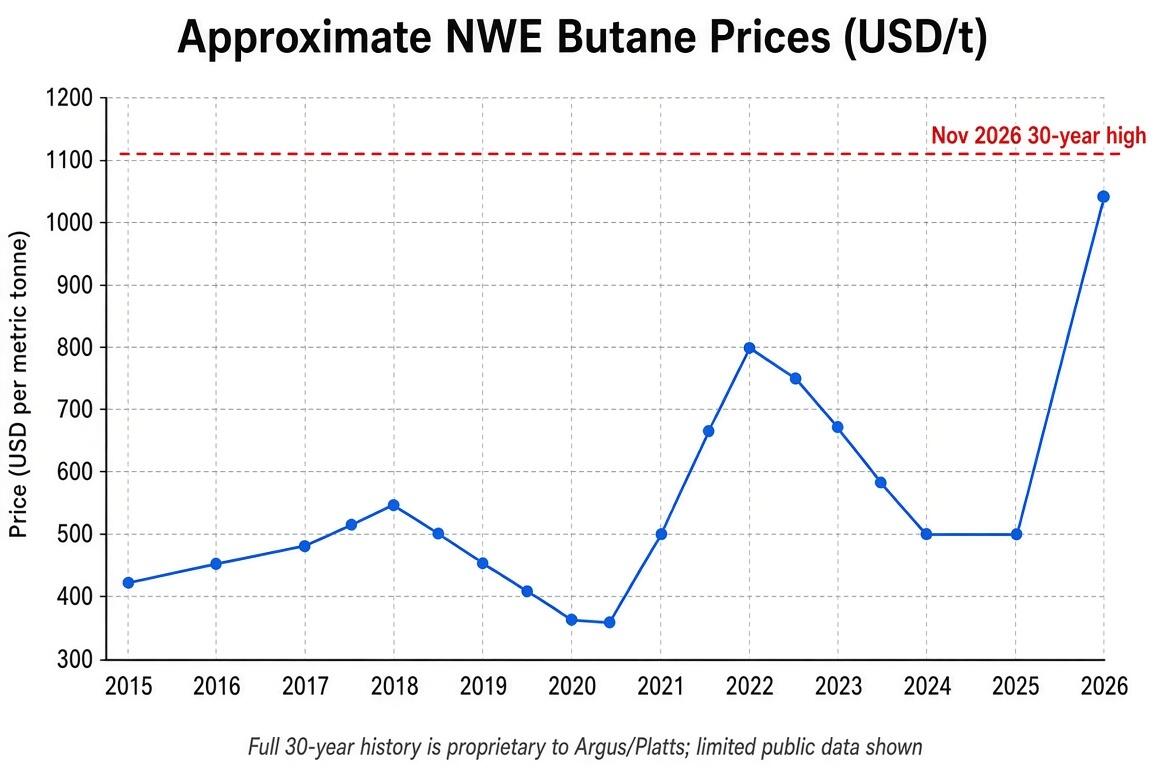
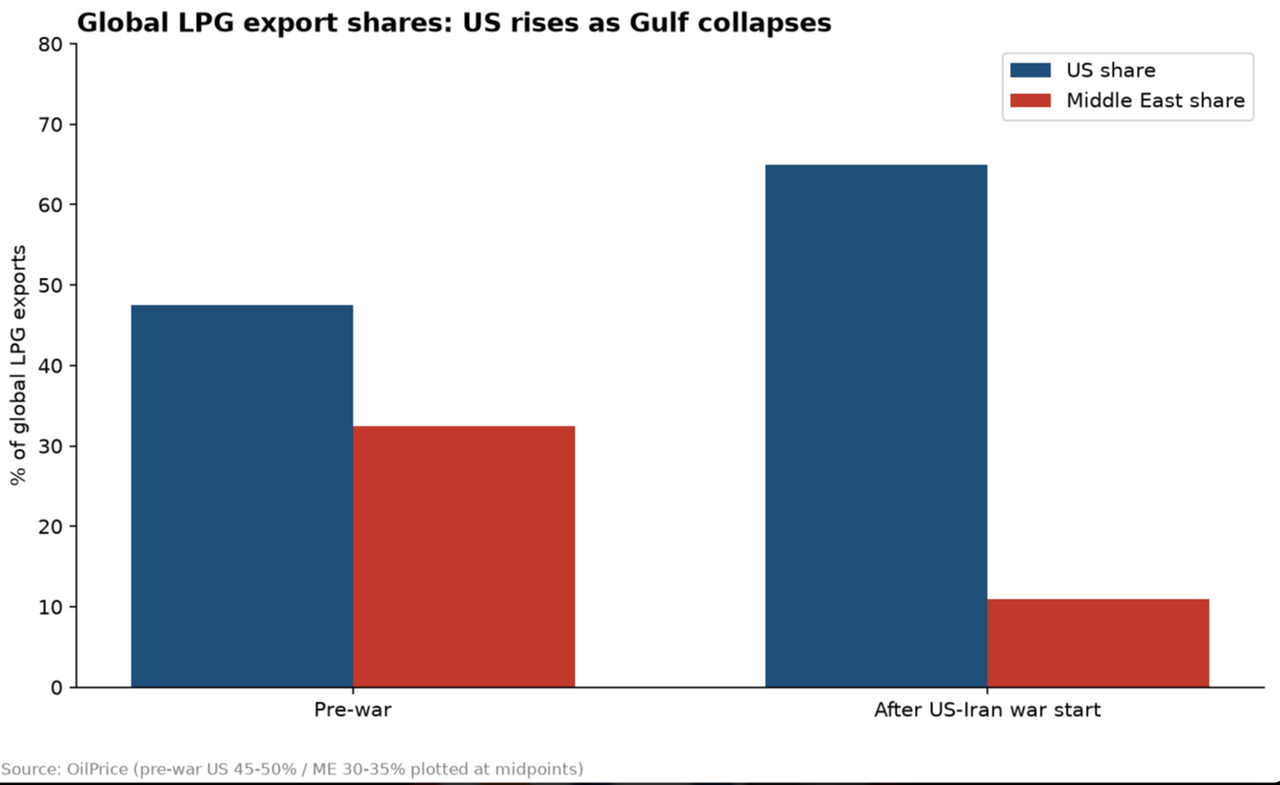
This surge in prices reflects several overlapping trends, with the most significant being a reorientation of global propane/butane trade flows since the US-Iran war kicked off in March. Before the conflict, the US supplied roughly 45-50% of global LPG exports and the Middle East another 30-35%. After the beginning of the Middle Eastern crisis, the Gulf countries’ share subsequently collapsed to 11%, while the US substituted much of this shortfall and its share reached 65%.
Asia has absorbed much of that replacement supply. Middle Eastern producers previously covered around half of Asia’s imports, offering relatively short voyages and cargoes suited to local requirements. In April-October, the US propane and butane supplied as much as 75% of Asian imports, drawing volumes away from other destinations, including Europe. That share eased to around 55% in October as deliveries from the UAE, Kuwait, Qatar and Saudi Arabia gradually recovered. Yet the broader restoration of Gulf exports has been stronger in oil, and the current flow of LPG shipments remains insufficient to loosen Asia’s inevitable reliance on American cargoes. This is pulling US cargoes away from other regions. Subsequently, in October butane monthly imports into the Amsterdam-Rotterdam-Antwerp (ARA) hub have fallen to a multi-year low of just 130,000 tonnes, down 34% from a year earlier.
However, replacing Middle Eastern supplies to Asia is complicated by their composition.
US LPG exports are approximately 75% propane and 25% butane in outright terms, whereas Indian (and many other Asian countries) cooking-gas requirements typically favour a blend closer to 50:50, with butane helping maintain suitable vapour pressure in warmer climates. More American propane therefore cannot fully compensate for missing Middle Eastern butane.
India’s exposure made the consequences particularly severe. At the outbreak of the crisis, roughly 87% of its LPG imports came from the Gulf, with the UAE and Qatar together accounting for half. Imports dropped from 2.03 million tonnes in February to 1.17 million tonnes in March, a fall of more than 40%. The government ordered refiners, including petrochemical complexes, to maximise LPG production and prioritise households. Some consumers switched to piped natural gas, although its higher cost and only partial indirect government support limited the relief. Recovering imports from the Middle East and strong reliance on US cargoes have given refiners more flexibility to ease emergency LPG production and restore output of other products, particularly petrochemicals.
China’s demand comes from a different direction, as expanding capacity for gasoline additives and basic chemicals increases its feedstock requirements. Five new plants producing MTBE (methyl tertiary-butyl ether, which raises gasoline’s octane rating, helping prevent engine knocking, with butane supplying its hydrocarbon component through several processing steps) opened in 2025, adding combined capacity of 3.4 million t/year and supporting demand for imported butane. Crucially, the gasoline using Chinese MTBE need not be consumed in China. Producers export the additive to other Asian markets, Europe and Latin America, allowing overseas demand to sustain butane purchases even when Chinese gasoline consumption is subdued. China produces butane domestically, but industrial expansion increases its need for supplementary imports.
This Asian demand is coinciding with another major factor that pushes butane prices up – the seasonal increase in Atlantic basin consumption. Winter gasoline specifications in the US and Europe require refiners to blend in more butane, whose high vapour pressure helps fuel vaporise and engines start in cold weather. The autumn switch into winter-quality gasoline typically strengthens butane demand between October and March, which means American producers are competing more actively with overseas buyers. US exports reached a record 2.4 million tonnes in May before decreasing to 1.55 million tonnes in October (still 12% higher than a year earlier). Asia received 840,000 tonnes, or 54% of October shipments, while Europe took only 105,000 tonnes, approximately 7%.
That distribution explains Europe’s predicament: American exports are seasonally decreasing, just as Asian demand leaves less and less butane available amidst strengthening European blending demand. Operational disruptions have tightened US butane availability further, with force majeure at Energy Transfer’s Nederland terminal in Texas and a compressor outage affecting butane loadings at Freeport last month.
Even Asia’s ability to attract American cargoes is now approaching a commercial limit. US butane at $920/t, plus approximately $320/t in freight to India, produces a delivered cost of $1,240/t. The landed US butane versus AFEI butane spread is at $50-60/t, making the arbitrage commercially unattractive for American producers. For comparison, in April the spread reached minus $300-400/t, creating a huge incentive for US shippers to sell their LPG volumes to Asia. For additional shipments to become once again attractive, US prices or freight must fall, or Asian prices must rise further. Winter blending demand complicates the first possibility, while the last would deepen the burden on importers already struggling with expensive energy.
Continued recovery in Gulf deliveries can ease pressure across these interconnected markets, allowing Indian refiners to retreat from emergency LPG production and freeing more American cargoes for Europe. Yet that relief depends on maritime security in the Hormuz Strait, leaving buyers exposed to renewed US hostilities with Iran. Another escalation would force India back into the market for long-haul cargoes while Chinese industrial demand and European winter consumption would compete for the same supplies. America remains the obvious source of replacement volumes, but its own internal dynamics and the current economics of shipping suggest it cannot keep filling the Gulf’s supply gap at prices buyers can comfortably afford.
Source: https://freedombunker.com/2026/11/06/butanes-perfect-storm-sends-prices-to-decade-highs/
Anyone can join.
Anyone can contribute.
Anyone can become informed about their world.
"United We Stand" Click Here To Create Your Personal Citizen Journalist Account Today, Be Sure To Invite Your Friends.
Before It’s News® is a community of individuals who report on what’s going on around them, from all around the world. Anyone can join. Anyone can contribute. Anyone can become informed about their world. "United We Stand" Click Here To Create Your Personal Citizen Journalist Account Today, Be Sure To Invite Your Friends.
LION'S MANE PRODUCT
Try Our Lion’s Mane WHOLE MIND Nootropic Blend 60 Capsules
Mushrooms are having a moment. One fabulous fungus in particular, lion’s mane, may help improve memory, depression and anxiety symptoms. They are also an excellent source of nutrients that show promise as a therapy for dementia, and other neurodegenerative diseases. If you’re living with anxiety or depression, you may be curious about all the therapy options out there — including the natural ones.Our Lion’s Mane WHOLE MIND Nootropic Blend has been formulated to utilize the potency of Lion’s mane but also include the benefits of four other Highly Beneficial Mushrooms. Synergistically, they work together to Build your health through improving cognitive function and immunity regardless of your age. Our Nootropic not only improves your Cognitive Function and Activates your Immune System, but it benefits growth of Essential Gut Flora, further enhancing your Vitality.

Our Formula includes: Lion’s Mane Mushrooms which Increase Brain Power through nerve growth, lessen anxiety, reduce depression, and improve concentration. Its an excellent adaptogen, promotes sleep and improves immunity. Shiitake Mushrooms which Fight cancer cells and infectious disease, boost the immune system, promotes brain function, and serves as a source of B vitamins. Maitake Mushrooms which regulate blood sugar levels of diabetics, reduce hypertension and boosts the immune system. Reishi Mushrooms which Fight inflammation, liver disease, fatigue, tumor growth and cancer. They Improve skin disorders and soothes digestive problems, stomach ulcers and leaky gut syndrome. Chaga Mushrooms which have anti-aging effects, boost immune function, improve stamina and athletic performance, even act as a natural aphrodisiac, fighting diabetes and improving liver function. Try Our Lion’s Mane WHOLE MIND Nootropic Blend 60 Capsules Today. Be 100% Satisfied or Receive a Full Money Back Guarantee. Order Yours Today by Following This Link.


| Visits: | 1,837,506,483 |
| Stories: | 8,733,187 |
Whistler Blowers, Insiders

