

Futures Extend Thanksgiving Turnaround As Nasdaq Dodges Bear Market, Oil Climbs On Houthi Strikes

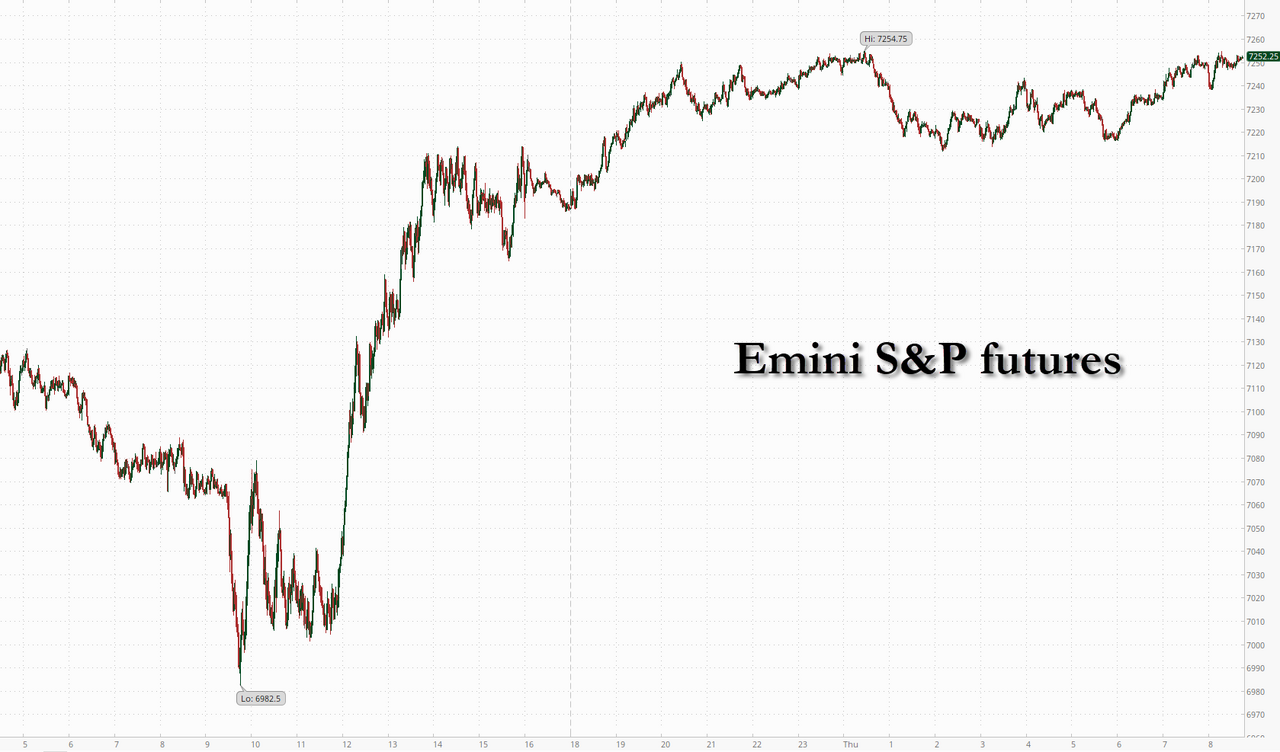
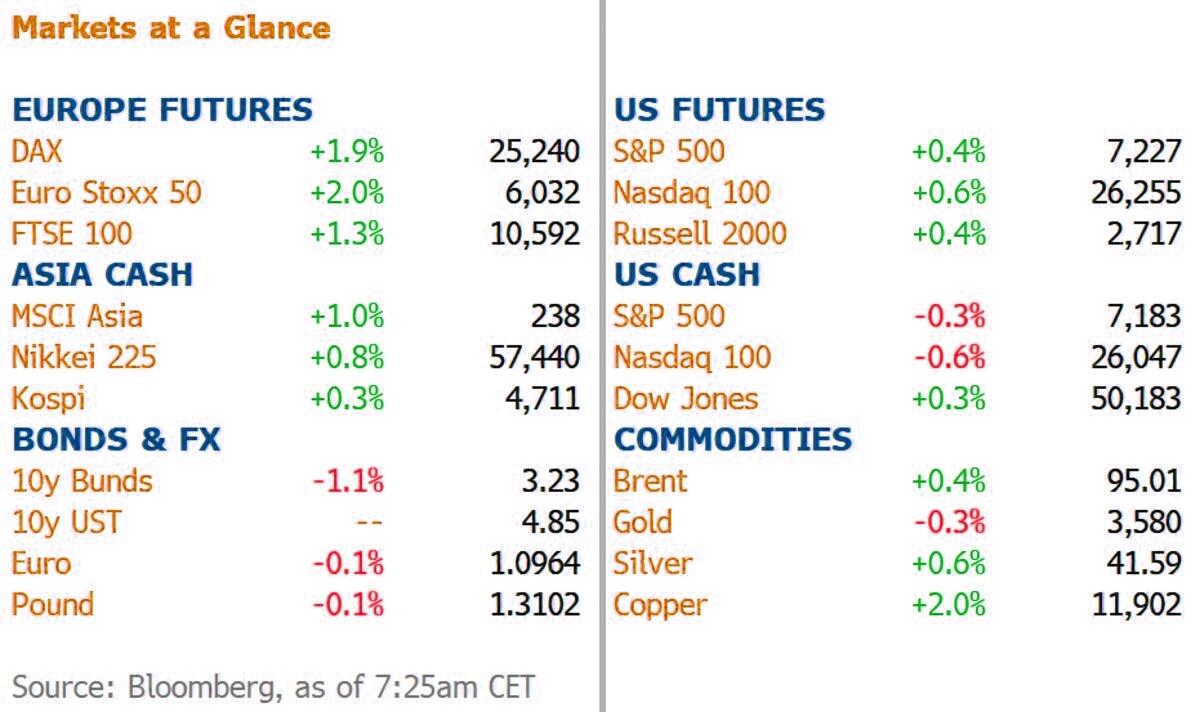
US futures are higher on Thanksgiving morning as Wednesday’s violent intraday reversal, which saw the Nasdaq 100 dip into a bear market before closing down just 0.6%, carries over into a broad global risk rebound, with the AI trade getting a second wind even as S&P put Nvidia on negative credit watch, Nvidia froze server shipments to four Southeast Asian nations and lenders slammed the brakes on Chinese data center loans; oil meanwhile is higher again after Yemen’s Houthis struck Saudi Red Sea ports, while copper jumps more than 3% off an 11-month low. US cash markets are closed for Thanksgiving (and close early on Friday), so the bounce gets a day to settle in thin, futures-only trading. As of 9:00am ET, Nasdaq futures are up 0.8%, having been up as much as 1% overnight, while S&P futures are 0.7 higher, near session highs, and Dow futures are 0.5%. On Wednesday, the S&P closed down 0.25% at 7,183 after tumbling as much as 3.2%, the Philly semis index clawed back from an 8% plunge to close down 0.65%, the equal-weight S&P rose 0.8% with 372 stocks higher, and the VIX closed at 28.29 after spiking to 34.95, as we detailed last night. There is no premarket session today, but the chip trade is leading the rebound overseas, with SK Hynix, Delta Electronics and Hon Hai among the biggest EM gainers, Kioxia and SoftBank up double digits in Tokyo and European semis rallying in sympathy. The day’s driver is the bounce itself: nobody can quite explain Wednesday’s turnaround, with Goldman’s desk calling it an abatement of supply rather than a wave of buying, and turnover in S&P stocks about 5% below the 20-day average (hardly the flush that marks a bottom). In rates, cash Treasuries are closed but futures have dipped, implying about a 2bp rise in the 10Y from Wednesday’s 4.85% close, as haven demand ebbs and higher oil prices weigh; Bunds and gilts are 2-3bps cheaper in a bear-flattening move. In FX, the Bloomberg Dollar Index is little changed while the Swiss franc, the haven of choice during Wednesday’s rout, is the worst G10 performer, down 0.4% against the greenback. In commodities, WTI rises 0.7% to $84.27 and Brent trades near $95 after the Houthi strikes on Jeddah and Jazan; silver tops $41 while gold slips. Bitcoin is back above $60,000. There is no US economic data or Fed speakers today given the holiday; the ECB publishes the account of its October meeting at 7:30am ET, and EU leaders gather in Brussels for a Euro Summit.
In other corporate news, S&P placed Nvidia’s AA rating on CreditWatch negative over governance concerns following the departure and return of CEO Jensen Huang, a review that will be limited to one notch, confirming our article from yesterday; Moody’s, meanwhile, kept its Aa1 rating with a stable outlook. Nvidia told manufacturing partners including Dell and Super Micro to stop shipping servers to buyers in Malaysia, Singapore, Thailand and Indonesia as US export controls tighten, according to the FT, and lenders have paused billions of dollars in data center loans tied to ByteDance, Alibaba and Tencent after the new US chip curbs. Palo Alto fell 3.7% after hours after a former executive sued, claiming he was fired for fighting accounting fraud; Targa Resources slid 3.3% after hours on reports it is in talks to buy Kinetik; and Vertex dropped 7.1% after the FDA extended the review of its kidney drug povetacicept by up to three months. The FCC approved SpaceX’s request to launch up to 1 million satellites for orbital data centers, even as the GPU landlord reportedly slashed Blackwell rents. Leopold Aschenbrenner’s Situational Awareness told investors it lost 65% after fees in the third quarter, while Michael Burry said he dumped his Nasdaq 100 puts and is now more long than short. A group led by Todd Boehly agreed to buy Lukoil’s international oil and gas assets.
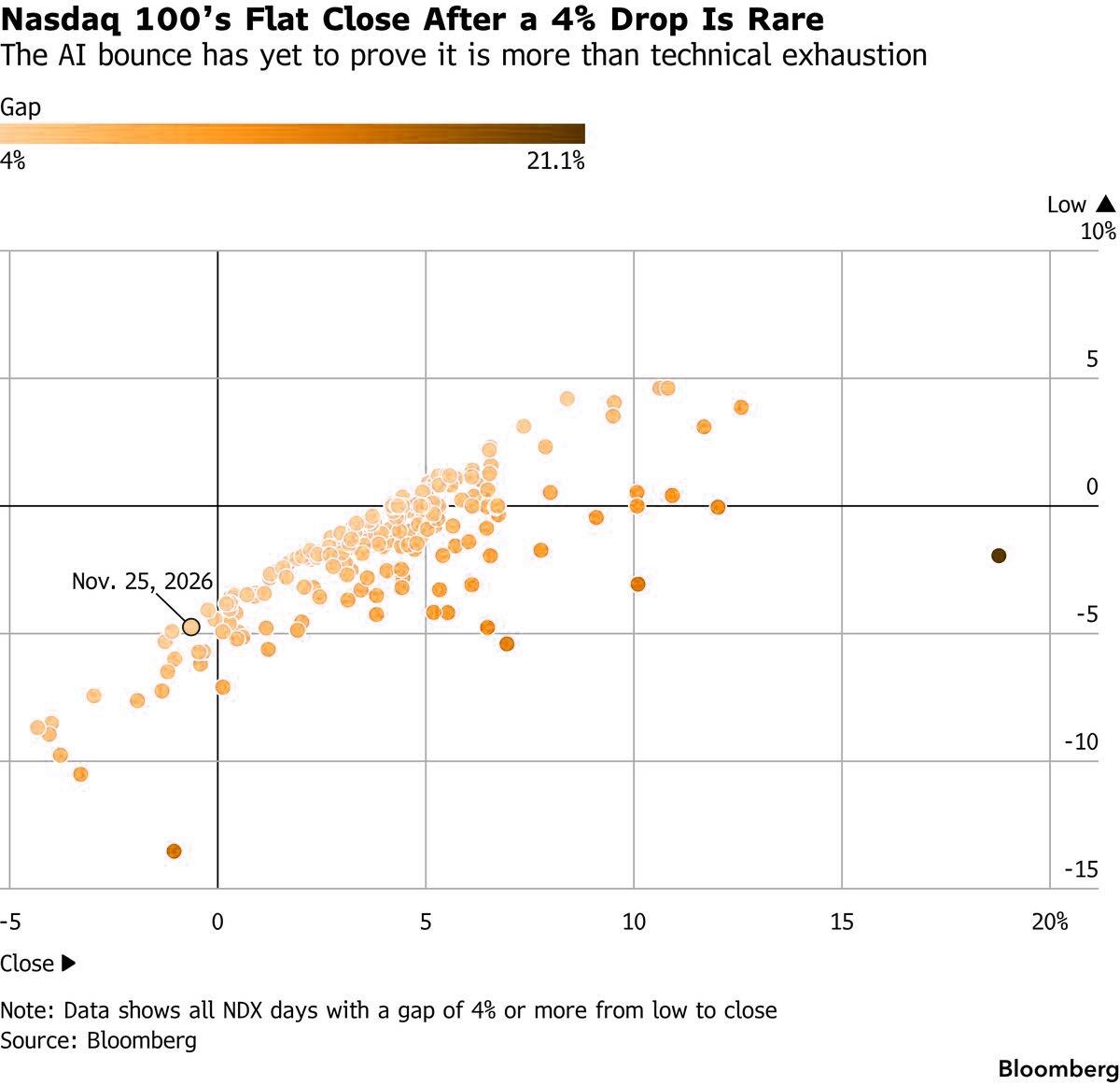
Wednesday’s session was one for the record books: the Nasdaq 100 was down 4.7% at its trough and finished just 0.6% lower, a reversal seen only 16 times since 1988, most recently in April 2025 and January 2022, according to Bloomberg. At the low, the tech-heavy index was 20% below its Oct. 6 record close, the bear-market line it also touched on Nov. 20 without closing below it. Even after the bounce, it is still down 8.2% in November. Bloomberg’s Jan-Patrick Barnert summed it up as a bounce still searching for a reason: welcome relief, but not yet a turn, with the line to watch being the bear-market threshold the Nasdaq has now touched twice.
The rebound is notable because the macro data stubbornly refuses to cooperate with the AI doom narrative: Q3 GDP was revised up to 4.3% annualized from 3.4%, initial claims fell to 189k and new home sales jumped to 701k, the highest this year. Yet the Fed under Kevin Warsh is still priced to hike in December, with DB noting odds slipped only to 96% by the close. That’s the tension Bloomberg’s Simon White flags in his latest MacroScope column: stress in markets and survey data is approaching the threshold that has historically pushed the Fed to pivot, and if the Fed loosens in response to soft-data stress while the hard data holds up, a “lucky escape” for stocks is possible; but with over two hikes priced by March, there is little sign of that yet.
“AI capex remains intact, financing is still readily available and pricing power is exceptional,” said Marija Veitmane at State Street Global Markets. “Sentiment cracked, fundamentals didn’t. With tech valuations looking increasingly attractive, the selloff may be starting to create its own reversal.”
Not everyone is convinced the worst is over. HashKey Capital partner Mia Mai said the rebound is not a full recovery until conviction in AI returns, and that investors are still holding off. Capital.com’s Kyle Rodda pointed to the other overhang, arguing that the return of global trade uncertainty is bad for markets in general, after the US unveiled a fresh round of tariffs on China, the EU and a dozen other economies to rebuild the tariff wall the Supreme Court struck down. Corpay’s Peter Dragicevich was more upbeat, suggesting the holiday could quiet volatility and that risk sentiment may be close to stabilizing.
For Joachim Klement at Panmure Liberum, caution remains warranted for stocks, especially since there was no clear catalyst for the tech rebound. The likelihood of a US interest rate hike next month threatens to push the cost of capital even higher, adding to headwinds for the AI trade.
“It’s a real mystery why dip buyers emerged,” he said. “Friday will be the real test if the recovery has staying power.”
Goldman’s US equity desk had few answers for either the drop or the bounce. Top-down net exposure management through ETFs was driving the bus, with ETFs accounting for 37% of the tape, a YTD high, while the desk graded activity on its own floor a 2 on a 1-10 scale, saying institutional flows were not commensurate with the size of the swings. Early supply hit semis and hyperscalers, the latter weighed by SemiAnalysis cutting its chip-leasing price estimates and soft checks on Google ad spend. Looking ahead, the desk models pensions as buyers of $15.5 billion of US equities into month-end, in the 84th percentile since 2000. Goldman’s Tony Pasquariello argues that last Friday marked the apex of one of the most full-bore pockets of deleveraging he has ever seen, with hedge funds selling global tech at the fastest pace in at least a decade, and that the condition of genuine fast-money capitulation has now been satisfied. The machines, however, have not: Goldman’s systematic desk estimates about $70 billion of global equity sales by trend-followers in the past week with another $100 billion to go over the next week, and Prime Brokerage data shows aggregate net exposure to AI stocks at the lowest since September 2025.
Goldman’s London TMT desk notes that the credit market is not buying the bounce yet: record CDS levels at Oracle and Alphabet suggest concerns are spreading to higher-quality names, while CoreWeave’s 5Y CDS widened another 122bps on Wednesday to an all-time wide of 1,452bps, per DB. Meanwhile the new BIS rule closing the China remote-access loophole is biting, with the desk describing Nvidia’s halted server orders as a pause, not a cancellation, and an unusual volume of already-deployed B300s appearing on the secondary market. Goldman’s Edoardo Greco thinks markets are now due some stalling, with bear market rallies to be expected while nets stay low, and a December Fed hike almost certain.
JPM’s Market Intel desk says the Thanksgiving turnaround is boosting risk sentiment, with its derivatives desk flagging US protection unwinds, and stays tactically bullish on global equities, though it sees the tech bounce as more technical and short-term than the V-shaped recovery of the first half, as buyside capex expectations show signs of peaking. JPM’s Positioning Intel team argues 2018 may be the downside exception rather than the base case: hedge fund net exposure has fallen more than 30% from its 12-month high, comparable to late 2018 and March 2020, gross flows are recovering and shorts have been added back quickly, while the remaining capitulation risk sits more with asset managers and a reversal in ETF flows than with hedge funds or CTAs.
In Europe, the bank sector has the most ground to make up after falling about 3% on Wednesday on a Bloomberg report that the ECB had contacted lenders including BNP Paribas and Societe Generale about their exposure to hedge funds. Separately, the Bank of England said hedge fund leverage amplified recent French bond moves, and banks borrowed a record £146.9 billion from the BOE’s short-term repo tool. ECB President Lagarde told EU leaders that AI is one reason the economy has held up.
In Europe, the Stoxx 600 is up 1.7% at 636.94, snapping a two-day decline as investors return to the AI trade, with 573 members up and just 25 down; miners and autos jump the most, while semiconductor stocks rally following the late recovery at US peers. Europe only took the first half of Wall Street’s round trip on Wednesday, when the Stoxx 600 fell 1.1% for its 7th drop in 8 sessions. Babcock rose as much as 6.6% after signing its largest-ever contract with the UK Ministry of Defence, while Bachem tumbled as much as 13% after unveiling 2031 targets that JPMorgan says imply clear downside to consensus. Here are the biggest European movers:
- Halfords shares rise as much as 13%, extending big year-to-date gains, after the UK car parts and bikes retailer reported first-half results that beat expectations, and increased the bottom end of its earnings guidance.
- Babcock International shares rise as much as 6.6% after the defense firm signed an £8.7 billion Gateway Agreement with the UK Ministry of Defence, its largest-ever contract, to provide submarine maintenance and naval base services.
- Hill & Smith shares rise as much as 5.6%, rebounding from their lowest level since late June, after the maker of fabricated metal products said it now expects full-year 2026 operating profit to be modestly above current analyst expectations.
- European semiconductor stocks rally on Thursday, following a recovery at US-listed peers late into Wednesday’s close.
- ISS shares fall as much as 2.7% and are among the worst performers on the Stoxx Europe 600 in early trading, as BNP Paribas cuts its recommendation on the Danish facility-services firm to underperform, citing margin risks and a tough sales comparison.
- Shares in Erste Bank Polska drops as much as 3.6% as its Austrian parent lowered the price in a tender offer after securing a stake of more than 50% in its Polish unit.
- Mitchells & Butlers shares fall as much as 4.1% after the pub operator flagged £95 million in cost headwinds over the 2027 full year, overshadowing robust results. Shares later pare most of their losses.
- Bachem drops as much as 13%, the most in nine months, after revealing its strategy and targets through 2031 ahead of a capital markets day. The biochemical manufacturer’s new medium-term goals imply clear downside to current consensus estimates, JPMorgan writes in a note.
Asian stocks rallied but faded into the close, with the MSCI Asia Pacific Index rising as much as 1.6% as the late recovery on Wall Street brought some stability. Taiwan’s Taiex jumped 2.5% led by Delta and Hon Hai, while Japan’s Nikkei faded from around 58,000 to close up about 0.9% (Kioxia, SoftBank and Advantest made up about 93% of the gain, per Goldman), and the Topix rose just 0.1%. Korea’s Kospi rose as much as 2.6% before fading to a 0.3% gain as foreigners flipped to net sellers after the Bank of Korea hiked by 25bps to 3.25%, its third increase this year, with two dissents. Hong Kong’s Hang Seng rose as much as 2%, and the Hang Seng Tech snapped a record 11-day losing streak, while China’s CSI 300 was little changed and the STAR 50 sank 5% on reports that lenders paused AI financing. Vietnam fell 1.5% after the US proposed some of its highest tariff rates on the country. Goldman’s Asia desk called the session more of a relief bounce than a sustained risk-on reversal, with turnover 25% below average in Japan. Elsewhere, hawkish BOJ board member Naoki Tamura said he expects to hike every few months, and may need to move faster or by 50bps if inflation risks materialize.
In FX, the Bloomberg Dollar Spot Index is little changed, with the greenback firming against most majors. The Swiss franc is the worst G10 performer after being Wednesday’s haven of choice, while the Aussie outperformed in Asia, rising 0.2% to 0.6640 after Australian capex jumped 12.2% on data center spending. EUR/USD is near 1.0965, GBP/USD is down 0.1% at 1.3105 and USD/JPY holds near 159.20. The Taiwan dollar posted its biggest gain since August as AI buyers returned. Goldman’s Praneet Shah calls this an AI shock, not yet a Fed pivot, and sees the dollar supported against AI-sensitive currencies until the Fed blinks.
In rates, cash Treasuries are closed for Thanksgiving, but futures have bear steepened, implying about a 2bp rise in 10Y yields from Wednesday’s close of 4.85%, which followed the biggest daily drop in three weeks (and a sloppy 7-year auction that tailed the most since May 2024). In Europe, Bunds bear flatten with the 10Y yield up 2-3bps at 3.25% as the tech rebound saps haven demand and higher oil underpins the selloff; gilts open lower for the first time in a week, with 10Y yields up 2bps at 5.15%. Italian and French 10Y yields are steady at 4.34% and 4.74%. Traders price about 55bps of ECB hikes by the end of next year, with a December move almost fully priced, and 21bps of BOE tightening next month. JPM notes about one hike has been priced out of both the ECB and Fed curves over the past week (just in time for oil to rebound).
In commodities, oil swung as continued Middle East hostilities threaten the recovery in the region’s crude exports: WTI for January is up 0.7% at $84.27 and Brent is little changed at $94.83, after the Houthis attacked Saudi Arabia’s Jeddah and Jazan ports and the Ras Tanura refinery, and Iran claimed two tankers hit mines off Oman. Partly offsetting, tanker traffic through Hormuz has actually risen this month despite the attacks, diesel prices are easing, and OPEC+ delegates say the group is considering rolling over current quotas for January. Copper jumped more than 3% from an 11-month low, silver rose above $41/oz, while gold slipped back below $3,600 after rebounding from near a 15-month low on Wednesday.
There is no US economic data and no Fed speakers today with US markets closed for Thanksgiving. The ECB publishes the account of its Oct. 28-29 meeting at 7:30am ET and EU leaders meet in Brussels; US stock and bond markets close early on Friday, Black Friday.
Market Snapshot
Top Overnight News
- Iran claimed two tankers hit mines off Oman’s Khasab on Thursday, according to Iranian state broadcaster IRIB: BBG
- Tanker traffic through the Strait of Hormuz has risen this month even as attacks on shipping have increased: BBG
- Ukraine said it hit an oil pumping station in Russia’s Bashkortostan region, while Russia was said to have hit grain ships off Odesa: BBG
- VP Vance said the administration received assurances that Nvidia CEO Jensen Huang is not under investigation and that he doesn’t think Huang needs a pardon; Vance added it was the board’s decision to bring Huang back: Newsquawk
- China’s Ministry of State Security may have been surveilling Alice Huang and sought information from her after her affair with Nvidia CEO Huang began, citing US intelligence officials: CBS
- Nvidia sold advanced AI chips to US-based entities secretly controlled by Chinese companies, some of which were later leased or sold on to Southeast Asia: CBS
- New York Governor Hochul declared a state of emergency ahead of the storm hitting New York City, Long Island and Westchester: Newsquawk
- Nvidia halted server shipments to Malaysia, Singapore, Thailand and Indonesia as US export controls tighten, telling partners including Dell and Super Micro to stop shipping to buyers there: FT
- Nvidia chip sellers are seeking new buyers for their hardware after the Trump administration tightened restrictions on Chinese companies’ remote access to the most advanced AI systems: CNBC
- OPEC+ is considering rolling over its current oil output quotas for January, delegates said: BBG
- Japan Tobacco is said to be studying a deal for Imperial Brands: BBG
- Norse Atlantic may file for bankruptcy and suspended today’s flights: BBG
- WSJ’s Timiraos wrote, “Wild Market Swings Are Colliding With a Fed Bent on Taming Inflation”, and that Fed Chair Warsh faces a choice between raising rates to fight inflation or believing the recent stock selloff will have the same effect: WSJ
- The Fed’s Beige Book showed eight of twelve districts reporting slight to moderate growth and four no change, with prices rising moderately and sustained cost pressure from energy, transportation, healthcare, insurance and tariffs: Newsquawk
- ECB President Lagarde told EU leaders that AI is one reason the economy has held up and has helped Europe withstand higher energy prices: BBG
- Banks borrowed a record £146.9 billion from the Bank of England’s short-term repo tool, while the BOE said hedge fund leverage amplified recent French bond moves: BBG
- All of Canada’s Big Six banks now expect the Bank of Canada to hike rates in December: BBG
- Hong Kong’s October exports rose 65.6% y/y, beating the 59.4% estimate: BBG
A more detailed look at global markets courtesy of Newsquawk
APAC stocks were on the front foot following the intraday recovery on Wall St, where the major indices finished mixed, but well off earlier lows amid suspected dip buying, which helped the Nasdaq 100 rebound from a brief dip into bear market territory. ASX 200 was led higher by strength in the mining, materials, resources and energy sectors, while participants also reflected on the stronger-than-expected Private Capital Expenditure data, which showed an increase of 12.2% (exp. 4.4%). Nikkei 225 climbed amid the tech rebound and briefly reclaimed the 58,000 level, with Kioxia and SoftBank up double-digits. KOSPI gained following the recent recovery in tech stocks, although upside was capped after the BoK hiked rates for the third time this year, which was as expected, while the latest projections by board members mostly showed expectations for at least another hike in the next six months. Hang Seng and Shanghai Comp were mixed with outperformance in Hong Kong amid encouragement following earnings from Li Auto and Shein, although the mainland lagged after the US announced new tariff proposals on the EU, China, and other trade partners, while it was also reported that NVIDIA (NVDA) halted server shipments to four Southeast Asian countries as US export controls tighten.
Top Asian News
- China outlined a plan for next-generation communication networks through 2030, calling for 6G network construction when appropriate, while it pushed for advancing 5G-A, 6G and satellite development.
- China issued its 15th five-year plan for services trade, aiming for a high-quality services trade framework and global competitiveness by 2035.
- BoK hiked its benchmark rate by 25bps to 3.25%, as expected, although the decision was not unanimous as board members Lee Soo-Hyung and Hwang Kun-Il dissented, while 6 of 21 policy rate projections by board members for the next six months were at 3.25%, 8 of 21 at 3.50% and 7 of 21 at 3.75%. BoK said exports and investment are projected to maintain strong growth, supported by the semiconductor sector, although uncertainty over the growth outlook remains, particularly regarding the extent of expansion in the semiconductor sector. It added that inflation is projected to remain above target for a prolonged period as elevated cost pressures continue to feed through to prices, while the timing of further rate hikes will depend on inflation trends, domestic economic conditions and financial stability.
- BoK Governor Shin said the global economy showed sound growth and that South Korea’s economy maintained high growth aided by exports and investment. Shin also commented that policy responses were needed until the BoK was confident inflation would come back to target, adding that cost pressure was trickling down and demand-side pressure also existed. Furthermore, he stated that the BoK also raised loan interest rates for its special loan programmes.
- BoJ Board Member Tamura said underlying CPI inflation has generally reached the 2% price stability target and that monetary policy has shifted from raising underlying CPI to the 2% target to avoiding further upward deviation and stabilising it around 2%. Tamura said the policy rate needs to move towards neutral as quickly as possible, noting that real interest rates remain accommodative relative to the period of unprecedented monetary easing, as well as stated that until underlying CPI inflation is more firmly anchored, there is a risk it could swing significantly in response to an external shock, so the BoJ needs to react to such shocks faster and more forcefully. Furthermore, Tamura later commented that he envisages raising interest rates by 25bps once every few months, but added if inflation risks materialise, the BoJ may need to accelerate the pace of rate hikes or deliver a 50bps increase.
European equity futures indicate a positive cash market open with Euro Stoxx 50 futures up 2.2% after the cash market closed with losses of 1.9% on Wednesday. US equity futures edged higher in a continuation of the prior US session’s intraday recovery.
Top European News
- ECB and Riksbank concluded an agreement for Sweden to join T2, the Eurosystem’s real-time gross settlement system, while the agreement paves the way for large-value payments in Swedish kronor to be settled through T2, with migration targeted for February 2030.
- France and Germany moved to shield the EU’s next seven-year budget from a possible Marine Le Pen presidency, according to the FT.
FX
- DXY regained some composure after retreating yesterday alongside an improvement in risk sentiment and following a slew of mixed data releases, which had little sway over price action in the dollar and yields. Nonetheless, the recovery in the dollar was limited amid a lack of Fed speakers and with the Fed Beige Book a non-event, while US participants are away for Thanksgiving Day.
- EUR/USD was contained after it stalled near the 1.1000 handle and gave back most of its spoils during the prior day, while the calendar is relatively light ahead, although the ECB Minutes from the October meeting are scheduled for today.
- GBP/USD trickled lower following recent swings through the 1.3100 level, while there were several comments from BoE officials, with Governor Bailey stating that the peak in inflation would be lower if current energy prices held and Lombardelli said lower oil prices meant the likely inflation peak was below the Bank’s November forecast, although Mann noted that inflation expectations were tilted to the upside and argued that the optimal policy response was to raise rates further and sooner.
- USD/JPY traded range-bound after recent oscillations around the 159.00 level and with a lack of tier-1 data from Japan to spur price action, while hawkish comments from BoJ’s Tamura did little to shift the dial.
- Antipodeans were mixed, with NZD/USD conforming to the humdrum mood across the FX space, and with AUD nursing recent losses, with the help of improved risk sentiment and after Australian Private Capex data smashed expectations.
- PBoC set USD/CNY midpoint at 6.7096 vs exp. 6.6655 (prev. 6.7088).
Fixed Income
- 10yr UST futures continued to pull back from yesterday’s peak alongside the rebound in risk sentiment, while prices were not helped by a mixed 7-year note auction and with US markets shut for the Thanksgiving Day holiday.
- Bund futures retreated to test the 123.00 level to the downside as recent gains in oil prices increase inflationary pressures, and with demand also constrained by the improved risk sentiment.
- 10yr JGB futures followed suit to the reversal in global peers, with prices returning to around the 128.00 level, while there were hawkish comments from BoJ’s Tamura that the policy rate needs to move towards neutral as quickly as possible and he sees raising interest rates by 25bps once every few months, but added if inflation risks materialise, the BoJ may need to accelerate the pace of rate hikes or deliver a 50bps increase.
Commodities
- Crude futures extended their gains amid ongoing geopolitical tensions and increased risks to Saudi Arabia’s production, with the Houthis striking the Ras Tanura refinery (550k BPD), while the Houthis also struck Saudi Arabia’s Jeddah and Jizan ports in retaliation for a Saudi attack on the port of Hodeidah in Yemen.
- Spot gold failed to sustain a retest of the USD 3,600/oz level after rebounding from around a 15-month low.
- Copper futures advanced alongside the improvement in global risk sentiment.
Trade/Tariffs
- US and China will work towards stable agricultural trade, with their agricultural working group to continue discussions.
- White House accused South Korea of breaking its promise to US President Trump to treat US tech companies fairly, stating that Seoul has since fined Coupang (CPNG) hundreds of millions of dollars, according to Fox News.
- Japan’s Chief Cabinet Secretary Kihara called proposed US tariff measures against Japan regrettable.
- Singapore’s Trade Minister said they disagree with USTR’s findings and are very disappointed by the proposed tariff actions, while he added that findings do not take into account the structure of Singapore’s economy, as well as urged the USTR to reconsider proposed actions and explore ways to reduce tariffs.
- India’s government said it remained committed to working closely with the US towards an early conclusion of the India-US bilateral trade agreement. New Delhi had taken note of the USTR Section 301 determination, which was currently under examination, and said it had engaged constructively throughout the investigation, while India added that it did not have structural excess capacity in any sector.
- Brazil protested the US recommendation on new aircraft and sugar tariffs, saying it aimed to pressure the government into national regulatory changes, while it pledged to seek a negotiated solution, but did not rule out reciprocal measures.
Geopolitics: Middle East
- Israeli security cabinet meeting was cancelled, with analysts said to believe that the cancellation most likely resulted from escalating disputes among Israeli officials regarding the Iran issue, according to Mehr News Agency.
- UKMTO received a report of an incident 50 nautical miles west of Dubai, UAE, where a tanker master reported an explosion caused by an unknown projectile close to the vessel, although the crew were safe and no damage to the tanker or environmental impact was reported.
- Saudi-led coalition said it intercepted and destroyed a drone launched by Yemen’s Houthis in the vicinity of Jeddah port, while it also said it destroyed two drones over the kingdom’s eastern region.
- Houthis said they carried out two successful operations, directly striking Jeddah port and Jizan port in Saudi Arabia.
Geopolitics: Ukraine
- Kyiv Mayor said the city was under attack from ballistic missiles.
- Russia’s Defence Ministry said forces conducted a massive strike on Ukraine overnight and hit defence industry facilities in Kyiv and a vessel in the Black Sea.
- Russia repelled a drone attack on an industrial area in Nevinnomyssk, according to the regional governor.
- China’s MOFCOM said it welcomes the EU decision to lift privately-owned Yusha Group from the Russia-related export sanctions list.
Geopolitics: Other
- US President Trump and NATO Secretary General Rutte held an “outstanding” meeting, in which they discussed the Iran and Russia-Ukraine conflicts, as well as US and NATO defence spending.
- North Korean leader Kim Jong Un said the nuclear weapons sector should focus on deploying tactical nuclear weapons across multiple domains, and that nuclear material production capacity was being systematically expanded, according to KCNA.
- South Korea’s Defence Ministry urged North Korea to stop justifying nuclear development and comply with UN Security Council resolutions.
Crypto
- Bitcoin edged higher in a choppy fashion and tested the USD 61,000 level to the upside.
US Event Calendar
- No US economic data: US markets closed for Thanksgiving
Central Bank Speakers
- No Fed speakers scheduled
- 7:30am: ECB publishes account of Oct. 28-29 policy meeting
DB’s Jim Reid concludes the overnight wrap
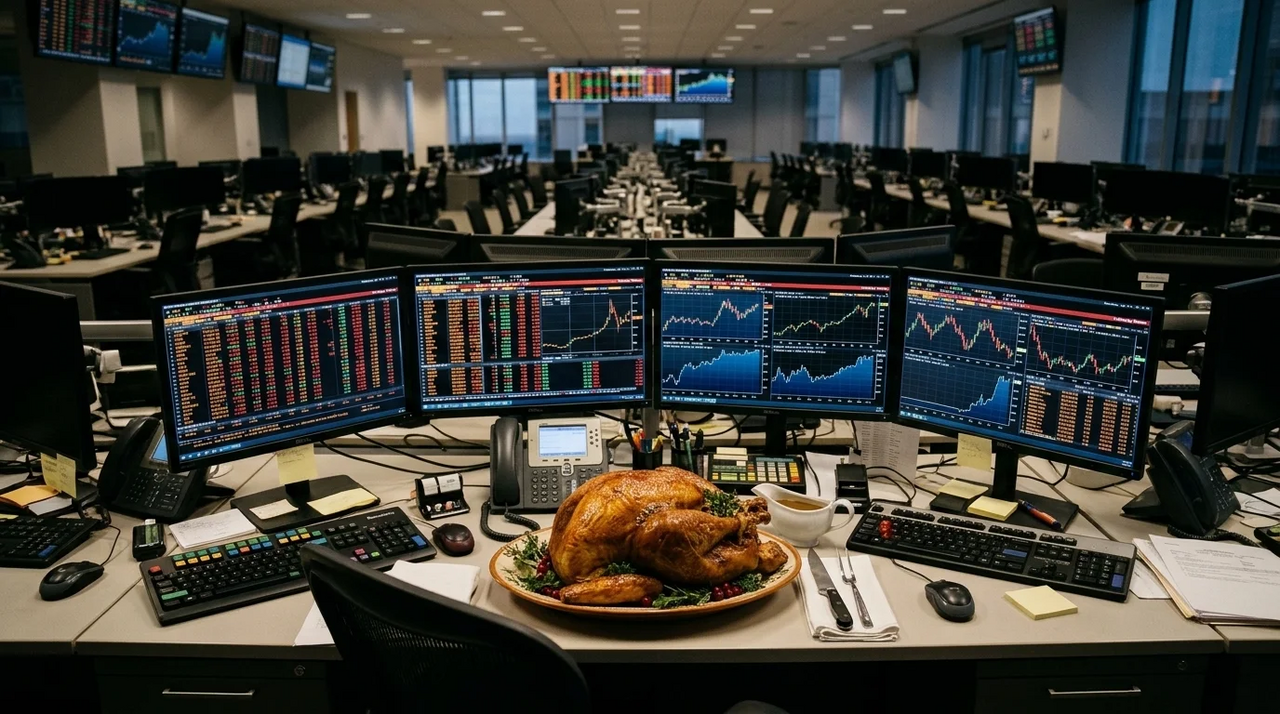
Happy Thanksgiving to all our American readers and if you’re up reading this live it must mean you forgot to take the turkey out of the freezer last night. Good luck. For many in financial markets it may be a bit more of a stressful Thanksgiving than normal given the recent market performance.
At one point yesterday the market slump was approaching Friday’s level of severity with the S&P 500 -3.21% at the lows and not much higher when Europe closed. However perhaps no-one wanted to have a stressful Thanksgiving as the S&P 500 rallied back hard to close ‘only’ -0.25% lower with 372 stocks higher and the equal-weight index up +0.82%. At the peak of the sell-off, the Philly semiconductor index was down -7.96% and fell beneath Friday’s low. However, the late rally lifted it to only -0.65% lower on the day, though the index is still down close to -40% since its record in June. Amid the volatility, the VIX Index (+1.93pts) closed at 28.29, from a peak of 34.95pts earlier in the session, whilst the risk-off move still pushed the 10yr Treasury yield (-7.5bps) down to 4.86%.
Going through the sell-off in more detail, the rally back was varied across sectors, as well as within tech itself. For instance, Nvidia (-3.91%) saw another sizeable decline as it fell for the 9th time in the last 10 sessions, and was also put on negative credit watch by S&P due to governance and management issues. As usual the review will take up to 90 days and they said it would be limited to one notch. So at AA currently this would “only” take it down to AA-.
Elsewhere CoreWeave (-0.08%) effectively reversed an opening decline of -12%. However, tech names came under more consistent pressure in the credit space, as CoreWeave’s 5yr CDS widened another +122bps yesterday to an all-time wide of 1452bps, whilst Oracle’s 5yr CDS (+8bps) also hit a new wide of 371bps. At the positive end, materials (+1.84%) and industrials (+0.82%) led the gains within the S&P 500. So this is a better market than last week when everything sold off for the first time rather than the rotation trade alternating between tech and non-tech. In fact, the renewed rotation trade has now seen the equal-weight S&P rise +3.97% so far this week, its best 3-day run since April 2025.
As all that was happening, we got a fresh reminder of how unusual this selloff has been, in that the US macro data has remained incredibly positive. Most notably, the Q3 GDP print was revised up to an annualised rate of +4.3%, having been at +3.4% before. And the measure showing “Real final sales to private domestic purchasers”, which has sometimes been called “core GDP”, was even revised up to an annualised +5.8%. So there was incredible strength, and that wasn’t just in the backward-looking numbers either. For instance, the weekly initial jobless claims fell to 189k in the week ending November 21 (vs. 200k expected), pushing the 4-week moving average back down to 196k. Meanwhile, new home sales unexpectedly jumped to an annualised rate of 701k (vs. 650k expected), which is their highest this year. So for all the focus on AI-exposed firms, there was still no sign of a broader macro slowdown that’s driven many past selloffs. Indeed, even after the dot com bubble, remember that the S&P 500 only entered bear market territory in March 2001, a full year after the peak, just as the US was entering an outright recession.
With the sell-off at its intra-day peak, Fed pricing was coming under significant pressure, with fresh doubts about whether the Fed could keep hiking for much longer, even though we had a firm core PCE inflation print for October. That showed monthly core PCE at +0.3% as expected, whilst the year-on-year print was a bit stronger than consensus at +3.3% (vs. +3.2% expected). The rally back took us off the lows but market pricing for a December hike was still down to 96% by the close, having been fully priced the previous day. And looking deeper into next year, the amount of hikes priced in by the September 2027 meeting fell -4.3bps on the day to 66bps. So that led to a decent rally for US Treasuries, with the 10yr yield (-7.5bps to 4.86%) posting its biggest daily decline in three weeks, while the 30yr yield (-7.2bps) fell to its lowest since early September at 5.25%. The 2yr yield was down a more modest -4.2bps to 4.64%, as oil prices posted further gains amidst ongoing reports of multiple attacks in the Middle East in recent days, with Brent crude (+3.51%) up to $94.61/bbl.
With everything else happening, we also had some fresh tariff news, as the US sought to rebuild the tariff wall following the Supreme Court ruling earlier this year. So the rate on China would be at 20%, although this could be doubled if trade talks fell apart. Then the EU and Japan would face a 15% rate, which could rise as high as 20% for each, whilst South Korea would face a 15% rate, which could go up to 25%. But there wasn’t much of a direct market reaction, as we’d already had multiple headlines the previous day suggesting this might happen.
Another asset class that saw some big moves over the last 24 hours were precious metals. Gold fell as much as -3.66% intra-day, which put it on course for its lowest level since August 2025, but it recovered to +0.85% on the day at $3.587/oz by the close. Similarly, silver reversed a -6.51% intra-day decline to close +0.91% higher. Meanwhile, industrial metals did lose further ground, with copper (-0.61%) down to its lowest since December 2025.
Earlier in Europe, the risk-off tone that dominated the US session until the continental close was also clear, albeit to a lesser extent given the continent’s lower exposure to tech. So that meant the STOXX 600 (-1.06%) fell for the 7th time in the last 8 sessions, alongside losses for the DAX (-1.26%), the CAC 40 (-0.75%) and the FTSE 100 (-0.38%). Then for sovereign bonds, we saw yields on 10yr bunds (-3.5bps), OATs (-3.8bps) and BTPs (-1.0bps) all move lower, so that’s continued to ease some of the fiscal pressure in Europe. Indeed, the 10yr bund yield fell to a 3-month low of 3.23% by the close.
Asian equities are rebounding sharply this morning led by the TAIEX (+2.79%), Hang Seng (+1.91%), Nikkei (+1.82%) and KOSPI (+1.31%). Mainland Chinese equities continue to be far lower beta with the Shanghai Composite (+0.20%) higher. US equity futures continue with their remarkable last 12 hour comeback with S&P 500 (+0.66%) and Nasdaq 100 (+0.96%) futures higher and Stoxx (+2.22%) futures surging given what’s happened since the European cash market closed yesterday.
On the policy front, the Bank of Korea (BoK) delivered a widely expected 25bp rate hike, raising its policy rate to 3.25%, the highest level in two years and the third increase of 2026, as policymakers continue to combat persistent inflationary pressures. The central bank also upgraded its 2026 GDP growth forecast to 3.9% from 3.3% and projects growth of 4.1% next year, reflecting sustained strength in semiconductor exports and robust global demand linked to the AI sector. However, stronger growth and a tighter housing market have contributed to more persistent domestic inflation pressures. The BoK also revised its CPI forecast modestly higher to 2.4% from 2.3%.
Elsewhere, BoJ board member Naoki Tamura signalled that the central bank may need to tighten policy more aggressively if inflation risks intensify and move beyond target. Tamura highlighted rising input costs, particularly higher crude oil prices associated with Middle East tensions, as a key factor behind accelerating wholesale inflation, noting that price pressures have broadened across a wide range of consumer goods. He emphasised that the BoJ should respond promptly to any signs of inflation overshooting its objective, potentially by accelerating the pace of rate hikes. Notably, Tamura had supported keeping policy rates unchanged at the BoJ’s October meeting. This has helped flatten the curve with 2yr yields up a basis point and 30yr yields down -2bps.
Looking at the day ahead, it’s a fairly quiet one given the US Thanksgiving holiday. Otherwise though, we’ll get the account of the ECB’s October meeting, and data includes the Euro Area M3 money supply for October. Finally, EU leaders will be meeting in Brussels. But mostly it will be about eating turkey.
Source: https://freedombunker.com/2026/11/26/futures-extend-thanksgiving-turnaround-as-nasdaq-dodges-bear-market-oil-climbs-on-houthi-strikes/
Anyone can join.
Anyone can contribute.
Anyone can become informed about their world.
"United We Stand" Click Here To Create Your Personal Citizen Journalist Account Today, Be Sure To Invite Your Friends.
Before It’s News® is a community of individuals who report on what’s going on around them, from all around the world. Anyone can join. Anyone can contribute. Anyone can become informed about their world. "United We Stand" Click Here To Create Your Personal Citizen Journalist Account Today, Be Sure To Invite Your Friends.
LION'S MANE PRODUCT
Try Our Lion’s Mane WHOLE MIND Nootropic Blend 60 Capsules
Mushrooms are having a moment. One fabulous fungus in particular, lion’s mane, may help improve memory, depression and anxiety symptoms. They are also an excellent source of nutrients that show promise as a therapy for dementia, and other neurodegenerative diseases. If you’re living with anxiety or depression, you may be curious about all the therapy options out there — including the natural ones.Our Lion’s Mane WHOLE MIND Nootropic Blend has been formulated to utilize the potency of Lion’s mane but also include the benefits of four other Highly Beneficial Mushrooms. Synergistically, they work together to Build your health through improving cognitive function and immunity regardless of your age. Our Nootropic not only improves your Cognitive Function and Activates your Immune System, but it benefits growth of Essential Gut Flora, further enhancing your Vitality.

Our Formula includes: Lion’s Mane Mushrooms which Increase Brain Power through nerve growth, lessen anxiety, reduce depression, and improve concentration. Its an excellent adaptogen, promotes sleep and improves immunity. Shiitake Mushrooms which Fight cancer cells and infectious disease, boost the immune system, promotes brain function, and serves as a source of B vitamins. Maitake Mushrooms which regulate blood sugar levels of diabetics, reduce hypertension and boosts the immune system. Reishi Mushrooms which Fight inflammation, liver disease, fatigue, tumor growth and cancer. They Improve skin disorders and soothes digestive problems, stomach ulcers and leaky gut syndrome. Chaga Mushrooms which have anti-aging effects, boost immune function, improve stamina and athletic performance, even act as a natural aphrodisiac, fighting diabetes and improving liver function. Try Our Lion’s Mane WHOLE MIND Nootropic Blend 60 Capsules Today. Be 100% Satisfied or Receive a Full Money Back Guarantee. Order Yours Today by Following This Link.


| Visits: | 1,839,810,007 |
| Stories: | 8,744,376 |
Whistler Blowers, Insiders

