

Futures Rise As Oil Slides Below $100 On Trump Iran Diplomacy Report, Tech Bounces Ahead Of Midterms

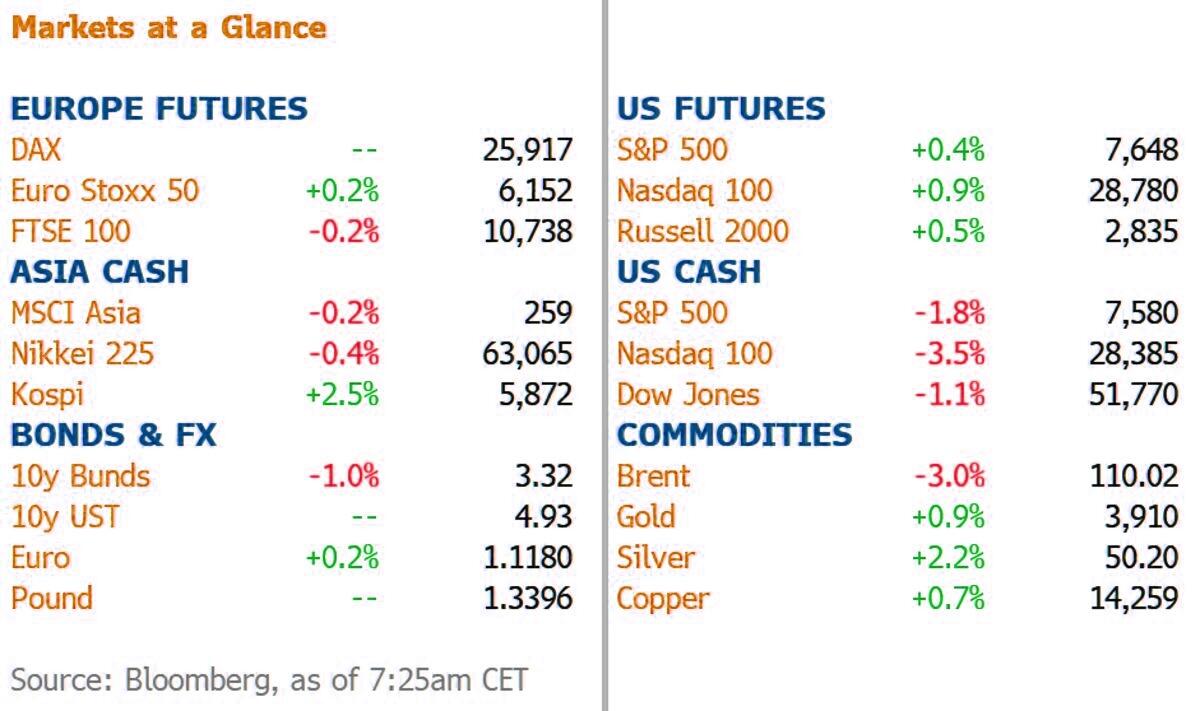
US futures are higher as a slide in oil, a tentative tech rebound and some old-fashioned seasonality lift sentiment on the eve of the midterms: crude tumbled more than 4% after Axios reported that Trump told Netanyahu he wants to give diplomacy with Iran more time before resuming strikes, chips bounced after Friday’s 7.2% SOX puke, and Chinese stocks jumped as Beijing convened yet another market rescue meeting; as a result Nasdaq futures are up almost 1% and WTI is back below $100. As of 8:00am ET, S&P futures are 0.3% higher at 7,638, well off session highs, while Nasdaq futures rise 0.6% to 28,758 and Dow futures are 0.4% higher. On Friday the S&P fell 1.8% and the Nasdaq 100 tumbled 3.5%, the worst day for both since June, capping a month in which the Nasdaq 100 lost 6.7% while the equal-weight S&P gained 5%. In premarket trading, Mag 7 names are mostly higher led by Nvidia and Alphabet, which opened the books on a seven-part bond offering spanning two to 19 years; Apple dips ahead of its earnings after the close. Semis and memory names rebound, while energy names slide with crude. The day’s driver is oil (again): Brent dropped as much as 4.4% to around $108.40 and WTI to $99.59 after the Axios report, and despite Goldman raising its year-end Brent forecast to $105 from $90; Iran’s FM said Qatar-mediated talks are making progress while Supreme Leader Mojtaba Khamenei ordered commanders to prepare for renewed confrontation, so the post-midterm strike window remains very much open. Treasuries are mixed with the curve pivoting flatter: long-end yields are about 2bp lower on the oil slump while the 10Y is little changed near 4.92%; gilts outperform, with the 10Y yield down about 5bp to 5.23%, the lowest since Sept. 23, on lower oil and gas prices, while OATs edge higher despite Fitch cutting France’s outlook to negative in an unscheduled move. The Bloomberg Dollar Spot Index drops 0.2% to a one-week low and the euro jumps 0.5% to 1.1214, its biggest gain in more than two weeks. In commodities, gold rises about 0.6% toward $3,900 and silver climbs back above $50, while LME copper gains 0.8%. Bitcoin trades just below $78,000 as Binance customers pull almost $5 billion after the exchange reopened following last week’s record hack. US economic data slate includes the October final S&P Global manufacturing PMI (9:45am), ISM manufacturing and September construction spending (10am) and the Fed’s Senior Loan Officer survey (2pm); Fed speaker slate includes Chicago’s Goolsbee (11:15am). Treasury sells $95 billion of 13-week and $82 billion of 26-week bills at 11:30am. Apple and Palantir report after the close.
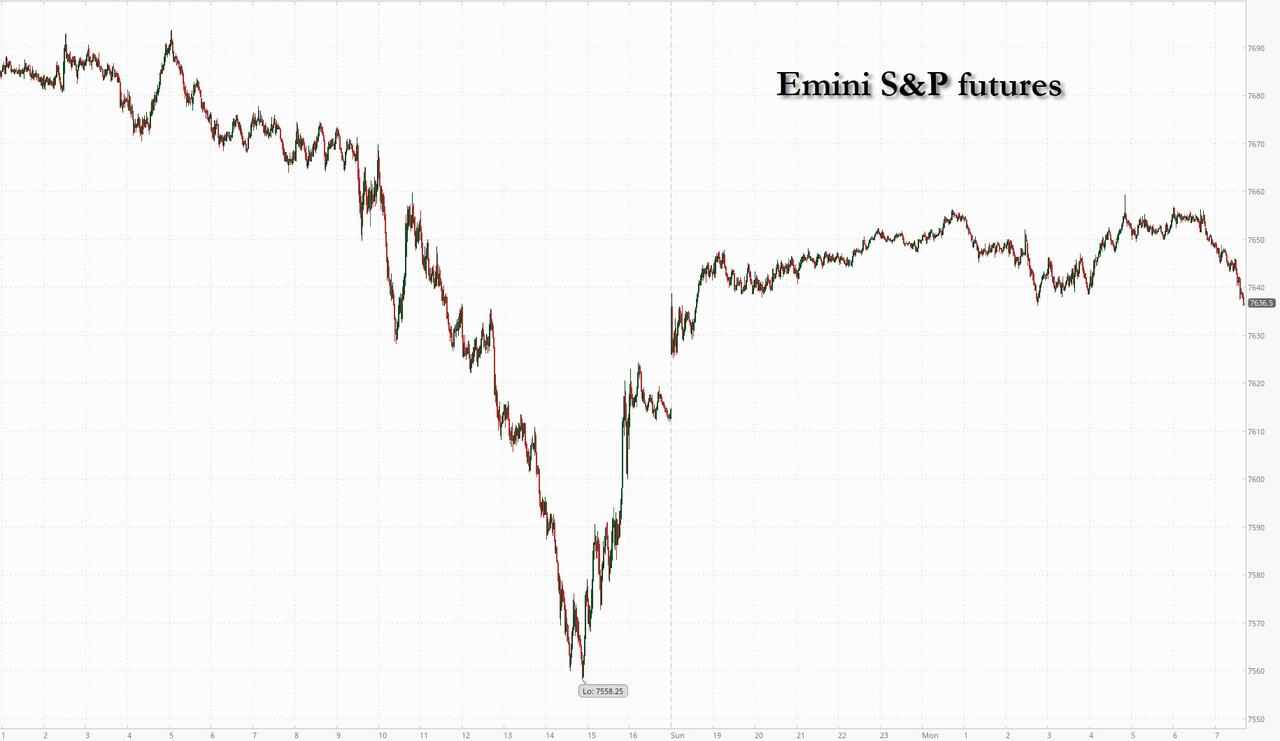
In premarket trading, Nvidia and Alphabet lead gains among the Mag 7 as tech stocks are set to rebound: Nvidia (NVDA) +1.0%, Alphabet (GOOGL) +0.7%, after opening the books on a seven-part offering spanning maturities from two to 19 years (Amazon +0.3%, Tesla +0.7%, Microsoft +0.4%, Meta Platforms (META) -0.6%, Apple (AAPL) -0.1%).
- Check Point Software (CHKP) drops 6% after the company reported revenue for the third quarter that missed the average analyst estimate.
- Crowdstrike (CRWD) rises 3% after Deutsche Bank upgraded the security software company to buy, seeing tailwinds related to AI.
- Estee Lauder (EL) gains 3% after reporting better—than-expected earnings and raising its outlook, the latest sign the beauty conglomerate’s turnaround effort is winning over consumers.
- Floor & Decor (FND) slips 1.6% after Goldman Sachs cut the recommendation to sell. The downgrade came after the flooring products supplier said comparable sales are down to start the fourth quarter.
- Geo Group (GEO) gains 3% after securing a contract from US Immigration and Customs Enforcement to provide support services at the 2,329-bed Big Spring Complex in Texas.
- Idexx Labs (IDXX) rises 6% after the animal health firm boosted its revenue guidance for the full year, following results for the third quarter that beat the average analyst estimate.
- Inovio Pharmaceuticals (INO) rallies 50% after the biotech got accelerated FDA approval for Voceryq, an immunotherapy to treat adults with recurrent respiratory papillomatosis.
- Kosmos Energy (KOS) falls 7% after the oil and gas company reported third-quarter adjusted earnings per share that missed the average analyst estimate as weather weighed on results.
- Marvell Technology (MRVL) climbs 1% after reaching a deal to buy Lumentum at an enterprise value $115 billion in a race to capitalize on the artificial intelligence boom. Lumentum (LITE) slips 1%.
- Okta (OKTA) rises 2% as the stock will replace Kenvue Inc. in the S&P 500 effective Wednesday.
- Once Upon a Farm (OFRM) falls 12% after the children’s nutritional food company said it will host a business update conference call/webcast at 8:30am NY time to discuss the company’s voluntary recall of its Tractor Wheels soft-baked bars due to potential choking hazard that was issued on Oct. 30.
In other corporate news, OpenAI cut its fundraising target by $10 billion to around $20 billion at a $1.25 trillion valuation (down from $30 billion at $1.4 trillion last month), as the AI selloff and rival Anthropic’s impending public listing complicate efforts to round up commitments (which is the polite way of saying the circular financing merry-go-round is slowing down); Anthropic, meanwhile, plans a Japan share sale worth as much as $3.5 billion ahead of its Nasdaq listing. Alphabet is back in the euro bond market for the second time this year, testing investor appetite after stress in tech debt pushed sector spreads wider. Perion soars after agreeing to be bought by Affle 3i; Xcel Energy is offering $2 billion of convertible notes; OPay halted its NYSE IPO citing a regulatory inquiry; BP completed the $6 billion sale of Castrol; and TotalEnergies is buying an operated interest in two Malaysian gas fields. Precigen, which markets a rival RRP treatment, tumbled after Inovio’s approval.
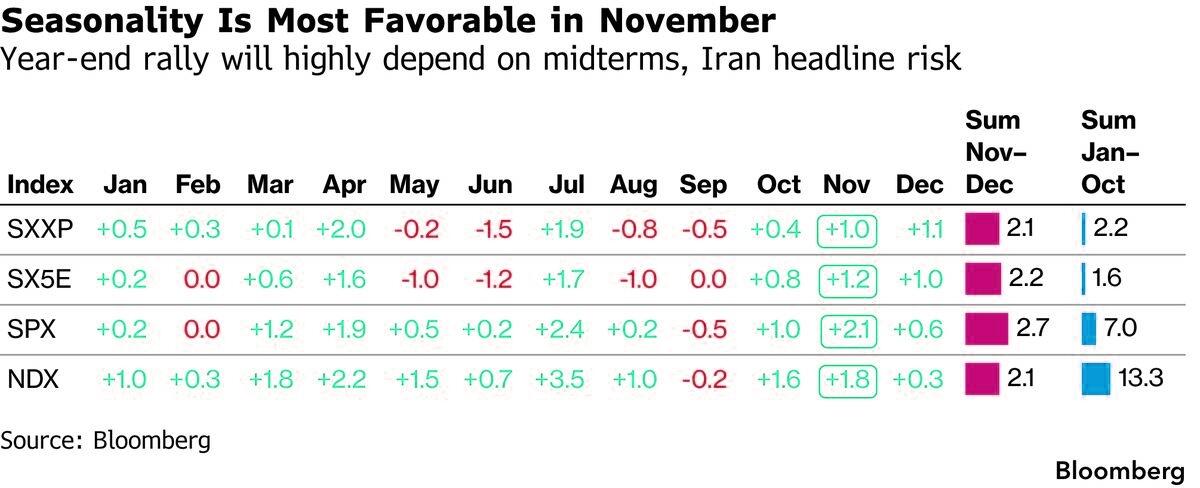
Stocks are starting November on the front foot after Friday’s tech rout, helped by a slump in oil that is giving risk assets and bonds a lift alike ahead of Tuesday’s midterm elections. As Bloomberg’s Jan-Patrick Barnert put it, the bounce is the easy part: seasonality favors the bulls, but tomorrow’s US midterms are anyone’s game. The S&P 500 has averaged a 2.1% gain in November over the past 20 years, and UBS already warned that the best month of the year meets near-record shorts, setting up a year-end squeeze.
Morgan Stanley’s Mike Wilson sees a few “clearing events” ahead that could take stocks lower temporarily, creating a great opportunity for investors to pile back in, while Oaktree’s Howard Marks said the recent AI stumbles have somewhat burst the bubble of infallibility around the sector. Not exactly a ringing endorsement for chasing the bounce.
“The key question is whether we are seeing a temporary correction in the very popular technology trade, or maybe the beginning of a reassessment of all these AI-related plays,” said Chaltan Wang, a portfolio manager at HashKey Capital.
“The USD remains caught between AI and oil,” said Moh Siong Sim, FX strategist at OCBC Bank Singapore.
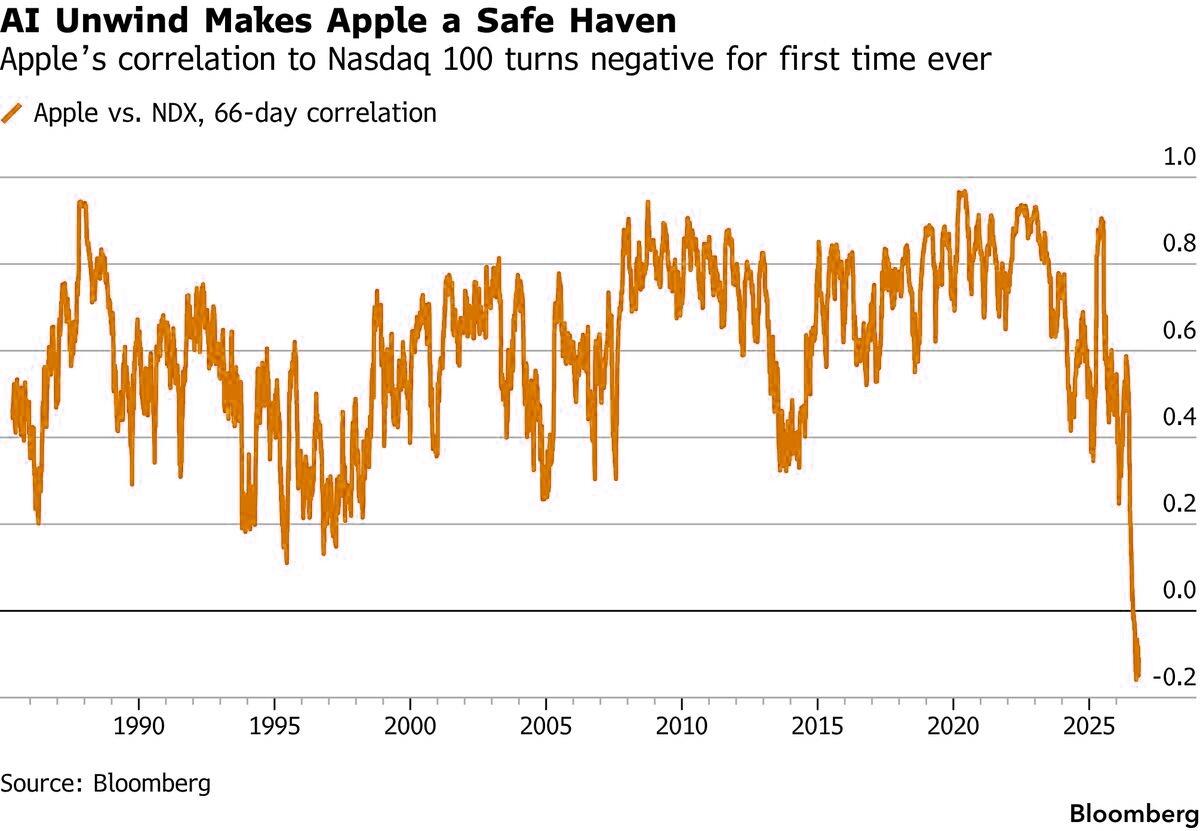
Meanwhile, the AI unwind has turned Apple into a safe haven: the company reclaimed the title of world’s most valuable on Friday and its correlation to the Nasdaq 100 has turned negative for the first time ever, which means tonight’s results and Palantir’s multiple will test how far Friday’s derating has to run.
On the midterms, Trump is already addressing the possibility of a setback, saying he may have to become “Mr. Veto” if Democrats win a majority; final NYT/Siena polls show Democrats leading in Senate battlegrounds Michigan, Texas, Kansas, Maine and Ohio. JPM’s Market Intel desk assigns 66% odds to a Blue Wave (Dem House and Senate), where it sees the S&P anywhere from down 25bp to up 50bp, vs 26% for a Split Congress (S&P +0.5% to +1%) and 7% for a Red Wave (+1% to +1.25%). Goldman’s Alec Phillips notes prediction markets imply a more than 90% chance that Democrats win the House and more than 65% for the Senate, and expects Trump “to announce new tariff increases after the election that would more than offset” any Democratic rollbacks (we laid out Goldman’s favorite trade if Democrats sweep last week, and Natixis’ view that a Democratic sweep could exorcise the AI bond bear).
JPM’s Andrew Tyler is sticking with his Tactically Bullish call despite the October carnage: the Positioning Intel team finds that when the Nasdaq 100 is within about 6% of its all-time high and suffers a 3.5%+ decline, the index tends to rebound about 3% the following week, and the effect is stronger when the drop happens on a Friday, suggesting de-grossing rather than a change in fundamental views. Tyler’s Monetization Menu favors a barbell of Tech and Cyclicals with a heavier weight on Cyclicals, and he flags that oil markets appear to have already priced a resumption of US-Iran hostilities, so “for Equity investors, adding some downside protection may be prudent.”
Over at Goldman, Lee Garrett writes that the desk sold a net $4.2 billion of tech delta on Friday, while SPX 12-month implied correlation sits near record lows around 20% and the forward P/E is about 19x, the lowest of 2026. Prime book gross leverage is 314.1% (97th percentile over five years) while net is just 73.6% (10th percentile), as “de grossing continued for a 3rd week and net remains low relative to still elevated gross”, confirming what we noted last week as hedge funds went underweight AI for the first time since 2023. Goldman’s Alexandre Privorotsky summed it up: “nobody really knows what to worry about”, adding that his gut says “we’re setting up for a painful year end rally… under owned, poorly participated in and impossible to chase.”
In Europe, OATs advance and outperform their German peers even after Fitch lowered its outlook on France, citing weaker growth, higher borrowing costs and a widening fiscal deficit; the OAT-Bund spread opened 1bp tighter at 164bp. ECB’s Makhlouf said the French government needs to fix its public finances and that every meeting is a live meeting, while ECB’s Kazimir warned markets may be underestimating the extent of further tightening needed. Separately, Germany is set to miss its November 1 gas storage target with reserves at 61.17% vs the 70% goal, confirming our article from the weekend, just as Dutch TTF hovers around €100/MWh.
In Europe, the Stoxx 600 is little changed, up 0.1% at 647.18 with 360 members up and 230 down, as travel and leisure outperforms after Ryanair’s results while energy lags with crude. Alstom plunges as much as 31% in Paris after cutting its margin forecast and warning of a significant free-cash outflow, and Roche slides after a UBS downgrade. JPM’s desk notes short covering of MidEast themes as ceasefire plays are bid, with Beta, Quality and Cyclicals leading and Value and Momentum lagging; Semis and Consumer outperform. Here are the biggest European movers:
- Fresenius shares are up as much as 3% after the German drugmaker entered a binding, exclusive development agreement with WuXi Biologics, granting access to as many as 37 biosimilar candidates over the next decade to expand its portfolio from 29 to up to 66 molecules.
- Vusion rises as much as 7.8% as Citi initiates with a buy rating and places the firm on a positive catalyst watch ahead of its upcoming capital markets day, which is seen as a potential catalyst for a re-rating.
- FirstGroup shares rise as much as 4.4 after the bus and rail services operator agreed the sale of assets to the West Yorkshire Combined Authority for £109 million.
- Medartis shares are up as much as 7.7% after the Swiss surgical-implants maker said it is confident of exceeding its full-year 2026 organic core sales growth guidance, driven by faster-than-expected adoption of the TOUCH thumb prosthesis in the US.
- Alstom shares fall as much as 31% in Paris after the train maker cut its adjusted Ebit margin forecast and warned of a significant free-cash outflow.
- Roche drops as much as 2% after the Swiss drugmaker was cut to neutral from buy at UBS.
- Bakkafrost falls as much as 6.4% after the salmon farmer delivers a significant miss on operational Ebit in the third quarter and guides for FY27 harvest below analyst expectations.
- Future shares drop as much as 5.3% after JPMorgan downgraded the media firm to neutral from overweight, seeing limited scope for outperformance given weak operational trends.
- NN Group slip as much as 1.1% before paring losses after the Dutch insurer named Tjeerd Bosklopper as its next CEO, succeeding David Knibbe who will step down next March.
Asian stocks erased early losses as a rebound in US futures and buying in tech names offset jitters over the AI trade, with the MSCI Asia Pacific Index steady after falling as much as 0.7%. South Korea’s Kospi rose 2.3% (DB has it up 2.77%) on SK Hynix’s buyback and local fund support, after October exports surged 93.7% YoY. Chinese stocks jumped, with the CSI 300 up 1.3% and the Hang Seng up 0.5%, after reports that the PBOC, NFRA and CSRC will meet banks and brokers to discuss market support measures, the latest round of plunge protection, which shrugged off official PMIs that slipped into contraction (manufacturing 49.3, non-manufacturing 49.7). Japan’s Topix fell 0.5% while the Nikkei was choppy around flat as Kioxia plunged as much as 17% on a cautious memory outlook, even as Tokyo Electron climbed after its results; Taiwan’s Taiex fell 0.3%, Australia’s ASX 200 dropped 0.7% ahead of an expected RBA hike, and Singapore was the region’s worst performer, down 1.4%. Goldman’s desk noted the 2% Kospi bounce and Tokyo Electron’s 5% jump after guiding to 87% operating profit growth. Tokyo is closed on Tuesday for Culture Day.
In FX, the Bloomberg Dollar Spot Index falls 0.2% to a one-week low, the fourth straight daily decline per JPM, as G10 currencies broadly gain on the oil slide and rising odds of a Democratic sweep. The euro is the best performer, up 0.5% to 1.1214 (Newsquawk has a session peak at 1.1237) despite Fitch’s France move; the Swedish krona tops the pile, up 0.7%. The pound rises 0.4% to 1.3446 while the yen is the laggard, with USD/JPY near 157.7 after Finance Minister Katayama’s jawboning failed to move the needle. In EM, the zloty fell to a three-year low amid a political fight over the central bank, while oil importers’ currencies such as the rupee and rand gained.
In rates, Treasuries are mixed with the curve pivoting flatter around a little-changed 7-year sector, following similar price action in bunds; long-end yields are about 2bp lower with 2s10s and 5s30s spreads about 2bp flatter vs Friday’s close, and the 10Y is little changed near 4.92%. Long-end tenors, and stock futures, are supported by the oil slump. Gilts outperform by around 4bp as lower oil and gas prices help, while bunds are little changed and OATs edge higher despite Fitch. There are no coupon auctions this week (3-, 10- and 30-year sales resume next week), but Wednesday’s quarterly refunding is in focus, with Wall Street bracing for the biggest overhaul of Treasury sales guidance in years and some dealers expecting cuts to 20- and 30-year issuance; Goldman expects sizes of $58 billion in 3s, $42 billion in 10s and $25 billion in 30s. The IG dollar issuance slate is blank so far, with syndicate desks forecasting around $45 billion this week and $150 billion for November (Alphabet is busy in euros instead). Fed speaker focus is on Goolsbee at 11:15am, with futures pricing roughly 18bp of hikes by year-end and a December hike the base case.
“We might have found the ceiling for yields, at least in the near term,” said Goldman’s Vickie Chang, noting that the US 10y1m OIS nearly reached 5.2% at the early-October peak.
In commodities, WTI for December fell 4.4% to $99.59 and Brent for January dropped 4.4% to $108.42 by 5:09am, with Brent trading in a $108.26-112.41 range, after Axios said Trump favors more time for diplomacy; Iran’s Foreign Ministry said compressing its seven-day proposal into two days was a sign of goodwill and that “America must make a decision”, while the IRGC claimed 11 oil tankers have caught fire in Hormuz since Oct. 25. Goldman raised its December 2026 Brent forecast to $105 from $90 and its 2027 average to $88 from $80, estimating a risk premium of about $27 that explains most of October’s rally. OPEC+ kept December quotas unchanged. Dutch TTF is down 3.8% and clings to €100/MWh. Spot gold trades in a $3,891-3,919 range and silver is back above $50, while 3M LME copper rises 0.8% to about $14,260/t.
US economic data slate includes the October final S&P Global US manufacturing PMI (9:45am, est. 56.0), ISM manufacturing (10am, est. 54.5), ISM prices paid (est. 77.2) and September construction spending (10am, est. 0.3%), and the Fed’s Senior Loan Officer Opinion Survey (2pm). Fed speaker slate includes Goolsbee (11:15am). Earnings before the open include Berkshire Hathaway, Marriott, Estee Lauder, Idexx and Check Point, while Apple, Palantir, Vertex, ON Semi, Roku, Williams and Diamondback report after the close.
Market Snapshot
Top Overnight News
- Oil dropped after a report said President Trump wants to give diplomacy with Iran more time before potentially resuming strikes following Tuesday’s midterm elections. Both Brent and WTI declined about 3%. BBG
- Iran said it could have Hormuz reopened within 2 days if the US agrees to its conditions. Al Arabiya
- Pakistan’s military is “cautiously optimistic” about its mediation between Iran and the United States, its spokesman said on Friday in his first interview since a high-level delegation visited Tehran this week. RTRS
- Gulf Arab states fear another US-Israeli attack on a better-prepared Iran could unleash an even more destructive war across the region, leaving them to pick up the pieces. BBG
- Goldman Sachs raised oil-price forecasts for the year-end and 2027 on elevated risks to supplies, joining other banks in hiking their outlooks after months of war in the Middle East. BBG
- The U.S. is backing a quick resumption of Russian natural-gas sales to Europe via pipelines running through Moscow’s wartime enemy -Ukraine- as part of negotiations aimed at securing an energy ceasefire ahead of the coming winter, according to U.S., European and Ukrainian officials. WSJ
- China’s central bank announced on Monday it would start a fresh round of a swap facility that would channel about $15 billion into the struggling onshore stock market, after its worst monthly sell-off in a decade dealt a heavy blow to investor confidence and threatened to add new risks to the country’s financial system. SCMP
- Chinese buying of US farm goods other than soybeans is on track for a seven-year low this year despite an agreement to purchase billions of dollars in imports, a Reuters analysis of customs data showed, underscoring long-running uncertainties about the deal. RTRS
- Wall Street is bracing for the biggest overhaul of Treasury sales guidance in years on Wednesday, with some dealers expecting cuts to 20- and 30-year bond issuance. Buyback guidance may also change. BBG
- Binance’s customers have withdrawn almost $5 billion from the world’s biggest cryptocurrency exchange since it reopened after a hack that saw $6.3 billion of crypto stolen from the platform in what could be the largest financial heist in history. RTRS
- In Senate races, Democrats lead in Michigan, Texas, Kansas, Maine and Ohio, hold an edge in Alaska and are effectively tied with the GOP in Iowa, final polls by the NYT and Siena showed. BBG
- 60% of S&P 500 companies have beaten consensus EPS expectations by more than a standard deviation of analyst estimates, above the historical average of 50% but a step down from the average of 64% during the past 4 quarters. Likewise, for the aggregate S&P 500, Q3 earnings so far have come in above consensus expectations, but the size of the upside surprise has been smaller than in recent quarters. GIR
- US President Trump said he may have to become “Mr Veto” if Democrats secure a majority in Tuesday’s midterm elections: New York Post (via Fox News)
- White House has reportedly been preparing contingency plans for months to advance parts of the president’s agenda by executive action if Democrats win control of Congress and has prepared for congressional investigations of the administration. Newsquawk
- OpenAI reportedly lowered its fundraising target by USD 10bln to around USD 20bln at a USD 1.25tln valuation, down from USD 30bln at a USD 1.4tln valuation last month, as an AI stock sell-off and rival Anthropic’s anticipated public listing complicate efforts to secure investor commitments: Financial Times
- Anthropic plans Japan share sale worth as much as USD 3.5bln ahead of Nasdaq listing: filing
- OPEC+ keeps December quotas stable as focus turns to 2027 limits. BBG
- Alstom shares plunged as much as 31% after the train maker cut its FY margin guidance and warned of a significant free-cash outflow. BBG
- Fitch revised France’s credit rating outlook to negative in an unscheduled review, citing weaker economic growth, higher borrowing costs and a widening fiscal deficit. BBG/Newsquawk
- JPM’s Feroli sees 54.5 for ISM manufacturing, 55.5 for ISM services and +75k for October payrolls with the unemployment rate falling to 4.1%; Goldman also forecasts +75k vs consensus +62k. JPM/GS
A more detailed look at global markets courtesy of Newsquawk
APAC stocks were ultimately mixed as the region partially shrugged off last Friday’s continued tech rout on Wall St, where the Nasdaq briefly dipped into correction territory following weak earnings, while participants were cautious ahead of the US midterm elections on Tuesday and as they second-guess whether US President Trump will resume strikes on Iran post-election, although there were some hopes for diplomacy after Iran held talks with Qatari mediators in Doha. ASX 200 was dragged lower by underperformance in miners, materials, resources and financials heading into a widely expected rate hike by the RBA tomorrow and with Westpac shares indecisive following its earnings results. Nikkei 225 saw choppy price action in which it swung between gains and losses, but clawed back initial losses and returned to above the 63,000 level. KOSPI rebounded from an initial dip and outperformed its regional peers, with South Korean President Lee pledging that the government will nearly double AI investment spending next year to KRW 21.3tln, while he also commented that the Future Response Fund will be a strategic investment platform, as well as a fiscal stability mechanism. Hang Seng and Shanghai Comp were underpinned following a recent slew of earnings, including from China’s big four banks, which all posted profit growth and with the PBoC meeting with Chinese regulators and major banks to discuss measures to support the capital market. In addition, the central bank announced changes to its 7-day reverse repo operations and shifted to overnight reverse repos as its main policy anchor, while participants also digested the latest PMI data, which was mixed as the official releases missed expectations and fell into contraction territory, but the Chinese RatingDog Manufacturing PMI continued to show an expansion.
Top Asian News
- PBoC was reported to meet with the NFRA, CSRC and major banks on Monday to discuss measures to support the capital market, including improvements to a relending programme for share buybacks and stake increases, according to Cailian, citing industry sources.
- PBoC announced changes to its 7-day reverse repo operations on Friday, which will move to fixed-quantity, rate-tender auctions with multiple winning prices. PBoC said other tools, including temporary repos and offshore central bank repo tools, will be priced off the overnight reverse repo rate, while 7-day reverse repo operations will mainly take place around tax periods and month-end.
- The PBoC is to launch a one-year, extendable swap facility for securities, fund and insurance companies on November 3 to support capital market stability, with 31 firms applying for over CNY 100bln in funding.
- Japan’s Finance Minister Katayama said it is important to appropriately gauge tax revenues and will do her best to estimate tax revenue accurately with higher transparency, adding that they are constantly improving the way to gauge tax revenues.
European bourses (Stoxx 600 +0.1%) are broadly firmer to start the week, following on from the upbeat tone in Asia and the downside in energy benchmarks on hopes for diplomacy. Sectors have a slight positive tilt; Travel & Leisure leads while Energy lags. Over in Asia, Chinese equities advanced following reports that the PBoC, NFRA and CSRC are set to meet with major banks on Monday to discuss measures to support equity markets, including optimising lending programmes for share buybacks. However, not everything was positive. Shares of Kioxia slumped over 15% after guiding Q3 operating profit of JPY 2.00tln (prev. 1.99tln Q/Q), which is seen as cautious and points to limited sequential growth. Key movers in Europe include: Alstom -28.2%, H1 sales missed estimates and cut its FY guidance; Ryanair +2.0%, Q2 sales and PAT broadly in line while announcing a review of Group-wide expenses; Fresenius +2.9%, entered an exclusive agreement with WuXi Biologics; Novartis -1.5%, downgraded to sell from hold at Deutsche Bank. US equity futures are higher to start the week, rebounding from last week’s losses that saw the NDX enter correction territory for the third time this year. It is a relatively quiet earnings docket today, outside of Apple, which is expected to report after-hours.
Top European News
- BoE is reportedly considering easing restrictions on higher-risk mortgage lending, with its Financial Policy Committee reviewing a proposal to raise the income multiple threshold to 5x from the current 4.5x, following pressure from lenders and the government, according to the FT.
- UK Chancellor Healey hinted at a delay in equalising minimum wages for young people, declining to reiterate the government’s commitment to bringing them in line with the national standard during this Parliament, amid a youth unemployment crisis.
- Trade union chiefs warned UK Chancellor Healey against pursuing “a trade-off between jobs and wages” after he signalled the Labour manifesto pledge to close the minimum wage gap for young people would be delayed until after the next election, according to FT.
- Fitch revised France’s credit rating outlook to negative in an unscheduled review, citing weaker economic growth, higher borrowing costs and a widening fiscal deficit since August 2026.
- Belgium PM De Wever is reportedly at the royal palace to tender his government’s resignation to King Philippe following the collapse of overnight budget negotiations, according to local media.
FX
- Snapshot: DXY is on the back foot this morning, with G10s broadly winning against the USD. The EUR and CHF hold towards the top of the pile, whilst the JPY is the slight laggard, but only posting losses of c. 0.3%. DXY holds towards the lower end of a 101.42 to 101.99 range, whilst EUR/USD has risen back above the 1.1200 mark, to make a session peak at 1.1237.
- Pressure in the USD can be attributed to two key factors: 1) pressure in the crude complex (Brent Jan’27 -4.1%), amidst constructive US-Iran diplomacy reports, and 2) increasing odds of a Democratic sweep; Kalshi odds show a 72% chance of a Dem Senate, and 94% of a Dem House (odds shown via the Newsquawk Midterm Panel). In theory a Dem sweep, or a more likely outcome, a gridlock, would be USD-negative. This is due to the higher likelihood of political friction, potential for shutdowns, and the knock-on effect on growth. Midterms will be the key determinant of USD action this week, but attention will also be on US ISM figures (today and Wednesday), as well as the NFP report on Friday.
- EUR is the best performer this morning, benefiting from the USD weakness, its high liquidity status and cooling Dutch TTF prices. The strength does appear to be USD-related, given that European newsflow over the weekend has been by and large negative. Starting in France, Fitch placed France’s credit rating on negative outlook and affirmed its A+ sovereign rating in an unscheduled move on Friday, reflecting concerns over the deteriorating state of the country’s public finances. Across the border, Germany was subject to nationwide violent protests, further evidence of the fragmentation within Europe.
- JPY is the mild underperformer this morning, with USD/JPY holding at the upper end of a 157.44 to 158.00 range. The pair was largely unreactive to jawboning from Japanese Finance Minister Katayama, who noted that PM Takaichi said the yen’s undervaluation is problematic and that the government remains ready to take action against disorderly FX moves, but also stated that conditions have improved from before and that she couldn’t say if current levels are good or bad.
Central Banks
- ECB’s Kazimir said markets may be underestimating the extent of further monetary policy action required, with the debate increasingly focused on the magnitude rather than the need for additional measures. He urged policymakers to act before elevated inflation becomes entrenched, rather than waiting for price pressures to broaden and businesses to pass on higher costs.
Fixed Income
- A firmer start to a potentially pivotal week for fixed income. Aside from the numerous data points, a handful of policy decisions and earnings, the week is headlined by the US midterms and then the potential for US kinetic action against Iran on the weekend. While of note, the implications for price action thus far see USTs near enough flat, despite the c. 4% of WTI downside; essentially, as participants await clarity on those two points.
- This leaves USTs in a narrow 106-15+ to 106-25+ band, with upside of a tick as things stand. Today, stateside, the main update is ISM Manufacturing PMI before after-hours earnings from Apple.
- Bunds are bid, faring slightly better than USTs, but still relatively contained amid a few conflicting factors for EGBs generally. Firstly, the discussed pullback in crude has also made itself known in Dutch TTF, which is teetering on the EUR 100/MWh handle, to the benefit of EGBs. However, the space is knocked by the surprise outlook cut to France by Fitch, and as civil unrest spilled over into Germany on the weekend.
- Amidst this, Bunds are bid by 12 ticks and at the top-end of 122.22 to 122.62 parameters, while OATs actually outperform among EGBs, despite Fitch placing the rating on a negative outlook, amid concerns over the nation’s finances.
- Gilts are bid and outperforming currently, higher by about 60 ticks and just off an 86.18 peak. Upside driven by the discussed energy moves, and the weekend press focused on potential aspects of the Burnham/Healey 10yr plan and commentary that they are looking to cut welfare, pending the two reviews due this month.
- Alphabet (GOOG) launched a seven-part EUR-denominated bond offering.
Commodities
- Crude benchmarks are lower, after retreating at the reopen amid hopes for diplomacy after Iranian negotiators held talks with Qatari mediators in Doha, with Iran’s FM Araghchi saying the talks are making progress, although no final conclusion has been reached. WTI Dec’26 holds within a USD 99.48-102.75/bbl range (USD 102.43-104.99/bbl range on Friday), while Brent Jan’27 is lower in a USD 108.26-112.41/bbl range (USD 111.03-114.29/bbl range on Friday).
- Benchmarks saw modest downside after sources said Iranian negotiators left the Doha talks on Sunday, but not due to difficulties in negotiations, with a draft proposal circulated for feedback and a follow-up meeting possible. Iranian Foreign Ministry spokesperson Baghaei also said the compression of Tehran’s seven-day proposal into two days is a sign of goodwill and that “America must make a decision”, which added modest pressure to the complex.
- Dutch TTF Dec’26 is lower by 3.8% at the time of writing and just about holds above the EUR 100/MWh mark, with ongoing diplomatic efforts weighing on energy sentiment today.
- Spot gold is firmer intraday amid the fall in energy, and within a USD 3,891-3,919/oz range (vs Friday’s USD 3,870-4,027/oz range), recouping some of Friday’s losses alongside a softer USD. Spot silver is back above USD 50/oz, within a USD 49.11-50.55/oz range (vs Friday’s USD 48.86-52.35/oz range).
- 3M LME copper is higher by 0.8% within a USD 14,190.30-14,298.03/t range (vs Friday’s USD 14,146.47-14,379.13/t range), as the mixed risk appetite gradually improves.
- Major OPEC+ producers reaffirmed their plans to keep December oil production quotas unchanged, as the ongoing Middle East conflict continues to disrupt a significant portion of the group’s output, while it was separately reported that potential adjustments to output policy could be considered in 2027, with the group expected to complete an assessment of member countries’ production capacities before determining quota baselines for 2027, according to Reuters, citing sources familiar with the matter.
- ADNOC’s CEO said nearly 1bln of bbls were drained from global inventories since the Strait of Hormuz was disrupted and that the world has eroded its supply buffers, and added stocks of diesels in some markets are at 35-year lows for this time of the season.
- Germany is set to miss its November 1 target for filling natural gas storage facilities, with reserves standing at 61.17% as of Friday, well below the 70% goal. The shortfall comes as colder weather sets in and despite efforts to increase fuel purchases through state-owned energy company SEFE, leaving the country with a reduced buffer ahead of peak winter demand, according to Gas Infrastructure Europe data.
- China and Oman reportedly agree to deepen oil and gas cooperation and expand new energy cooperation in solar, storage and wind, Xinhua reported.
- Goldman Sachs raised its Brent crude price forecast for December 2026 to USD 105/bbl (prev. 90/bbl) and its 2027 average forecast to USD 88/bbl (prev. c. 80/bbl), citing heightened Middle East supply risks and a substantial near-term risk premium. It warned markets are increasingly pricing in potential escalation following the November 3 US midterm elections.
Trade/Tariffs
- US President Trump said he spoke with Canadian PM Carney the other day and they are close to a deal, stating that they have the concept of a very good deal with Canada which will build and pay for the Keystone Pipeline.
- Canadian PM Carney said he held a productive conversation with US President Trump on bilateral trade and that both sides are exploring a framework for a mutually beneficial Canada‑US trade agreement.
- Canadian PM Carney said Canada would not hurry into a trade deal with the US unless the terms were in its best interests, while he suggested Canada would remain in President Trump’s crosshairs after the US midterm elections.
- Several Chinese automakers have travelled to Beijing to negotiate the allocation of EU hybrid vehicle export quotas with government departments, Cailian reported.
Geopolitics: Middle East
- US President Trump reiterated that the conflict with Iran is expected to “end very soon.” Trump separately commented on Sunday that he had a good talk with Israeli PM Netanyahu and discussed Iran.
- US President Trump reportedly could resume strikes on Iran a day after the midterm elections, according to MS Now, while a Chinese media report also noted that Trump plans to resume military strikes against Tehran after the US midterm elections.
- US President Trump is reportedly focused on getting nuclear concessions from Iran and reopening the Strait of Hormuz, while US officials are concentrating on limiting any new action against Iran to possibly just days, according to Jerusalem Post.
- US Secretary of State Rubio said President Trump has not yet decided whether to resume military action against Iran, but would like to resolve the conflict diplomatically.
- US Central Command posted that the Iranian Foreign Minister’s recent claim that Iran has not attacked civilians in neighbouring countries is false, while CENTCOM added that Iran has not only intentionally attacked civilian infrastructure, neighbourhoods, and other facilities in neighbouring Gulf countries, but it has also deliberately attacked civilian mariners at sea.
- An Israeli source said Israeli PM Netanyahu urged US President Trump to strike Iran immediately after Tuesday’s midterm elections, while Trump is said to favour letting negotiations continue, according to Axios.
- Israel’s Mossad and IDF appear to be divided on targets for new Iran operations, with Mossad chief Gof drafting plans to advance Israeli PM Netanyahu’s push for Iranian regime change, while the IDF is focused primarily on eliminating concrete threats. Furthermore, the potential targets cited include Pickaxe Mountain, new facilities linked to weapons R&D, newly built or repaired ballistic missile production sites and strategic weapons projects, according to sources cited by Jerusalem Post.
- Gulf states warned that a renewed US–Israel strike on Iran could trigger a larger regional war.
- Iranian negotiators held talks with Qatari mediators in Doha on Saturday to discuss potential pathways to ending the Gulf conflict, as diplomats seek to prevent a renewed outbreak of hostilities after the midterm elections, according to Reuters, citing a source briefed on the negotiations. It was separately reported by Axios that the Iranian delegation left Doha and mediators are working on addressing the remaining concerns of both parties. Furthermore, Reuters reported that Iranian negotiators departed talks with Qatari mediators on Sunday, although their departure was not due to difficulties in negotiations. A draft proposal is being circulated, with a follow-up meeting possible as efforts continue to reach an agreement to end the conflict.
- Iran has reportedly conveyed seven conditions to Qatar for reaching an agreement with Washington, including lifting the US blockade of Iranian ports, according to Kyodo citing a senior Iranian official. Tehran is said to be willing to adopt a flexible position on nuclear issues if an agreement to reopen the Strait of Hormuz is reached, although significant differences remain as the US seeks simultaneous nuclear concessions.
- Iran’s Foreign Ministry Spokesperson Baghaei said Tehran’s willingness to shorten its seven-day proposal to two days demonstrates goodwill, adding that negotiations remain ongoing despite increasing complexity. He said Iran has conveyed its position to Washington and the US must now make a decision, while insisting the Strait of Hormuz cannot reopen before US sanctions are lifted. On the NPT, he said that withdrawal from the NPT remains under discussion, but Iran remains committed to the treaty, and denied that exporting 60%-enriched uranium to a third country was discussed in Doha.
- Iranian Foreign Minister Araghchi said talks mediated by Qatar are ongoing and making progress, although no final conclusion has been reached. Araghchi also commented that Tehran has studied US VP Vance’s message and discussed it at a high level, while he added the US effort to open a broader dialogue is a positive step, but there are no current plans for a meeting with US officials and that Tehran will decide whether talks are direct or indirect after the US accepts Iran’s conditions. Furthermore, he stated that the current proposal on the table is the same as Iran’s seven-day plan and that mediators presented proposals on the nuclear issue, which Tehran is examining.
- Iranian Foreign Minister Araghchi said that Tehran is prepared on both defence and diplomatic fronts, while he added that which route it pursues depends on whether the US acts rationally. Furthermore, it was stated that Iran urged the US to remain rational and prioritise diplomacy over other options.
- Iran’s Supreme Leader Mojtaba Khamenei ordered senior military commanders to prepare for a renewed confrontation with the US and Israel, as well as expand Tehran’s retaliation options, despite his top diplomat signalling progress in diplomatic talks, while he told IRGC chiefs that “every level and type of threat must be met with an immediate, effective response, without geographical limitations”.
- IRGC targeted a violating vessel in the Strait of Hormuz, according to Sabereen News.
- UKMTO received a report of an incident in the Strait of Hormuz, where a vessel was struck by an unknown projectile, while it also received a report of an incident 72 nautical miles east of Ras Al Khafji, Saudi Arabia, in which a tanker was struck by two unknown projectiles, although the crew was accounted for and there were no reported environmental impacts.
- Houthi armed forces military source warned international investors that Saudi Aramco facilities lie fully within the range of the Houthi forces and that any investment in them constitutes a high-risk gamble fraught with losses.
Geopolitics: Ukraine
- US is pushing for a quick resumption of Russian natural-gas sales to Europe via pipelines running through Ukraine in an effort to unlock an energy ceasefire between Moscow and Kyiv, but faces resistance in European capitals, according to WSJ. In response to the report, Russia’s Kremlin said the realities on the ground currently rule out plans to resume Russian gas supplies to Europe via Ukraine.
- Ukrainian President Zelensky said if Washington wants Kyiv to refrain from striking Russian refineries, Moscow must stop attacking Ukraine’s energy system, while he said Ukraine has proposed to the US the purchase of Patriot missiles and is willing to raise the necessary funding.
- US First Lady Melania Trump posted that the Oleshky ceasefire concluded on November 1 and that the mission was a success, delivering critical aid to the region and enabling the evacuation of nearly 800 people.
Crypto
- Bitcoin trades at the lower end of its USD 77.8k-78.76k range, but is down around 5% from Thursday’s high before Binance disclosed a hack that would see USD 6.3bln of assets siphoned off.
- Binance announced the resumption of withdrawals in phases on Sunday, two days after hackers attempted to steal more than USD 6bln from the crypto exchange in the largest cyber theft on record.
US Event Calendar
- 09:45: Oct F S&P Global US Manufacturing PMI, est. 56.0, prior 56.0
- 10:00: Oct ISM Manufacturing, est. 54.5, prior 54.5
- 10:00: Oct ISM Prices Paid, est. 77.2, prior 77.9
- 10:00: Oct ISM New Orders, est. 55.0, prior 55.3
- 10:00: Oct ISM Employment, est. 52.0, prior 52.7
- 10:00: Sep Construction Spending MoM, est. 0.3%, prior 0.9%
- 11:30: US to sell $95 billion of 13-week bills and $82 billion of 26-week bills
- 14:00: Fed Senior Loan Officer Opinion Survey
Central Bank Speakers
- 11:15: Fed’s Goolsbee moderates discussion
DB’s Jim Reid concludes the overnight wrap
Welcome to the first business day of November. It feels like only yesterday we were sweltering through the hottest days on record. Now the bobble hat is back for the next 4-5 months and, rather more importantly and depressingly, my golf ball has stopped running merrily down the fairways. The week ahead is a big one in the US and with it for global markets, with tomorrow’s midterm elections and Friday’s October jobs report the obvious highlights, alongside the ISM surveys and Wednesday’s Treasury quarterly refunding announcement. Elsewhere, central-bank decisions are due in Australia tomorrow, Sweden on Wednesday, and the UK and Norway on Thursday, while China’s private PMIs, German activity data and Japanese wages will also be in focus. Earnings remain busy too, with Apple and Palantir today, AMD tomorrow, and ARM and a broader slate later in the week.
Even all those events above may be trumped by the next move in tech after a tumultuous end to last week. Over the weekend our US equity strategists upgraded US tech from neutral to positive, reversing a well-publicised move they made three weeks ago. They see the sector having underperformed the market by 16% over those three weeks, with it being down -11% against the rest of the index being up +6%. It’s now at the bottom of a channel versus the index, levels its bounced aggressively off 5 times in the last 2.5 years. See their piece here.
The recent turmoil in tech was a fitting end to a tough October which Peter Sidorov has just reviewed in our monthly performance review. It was a month that investors grappled with mounting doubts around the AI trade, French sovereign stress, and higher energy prices. Brent crude (+13.6%) extended its rise amid concerns over renewed US-Iran escalation, while European natural gas rose above €100/MWh for the first time since 2022. Treasury yields reached post-2002 highs early in the month but ended up posting their best monthly return of 2026 (+2.3%), as sovereign bonds rebounded amid deteriorating tech sentiment and dovish-leaning decisions from the Fed, ECB and BoJ. Equities were mixed, with the STOXX 600 (+2.0%) and the equal-weighted S&P 500 (+5.0%) gaining, but the Nasdaq (-5.3%) suffering its worst month since March 2025 as concerns around AI capex intensified. European credit and European banks also struggled as OAT-Bund spreads neared their 2011 peak. See the full review of a complicated month here.
Looking at more depth at the week ahead, tomorrow’s midterms will determine control of Congress for the final two years of President Trump’s term. Polling suggests Democrats are favoured to gain the three seats needed for a House majority, while the Senate remains a much closer contest and the outcome in either chamber could take several days to become clear if the margins are tight. Polymarket currently put the probability of the Democrats taking the Senate at 72.0%. Well renowned pollster Nate Silver currently suggests a 75% probability.
From a near-term fiscal perspective, the lame-duck session after the election could prove at least as consequential as the composition of the new Congress according to our economists, with government funding expiring on December 11 and Republicans likely to seek a reconciliation bill that could include additional defence spending and potentially address the debt limit. Markets will also look to see what happens to the Iranian conflict in the days after midterms. The concern is clearly that energy prices become less of a pressing political issue once the vote is out the way, allowing for more aggressive action in and around Iran. For this morning though, Brent is -3.47% lower after Axios reported that Trump favours giving diplomacy longer to work, rather than a policy of imminent strikes. This was apparently relayed in a call to Israeli PM Netanyahu who was said to be concerned by this news. S&P 500 (+0.49%) and NASDAQ 100 (+1.01%) futures have snapped back up this morning.
Friday’s October employment report is the main US data release. Our economists expect headline payrolls to rise by +55k, up from +29k in September, with private payrolls also increasing by +55k after +46k. They expect the unemployment rate to remain at 4.2%, hours worked to stay at 34.4 and average hourly earnings growth to rebound to +0.3% MoM from +0.1%. On those forecasts, their payroll-based proxy for nominal compensation growth would ease a tenth to 4.1% YoY, which would still be consistent with solid consumer spending growth.
There are several labour-market indicators ahead of Friday. Tomorrow’s September JOLTS report will provide the latest read on hiring, quits and layoffs, which have been relatively stable over the past year. On Wednesday, our economists expect ADP private employment growth of +75k, down from +90k previously. Given the correlation between ADP and nonfarm payroll growth, that release could have an important bearing on expectations heading into Friday.
The business surveys will be another focus. Our economists expect today’s October manufacturing ISM to rise to 54.8 from 54.5, followed by an increase in the services ISM to 55.1 from 54.9 on Wednesday. Watch out for the prices paid component as well. These surveys should also offer a useful comparison with the much weaker picture from consumers: our economists expect Friday’s preliminary University of Michigan sentiment index to fall to 45.7 from 48.0 in October. Thursday also brings Q3 nonfarm productivity and unit labour costs, while the Fed’s Senior Loan Officer Opinion Survey is due today.
The data will be viewed against the backdrop of last week’s FOMC meeting, where the Fed left rates unchanged but Chair Warsh reiterated that further tightening is likely to be needed. Barring meaningful downside surprises this week, our economists think the labour-market data should reinforce expectations of another rate hike at the December 9 meeting. There is also plenty of Fedspeak this week, with New York Fed President Williams’ moderated discussion on Friday among the more notable appearances. On the fiscal side, Wednesday’s Treasury quarterly refunding announcement will be another important event for rates markets. See our strategists’ preview here.
Moving to Europe, the main events are central-bank decisions. The Riksbank announces on Wednesday, followed by the BoE and Norges Bank on Thursday. Market probabilities for a hike are 70.4%, 95.6% and 4.4% respectively. See our UK economists’ preview of the BoE’s likely first hike since 2023 here. Germany has a run of September activity data, beginning with retail sales today, followed by factory orders on Thursday and industrial production on Friday. Inflation releases include Switzerland tomorrow, the Eurozone on Wednesday and Sweden on Thursday.
In Asia, China’s October private services PMI on Wednesday follows manufacturing earlier today and the official ones over the weekend (more below). Japan’s September labour cash earnings are out on Thursday, while the BoJ publishes the minutes from its September meeting on Wednesday. In Australia, the RBA decision is tomorrow and our economists expect rates to remain on hold even though the market is pricing an 82% probability of a hike. See why they disagree with consensus here.
Finally, earnings remain busy. Apple and Palantir report today, followed by AMD and Arista Networks tomorrow, and ARM, Qualcomm, McDonald’s, Novo Nordisk and Uber on Wednesday. Thursday’s slate includes Toyota, Sony, Deutsche Telekom, Rheinmetall and Nintendo, while Moderna and Mitsubishi Heavy Industries are among those reporting on Friday.
Over the weekend, China’s official PMIs delivered a noticeably weaker-than-expected start to Q4. The manufacturing PMI fell to 49.3 in October from 50.1 in September, below the 50.0 consensus. The details were also soft, with the production index falling to 49.8 from 51.7 and new orders to 49.4 from 50.5, although high-tech manufacturing remained relatively resilient at 51.3. Meanwhile, the official non-manufacturing PMI slipped to 49.7 from 50.2, taking it below 50 as well, which was where the consensus was. Construction was particularly weak while services were flat at 50.0. So after September’s better numbers, the official October surveys suggest momentum weakened again at the start of Q4, with softer domestic and external demand still weighing on the broader economy. In slightly better news this morning’s private sector manufacturing PMI matched expectations at 52.0 in October, only slightly below September’s 52.1.
Asian equity markets are snapping back this morning with the KOSPI (+2.77%) leading gains buoyed by index heavyweights SK Hynix and Samsung Electronics. Elsewhere, Chinese stocks are also trading decently higher with the CSI 300 (+0.89%) and the Shanghai Composite (+0.97%) outperforming the Hang Seng (+0.72%). Meanwhile, the Nikkei (-0.01%) is back to flat with Kioxia down over -15% after a Q3 forecast miss. Kioxia was the largest company in the index in late June trading at over 36,000. It’s now back to just over 11,000 showing the recent dispersion in the AI trade. Elsewhere the S&P/ASX 200 (-0.57%) is lower as the RBA starts its two-day policy gathering.
Separately, South Korea’s manufacturing sector expanded at its slowest rate in eight months during October as output and demand weakened. The S&P Global PMI fell to 51.3 in October from 53.9 in September, marking the lowest reading since February.
Recapping last week now and the biggest market moves came with the volatility in the AI trade, with a strong recovery early in the week giving way to a renewed sell-off that sharpened on Friday. This was exemplified by the swing in the Philly semiconductor index, which had been more than +8% higher on the week as of Wednesday, but ended up posting a fourth consecutive weekly decline (-0.84%) following a -7.20% slump on Friday. The Nasdaq saw an even larger weekly decline (-2.00%) after posting its worst day since June on Friday (-2.86%). And the Mag-7 fell -2.24% (-1.72% Friday), with Alphabet (-12.61%) and Amazon (-3.08%) losing ground after underwhelming results. The S&P 500 also ended the week lower (-0.57%, -1.82% Friday), though the equal-weighted version of the index still gained on the week (+0.80%, -0.79% Friday) amid a rotation trade.
Outside the US, equities mostly held on to their weekly gains despite Friday’s losses. In Europe, the rebound of the Stoxx 600 (+1.73%, -0.36% Friday) was led by the DAX (+2.53%, -0.85% Friday) and the CAC (+2.40%, -0.01% Friday). In Asia, both the Kospi (+3.25%, -3.48% Friday) and Nikkei (+0.95%, -2.12% Friday) gained, though Chinese equities struggled with the CSI 300 down -2.92% (-1.39% Friday). European credit also outperformed, with IG (-4bps) and HY (-12bps) credit spreads tightening after the earlier sell-off.
Sovereign bonds gained amid the risk-off tone and on-hold decisions by the Fed, ECB and BoJ. Treasuries outperformed, with both 10yr (-6.6bps, -0.9bps Friday) and 2yr (-9.4bps, -1.0bps Friday) yields falling to their lowest levels in seven weeks, at 4.93% and 4.59% respectively. In Europe, 10yr bunds (-2.2bps, -3.2bps Friday) and gilts (-7.2bps, -1.0bps Friday) advanced, with OATs (-4.7bps, +1.6bps Friday) also gaining despite a renewed widening in OAT-Bund spread on Friday.
Across other asset classes, oil prices saw a modest increase, with Brent crude (+0.79%, +2.40% Friday) ending the week at $117.64/bbl, within touching distance of its 2026 high, amid persisting concerns over possible US-Iran re-escalation after this week’s midterm elections. Meanwhile, gold (-3.04% on the week) and silver (-8.89%) fell to their lowest levels since last autumn. Finally, in the FX space, the Brazilian real (-8.44%) and the Israeli shekel (-1.12%) were two of the worst performing currencies last week after their elections.
Monday November 2
- Data: US October ISM index, September construction spending, China October RatingDog manufacturing PMI, Germany September retail sales, Italy October new car registrations, budget balance, manufacturing PMI, Canada October manufacturing PMI
- Central banks: Fed’s Senior loan officer opinion survey, Fed’s Goolsbee speaks, ECB’s Vujcic, Makhlouf, Escriva, Moulin and Radev speak
- Earnings: Apple, Palantir, Vertex, Marriott, Estee Lauder, Ryanair
- Auctions: US Treasury quarterly borrowing estimates
Tuesday November 3
- Data: US September JOLTS report, factory orders, October total vehicle sales, Japan October monetary base, France September budget balance, New Zealand Q3 labour force survey, Switzerland October CPI
- Central banks: RBA decision, ECB’s Radev, Moulin, Kocher, Dolenc, Nagel, Sleijpen and Escriva speak, BoC’s Macklem and Rogers speak
- Earnings: AMD, Amgen, Arista Networks, Shopify, Pfizer, Eaton, Marathon Petroleum, Intesa Sanpaolo, Booking, Energy Transfer, Ferrari, Apollo, Bayer, Keurig Dr Pepper, Block
- Other: UK Chancellor Healey and Treasury ministerial team answer oral questions in the House of Commons
Wednesday November 4
- Data: US October ISM services, ADP report, September trade balance, China October RatingDog services PMI, Italy October services PMI, UK October official reserves changes, Eurozone October CPI, Canada September international merchandise trade, October services PMI
- Central banks: Riksbank decision, ECB’s Lane and Moulin speak, BoJ minutes of the September meeting
- Earnings: ARM, QUALCOMM, McDonald’s, Novo Nordisk, Uber, CVS Health, McKesson, Datadog, Emerson Electric, AppLovin, MercadoLibre, Coherent, BMW, Expedia, Leonardo, Kraft Heinz, Fair Isaac, Vonovia
- Auctions: US Treasury quarterly refunding announcement
Thursday November 5
- Data: US Q3 nonfarm productivity, unit labor costs, initial jobless claims, UK October new car registrations, construction PMI, Japan September labor cash earnings, Germany September factory orders, October construction PMI, France September industrial production, Italy September retail sales, Eurozone September PPI, Sweden October CPI
- Central banks: BoE decision, Norges bank decision, Fed’s Hammack and Barkin speak, ECB’s Lagarde, Dolenc, Cipollone, Schnabel, Moulin, Schnabel, Zigman and Nagel speak
- Earnings: Toyota Motor, Sony, Deutsche Telekom, Parker-Hannifin, Cloudflare, Airbnb, National Grid, Lumentum, DHL, Cummins, Nintendo, Rheinmetall, Atlassian, AP Moller – Maersk, ArcelorMittal, Commerzbank, Legrand, Banca Monte dei Paschi di Siena, Kimberly-Clark, Verisk Analytics, Unity Software
Friday November 6
- Data: US October jobs report, November University of Michigan survey, September consumer credit, Germany September industrial production, France September current account balance, trade balance, Q3 wages, Eurozone September retail sales, Canada October labour force survey
- Central banks: Fed’s Logan, Williams, Musalem and Bowman speak, ECB’s Lane speaks, BoE’s Pill speaks
- Earnings: Moderna, Mitsubishi Heavy Industries, Constellation Software
Source: https://freedombunker.com/2026/11/02/futures-rise-as-oil-slides-below-100-on-trump-iran-diplomacy-report-tech-bounces-ahead-of-midterms/
Anyone can join.
Anyone can contribute.
Anyone can become informed about their world.
"United We Stand" Click Here To Create Your Personal Citizen Journalist Account Today, Be Sure To Invite Your Friends.
Before It’s News® is a community of individuals who report on what’s going on around them, from all around the world. Anyone can join. Anyone can contribute. Anyone can become informed about their world. "United We Stand" Click Here To Create Your Personal Citizen Journalist Account Today, Be Sure To Invite Your Friends.
LION'S MANE PRODUCT
Try Our Lion’s Mane WHOLE MIND Nootropic Blend 60 Capsules
Mushrooms are having a moment. One fabulous fungus in particular, lion’s mane, may help improve memory, depression and anxiety symptoms. They are also an excellent source of nutrients that show promise as a therapy for dementia, and other neurodegenerative diseases. If you’re living with anxiety or depression, you may be curious about all the therapy options out there — including the natural ones.Our Lion’s Mane WHOLE MIND Nootropic Blend has been formulated to utilize the potency of Lion’s mane but also include the benefits of four other Highly Beneficial Mushrooms. Synergistically, they work together to Build your health through improving cognitive function and immunity regardless of your age. Our Nootropic not only improves your Cognitive Function and Activates your Immune System, but it benefits growth of Essential Gut Flora, further enhancing your Vitality.

Our Formula includes: Lion’s Mane Mushrooms which Increase Brain Power through nerve growth, lessen anxiety, reduce depression, and improve concentration. Its an excellent adaptogen, promotes sleep and improves immunity. Shiitake Mushrooms which Fight cancer cells and infectious disease, boost the immune system, promotes brain function, and serves as a source of B vitamins. Maitake Mushrooms which regulate blood sugar levels of diabetics, reduce hypertension and boosts the immune system. Reishi Mushrooms which Fight inflammation, liver disease, fatigue, tumor growth and cancer. They Improve skin disorders and soothes digestive problems, stomach ulcers and leaky gut syndrome. Chaga Mushrooms which have anti-aging effects, boost immune function, improve stamina and athletic performance, even act as a natural aphrodisiac, fighting diabetes and improving liver function. Try Our Lion’s Mane WHOLE MIND Nootropic Blend 60 Capsules Today. Be 100% Satisfied or Receive a Full Money Back Guarantee. Order Yours Today by Following This Link.


| Visits: | 1,836,924,891 |
| Stories: | 8,730,690 |
Whistler Blowers, Insiders

