

Taiwan Kills The Shorts: Blanket Ban, Stock-Lending Freeze And A $15 Billion Rescue Fund After The Taiex’s Worst Week Since 1991

Last Thursday we reported that “Taiwan Strangles The Shorts After The Taiex Loses 5,000 Points In Three Days.”
Well, Taiwan has now killed them.
On Saturday, one day after the Taiex wrapped up its worst week in 35 years, the island’s Financial Supervisory Commission banned short selling below the previous day’s closing price across the entire market, Bloomberg reported. The ban covers every listed and OTC stock, and it applies whether the shares are borrowed or shorted on margin. Separately, the Finance Ministry’s NT$500 billion ($15 billion) National Financial Stabilization Fund confirmed that it is already in the market buying, and asked investors to keep the faith.
The new rules kick in on Monday, November 23, and mark the third round of short-selling curbs in 15 days. The first two, as regular readers recall, did not go well.
We ended Thursday’s post by observing that with the short-sale quota already cut from 30% to 1%, there was “only one number left: zero.” It took Taipei less than a day and a half to get there in spirit, if not in letter: the quota technically stays at 1%, but a short seller can now only sell into a stock that is up on the day. In a market that just fell 17.5% in five sessions, that is probably a distinction without much of a difference.
Round Three: No Shorts, No Puts, No Borrow
The FSC’s Saturday statement lists five measures, all effective Monday:
- No shorting below the prior close, for any stock. The restriction covers TWSE and TPEx shares and Taiwan Depositary Receipts, for both margin shorts and securities-lending shorts. Until Friday it only applied to names that had dropped 3.5% or more the day before.
- Short-sale margin goes to 150% from 130%. It was 90% at the start of the month.
- No new put warrants. The regulator stops accepting brokers’ applications to list them.
- A stock-lending freeze. Financial institutions and other lenders are urged to stop lending shares, to recall the ones already out on loan, or to let those loans expire without renewal (in Taipei, a regulator’s suggestion is rarely optional).
- Buybacks, please. Companies that complete repurchases between now and the first quarter get credit toward their 2026 ESG score. Yes, really.
Securities and futures firms hedging their own books are exempt. There is no end date: the FSC says it will adjust the measures as conditions warrant.
So how did the first two rounds work out? Round one on November 6 bought a 10% squeeze in five sessions, and all of it was gone within the next four. Round two on Thursday bought nothing at all: the Taiex fell 6.2% the very next day, its third-largest point loss on record according to CNA.
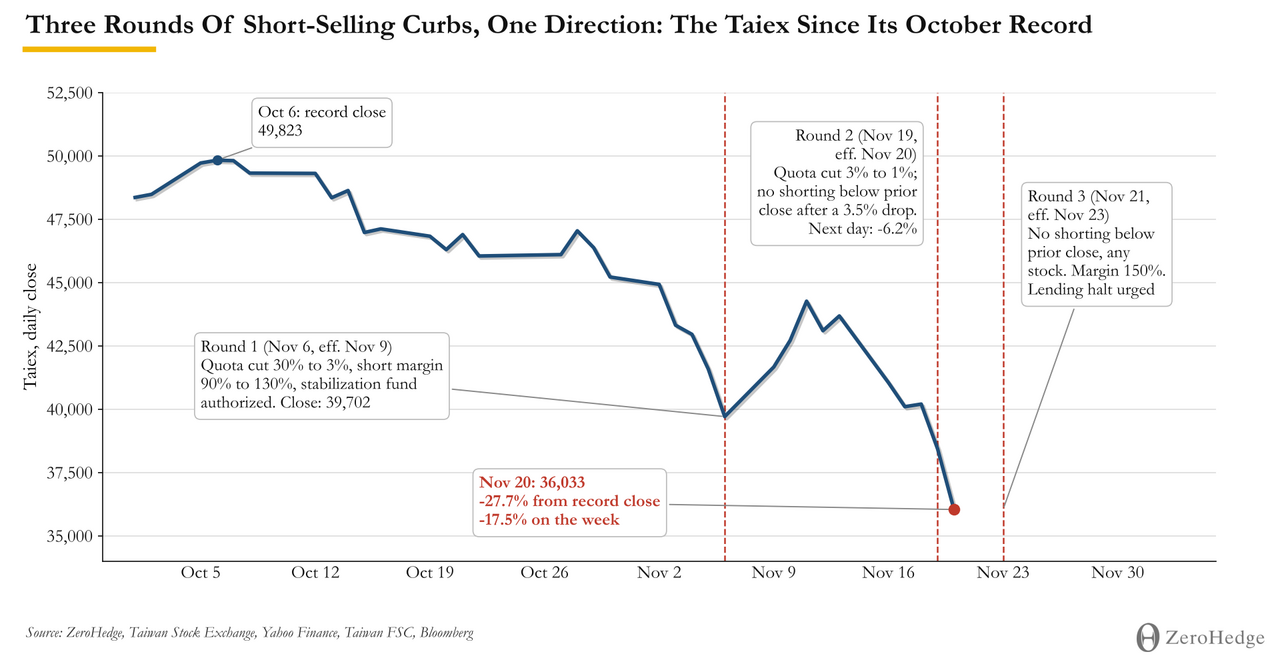
The last time Taipei went for a blanket below-the-close ban was August 2015, during the China devaluation scare. More on how that one and the other precedents played out further down.
First, the mechanics. A short order now has to be priced at or above the previous session’s close. If a stock gaps down at the open and never trades back to yesterday’s level, not a single share can be shorted all day outside the exempt hedging desks, quota or no quota. Shorts are allowed only when the stock is green, which is a bit like permitting umbrellas on sunny days.
Goldman To Clients: Expect Recalls
While the price rule got the headlines, the lending freeze matters more.
The first two rounds made it harder to put on new shorts. Round three goes after the shorts that already exist, by leaning on the institutions that lend the stock. Goldman’s prime desk noticed right away. In a Reg FYI sent to clients on Saturday morning (available to pro subs), Goldman’s Nikita Rastogi confirmed the price restriction now applies market-wide and that the quota is unchanged, and then flagged the part that should worry anyone still short Taiwan: the bank is still working out with its lending counterparts what the FSC’s call to stop lending, recall loans and not renew them means in practice.
Here is how Rastogi laid it out for clients:
No short selling below the previous trading day’s closing price. The restriction, previously triggered only where a security had fallen by 3.5% or more, now applies market-wide.
There is no further change to the Short Sell Quota at this time.
Regarding the FSC’s comments on stock lending, including suspending new lending, recalling existing loans and not renewing outstanding loans, GS is assessing the implications with our lending counterparts.
Translation: Goldman doesn’t know yet how much borrow is about to disappear. And neither does anyone else.
The desk then re-sent its earlier client FAQ (available here for pro subs), noting that it still holds after the latest announcement. From the FAQ the desk says still applies:
2. Is there a possibility of recalls and what is the size and frequency expected?
Recalls may occur depending on what % of a clients’ short synthetic position is internalized. GS touchpoints/coverage will reach out to clients most likely to be impacted.
5. Will my SBL fill rates be impacted?
We do not expect a material impact to fill rates. However, clients’ ability to execute short sales may be constrained by the applicable market wide short sell quota.
Put differently, Goldman will keep offering locates, expects claw-backs to stay under 1%, and doesn’t see a big hit to fill rates. But recalls are on the table, the first day’s will be handled manually, and whether you can actually execute a short is up to the regulator. That FAQ was written before the island’s lenders were told to pull their stock, so maybe treat that sub-1% estimate as a number with a short shelf life.
Why does this matter for the tape? Because the shorts never left. According to S3 Partners data cited by Bloomberg, aggregate short interest across Taiwanese equities stood at 5.28% of float on Thursday, barely changed from 5.49% on November 6, the day of the first curb. Two rounds of restrictions and a 10% squeeze later, the bears were sitting almost exactly where they started. S3′s head of research told Bloomberg why: funds that are already short have little reason to cover just because new shorts got harder, as long as their thesis is intact.
A recalled loan changes that math. If the lender wants its shares back and the borrower can’t find a replacement, the short gets bought in, thesis or no thesis. That is the squeeze Taipei seems to be trying to engineer for Monday’s open, and with a single-digit share of the float sold short and nobody allowed to reload below Friday’s close, it will probably get one.
There are, as always, leaks. As we noted Thursday, Goldman just went live with synthetic futures access in Taiwan, and foreigners added $3.1 billion of net short futures the week the first cut took effect. Then there’s New York: the ADR of TSMC (2330 TT) still trades at an 11% premium to the local line, according to Goldman, and nobody at the FSC can stop a hedge fund from shorting it. Restrict one instrument and the hedges move to the next, where they hit the cash market through arbitrage anyway.
The Sellers Don’t Borrow Shares
Which brings us to the problem with the whole exercise. Goldman’s Matthew Mason, a partner on the bank’s Asia equities desk who spent the end of last week visiting clients in Taipei, writes in his latest First Light note (available to pro subs) that the Taiex lost nearly $800 billion in market cap last week, while the MSCI Asia Pacific had its worst week since March 2020. Taiwan, which had held up through some of this year’s ugliest episodes, went “from ballast to anchor in the span of five sessions.”
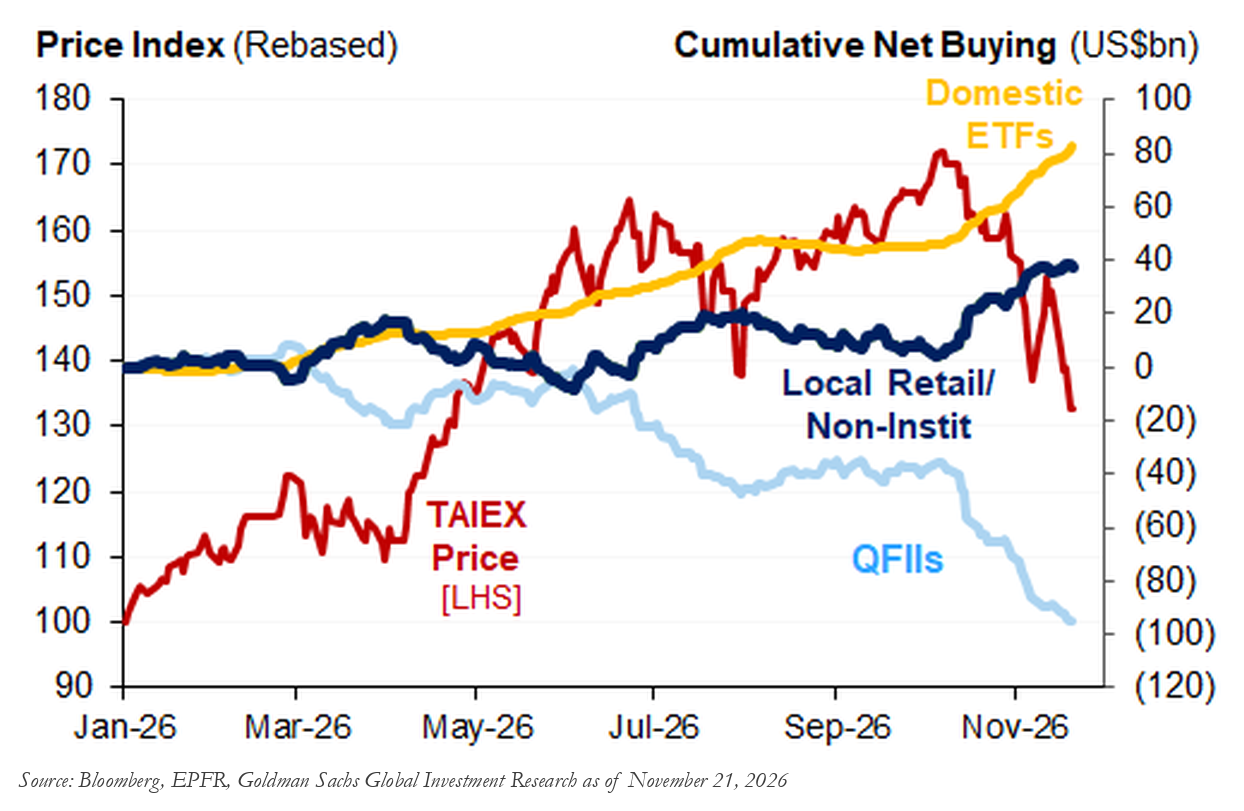
Who did the selling? On Mason’s numbers, foreigners have pulled a net $95 billion out of Taiwanese stocks this year, and a quarter of that left in November alone, $6 billion of it last week. Shorts had been building too, he adds, but the acceleration is in plain old selling by overseas holders. Goldman’s Hong Kong desk has an even bigger tally, as we noted in Friday’s wrap: $99 billion sold on the TWSE this year, $75 billion of it in TSMC.
The weekly breakdown from Goldman’s Taiwan strategists tells the same story:
- Foreign institutions net sold $5.8 billion of cash equities, $3.8 billion of it TSMC;
- Domestic funds, the buyers of last resort for most of the slide, turned net sellers to the tune of $660 million. Goldman’s Taipei sales desk had flagged the turn on Thursday night: local mutual funds bought in 25 of the prior 27 sessions while the market fell 22%, and then they stopped;
- Short interest fell.
Read that last one again. In the worst week since 1991, the one group the regulator has spent three rounds of rulemaking on was reducing its bets. The foreigners and the local funds were selling stock they already owned, and no quota, price rule or lending freeze does anything about that.
The chart below, from Mason’s note, shows who has been on each side all year: foreigners (light blue) selling about $95 billion, retail and domestic ETFs buying it.
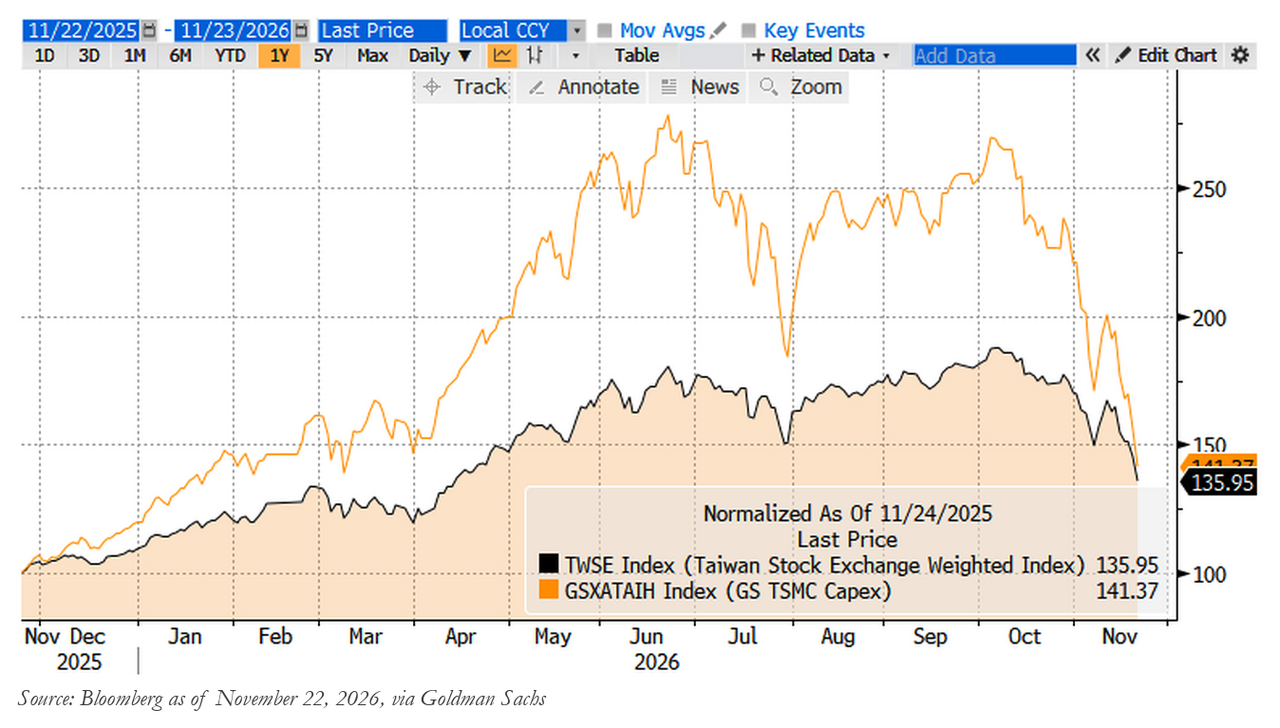
The damage was most concentrated where the crowd had lingered. Goldman’s Taiwan AI Ecosystem basket fell 27% on the week and its TSMC Capex basket lost 27.2%, which has now given back most of a year of outperformance versus the index (chart via Goldman, source Bloomberg).
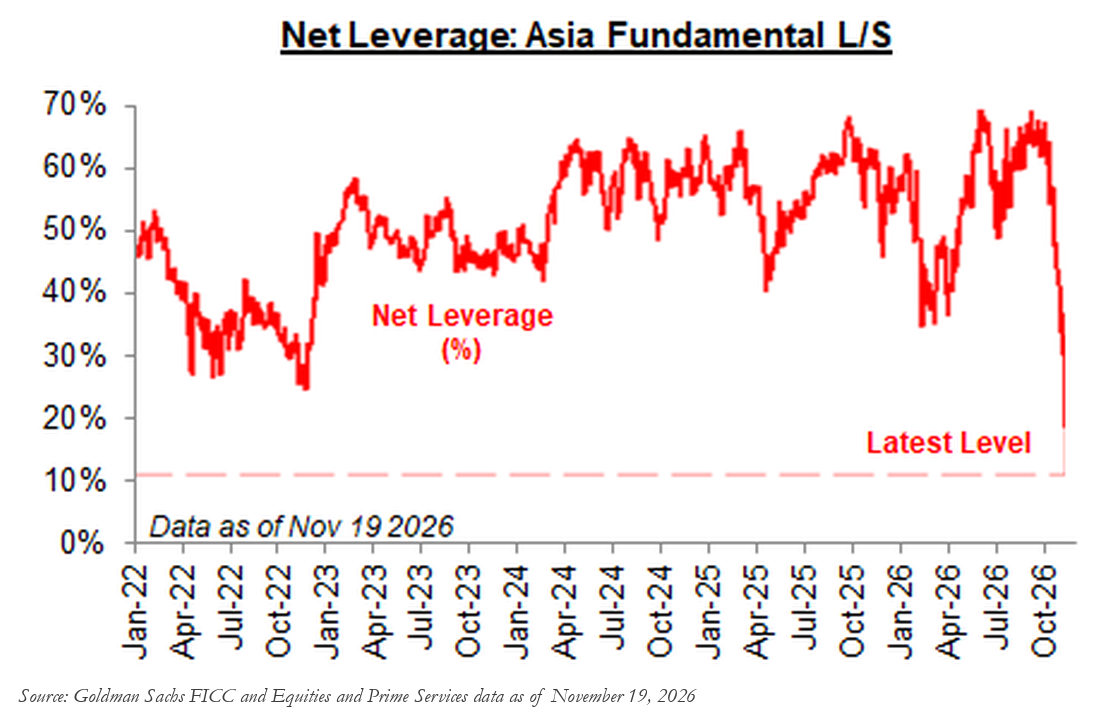
As for the hedge funds Taipei is so worried about, they are mostly gone already. Goldman’s prime book shows net leverage for Asia fundamental long/short managers collapsed by 47 points in a month to about 10%, the lowest in more than a decade of records, a dynamic we covered for the global book this weekend in “Shorting The Dip” and, from JPMorgan’s side, in “Abandon All Hope.”
JPMorgan’s International Market Intelligence team doesn’t think the process is done. In its Friday briefing the desk called Korea and Taiwan the worst hit markets in the region and said Taiwan likely has further to go, for two reasons: the retail deleveraging is still underway, and foreigners still own more of it than they do Korea, where the de-risking happened earlier. Barclays, per Bloomberg, pinned Monday’s leg down mainly on forced selling by retail. In other words, the two banks agree on who the marginal seller is: a leveraged local, with no borrow ticket in sight.
53% Below The Line
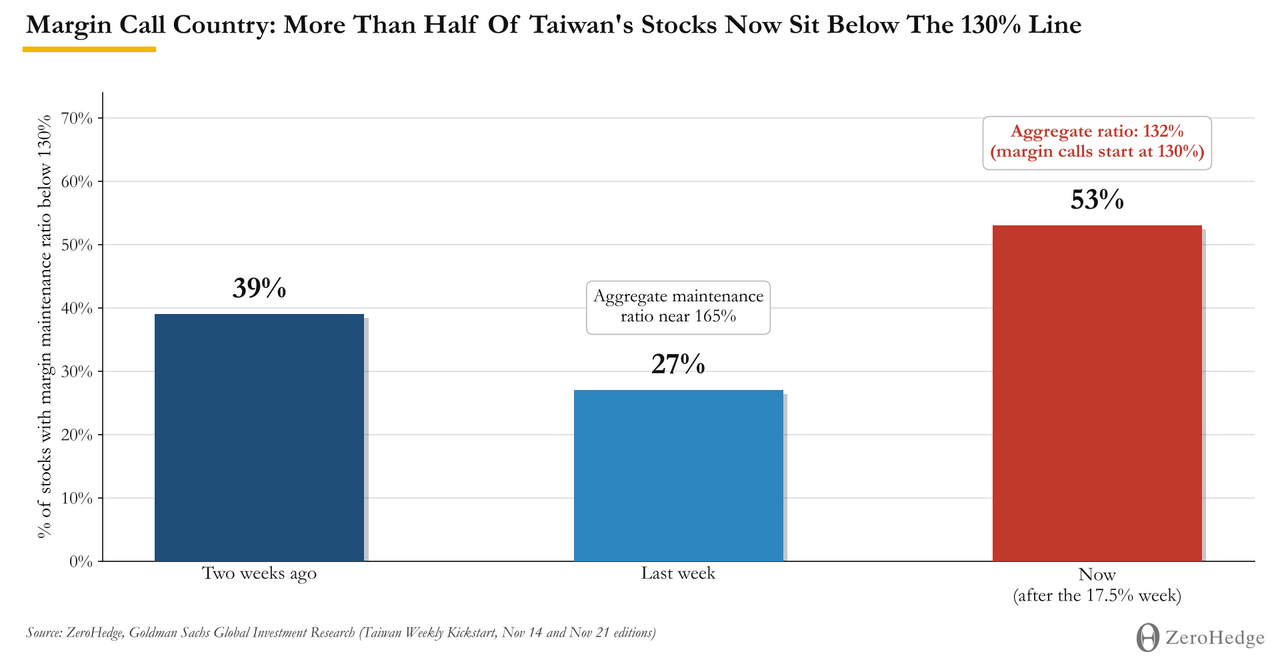
Last Thursday, we passed along Goldman’s then-reassuring margin stats (maintenance ratio near 165%, only 27% of stocks under the 130% threshold) with the caveat that they predated the puke, “so expect those numbers to look much worse in the next update.” Here is the update, from Friday’s Kickstart:
Retail Leverage: Retail leverage has fallen sharply, but margin-call and forced-deleveraging risks remain elevated (Exhibit 17). Margin balances have declined to US$17bn from a US$28bn peak, while the aggregate MMR has fallen to 132%, close to the 130% margin-call threshold, with 53% of stocks now below this level. Leveraged ETF exposure also remains elevated at US$11bn, or 0.8% of market free float, as retail investors continue to buy the dip.
Much worse it is. The aggregate margin maintenance ratio has dropped from about 165% to 132% in a week, a hair above the 130% level where margin calls go out, and 53% of all stocks are already below it (that’s 44% of the free float excluding TSMC, per Mason). Margin balances are down to $17 billion from a $28 billion peak, so a lot of forced selling has already happened. A lot hasn’t.
And yet retail keeps buying. Goldman counts $4.8 billion of ETF inflows last week, including $700 million into leveraged products where exposure still stands at $11 billion, and its flow desk has Taiwanese retail as net buyers of $2.5 billion. On Friday, as TSMC slid to a seven-month low, retail investors piled into the stock through odd lots, according to the exchange. Mason’s read on what that means:
The counterbalance remains a persistent retail community that still leans bullish, despite recent margin unwinds bringing balances down nearly 50% from the peak to $17bn. The unwind could have further to run, with 53% of Taiwanese equities, or 44% of ex-TSMC free float, below the 130% margin-call threshold. Local sentiment therefore matters, particularly given retail still accounts for 60% of trading volume.
So the market’s fate rests with a retail crowd that does 60% of the volume, is still leaning long, and is carrying margin loans against stocks more than half of which are already through the call line. An Aberdeen fund manager put it plainly to Bloomberg: Taiwan’s margin loan balance is still too high and has to come down more.
This is the part a short ban can’t reach. Margin clerks don’t check the FSC’s website before they liquidate.
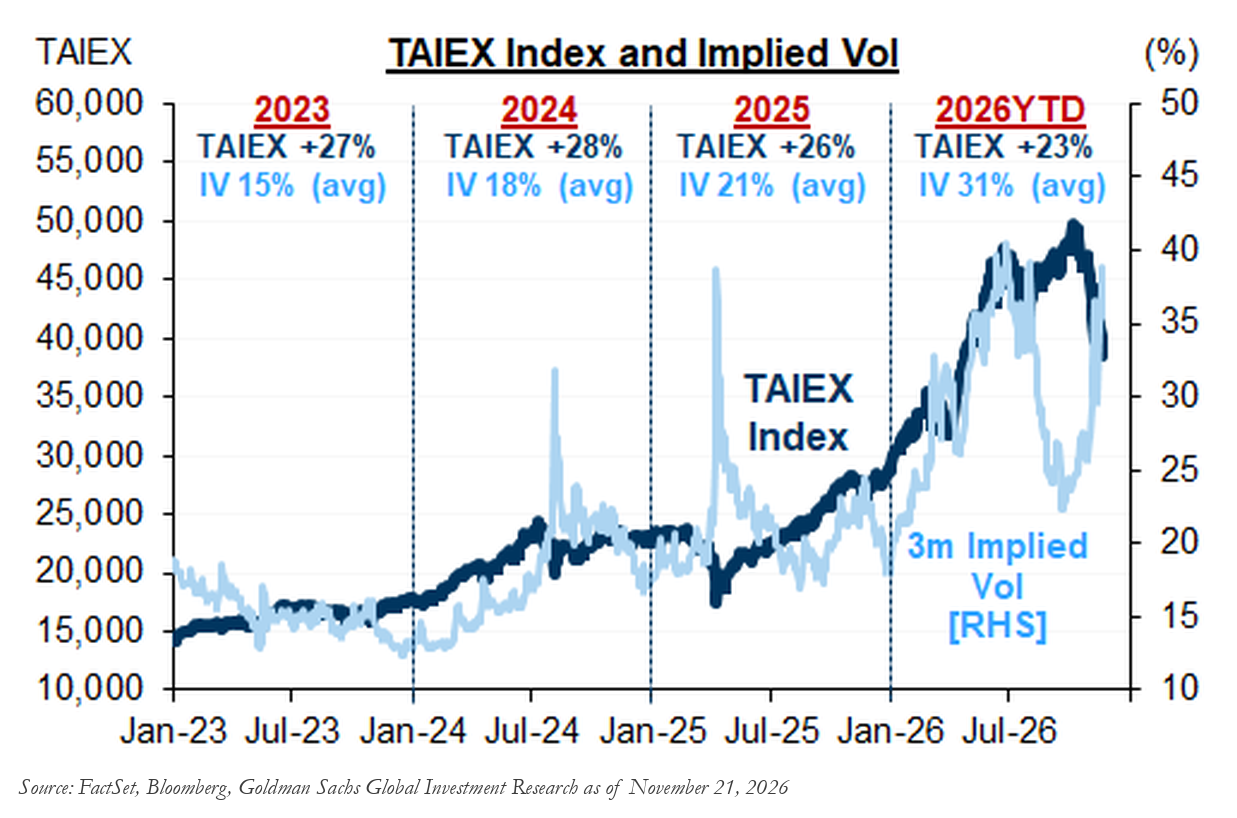
One more thing from the Kickstart. When Goldman cut Taiwan to Market Weight last week, its 50,000 Taiex target implied about 30% upside. After Thursday and Friday it implies close to 40%, which the strategists note comes with 40% implied volatility. Upside that grows only because the index keeps falling is not the kind anyone asked for.
 A Bazooka That Has Never Fired More Than A Quarter Of Its Rounds
Then there’s the other half of Saturday’s announcement, the NT$500 billion stabilization fund. Per Bloomberg, the fund said it has been buying since November 6, blamed the rout on worries about tighter US regulation of AI, capex returns and margin-financing risks, and pointed to record macro data: the economy grew 14.4% in the third quarter and October export orders jumped 78% from a year earlier.
Two observations.
First, if the fund has been buying since November 6, it has been buying into a market that is 9.2% lower than where it closed that day. And the fund’s own assessment that foreign selling has gradually eased sits a little awkwardly next to Goldman’s count of $6 billion out the door last week.
Second, the $15 billion is a ceiling, and Taipei has never come anywhere close to it. The current intervention is the fund’s tenth since it was set up in 2000. According to figures compiled by local press, the most it has ever deployed is about NT$123 billion, or roughly $3.7 billion, after the dotcom bust. During the April 2025 tariff panic it spent about NT$12 billion ($370 million or so) over 279 days. The average across the nine completed interventions is about NT$41 billion, or $1.2 billion.
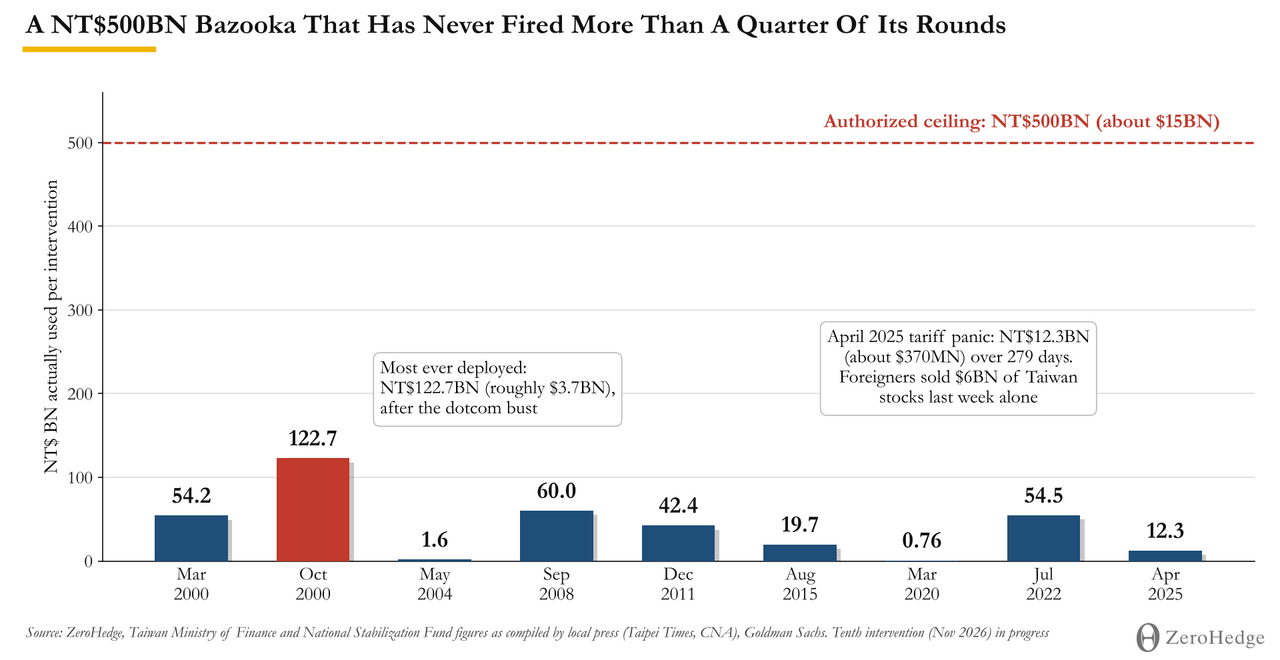
Some napkin math (and it is napkin math, since these are different things): if this turns into the biggest intervention in the fund’s history, it still covers roughly three days of last week’s foreign selling. Goldman’s Taipei sales desk made a similar point on Thursday night, setting the fund’s roughly $15 billion of usable firepower against about $90 billion of foreign net selling this year, and noting that the activation came earlier in the selloff than in past interventions. Which probably means the confidence effect was spent before the forced sellers showed up.
The Cabinet’s contribution on Saturday was to declare the plunge short-term. We’re sure the 53% of stocks under the margin line found that comforting.
What Happened The Last Five Times
Taipei has been here before, and so have we: on the evening of November 5 in New York, hours before the first package was announced, we noted that Taiwan was going…
And straight to bailouts
*TAIWAN TO UNVEIL STOCK STABILIZATION ACTS THIS AFTERNOON: PAPER https://t.co/FV1ozJCULZ
— zerohedge (@zerohedge) November 6, 2026
… and three days later the measures looked like a triumph:
*TAIWAN’S TAIEX EXTENDS GAINS TO 6.3% ON STABLIZATION MEASURES
— zerohedge (@zerohedge) November 9, 2026
That triumph lasted five sessions. So how did the earlier ones go? Building on the clampdown history from Goldman’s Peter Slater that we rebuilt on Thursday (available here for pro subs), here is every major FSC short-selling crackdown since Lehman, and what the Taiex did next:
Six Clampdowns: What The Taiex Did After Taipei Went After The Shorts
| Episode | What Taipei did | How long | Worst close after curbs began | By the time curbs came off |
|---|---|---|---|---|
| Sep-Dec 2008 (Lehman) |
No shorting below prior close for 150 index stocks from Sep 22, then all short selling suspended through Dec 31 | ~100 days | -31.5% (Nov 20) | -23.1% |
| Aug-Sep 2015 (China devaluation) |
Blanket ban on shorting below prior close | 28 days | -4.8% (day one) | +8.7% |
| Mar-Jun 2020 (Covid) |
Short-sale volume limits; no shorting below prior close after a 3.5% drop | ~12 weeks | None lower | +35.0% |
| Oct 2022-Feb 2023 (Fed hikes, chip bust) |
Quota cut 30% → 20% → 10%; margin 90% → 120%; 3.5% trigger | ~145 days | -5.6% (Oct 25) | +16.3% |
| Apr-May 2025 (Liberation Day) |
Quota cut 30% → 3%; margin 90% → 130% | 49 days | -18.3% (Apr 9) | +1.7% |
| Nov 2026 (AI unwind) |
Quota 30% → 3% → 1%; margin 90% → 130% → 150%; blanket ban below prior close; put warrants and stock lending frozen | 14 days and counting | -9.2% so far (Nov 20) | No end date |
Source: ZeroHedge, Taiwan FSC, Central Bank of the Republic of China (Taiwan), Goldman Sachs (Peter Slater), Yale Program on Financial Stability, CNA, Yahoo Finance. Taiex moves are measured from the last close before the first curb took effect (2020: the close on the day the measures were adopted); day counts are ZH calculations.
A few things stand out. In every episode except Covid, the Taiex closed lower after the curbs took effect than it did before. Sometimes that was a one-day affair (2015). In 2008, the only time Taipei suspended short selling outright, it meant another 31.5%. The two clean wins, 2015 and 2020, were the ones where the outside shock faded within weeks (and in 2020 it took every central bank on the planet). And outside of 2008, the curbs only came off once the index was back above where it started, which took anywhere from 28 to 145 days.
Put differently: a short ban has never ended a Taiwanese selloff, but the end of a selloff has ended every short ban.
None of this is a Taiwanese peculiarity. When the SEC banned shorting in 799 financial stocks in September 2008, the New York Fed later concluded that the ban did nothing to stop the decline in those stocks and added more than $1 billion in trading costs across equity and options markets. Korea banned short selling outright from November 2023 to March 2025 and still ended up where it is today.
Speaking of Korea: on Sunday, after the Kospi’s 5.2% Friday plunge to a ten-month low of 4,869.96, Seoul’s top financial officials held an emergency meeting and said they would ready a stock market stabilization fund for immediate use, relax limits on corporate buybacks for three months, and launch a special three-month crackdown on illegal short selling, Seoul Economic Daily reported. Asia’s bailout brigade, which we first profiled on November 6, is back for an encore before the first act has finished.
Here’s what to watch this week:
- Monday’s open (Sunday evening in New York): how violent the squeeze is, and whether anyone sells into it. Japan is closed, so Taiwan and Korea trade without their usual wingman;
- Recalls and buy-ins: whether the island’s lenders actually pull stock, and what that does to borrow costs in the names with the most short interest;
- The 130% line: any day the Taiex closes lower, more of that 53% turns into forced selling;
- Foreign flows: the fund says the selling is easing. Goldman’s tally will tell us on Friday;
- Futures and the TSMC ADR premium: where the hedges go now that the cash market is closed to them;
- Saturday’s local elections, which Mason flags as the first read on the political landscape before the January 2028 presidential vote. Regulators rarely get less creative ahead of an election;
- Jensen Huang’s congressional hearing in early December, the next catalyst for the Nvidia supply chain according to Goldman’s regional desk.
Who Buys When Nobody Has To Cover?
The bull case for Monday is simple, and it’s a fair one. Hedge fund positioning in Asia is the lightest on record, valuations have reset to 12.7x forward earnings (1.3 standard deviations below average, per Goldman) with 32% earnings growth still penciled in for 2027, the shorts are about to lose their borrow, and JPMorgan’s market intelligence desk is tactically bullish on global equities and sees a technical bounce in semis from here. Taiwan will probably rip at some point this week, and maybe hard.
But we’ve seen this movie. It ran two weeks ago, lasted five sessions, and ended with the worst week since 1991.
The trouble with squeezing out the shorts is what comes after. A short seller is the one participant in a falling market who is guaranteed to buy eventually. Taipei has now told that buyer to cover at the open on Monday and not to come back unless prices are rising. Which means the next time foreigners sell and the margin clerks call, there will be even fewer bids underneath than there were last week, and the only buyer left with size is a fund that has never spent more than a quarter of its headline number.
Goldman’s own sales desk seems to have reached the same conclusion. As Bloomberg reported, the desk told institutional clients on Friday that every day looks like the day to bottom-fish on the technicals, but that if 2026′s momentum taught traders that highs can keep going higher, then lows can keep going lower too.
We’ll side with the desk, and with 2022 over 2015: a sharp squeeze first, and then lower lows until the foreign selling and the margin unwind have actually run their course.
In the meantime, Taipei has now restricted shorts, puts and stock loans. About the only thing left to restrict is selling.
Much more in the full Goldman Reg FYI, the Taiwan Weekly Kickstart and Mason’s “First Light” note, all available to pro subs.
Source: https://freedombunker.com/2026/11/22/taiwan-kills-the-shorts-blanket-ban-stock-lending-freeze-and-a-15-billion-rescue-fund-after-the-taiexs-worst-week-since-1991/
Anyone can join.
Anyone can contribute.
Anyone can become informed about their world.
"United We Stand" Click Here To Create Your Personal Citizen Journalist Account Today, Be Sure To Invite Your Friends.
Before It’s News® is a community of individuals who report on what’s going on around them, from all around the world. Anyone can join. Anyone can contribute. Anyone can become informed about their world. "United We Stand" Click Here To Create Your Personal Citizen Journalist Account Today, Be Sure To Invite Your Friends.
LION'S MANE PRODUCT
Try Our Lion’s Mane WHOLE MIND Nootropic Blend 60 Capsules
Mushrooms are having a moment. One fabulous fungus in particular, lion’s mane, may help improve memory, depression and anxiety symptoms. They are also an excellent source of nutrients that show promise as a therapy for dementia, and other neurodegenerative diseases. If you’re living with anxiety or depression, you may be curious about all the therapy options out there — including the natural ones.Our Lion’s Mane WHOLE MIND Nootropic Blend has been formulated to utilize the potency of Lion’s mane but also include the benefits of four other Highly Beneficial Mushrooms. Synergistically, they work together to Build your health through improving cognitive function and immunity regardless of your age. Our Nootropic not only improves your Cognitive Function and Activates your Immune System, but it benefits growth of Essential Gut Flora, further enhancing your Vitality.

Our Formula includes: Lion’s Mane Mushrooms which Increase Brain Power through nerve growth, lessen anxiety, reduce depression, and improve concentration. Its an excellent adaptogen, promotes sleep and improves immunity. Shiitake Mushrooms which Fight cancer cells and infectious disease, boost the immune system, promotes brain function, and serves as a source of B vitamins. Maitake Mushrooms which regulate blood sugar levels of diabetics, reduce hypertension and boosts the immune system. Reishi Mushrooms which Fight inflammation, liver disease, fatigue, tumor growth and cancer. They Improve skin disorders and soothes digestive problems, stomach ulcers and leaky gut syndrome. Chaga Mushrooms which have anti-aging effects, boost immune function, improve stamina and athletic performance, even act as a natural aphrodisiac, fighting diabetes and improving liver function. Try Our Lion’s Mane WHOLE MIND Nootropic Blend 60 Capsules Today. Be 100% Satisfied or Receive a Full Money Back Guarantee. Order Yours Today by Following This Link.


| Visits: | 1,839,419,680 |
| Stories: | 8,742,048 |
Whistler Blowers, Insiders

