

The Seduction Of Market Bounces On The Way Down

Submitted by QTR’s Fringe Finance
Just wanted to offer up a quick lesson this morning because every time the market stages one of these violent next-day bounces like it had yesterday (NASDAQ was up about +3.7%), I find myself dealing with the same giant brained geniuses telling me my bearish outlook is wrong and the worst is over.
It’s not just the usual collection of social media NPCs who suddenly become market strategists after one green day. It’s the talking heads on financial television, too, breathlessly celebrating the rebound and assuring everyone that buyers are back, confidence has returned, and the market has finally found its footing.

Market participants, definitely thinking for themselves
Apparently, a single day of rising stock prices is all it takes to erase whatever problems sent the market plunging in the first place.
Consider a NASDAQ that gets absolutely crushed by -5.5% one day like it did last week, only to come roaring back +3.7% the next like it did yesterday. The second day feels spectacular.
It feels like Jensen smoking a post-coital cigarillo with Alice Huang. You feel like king of the world. Screens are glowing green and the bulls are practically taking victory laps. “Eat a dick, bears,” retail traders who were in diapers when Lehman went bankrupt will say.
But here’s the problem people for some reason don’t notice: the market is still down almost 2% over those two days. The rebound hasn’t erased the damage. It has merely made investors feel better about it. And that distinction is worth carefully noting because if you repeat that exact pattern over any meaningful period of time, the market doesn’t recover. It collapses. That’s the point of this little PSA I’m putting out this morning.
A Quick Exercise…
Let’s start with an index trading at 7,500. For hypothetical purposes, we’ll just call it the P&S 500.
On Monday, it falls -5.5%, bringing it down to 7,087.50. On Tuesday, it rallies +3.7%, bringing it back to 7,349.74. Two days of extraordinary volatility, including a massive relief rally, and the index has still lost 150 points, or almost exactly 2%.
Now imagine that same two-day pattern repeating. Every down day is followed by an impressive rally. Every rally brings fresh excitement, new bullish predictions, and another round of declarations that the bottom is in. Yet every two-day cycle leaves the index approximately 2% lower than where it started.
Here’s what happens if that pattern continues, assuming 252 trading days per year.
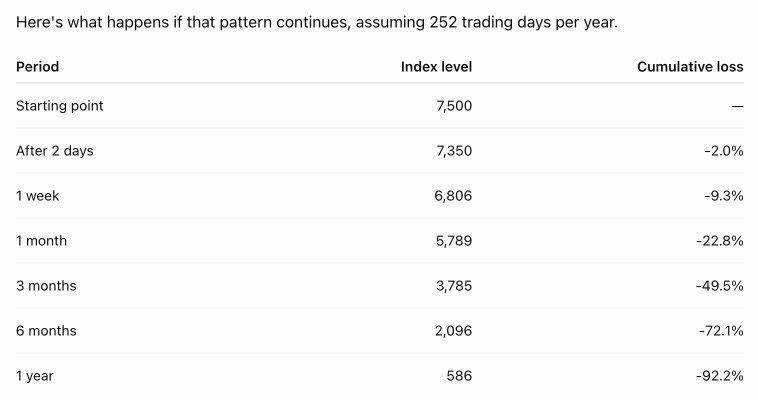
These are hypothetical calculations, not a prediction that the index will follow this precise pattern. Obviously it won’t. But the arithmetic illustrates something that the daily cheerleading conveniently ignores. A market can experience an endless series of spectacular rallies while simultaneously destroying an extraordinary amount of wealth.
In this example, the index loses nearly half its value in three months despite rallying +3.7% every other trading day. By six months, almost three-quarters of its value is gone. Its a pedestrian and simple observation…but one no one seems to remember.
The point isn’t that every rally is meaningless or that markets can’t recover from severe selloffs. It’s that the size of a one-day bounce tells you remarkably little about the health of the underlying trend. A 3.7% rally might look fantastic on television, but it doesn’t change the fact that the index is still substantially lower than it was two days earlier.
Investors Keep Falling for It…
The seduction of the next-day bounce is largely psychological, and recency bias is at the center of it. Investors have a remarkable tendency to overweight whatever happened most recently.
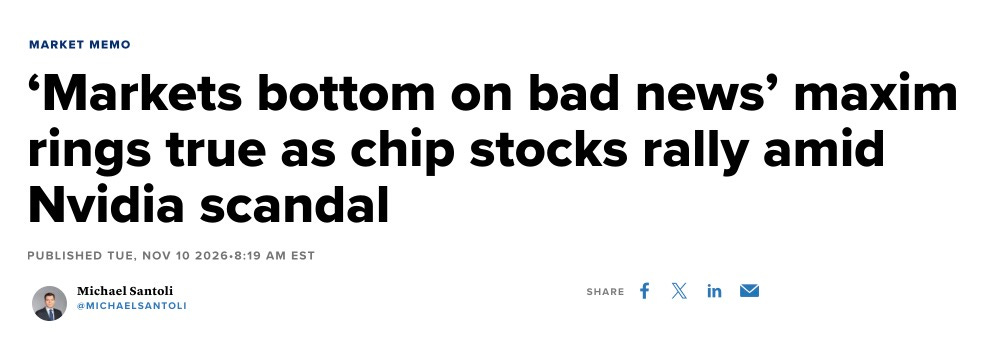
Yesterday’s -5.5% collapse feels like ancient history the moment today’s +3.7% rally gets underway. The latest price action becomes the dominant narrative, and suddenly the same people who were terrified 24 hours earlier are convinced the market is headed for new highs. This was yesterday:
This tendency becomes even more powerful when it collides with the long-standing bullish bias of the investment industry. For years, investors have been conditioned to buy the dip, trust the trend, and assume that every selloff is a temporary interruption in a market that inevitably moves higher.
That conditioning has been reinforced by long periods in which buying weakness was rewarded. But the strategy that works beautifully in a sustained bull market can become extraordinarily painful when the broader trend changes. In a declining market, buying every dip can mean repeatedly purchasing assets that become cheaper still.
Then there’s the nonstop cheerleading from financial television, Wall Street strategists, and market commentators whose default position seems to be that every decline is an opportunity and every rally is confirmation that they were right. A sharp selloff is dismissed as an overreaction, while a smaller rebound is treated as evidence of a fundamental turnaround. The asymmetry is remarkable.
Bad news is temporary, good news is permanent, and somehow every market development eventually becomes another reason to buy stocks. It’s why I wrote this piece last year: This Next Market Crash Will Break Our Fragile Brains
85% OFF FOREVER IF YOU SUBSCRIBE TODAY: I am again offering an 85% discount to anyone that wants to become a Fringe Finance annual subscriber today. It’s a discount you can keep and stays applied for as long as you wish to remain a subscriber: Get 85% off forever
The media environment makes this worse because a dramatic rebound is an irresistible story. A Nasdaq rallying 3.7% makes for exciting television, particularly after a brutal selloff. It gives commentators something positive to say, traders something to celebrate, and anxious investors a reason to believe their losses will soon disappear.
But the emotional relief of a green day is not the same thing as an improvement in market fundamentals. Earnings expectations, economic risks, liquidity conditions, and valuations don’t necessarily improve because stock prices have bounced for six hours.
And when the prevailing market trend is lower, these rallies can be especially deceptive. Falling markets often produce violent countertrend moves, fueled by short covering, oversold conditions, and investors rushing to position for a bottom. Some of the biggest daily gains in market history have occurred during major bear markets. The magnitude of the rally alone is therefore a poor indicator of whether the decline has actually ended.
The Other Math Investors Forget: Recovering Losses
There’s another simple mathematical exercise worth remembering whenever investors start celebrating a rebound. Percentage losses and the gains required to recover from them are not symmetrical. The further a market falls, the larger the percentage gain needed just to return to its starting point.
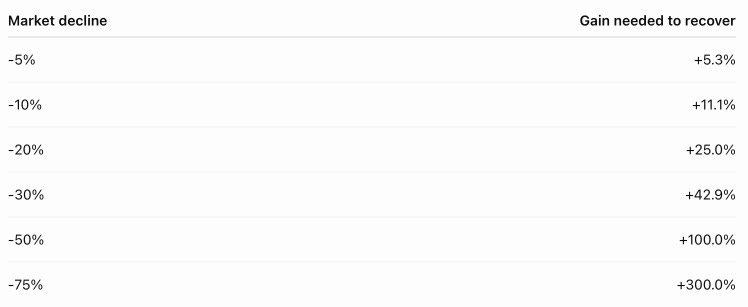
A market that loses 20% doesn’t need a 20% rally to get back to even. It needs 25%. A market that loses half its value must double just to recover its losses. And a market that falls 75% needs to quadruple from its lows to return to its previous level.
This is why capital preservation matters so much during sustained market declines, and why the repeated celebration of relief rallies can be so misleading. The deeper the losses become, the more difficult the recovery gets. A series of exciting green days can create the impression of progress even as the market falls further behind.
Don’t Confuse a Bounce With a Bottom
None of this means that every sharp rebound should be sold or that a bearish outlook will always be correct. Genuine market bottoms happen, and as I wrote days ago the early stages of a new bull market can include some of the most powerful rallies investors will ever see. The problem is that a single big up day provides almost no reliable evidence that such a transition has occurred: My Market Outlook For Monday In 15 Quick Points
What matters is whether the market can sustain its advance, repair the technical damage, improve its underlying breadth, and ultimately reverse the trend that produced the selloff in the first place. Until then, a violent bounce may be nothing more than another rally in a declining market.
So the next time the Nasdaq plunges 5.5% and then rockets 3.7% the following day, I’m sure I’ll hear from the same crowd telling me the worst is over, that the bears have been proven wrong, and that anyone who isn’t buying is missing the opportunity of a lifetime. The television cheerleaders will be right there with them, celebrating the comeback as though the previous day’s losses have somehow vanished.
But the math doesn’t care about their enthusiasm. Repeat that 5.5% decline and 3.7% rebound often enough, and an index starting at 7,500 is below 3,800 in three months and barely above 2,000 in six.
That’s the danger of the next-day bounce. It can make investors feel like they’re winning even while the market is taking them apart.

QTR’s Disclaimer: Please read my full legal disclaimer on my About page here.
Source: https://freedombunker.com/2026/11/11/the-seduction-of-market-bounces-on-the-way-down/
Anyone can join.
Anyone can contribute.
Anyone can become informed about their world.
"United We Stand" Click Here To Create Your Personal Citizen Journalist Account Today, Be Sure To Invite Your Friends.
Before It’s News® is a community of individuals who report on what’s going on around them, from all around the world. Anyone can join. Anyone can contribute. Anyone can become informed about their world. "United We Stand" Click Here To Create Your Personal Citizen Journalist Account Today, Be Sure To Invite Your Friends.
LION'S MANE PRODUCT
Try Our Lion’s Mane WHOLE MIND Nootropic Blend 60 Capsules
Mushrooms are having a moment. One fabulous fungus in particular, lion’s mane, may help improve memory, depression and anxiety symptoms. They are also an excellent source of nutrients that show promise as a therapy for dementia, and other neurodegenerative diseases. If you’re living with anxiety or depression, you may be curious about all the therapy options out there — including the natural ones.Our Lion’s Mane WHOLE MIND Nootropic Blend has been formulated to utilize the potency of Lion’s mane but also include the benefits of four other Highly Beneficial Mushrooms. Synergistically, they work together to Build your health through improving cognitive function and immunity regardless of your age. Our Nootropic not only improves your Cognitive Function and Activates your Immune System, but it benefits growth of Essential Gut Flora, further enhancing your Vitality.

Our Formula includes: Lion’s Mane Mushrooms which Increase Brain Power through nerve growth, lessen anxiety, reduce depression, and improve concentration. Its an excellent adaptogen, promotes sleep and improves immunity. Shiitake Mushrooms which Fight cancer cells and infectious disease, boost the immune system, promotes brain function, and serves as a source of B vitamins. Maitake Mushrooms which regulate blood sugar levels of diabetics, reduce hypertension and boosts the immune system. Reishi Mushrooms which Fight inflammation, liver disease, fatigue, tumor growth and cancer. They Improve skin disorders and soothes digestive problems, stomach ulcers and leaky gut syndrome. Chaga Mushrooms which have anti-aging effects, boost immune function, improve stamina and athletic performance, even act as a natural aphrodisiac, fighting diabetes and improving liver function. Try Our Lion’s Mane WHOLE MIND Nootropic Blend 60 Capsules Today. Be 100% Satisfied or Receive a Full Money Back Guarantee. Order Yours Today by Following This Link.


| Visits: | 1,838,158,806 |
| Stories: | 8,735,636 |
Whistler Blowers, Insiders

