
The New Baghdad Railway: Why China Is America’s Ultimate Target

Mats Nilsson
21st Century Wire
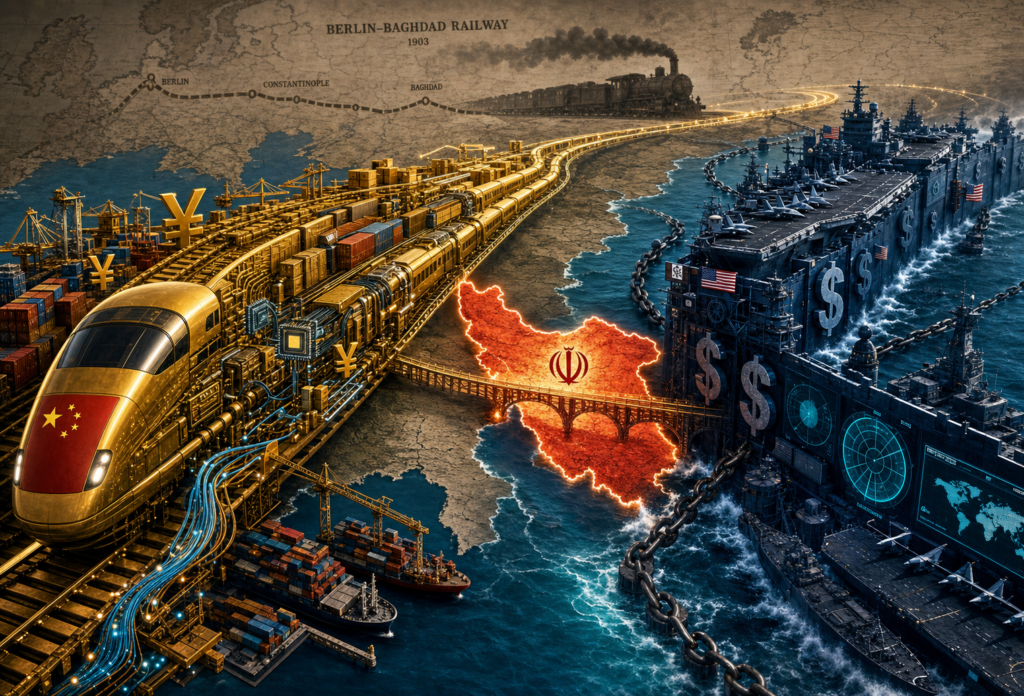
Why does China’s quest for prosperity mark it as America’s ultimate geopolitical target? The assertion is provocative, especially in a period marked by renewed diplomacy between China and the United States. However, it must be said: Iran is an intermediate target. The ultimate target is China. This claim, echoing an older European tradition of geopolitical analysis, reframes not only contemporary tensions in the Middle East, but the entire structure of 21st-century global competition. It posits that American-led pressure on Iran is not merely a contained crisis over nuclear proliferation or regional hegemony, but a flanking manoeuvre in a much larger, epoch-defining struggle against Beijing.
The historical parallel is equally striking, reaching back to the early 20th century, when the British Empire, then the reigning maritime hegemon, viewed Imperial Germany not merely as a rival, but as an existential threat. The cause of that threat was not a hot war, but a railway: the Berlin-Baghdad-Basra line.
To the British strategic mind in the years 1905-1910, this iron ribbon stretching from the heart of Europe to the Persian Gulf was a dagger pointed at the jugular of the British Empire, because it promised to connect Germany’s industrial might directly to the resources and markets of the East, bypassing the British-controlled sea lanes of the Suez Canal and the Cape of Good Hope. This wasn’t just competition; it was a perceived lethal threat to the maritime dominance upon which British global power was built. The narrative argues that this land-based challenge to sea-based supremacy was a primary catalyst for the First World War, a war Britain initiated to smother a peaceful, innovative, and economically ascendant competitor. In this article, a sweeping historical analogy casts the United States as the anxious British hegemon, while China is the new Germany, a nation peacefully focused on innovation and economic prosperity, building up a trade surplus, thereby being considered a threat to powers that want to dominate.
From this premise, we must ask: If China is the new Germany, what is its Baghdad Railway? The answer is not a single line of rail but a sprawling, multimodal network of infrastructure, finance, and digital connectivity that constitutes China’s grand strategy. Belt and Road Initiative (BRI) is one name, and its purpose, in American eyes, is remarkably similar to that of its early 20th-century precursor: to rewire the global economic and geopolitical map in a way that renders America’s maritime-centric dominance obsolete, thereby making China the definitive target in a new struggle for Pacific and global primacy.
The Ghost of Berlin-Baghdad
To understand Washington’s anxiety about Beijing today, one must first immerse oneself in the strategic psyche of a hegemon in peril. Once upon a time, British power rested on two pillars: unchallenged naval supremacy and command of the global financial system. The Royal Navy controlled the critical maritime chokepoints: the English Channel, Gibraltar, Malta, the Suez Canal, the Cape of Good Hope, and Singapore. This aqueous ring locked down the Eurasian landmass, dictating the terms of global trade and ensuring that all economic arteries flowed through British-controlled valves.
The Berlin-Baghdad Railway represented a revolutionary circumvention of this entire system. Financed by German banks like Deutsche Bank, built by German steel and engineering firms, and backed by the German state, it was a geopolitical masterstroke of connectivity. It promised to link Berlin, via the Orient Express network, through the Austro-Hungarian heartland, across the Balkans, and directly to Constantinople. From there, it would plunge into Anatolia, sweep through the mineral-rich Mesopotamian plains, and terminate at Basra on the Persian Gulf, a warm-water port just a stone’s throw from British India.
For British strategists, this was a nightmare made real. Firstly, it threatened their economic supremacy. German goods could travel to Asian and African markets faster and cheaper than British goods, which were reliant on the long sea voyage. Secondly, it threatened the Suez Canal’s strategic monopoly. A German-controlled rail corridor alongside the Tigris and Euphrates offered an alternative route to the East, outside the Royal Navy’s reach. Thirdly, it threatened the Raj. The railway’s potential extension to Iran and Afghanistan would place a hostile industrial power on India’s very doorstep. In this calculus, Germany’s peaceful focus on commerce and construction was indistinguishable from an act of geopolitical war. Its economic philosophy, a threat to a power that equated its own dominance with global stability, made conflict inevitable. The railway was the proof that Germany wasn’t just playing the game differently; it was trying to change the entire board.
The New Rails
Now, invert this historical template onto the contemporary landscape. China is today’s Germany; a manufacturing and export titan that has transformed itself from a peripheral player into the world’s workhorse, accumulating massive trade surpluses and directing its national energy toward technological innovation and economic efficiency. It preaches a doctrine of peaceful coexistence and mutual prosperity, famously reframing its rise as a peaceful development. Yet, to the United States, the reigning maritime hegemon, this economic prowess is the visible tip of a deeply threatening strategic iceberg. The BRI is in this context a conscious, state-directed effort to build the 21st-century arteries of trade. Just as the German railway was more than steel and sleepers, the BRI is more than ports, highways, and fibre-optic cables. It is a systemic challenge.
The “Silk Road Economic Belt,” the overland component of the BRI, is the direct spiritual descendant of the Berlin-Baghdad concept. A network of transcontinental railways, the most prominent being the China-Europe Railway Express, which now links megacities like Chongqing, Xi’an, and Chengdu to a future terminus in Duisburg, Germany, with spurs reaching Madrid, London, and beyond. These modern “iron camels” carry Chinese-manufactured goods such as laptops, auto parts, apparel and ideas, across the Eurasian steppe in a fraction of the time it takes to ship them by sea.
To an American politician, this belt provides a land-based continent, connecting China’s manufacturing engine directly to the wealthy European consumer market, completely bypassing the US Navy’s command of the South China Sea, the Strait of Malacca, and the Indian Ocean. In a conflict scenario, a US Seventh Fleet’s naval blockade would be rendered far less effective if vital supply chains could hum along on high-speed rail across Kazakhstan, Russia, and Belarus. This is the “lethal” circumvention, not of the Suez Canal specifically, but of the entire American thalassocracy.
The Maritime Road
The BRI’s maritime component completes the strategic encirclement from the other direction. Instead of a railway terminal in Basra, China is building or upgrading a string of deep-water ports from the South China Sea to the Mediterranean. The crown jewel is Gwadar in Pakistan, a major Chinese investment that offers a direct Arabian Sea outlet for western China, unfreezing vast economic regions and providing a critical energy import gateway. This is followed by the container port of Hambantota in Sri Lanka, a logistics hub leased to China for 99 years, and Kyaukpyu in Myanmar, terminus for oil and gas pipelines that again bypass the Malacca Strait. From Djibouti in the Horn of Africa, where China has established its first overseas military base, to the port of Piraeus in Greece, where COSCO Shipping controls the main container terminal, this chain is the modern version of the Kaiser’s desired Persian Gulf foothold. Each port is a node not just for trade, but for naval resupply, dual-use logistics, and intelligence gathering and its approaches challenge the US Navy’s traditional supremacy in central strategic waters.
Financial and Digital Railroads
The BRI is financed by the Asian Infrastructure Investment Bank (AIIB), the Silk Road Fund, and the New Development Bank; Chinese-led institutions that act against the current primacy of the American-dominated IMF and World Bank. This financial tracklaying is as critical as the physical kind. It offers developing nations an alternative to the old Washington Consensus of neoliberal reform, one that comes with no lectures on governance or human rights, only a transactional “win-win” partnership. This allows Beijing to weave a global financial web where the yuan plays an increasingly prominent role in trade settlement, creating a parallel monetary system that nibbles away at the dollar’s reserve currency status, the very lifeblood of American power.
The digital dimension adds a layer the Kaiser’s Germany could never have imagined. Huawei’s 5G networks and undersea fibre-optic cables are the ghost-railways of the 21st century. They transmit the data that powers modern economies. For Washington, a global digital architecture built on Chinese technology is an existential threat, a “digital Baghdad Railway” that routes the world’s most sensitive information through Shenzhen instead of Silicon Valley, creating a pervasive vulnerability that could be weaponized for economic espionage or infrastructure disruption.
The Logic of the Intermediate Iran
Now the original claim that “Iran is an intermediate target” fits seamlessly into this historical framework. Old Mesopotamia was the crucial middle section of the German railway project. It was the territory that connected the Anatolian plateau to the Persian Gulf, the land where the railway’s strategic value crystallized. For Britain, preventing German dominance in Mesopotamia was an absolute strategic imperative, leading to the invasion of Basra in 1914 and the eventual carving up of the Ottoman Empire.
Today, Iran is the geopolitical lynchpin of the BRI’s central corridor. Geography has made it unavoidable. It is the bridge connecting the Caspian region to the Persian Gulf, the only land route for China’s overland belt to reach the Middle East and connect seamlessly with the maritime road. As such, Iran is the intermediate target par excellence. The US strategy of imposing crushing sanctions, unilaterally withdrawing from the JCPOA and applying continuous military pressure in the Strait of Hormuz mirrors Britain’s pre-WWI strategy of undermining the Ottoman Empire’s integrity to stop the German advance.
The goal is not merely to restrict Iran’s nuclear ambitions or its regional influence over proxies. The deeper strategic purpose is to sever the ligament of the BRI. A chaotic, sanctioned, and isolated Iran represents a fundamental fracture in China’s Eurasian land bridge. It stops the east-west flow of goods and energy, containing China within its own littoral and preserving the Indian Ocean as an uncontested American lake. The attempts to hinder the 25-year comprehensive cooperation agreement between China and Iran, a $400 billion project to rejuvenate Iran’s infrastructure and integrate it into the BRI, are the contemporary echo of British diplomatic pressure on the Ottoman Sultan to stall German construction.
The target is China, but the battlefield is Iran.
So why is China’s peaceful, connectivity-focused strategy considered a “lethal threat” by those powers that see themselves as natural aggressive hegemons? The answer lies in maritime empire. A sea-based power derives its strength from its ability to police stations, nodes, and flows. Its wealth comes from being the tollgate of the global commons, and a rival land-based empire that integrates the entire Eurasian supercontinent drastically reduces that toll revenue and erases the strategic geography that makes maritime dominance possible.
The United States’ global primacy since 1945 has been built on precisely this British model, elevated to a planetary scale. Its military ensures command of the commons, guaranteeing the free flow of oil from the Middle East, manufactured goods from East Asia, and capital across all borders. The US dollar, as the currency for all commodity trade, ensures American financial hegemony. A successful BRI, therefore, strikes at both foundations of American power by creating a parallel logistics system beyond naval control and seeds a parallel financial system beyond the dollar’s sole purview. For the American strategic community, it is a blueprint for a post-American world; peaceful economic integration is the mechanism of disempowerment. The trade surplus Beijing accumulates is not seen as a sign of healthy commerce but as the war chest of a challenger, the tangible fuel for a geopolitical machine designed to reorder the world without American consent. Since you cannot simply lay naval mines on a trans-Eurasian railway, you attack its nodes, its sponsors, and its enabling technologies through a multi-pronged campaign.
The primary form is a trade and technology war. The seemingly surgical tariffs placed on Chinese goods are high-explosive aimed at the manufacturing centers of Zhengzhou and Shenzhen, the starting stations of the China-Europe railway. The real krieg is the decapitation strike on Huawei, SMIC, and other tech champions, starving them of advanced semiconductors and semiconductor manufacturing equipment; It is an attempt not only to prevent China from building its network, but also to stop it from climbing the value chain, from the “world’s factory” to the “world’s laboratory”, a transformation that would make its challenge to U.S. dominance permanent.
The second form is the relentless attack on the BRI narrative itself. The coordinated characterization of the strategic narrative initiative as “debt-trap diplomacy” is a form of psychological bombing. It aims to explode the credibility and soft power that lubricate the BRI’s expansion, turning China from a partner into a predator in the global consciousness. Every Western report of a scaled-back port project in Sierra Leone is treated as a strategic victory, a successful payload detonating on the railway’s ideological foundations.
A third, more covert form, is what the original premise labels as coronating the Russian connection. The instigation and management of the Ukraine crisis serve, from this perspective, a dual purpose. It cuts Europe’s most critical energy and resource ties to the Eurasian heartland, a prerequisite for breaking the logic of the land bridge. How can a Berlin-Duisburg train compete with a ship if the route goes through a war zone or a pariah state? By triggering a crisis that forces Europe to decouple from the Eurasian mainland and re-anchor itself firmly to the US-led maritime system of LNG terminals and American weapons contracts, Washington plants explosives in the very middle of the modern Baghdad Railway.
The Inevitability of a New Great Game
China today is not Wilhelmine Germany, a bellicose, semi-authoritarian state with a propensity for dramatic, destabilising blunders. Nor is the modern globalised economy as zero-sum as that of 1913. Yet, as a tool for understanding the psychological drivers of US strategy, the Berlin-Baghdad paradigm offers a profound and chilling clarity, because it reveals the tragic arc: a dominant thalassocracy views a rising, commercially oriented continental power’s natural expansion as an inherent act of aggression.
The American strategic mind is haunted by a spectral railway crossing Eurasia. It sees China’s quest for innovation and its swelling trade surplus not as aspirational economic milestones but as the clinking sounds of the handcuffs being made for an empire in decline. In this light, the pressure on Iran is indeed just a saboteur’s mission on an intermediate target, a preliminary demolition on a bridge we must cross to get to the real objective.
The ultimate target is China because, in the eyes of its rival, China is building the infrastructure of a world where American dominance is just a historical memory. And for a power that has conflated its own dominance with the very definition of what is “excellent & good,” there can be no threat more lethal than a peaceful path to its own obsolescence. The war against that future, like the one ignited over a century ago, begins by bombing a railway.
Mats Nilsson, LL.M is a Swedish geopolitical analyst and Senior Analyst at Dissident Club, Sweden. His analysis focuses on great-power competition, NATO and US strategic doctrine, Eurasian infrastructure corridors, and the historical logic of maritime empires confronting rising continental powers. His work often situates contemporary conflicts, from Iran to Ukraine to the Indo-Pacific, within the broader transition from a US-led unipolar order toward an emerging multipolar world.
READ MORE CHINA NEWS AT: 21st Century Wire China Files
SUPPORT OUR INDEPENDENT MEDIA PLATFORM – BECOME A MEMBER @21WIRE.TV
VISIT OUR TELEGRAM CHANNEL
21st Century Wire is an alternative news agency designed to enlighten, inform and educate readers about world events which are not always covered in the mainstream media.
Source: https://21stcenturywire.com/2026/06/29/the-new-baghdad-railway-why-china-is-americas-ultimate-target/
Anyone can join.
Anyone can contribute.
Anyone can become informed about their world.
"United We Stand" Click Here To Create Your Personal Citizen Journalist Account Today, Be Sure To Invite Your Friends.
Before It’s News® is a community of individuals who report on what’s going on around them, from all around the world. Anyone can join. Anyone can contribute. Anyone can become informed about their world. "United We Stand" Click Here To Create Your Personal Citizen Journalist Account Today, Be Sure To Invite Your Friends.
LION'S MANE PRODUCT
Try Our Lion’s Mane WHOLE MIND Nootropic Blend 60 Capsules
Mushrooms are having a moment. One fabulous fungus in particular, lion’s mane, may help improve memory, depression and anxiety symptoms. They are also an excellent source of nutrients that show promise as a therapy for dementia, and other neurodegenerative diseases. If you’re living with anxiety or depression, you may be curious about all the therapy options out there — including the natural ones.Our Lion’s Mane WHOLE MIND Nootropic Blend has been formulated to utilize the potency of Lion’s mane but also include the benefits of four other Highly Beneficial Mushrooms. Synergistically, they work together to Build your health through improving cognitive function and immunity regardless of your age. Our Nootropic not only improves your Cognitive Function and Activates your Immune System, but it benefits growth of Essential Gut Flora, further enhancing your Vitality.

Our Formula includes: Lion’s Mane Mushrooms which Increase Brain Power through nerve growth, lessen anxiety, reduce depression, and improve concentration. Its an excellent adaptogen, promotes sleep and improves immunity. Shiitake Mushrooms which Fight cancer cells and infectious disease, boost the immune system, promotes brain function, and serves as a source of B vitamins. Maitake Mushrooms which regulate blood sugar levels of diabetics, reduce hypertension and boosts the immune system. Reishi Mushrooms which Fight inflammation, liver disease, fatigue, tumor growth and cancer. They Improve skin disorders and soothes digestive problems, stomach ulcers and leaky gut syndrome. Chaga Mushrooms which have anti-aging effects, boost immune function, improve stamina and athletic performance, even act as a natural aphrodisiac, fighting diabetes and improving liver function. Try Our Lion’s Mane WHOLE MIND Nootropic Blend 60 Capsules Today. Be 100% Satisfied or Receive a Full Money Back Guarantee. Order Yours Today by Following This Link.


| Visits: | 1,822,918,590 |
| Stories: | 8,675,797 |
Whistler Blowers, Insiders