

The Drakon Files – Part I: A Submarine for Israel and a Scandal Made in Germany

Freddie Ponton
21st Century Wire
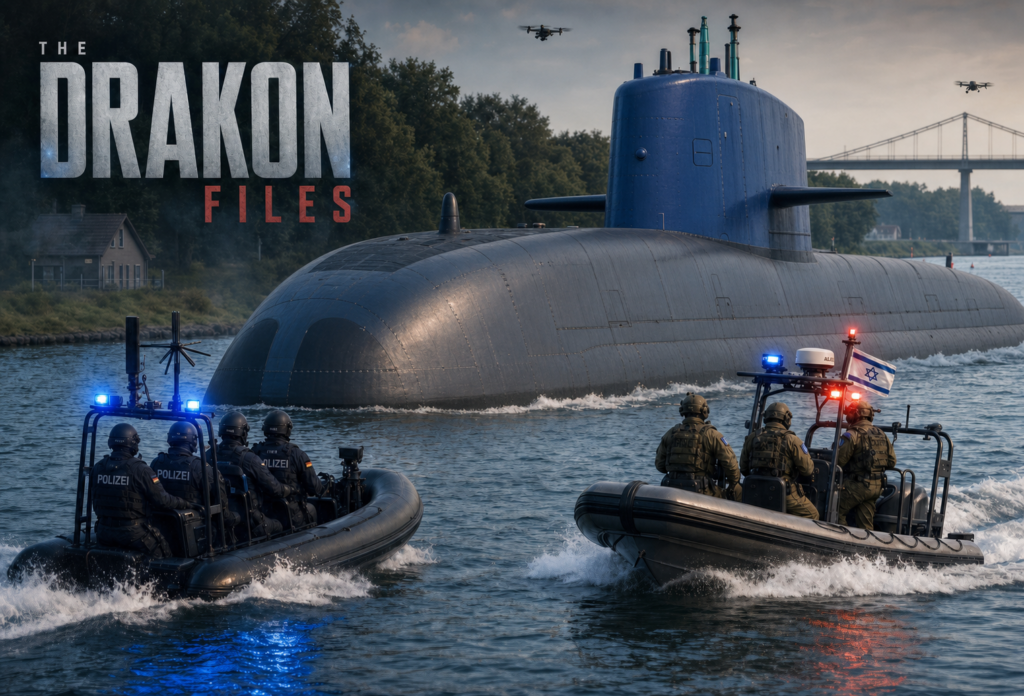
On 1 September 2026, the INS Drakon left the TKMS shipyard in Kiel under police escort and entered the canal on its way to Haifa. The submarine had reportedly been transferred to the Israeli navy behind closed doors on 22 July. German taxpayers contributed €135 million towards the vessel, even as the wider naval procurement programme remained at the centre of an unfinished Israeli criminal trial and a state inquiry into decisions that investigators say bypassed the country’s security establishment.
VIDEO: The Israeli submarine INS Drakon passes through the Kiel Canal under heavy police protection on 1 September 2026, beginning its journey from Germany to Haifa, Israel.
.
By 2017, the allegations had become serious enough for Berlin to postpone a separate agreement to finance three more submarines. The delay lasted only until October, when Germany committed another €540 million, but this time attached an unpublished condition requiring the corruption investigations to end and the resulting suspicions to be cleared before the vessels could be delivered. A later Bundestag answer confirmed that the memorandum addressed the allegations without revealing how Berlin eventually decided that its condition had been met.
The Israeli attorney general was expected to confirm that the investigations had ended, while Berlin kept the power to decide whether the corruption suspicions had been cleared and to stop delivery if new evidence emerged. The decision was to be recorded through an exchange of notes between the two governments. Neither the exchange nor Germany’s assessment has been published. Although the agreement did not cover the Drakon, which had been ordered years earlier, Berlin had made the corruption case a condition of its next €540 million commitment. It later allowed the programme to continue while the Israeli proceedings remained unfinished, without revealing who cleared the condition or what evidence justified it.
At the centre of the case stood an intermediary whose appointment ThyssenKrupp says it can no longer explain.
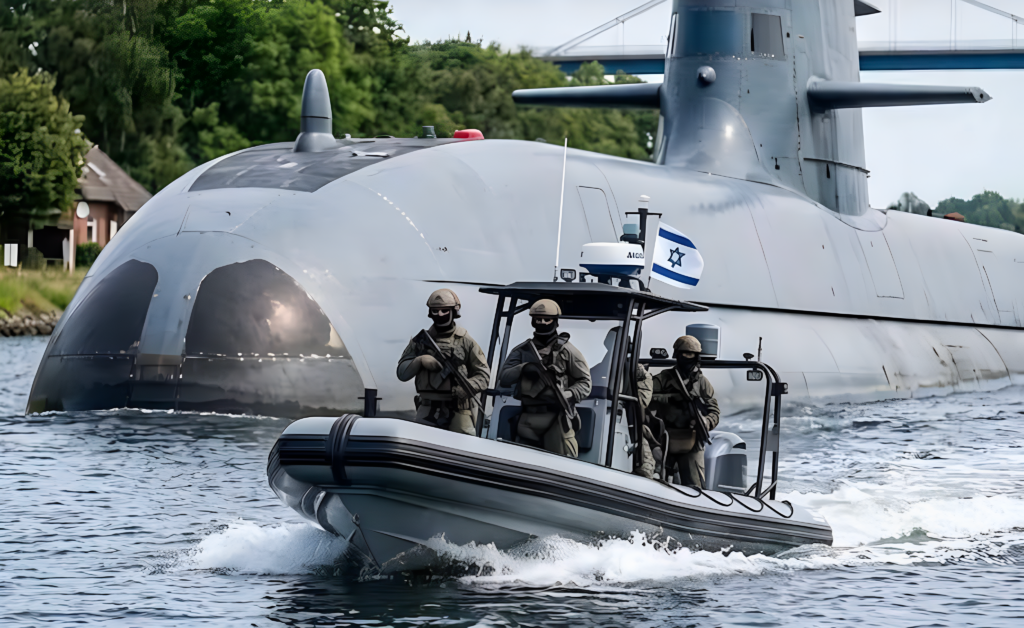
IMAGE: Armed Israeli security personnel escort the INS Drakon during its passage through the Kiel Canal in Germany. (Source: Israël, My Beloved via Facebook)
The Man in the Middle
Michael Ganor had represented ThyssenKrupp in Israel since 2009 and received €10.4 million in commissions from the naval contracts. Israeli prosecutors allege that he channelled part of that money to officials who could help steer purchases towards the German shipbuilder.
But Ganor’s potential earnings did not stop when ThyssenKrupp secured a contract. Internal company documents reported by Globes put his commission at 2% and show that he could also earn from procurement used to meet ThyssenKrupp’s offset obligations in Israel. He was therefore positioned to benefit when Israel bought the vessels and again when work generated by those purchases flowed back to Israeli companies. The offset contracts and their beneficiaries remain undisclosed, concealing how far Ganor’s influence and financial interests may have extended through the deal.

IMAGE: Michael (Mickey) Ganor. (Source: Reuven Castro, Walla | Project logo: OCCRP)
The representative Ganor replaced later described the appointment under oath. During a visit to Israel, he said, a senior ThyssenKrupp executive was warned that no further orders would be placed unless Ganor got the job. The outgoing representative waited in the executive’s hotel room while the conversation took place. Less than ten minutes later, the executive returned and told him that Ganor would be appointed.
ThyssenKrupp says Ganor passed its compliance procedures and that an external law firm reviewed his contract. Yet the company can no longer reconstruct how an ultimatum delivered in Israel became an appointment approved in Germany. Its internal inquiry did not interview Ganor and was described by the company’s own spokesman as limited. According to ThyssenKrupp, Israeli investigators declined its offer of documents and interviews, while its Israeli lawyers warned that questioning Ganor during the criminal investigation might be treated as obstruction of justice. The inquiry ended without speaking to the man at the centre of the allegations. Its report was sent to the German government and remains confidential.
Israel continued to follow the money. The trail led to Avriel Bar-Yosef, the former deputy head of the National Security Council, which advises the prime minister from inside the Prime Minister’s Office. Prosecutors accuse him of accepting money from Ganor in return for advancing his interests. He was charged with bribery and breach of trust.

IMAGE: Composite image of Benjamin Netanyahu and David Shimron, his personal lawyer and relative, who also represented Michael Ganor.(Source: Palestine Chronicle)
From Ganor, the investigation that became known as Case 3000 moved closer to Netanyahu. David Shimron, the prime minister’s personal lawyer and relative, had represented Ganor. During a separate tender for naval vessels, Shimron contacted the Israeli Defence Ministry and questioned why the tender had been issued, allegedly seeking to have the contract awarded directly to ThyssenKrupp. The tender was later cancelled, and the contract went to the German company after Berlin agreed to subsidise part of the purchase.
Israeli police recommended charges against Shimron, but prosecutors ultimately closed the case against him. Netanyahu was questioned as a witness rather than a suspect and was never charged. His office has said the allegations were thoroughly investigated and found to be baseless.
An archive of 50 sworn statements submitted to Israel’s High Court revealed a broader breakdown in the way the vessels had been chosen. Former defence ministers, military commanders, intelligence chiefs and senior security officials described strategic acquisitions advanced without normal planning, officials bypassed and decisions concealed from the institutions responsible for determining Israel’s military needs.
Former Defence Ministry director-general Dan Harel described the pressure reaching his own office. He said he was urged to cancel an international tender and structure the acquisition in Germany, or in a way that favoured ThyssenKrupp. Harel refused to act without a written instruction bearing Netanyahu’s signature. None came. He also recalled Netanyahu demanding another submarine despite professional opposition, leaving him with the impression that an interest he could not identify was driving the expansion of the relationship with the German shipbuilder. Harel’s sworn evidence formed part of the High Court filing, and its central allegations were later reported.
The Israeli investigation, which became known as Case 3000, followed the commissions paid to Ganor and the money he allegedly passed to Israeli officials, while the sworn statements revealed the procurement system pushed aside to make those purchases possible. Yet the investigation stopped short of the other end of the transaction: Germany, where ThyssenKrupp had installed Ganor at the centre of its Israeli business, authorised the commissions he received and secured contracts underwritten by German taxpayers.
Ultimately, the investigation had followed the money into Israel, while the unanswered questions led back to what ThyssenKrupp and the German government knew before the payments were made.
What Germany Did Not Establish
By the summer of 2017, the arrests and allegations in Israel had become serious enough for Germany to put the agreement for three future submarines on hold. But the pause did not lead to a criminal investigation. As the Israeli inquiry widened and ThyssenKrupp’s limited internal findings reached the German government, prosecutors continued only to monitor the affair.
Nearly two years passed before prosecutors in Bochum opened a formal investigation in March 2019. The publicly identified trigger was not a referral from another German authority or company records supplied by a whistleblower, but allegations reported in the international press.

IMAGE: The Bochum Justice Centre, where German prosecutors opened an investigation into the naval contracts in March 2019. (Source: Boga)
The Bochum investigators examined whether anyone in Germany had committed bribery or related offences in connection with the naval contracts. They closed the file at the end of 2020 and announced the decision the following January, saying they had found no sufficient suspicion of criminal conduct by any identifiable person in Germany.
The inquiry ended without a public account of how Ganor obtained his position, who approved his commission arrangements, what ThyssenKrupp knew about his alleged payments to Israeli officials, or whether warning signs had surfaced inside the company. Nor did the Israeli indictment or the creation of a state commission of inquiry bring German investigators back to the case, according to NDR’s later investigation. The file remained closed, the questions remained unanswered, and German taxpayers continued to subsidise contracts whose path through Israel had become the subject of one of the country’s largest corruption investigations.
Two Investigations, No Resolution
Four months after Bochum closed its investigation, Israeli prosecutors indicted Ganor, Bar-Yosef and several other defendants. Allegations of bribery, money laundering, fraud and breach of trust surrounding the naval contracts would now be tested in an Israeli courtroom while the German file remained shut. The defendants deny wrongdoing and are presumed innocent.
The trial could determine whether individuals had committed crimes, but not why Israel bought the vessels, how military and government procedures had been pushed aside, or who was responsible for those decisions. In 2022, the government created a state commission led by former Supreme Court president Asher Grunis to pursue the questions the criminal case could not answer.

IMAGE: Asher Grunis, the former Israeli Supreme Court president appointed to lead the state commission examining the submarine affair. (Source: Alex Kolomoisky/Flash90 via Times of Israel)
The commission examined how Netanyahu’s government, the military and the security establishment decided to buy submarines and warships between 2009 and 2016. Its mandate excluded alleged crimes already before the courts, leaving it to investigate how the purchases were advanced rather than whether the Case 3000 defendants had committed criminal offences.
In its January 2026 report, the commission found that the normal safeguards around acquisitions worth billions had repeatedly failed. Professional bodies were bypassed, contacts and understandings with foreign parties went undocumented, and purchases proceeded without a coherent assessment of Israel’s wider security needs. The resulting systemic failures endangered national security and damaged Israel’s foreign relations and economic interests.
The same absence of scrutiny shaped Israel’s response to Germany’s sale of submarines and warships to Egypt. The commission described the handling of weapons sales by allies to third countries as chaotic and found that it had endangered national security. Evidence before the inquiry alleged that Netanyahu approved the German sale without consulting or notifying the Defence Ministry. He denies approving it, and the commission has yet to reach a final finding on his role.
The commission had already sent warning letters to Netanyahu and four former security officials in June 2024. Its provisional findings said Netanyahu had bypassed his government in reaching understandings with Germany and advanced purchases without orderly staff work. High Court proceedings had delayed access to evidence and temporarily frozen the commission’s work. The commission is now due to begin closed hearings in November, when those warned can challenge the evidence before its final report. The public now knows that decisions made beyond the usual safeguards put national security at risk, but the evidence that may reveal who authorised them, and why, will be heard behind closed doors.
Approved Behind Closed Doors
While Israel’s commission was reconstructing how safeguards had been bypassed, Germany was moving towards another approval. According to NDR’s reconstruction, the Federal Security Council authorised the Drakon for export in December 2023, while the commission was still gathering evidence. The operative export authorisation reportedly followed in May 2026, after the commission had found systemic failures in the procurement process that endangered national security.

IMAGE: The Federal Chancellery in Berlin, where the Federal Security Council meets behind closed doors to decide sensitive arms exports. (Source: The Official Website of Berlin)
Those findings did not stop the export, and Germany’s approval process leaves no public record showing what weight, if any, ministers gave them. The Federal Security Council brings together the chancellor and senior ministers, but its deliberations are secret. Berlin has disclosed neither whether the Israeli evidence was considered nor how another submarine was approved while responsibility for the earlier decisions remained unresolved. Secrecy did more than conceal the discussion; in this case, it prevented the public from testing whether the government had confronted the risks at all.
In 2020, more than a year after Bochum prosecutors opened their case, the federal government told the Bundestag that it knew of no investigations connected to the sixth submarine. It neither identified the Bochum inquiry nor explained why an investigation into the wider naval-contract affair did not count. By the time the Drakon was approved, Germany had been confronted with arrests, indictments and findings that the procurement process had endangered Israeli security, yet the public was still given no account of how any of this bore on the export.
Germany did not have to wait for Israel to assign personal guilt before deciding whether the failures already established demanded greater scrutiny. Instead, it approved the submarine without providing the information needed to judge that decision, while committing public funds to the result. What remained hidden in the approval process became tangible in the federal budget, where taxpayers continued to underwrite the contracts without knowing how the risks surrounding them had been assessed.
The Public Money Continued
By the time Germany authorised the Drakon, its taxpayers had supported Israel’s submarine fleet for more than three decades. The policy began during the Gulf War, after German companies helped Saddam Hussein’s Iraq develop missile and chemical-weapons capabilities that threatened Israel. Helmut Kohl’s government responded by financing two Dolphin-class submarines in full and half the cost of a third. Together, the first three boats cost Germany about 1.1 billion Deutschmarks, roughly €560 million.
What began as a response to that crisis outlasted it. Berlin later paid slightly more than one third of the fourth and fifth submarines, committed up to €135 million towards the Drakon and financed roughly one quarter of Israel’s four warships. An exceptional act of historical responsibility had become a standing channel through which German public money supported Israeli naval power. Once corruption allegations surrounded the contracts, that history could explain the spending, but it could not excuse the failure to account for it.
Angela Merkel’s government continued the policy even as the strategic implications became harder to ignore. In 2012, Spiegel reported that Israel was equipping the German-built submarines with nuclear-tipped cruise missiles. Former senior German defence officials said they had always assumed the vessels would carry nuclear weapons. Merkel’s government maintained that Germany delivered the submarines unarmed and declined to address their subsequent armament. Berlin was therefore subsidising vessels that former officials understood could serve as platforms for Israel’s nuclear deterrent.

IMAGE: German Chancellor Angela Merkel and Israeli Prime Minister Benjamin Netanyahu in Jerusalem in early 2011. SPIEGEL has learned that Israel is equipping German-made submarines with nuclear-tipped missiles. (Source: Moshe Milner/ dpa via Der Spiegel)
The Drakon was initially priced at about €450 million, including Germany’s €135 million contribution, although later published estimates placed its value between €500 million and €700 million. The federal government has confirmed that appropriations for the procurement of Israeli defence systems do not have to be repaid. Germany’s contribution was not a loan, but a permanent transfer from the federal budget.
Yet Berlin could not tell Parliament where all the publicly supported work had gone. When Bundestag members asked in 2025 which Israeli companies had participated as subcontractors on German-built submarines and what share of the contracts they had received, the government replied that it did not know. It could account for the subsidy, but not identify every company that benefited from it or how much value each had received.
Despite that gap, the next agreement expanded the industrial relationship. Israel’s €3 billion order for three Dakar-class submarines included more than €850 million in reciprocal procurement and industrial cooperation with Israeli companies, including defence businesses. Germany committed a further €540 million, carrying its support from the contracts under investigation into a larger generation of purchases involving Israeli companies, even though the government had said it did not know which Israeli subcontractors had worked on the earlier publicly financed submarines or what share of their value they had received.
Berlin had promised that the next agreement would not proceed until the corruption investigations had ended and the resulting suspicions had been cleared. The condition remains unpublished, the Israeli criminal proceedings continue, and Germany has not disclosed the assessment that allowed the programme to proceed. Yet the Drakon departed, three more submarines were ordered and German taxpayers were committed to another €540 million.
By treating an unpublished anti-corruption condition as satisfied, German officials allowed the submarine programme to expand beyond the corruption affair, converting a decision the public could not examine into billions of euros in contracts and hundreds of millions in public support. Germany has yet to say who made that decision, what evidence they examined or how they concluded that Berlin’s promise had been kept.
Part II of The Drakon Files, “The Clearance Berlin Cannot Explain”, will trace that unpublished condition through the ministries and approval bodies responsible for the contracts. It will examine the commission and offset arrangements attached to the programme, and determine whether Germany’s promised safeguard was formally satisfied or disappeared inside the secrecy surrounding the deal.
READ MORE GERMANY NEWS AT: 21st Century Wire Germany Files
SUPPORT OUR INDEPENDENT MEDIA PLATFORM – BECOME A MEMBER @21WIRE.TV
VISIT OUR TELEGRAM CHANNEL
21st Century Wire is an alternative news agency designed to enlighten, inform and educate readers about world events which are not always covered in the mainstream media.
Source: https://21stcenturywire.com/2026/09/04/the-drakon-files-part-i-a-submarine-for-israel-and-a-scandal-made-in-germany/
Anyone can join.
Anyone can contribute.
Anyone can become informed about their world.
"United We Stand" Click Here To Create Your Personal Citizen Journalist Account Today, Be Sure To Invite Your Friends.
Before It’s News® is a community of individuals who report on what’s going on around them, from all around the world. Anyone can join. Anyone can contribute. Anyone can become informed about their world. "United We Stand" Click Here To Create Your Personal Citizen Journalist Account Today, Be Sure To Invite Your Friends.
LION'S MANE PRODUCT
Try Our Lion’s Mane WHOLE MIND Nootropic Blend 60 Capsules
Mushrooms are having a moment. One fabulous fungus in particular, lion’s mane, may help improve memory, depression and anxiety symptoms. They are also an excellent source of nutrients that show promise as a therapy for dementia, and other neurodegenerative diseases. If you’re living with anxiety or depression, you may be curious about all the therapy options out there — including the natural ones.Our Lion’s Mane WHOLE MIND Nootropic Blend has been formulated to utilize the potency of Lion’s mane but also include the benefits of four other Highly Beneficial Mushrooms. Synergistically, they work together to Build your health through improving cognitive function and immunity regardless of your age. Our Nootropic not only improves your Cognitive Function and Activates your Immune System, but it benefits growth of Essential Gut Flora, further enhancing your Vitality.

Our Formula includes: Lion’s Mane Mushrooms which Increase Brain Power through nerve growth, lessen anxiety, reduce depression, and improve concentration. Its an excellent adaptogen, promotes sleep and improves immunity. Shiitake Mushrooms which Fight cancer cells and infectious disease, boost the immune system, promotes brain function, and serves as a source of B vitamins. Maitake Mushrooms which regulate blood sugar levels of diabetics, reduce hypertension and boosts the immune system. Reishi Mushrooms which Fight inflammation, liver disease, fatigue, tumor growth and cancer. They Improve skin disorders and soothes digestive problems, stomach ulcers and leaky gut syndrome. Chaga Mushrooms which have anti-aging effects, boost immune function, improve stamina and athletic performance, even act as a natural aphrodisiac, fighting diabetes and improving liver function. Try Our Lion’s Mane WHOLE MIND Nootropic Blend 60 Capsules Today. Be 100% Satisfied or Receive a Full Money Back Guarantee. Order Yours Today by Following This Link.


| Visits: | 1,833,151,744 |
| Stories: | 8,711,014 |
Whistler Blowers, Insiders

