

Europe’s Energy Hypocrisy, Russian LNG Profits and US Dependence

Freddie Ponton
21st Century Wire
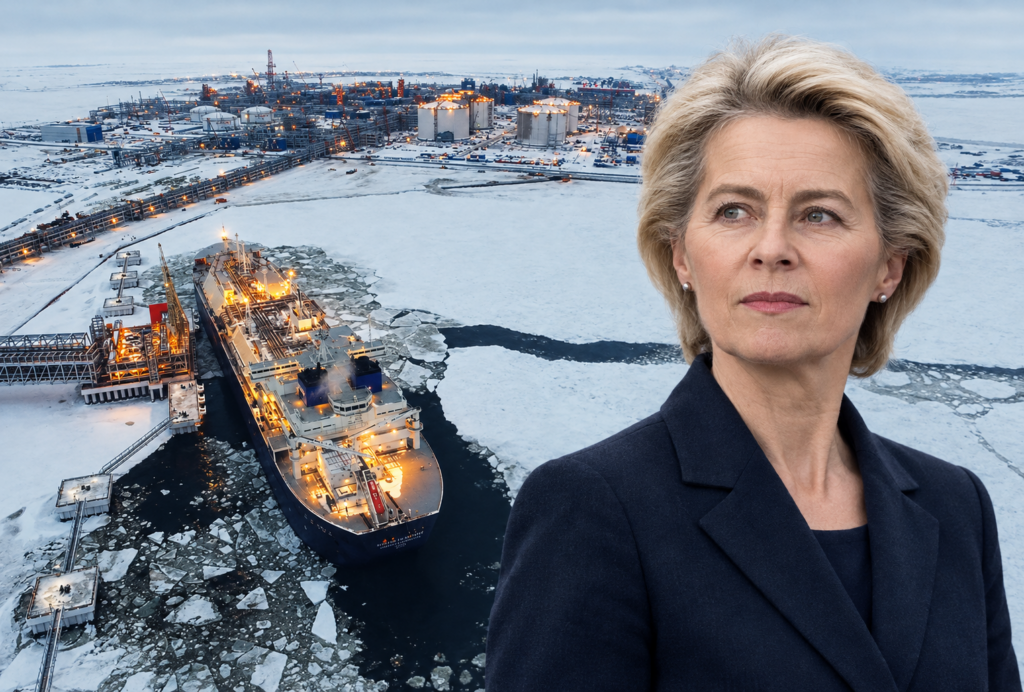
For four years, Europe presented its energy break with Russia as a strategic and moral necessity, with Brussels expanding sanctions, promising to cut Moscow’s revenues and preparing a complete ban on Russian liquefied natural gas. Yet European companies bought more LNG from Russia’s Yamal project in the first nine months of 2026 than in the same period of 2025.
EU ports received a record 12.18 million tonnes of Yamal LNG between January and September 2026, an increase of 9.5% over the same period in 2025. The gas arrived in 167 cargoes, roughly one every 1.6 days. The EU received 85% of Yamal’s recorded deliveries by volume even as the project’s worldwide shipments fell by 1.3%.
Urgewald, a German environmental and human rights organisation, placed the estimated benchmark value of those deliveries at €7.88 billion, using cargo volumes and monthly European TTF gas prices rather than disclosed contract payments. European leaders spoke of economic separation while EU ports remained the destination for a multibillion-euro Russian LNG trade.
Sanctions that preserved trade
The EU’s ban on Russian LNG under existing short-term contracts took effect on 25 April 2026. Eligible long-term agreements signed before 17 June 2025 could continue supplying Europe through the end of 2026, with the prohibition taking effect on 1 January 2027. Brussels could announce the coming break while established contracts kept Russian cargoes moving.
Five months after the ban on imports under eligible short-term LNG contracts took effect, EU ports received 792,440 tonnes of Yamal LNG in September, slightly more than a year earlier.
Yamal sold most of its output under long-term contracts signed before the war. TotalEnergies agreed to buy 4 million tonnes a year directly from the project, CNPC contracted 3 million, Germany’s SEFE inherited a 2.9 million tonne agreement, and Spain’s Naturgy held another for 2.5 million tonnes. Novatek sold part of its own allocation through separate agreements with TotalEnergies, Shell and Gunvor, now known as Centalion Group Ltd, These contracts kept major European energy companies commercially tied to Yamal after the political rupture with Moscow, securing supplies that could be sold or traded through their international portfolios, with destination flexibility varying by agreement.
TotalEnergies chief executive Patrick Pouyanné confirmed that its Yamal agreements were linked to Brent crude. During periods of extreme volatility, those long-term contracts secured supplies that could cost less than replacement gas on the European spot market. When spot prices outpaced oil-linked purchase prices, the gap created an opportunity to earn more from selling the contracted cargoes.
Buyers could exploit that opportunity through global portfolios spanning ships, terminals, storage facilities and supplies from several producing countries. They could exchange cargoes, redirect available gas and meet customer obligations from alternative sources, freeing supplies for sale in markets offering stronger returns.
Russian officials acknowledged that portfolio buyers could swap Yamal supplies against gas from other sources and direct available cargoes towards the most lucrative markets. A Yamal cargo could fulfil one obligation while freeing another supply for sale elsewhere, allowing traders to earn from price differences across markets.
The contracts that bound companies to Russian suppliers also secured access to gas that could cost less than replacement cargoes bought at crisis prices. Keeping those agreements meant preserving both the supply and the trading opportunities it created.
The profits behind the policy
TotalEnergies owns 20% of Yamal LNG and holds 19.4% of Novatek, the project’s controlling shareholder. It also buys and markets Yamal cargoes, giving it commercial interests as both a shareholder and a cargo trader.
In July 2026, chief executive Patrick Pouyanné told analysts that lifting and selling Yamal cargoes generated an average of about $400 million annually. TotalEnergies had direct access to the cash booked through its UK trading entity. The income fluctuated with Brent crude prices because the contracts were linked to oil.
TotalEnergies also retained rights to dividends through its ownership positions, although sanctions limited its ability to transfer those funds from Russia to Europe. Pouyanné confirmed that some cash flows had been distributed without disclosing how much had been repatriated, while the company’s Novatek dividends, which he had valued at around $600 million annually in 2024, had previously remained stuck abroad.
The commercial incentive extended beyond the immediate Yamal income, as continued deliveries preserved access to contracted gas while removing Russian LNG before replacement supplies became available could drive prices higher across the wider market. Pouyanné warned at a French Senate hearing that replacing those supplies would force Europe to pay more, and told analysts in April 2024 that sanctions on Yamal would benefit TotalEnergies’ global portfolio by pushing LNG prices higher.
TotalEnergies had commercial interests under either outcome, as continued Yamal trade generated sales income while a sudden prohibition could tighten supply and raise the value of gas sold elsewhere in its portfolio. Continued access and greater scarcity offered different routes to income, leaving the company with a potential financial benefit even if Russian deliveries stopped.
A French Senate inquiry called in 2024 for France to lead efforts to sanction Russian LNG and end its own imports as soon as possible, yet two years later TotalEnergies was still earning about $400 million annually from Yamal sales.
Germany’s retained Russian contract
Germany’s state-owned energy group SEFE inherited a contract for about 2.9 million tonnes of Yamal LNG annually through the former Gazprom Marketing & Trading business, after Berlin nationalised its parent company, Gazprom Germania, in 2022. The group became Securing Energy for Europe, retaining the Russian supply agreement under German state ownership.
SEFE’s trading operation later attributed substantial profits across its LNG portfolio to contractual flexibility, freight optimisation and arbitrage, while its 2024 financial report recorded £411.2 million in EBITDA and £199.4 million in profit after tax. Those figures covered SEFE Marketing & Trading and its subsidiaries, without isolating the contribution from Yamal.
That flexibility extended to its Indian supply obligations, for which Reuters reported that the business had arranged cargoes from other sources to reduce freight costs. SEFE’s chief executive also explained that it could retain Yamal supplies in Europe and serve India from elsewhere in its portfolio when doing so was cheaper, although that account described an available trading option rather than documenting individual cargo swaps.
Under German state ownership, SEFE retained a long-term agreement for about 2.9 million tonnes of Yamal LNG annually, even as Europe sought to reduce its dependence on Russian energy. Berlin’s nationalisation changed the ownership of Gazprom’s former German business, but the Russian supply agreement remained in place, preserving its commercial ties to Yamal inside a state-owned international trader.
Shell’s phased withdrawal
On 8 March 2022, Shell announced a phased withdrawal from Russian hydrocarbons, including oil, gas and LNG, but later acknowledged that long-term contractual commitments remained despite the end of its spot purchases of Russian LNG.
Among those commitments was a 2015 agreement with Novatek for approximately 900,000 tonnes of Yamal LNG annually, with a term exceeding 20 years. In February 2023, a Shell spokesperson confirmed that the company was still receiving Russian LNG cargoes under that contract, almost a year after announcing its withdrawal.
Shell’s Yamal agreement sat within a global LNG portfolio, with its cargoes passing through a contractual transhipment point at Montoir-de-Bretagne in France. Across the wider business, Shell used its international operations to capture differences in regional demand and prices, and chief executive Wael Sawan attributed strong late-2023 trading results to arbitrage between eastern and western markets. Those results demonstrate the commercial value of portfolio flexibility, without identifying how much came from Yamal.
Naturgy and former Gunvor also retained access to Yamal supplies through long-term agreements, with Naturgy contracted for 2.5 million tonnes annually and Centalion Group Ltd, for about 500,000 tonnes through Novatek. Reporting on Yamal’s portfolio buyers describes how companies could exchange those supplies with gas sourced elsewhere and direct cargoes towards more lucrative markets.
The contracts therefore carried commercial opportunities alongside their obligations, preserving access to gas that could be sold or exchanged within wider portfolios. Remaining in the trade could generate value even where companies presented their continuing purchases as a contractual constraint, although that potential should not be confused with a verified profit from each agreement.
Russian gas beyond Nord Stream
On 7 February 2022, then US President Joe Biden stood beside German Chancellor Olaf Scholz and said that a Russian invasion would bring Nord Stream 2 to an end. Asked how Washington could achieve that when Germany controlled the project, he maintained that the United States could ensure the outcome without explaining the mechanism.
Germany halted Nord Stream 2’s certification on 22 February 2022, preventing a pipeline that had never entered commercial service from beginning operations. Nord Stream 1 had already stopped delivering gas when explosions ruptured three of the system’s four pipeline strings on 26 September 2022, leaving only one Nord Stream 2 string intact. With the Nord Stream route out of operation, Russian LNG continued reaching European terminals through the contracts held by companies such as TotalEnergies, SEFE and Shell.
Yamal had begun exporting LNG in December 2017, almost five years before the Nord Stream explosions, and its seaborne supply network survived the loss of the pipelines. European companies continued buying Russian gas under long-term contracts, receiving by-sea supplies that remained commercially valuable even as the direct pipeline connection between Russia and Germany stood idle.
America captured the market
The decline of Russian pipeline supplies opened a larger European market for American LNG, and Washington worked with Brussels to expand the trade. In their 25 March 2022 agreement, the United States pledged to work towards at least 15 billion cubic metres of additional LNG for the EU that year, including supplies from international partners, while maintaining a regulatory environment that would support additional export capacity. The European Commission committed to working with member states to secure demand for approximately 50 billion cubic metres of additional American LNG annually until at least 2030, giving the effort to reduce Russian dependence a long-term market for US supplies.
American deliveries to the EU rose from 22 billion cubic metres in 2021 to 56 billion in 2022, exceeding the initial expansion target. By the second quarter of 2026, the United States supplied 63.2% of EU LNG imports, with Russia second at 17.3%. Europe’s retreat from Russian pipeline gas had been accompanied by a US-European policy effort to expand American supply, while Russian LNG retained a substantial place in the same market.
Dependence became leverage
Europe’s reliance on American supplies extended beyond LNG, giving Washington leverage over another essential fuel when the Trump administration asked the EU to release 120 million barrels of emergency diesel over six months. Washington presented reserve releases as an alternative to restricting American diesel exports, a threat with considerable force because the United States supplied around half of the EU’s diesel imports in August 2026.
Washington was pressing Europe to release finished diesel that could reach consumers without further refining, while its own emergency contribution consisted of crude offered to companies under loan arrangements requiring repayment in oil with additional barrels. The US Department of Energy’s September solicitation explicitly built replenishment into those contracts, leaving Europe under pressure to draw on immediately usable fuel while American releases carried a contractual obligation to restore its crude reserves.
The pressure was followed by a G7 agreement on 2 October 2026 to coordinate the release of 100 million barrels over four months, with a substantial diesel release brought forward into the first 20 days. G7 leaders also reaffirmed their commitment to refrain from energy export restrictions against one another, placing continued access to supplies alongside the agreement to draw down emergency stocks.
Washington had helped build a larger European market for American energy as part of the effort to reduce dependence on Russia, then used the prospect of restricting diesel exports to press European governments to release their reserves. Europe’s reliance on an allied supplier had left it exposed to pressure over access to fuel, with emergency stocks becoming part of the negotiation over keeping those supplies flowing.
A credibility crisis
European leaders need to explain how their effort to cut Russia’s energy revenues can be reconciled with rising Yamal deliveries to EU ports and European traders earning income from the cargoes. TotalEnergies’ disclosure of about $400 million in annual income makes continued trade harder to present solely as an unwanted contractual obligation, when the same agreement also sustained a valuable business. Compliance with the sanctions timetable does not resolve the political contradiction; it shows how much commerce that timetable allowed to continue.
Brussels also committed to building long-term demand for American LNG, while Washington later demonstrated its willingness to use fuel exports as leverage over European governments.
Whose interests are being served when Europe distances itself from Russian pipeline supplies, remains a paying customer for Russian LNG and becomes more exposed to American pressure?
European leaders owe their citizens an explanation of why Russia remained an acceptable supplier for profitable LNG contracts while economic separation was presented as a strategic necessity. They must also explain whose interests were served by replacing that dependence with greater exposure to Washington.
READ MORE EUROPEAN NEWS AT: 21st CENTURY WIRE EUROPE FILES
SUPPORT OUR INDEPENDENT MEDIA PLATFORM – BECOME A MEMBER @21WIRE.TV
VISIT OUR TELEGRAM CHANNEL
21st Century Wire is an alternative news agency designed to enlighten, inform and educate readers about world events which are not always covered in the mainstream media.
Source: https://21stcenturywire.com/2026/10/12/europes-energy-hypocrisy-russian-lng-profits-and-us-dependence/
Anyone can join.
Anyone can contribute.
Anyone can become informed about their world.
"United We Stand" Click Here To Create Your Personal Citizen Journalist Account Today, Be Sure To Invite Your Friends.
Before It’s News® is a community of individuals who report on what’s going on around them, from all around the world. Anyone can join. Anyone can contribute. Anyone can become informed about their world. "United We Stand" Click Here To Create Your Personal Citizen Journalist Account Today, Be Sure To Invite Your Friends.
LION'S MANE PRODUCT
Try Our Lion’s Mane WHOLE MIND Nootropic Blend 60 Capsules
Mushrooms are having a moment. One fabulous fungus in particular, lion’s mane, may help improve memory, depression and anxiety symptoms. They are also an excellent source of nutrients that show promise as a therapy for dementia, and other neurodegenerative diseases. If you’re living with anxiety or depression, you may be curious about all the therapy options out there — including the natural ones.Our Lion’s Mane WHOLE MIND Nootropic Blend has been formulated to utilize the potency of Lion’s mane but also include the benefits of four other Highly Beneficial Mushrooms. Synergistically, they work together to Build your health through improving cognitive function and immunity regardless of your age. Our Nootropic not only improves your Cognitive Function and Activates your Immune System, but it benefits growth of Essential Gut Flora, further enhancing your Vitality.

Our Formula includes: Lion’s Mane Mushrooms which Increase Brain Power through nerve growth, lessen anxiety, reduce depression, and improve concentration. Its an excellent adaptogen, promotes sleep and improves immunity. Shiitake Mushrooms which Fight cancer cells and infectious disease, boost the immune system, promotes brain function, and serves as a source of B vitamins. Maitake Mushrooms which regulate blood sugar levels of diabetics, reduce hypertension and boosts the immune system. Reishi Mushrooms which Fight inflammation, liver disease, fatigue, tumor growth and cancer. They Improve skin disorders and soothes digestive problems, stomach ulcers and leaky gut syndrome. Chaga Mushrooms which have anti-aging effects, boost immune function, improve stamina and athletic performance, even act as a natural aphrodisiac, fighting diabetes and improving liver function. Try Our Lion’s Mane WHOLE MIND Nootropic Blend 60 Capsules Today. Be 100% Satisfied or Receive a Full Money Back Guarantee. Order Yours Today by Following This Link.


| Visits: | 1,834,674,339 |
| Stories: | 8,719,292 |
Whistler Blowers, Insiders

