

60+ Foods and Supplies That Outlast a Supply Chain Failure, and the 2030 Shelf They Are Heading Toward

Grocery retail runs on turnover, and turnover is why the shelves look permanent when they are not. A supermarket cannot afford to hold much. Carrying costs run between a fifth and a third of stock value once refrigeration, shrinkage, insurance and floor space are counted, so the industry spends its effort making inventory move rather than sit. Kroger and Albertsons both turn their stock more than a dozen times a year, which reads like a comfortable month of cover until you notice the average includes pallets of detergent and cases of soda in the back room. The perishable perimeter — meat, dairy, produce, bread — turns in days. That is where thinness shows first.
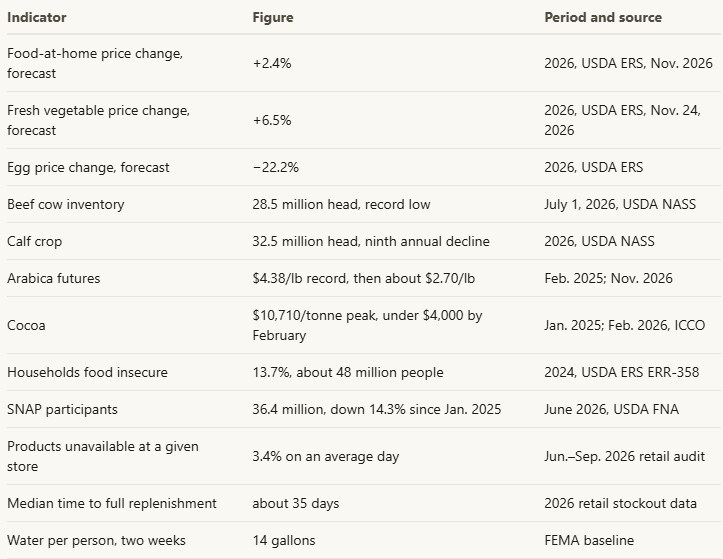
Independent audits of American retail availability put the everyday baseline near 3.4 percent of products unavailable at a given store on a given day, with late-afternoon stockout rates in fresh categories climbing toward a quarter by eight in the evening once demand and restocking schedules collide. Recovery time matters more than the rate: across retail generally, an out-of-stock takes a median of about five weeks to reach full replenishment. Five weeks is acceptable while trucks run. It becomes a different number when they don’t, because the replenishment pipeline is the same pipeline everyone else is queuing in.
Demand shocks expose this at once. A hurricane forecast putting landfall within two hundred miles starts the buying before the weather does, and bread, water, batteries and milk go in an afternoon. Winter Storm Uri added a harder variable in February 2021 when it took the Texas grid down; stores that still had stock began limiting water and meat by the package inside a day, largely because they could no longer refrigerate what they held. The 2022 formula shortage worked by a different mechanism — a single plant closure against a concentrated manufacturing base and a fragile WIC contracting system — and it emptied shelves for months rather than hours, sending parents across county lines. Avian influenza ran from 2022 into 2025 and killed enough laying hens to double egg prices in some markets. None of those events shared a cause. What they shared was a store with no cushion and a public that assumed one existed. (EXCLUSIVE VIDEO: Inside Factory Farms – Hidden Camera Footage Reveals What Really Happens Behind Closed Doors!)
The 2026 price picture is more mixed than the alarmist version of this subject allows, and the honest reading belongs before the list. Grocery inflation has cooled hard from the 11.4 percent recorded in 2022. The USDA’s November outlook puts food-at-home prices up 2.4 percent for the year, below the twenty-year average, and forecasts retail egg prices down about 22 percent as flocks rebuild. Fresh vegetables are the exception at a forecast 6.5 percent. Beef keeps climbing because the cattle herd is the smallest in the fifty-five years the series has run: 28.5 million beef cows on July 1, 2026, with a calf crop of 32.5 million head marking a ninth consecutive annual decline. Coffee and cocoa, the two commodities that dominated the 2024 and 2025 headlines, have both corrected. Arabica fell from a February 2025 record near $4.38 a pound to roughly $2.70 in late November 2026 on a record Brazilian crop, and cocoa slid from a January 2025 peak above $10,700 a tonne to under $4,000 by February 2026 as West African supply recovered and industrial demand collapsed. Anyone who stocked coffee at the top owns a case of expensive beans and a lesson about timing.
Household strain has not eased with the inflation rate. Food insecurity stood at 13.7 percent of households in the 2024 data, covering nearly 48 million people, and the USDA announced in September 2025 that it would stop publishing the annual household food security report, which means the national series ends on that figure. SNAP enrollment averaged 42.1 million a month in fiscal 2025 and had fallen to 36.4 million by June 2026, a drop of 14.3 percent driven largely by the work requirements and eligibility changes in the 2025 reconciliation law, which cut roughly $187 billion from the program over a decade. Fewer people on the rolls while grocery prices still rise at twice the 2024 rate is the arithmetic behind most of the pantry interest you can measure.
Everything to this point is reported fact with a source and a date. What follows is the part that is forecast, and it is worth separating clearly rather than smuggling in as certainty.
2027 through 2030, as projection rather than fact. Beef is the most reliable of these calls because cattle biology sets the clock. A retained heifer does not produce marketable beef for roughly two years, and the July 2026 report shows retention only beginning, with the beef cow herd still falling. On that trajectory, retail beef stays elevated through 2028 and settles into a structurally higher band by 2030, with the cheap cuts disappearing first. The USDA has not published a 2030 price target, so treat the shape of that curve as inference from the reproduction cycle rather than a number.
Coffee points the other way in the near term and then flattens. A record Brazilian crop of 71.9 million bags for 2026/27 and a Rabobank call of $2.50 to $3.00 by late 2026 both argue for relief through 2027. The floor underneath it, though, is policy and weather rather than harvest: tariffs on Brazilian origin remain in place and can move either direction, and arabica is a tree crop with a multi-year establishment lag. Expect 2030 coffee cheaper than the 2025 peak and dearer than the 2019 baseline. Cocoa is the volatile one — the crash below $4,000 in February 2026 came with ICE-certified stocks at a two-and-a-half-year high, but West African trees are ageing, disease pressure is chronic, an El Niño was expected later in 2026, and EU traceability rules add compliance cost. The 2027 cocoa market is likely to swing hard in both directions before any new equilibrium.
Grain and legume prices follow diesel and fertilizer with a lag of about two seasons, which makes the current window a comparatively cheap one for building a calorie base and argues for buying it before the lag closes. Water is the slowest variable and the most consequential: drawdown in the Ogallala and the Central Valley continues, and each acre retired from irrigated production removes supply permanently rather than cyclically. Retail consolidation, meanwhile, keeps shrinking store counts per capita while average store size grows, so the nearest shop gets farther away as the assortment narrows toward what keeps. Projections of a visibly thinner fresh perimeter and a fatter center-store by 2030 are consistent with those incentives, though no retailer has published one.
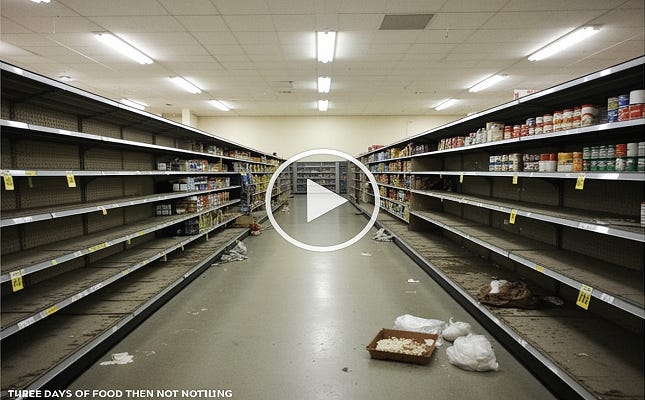
🛒 Three days is about perishables and surge, not total stock. A store holds weeks of detergent and days of milk, and the milk is what people come for. Multiply a town’s population by the contents of the refrigerated cases and the supply is measured in hours once buying accelerates. Highway stores empty before neighborhood stores, cheap cuts before expensive ones, and the sequence outruns any household reaction. The shelf is the end of a pipe, not a buffer.
📦 Rotation is a purchasing system, not a virtue. Buy what the kitchen already cooks, write the month on every package, load new behind old, pull from the front. Done consistently, six months of cover costs close to nothing across a year because it displaces grocery spending instead of adding to it. The failure mode is the opposite habit: a closet of discount cans bought in one enthusiastic weekend, never eaten, thrown out three years later.
⏳ Moisture, oxygen, temperature and light set every real shelf life. Control those four and milled white rice holds for decades; ignore them and the same rice hosts weevils by the first warm week. Whole grains, dry legumes, salt, sugar and honey sit at the far end of the curve. Onions and potatoes sit at the near end regardless of care. The entries below say which is which, because packaging and storage decide the outcome more than the food does.
🥫 Fat and water run out before calories do. Households overbuy starch because it stacks neatly and costs little, then find in the sixth week that they cannot absorb the vitamins they are eating, that nothing tastes of anything, and that the water went on day five. Fat carries flavor and fat-soluble vitamins. Water carries everything. Budget both before another sack of rice.
What follows is the inventory, organized by aisle and by what each item actually does, with shelf lives stated under specific conditions, the storage failures that shorten them, and the places where the conventional wisdom is wrong:
You’ll Understand Everything After Watching This VIDEO!
Seasoning, Fat and Acid: The Shelf That Makes Stored Food Edible
Stored calories without seasoning become a chore inside a fortnight. A kitchen with salt, fat and acid available eats with appetite rather than obligation, and the whole tier is cheap enough to build in an afternoon. Buy volumes the household will use within two years and pull them through ordinary cooking.
1. Salt. Three jobs, and flavor is only one. Curing meat and vegetables depends on it, electrolyte replacement depends on it during heavy sweating, and every other stored food depends on it to be worth eating. Non-iodized canning salt keeps indefinitely in a sealed bucket. Iodized table salt loses its iodine over roughly five years, though the salt itself does not degrade, so keep the iodized for the table and the coarse for curing. Twenty pounds costs under ten dollars.
2. Sugar, white and brown. Nothing grows in dry white sugar, which is why it keeps indefinitely and needs only pest-proofing. Brown sugar is the reverse problem: molasses draws moisture until the bag sets like mortar, so seal it in Mylar with the air pressed out or store a terracotta disc in the jar. Beyond baking and coffee, sugar holds a real resale floor in a shortage, being cheap to store and impossible to improvise.
3. Raw honey. Low moisture, high acidity and a glucose oxidase enzyme that generates hydrogen peroxide make honey hostile to microbial growth, which is why sealed jars recovered from Egyptian tombs were still edible. Crystallization is a sugar phenomenon rather than spoilage; a warm water bath reverses it. The evidence for honey as a cough suppressant in adults and children over one year is modest but real, and it has been used on wounds for centuries, though a modern dressing outperforms it for anything serious.
4. Spirits at 40 percent and above. Sealed glass holds whiskey, rum, vodka and bourbon for decades with only slow quality drift. Straight spirits do not freeze in a home freezer and do not spoil. The disinfectant reputation needs qualification, since 40 percent alcohol is weaker than the 60 to 90 percent of isopropyl or ethanol used on surfaces, so treat a bottle as a fair cleaner for intact skin and a poor substitute for a proper antiseptic. As a trade good it moves faster than almost anything else here.
5. Whole peppercorns. Ground pepper loses its volatile oils inside a year. Whole peppercorns hold four to five in a sealed jar, longer under vacuum, and a cheap mill converts them as needed. Two pounds is a large household supply and costs little. The piperine bite also makes bland food register as food.
6. A spice shelf built for rotation rather than display. Cumin, coriander, paprika, chili powder, oregano, thyme, bay, cinnamon, turmeric and mustard powder, bought whole where the seed exists and ground at the point of use. Ground spices fade in two to three years sealed and dark, faster above a stove. The purpose is range: the same lentils become a curry on Monday and a paprika stew by Thursday, which does more for a household’s willingness to eat them than any nutritional argument.
7. Bouillon cubes and paste. Concentrated salt and glutamate that turns water and vegetable trim into stock. Cubes hold about two years and far longer vacuum-sealed; a refrigerated paste runs roughly a year after opening and tastes markedly better. This is the difference between soup and a pot of hot water with carrots in it, and the salt load is high enough to count against the day’s intake.
8. Coffee, instant and whole bean. Habitual drinkers get headaches, irritability and flat energy from withdrawal, rarely at a convenient hour. Instant holds two to three years sealed and needs only hot water. Whole bean outlasts ground by a wide margin; green beans outlast both and can be roasted at home, badly at first. Store away from light and heat. With arabica well off its record, this is the cheapest buying moment in two years, though the 2027 crop is the better bet for the bulk of it.
9. Tea, loose and bagged. Two years sealed, and the cheapest caffeine available. Black tea also gives a household something warm to do with its hands on a long evening, which counts for more than it sounds. Chamomile, peppermint and ginger cover the medicinal side without pretending to be medicine.
10. Vinegar, white and cider. Five percent acetic acid, indefinite shelf life, and a use list with nothing to do with salad: descaling kettles, cutting grease, killing mildew, deodorizing a bucket, pickling vegetables, setting dye. A gallon of white vinegar costs about four dollars. Apple cider vinegar does the same work with more flavor and better odds of being drunk.
The Calorie Base: Grain, Legume and Dry Staple
An adult needs roughly two thousand calories a day, which puts a six-month buffer for one person near 360,000 calories and well past two hundred pounds of grain before a vegetable enters the picture. This tier decides whether a pantry is real, and it punishes careless storage hardest. The two-season lag between diesel and grain prices makes this the tier to buy before the lag closes.
11. White rice. Milling strips the oil-bearing bran, which is exactly why white rice outlasts brown rice by a factor of fifty under identical conditions. Sealed in seven-mil Mylar with a 300cc oxygen absorber per gallon and held below 60°F, it holds twenty-five to thirty years at quality; in the paper sack above the stove it hosts weevils inside a season. Buy twenty-five and fifty-pound sacks, decant, seal, date. At roughly 1,600 calories a pound it is the most calorie-dense thing per dollar and per cubic foot on this list.
12. Hard red and hard white wheat berries. Whole grain keeps thirty years sealed and offers what rice does not: it sprouts for fresh green matter and mills into flour. A hand mill turns six pounds into flour in about twenty minutes, enough for two loaves and a forearm cramp. Buy food-grade grain from a bulk grocer or a feed supplier selling for human consumption, and apply the same Mylar and absorber protocol.
13. Rolled oats. Twenty to thirty years in Mylar with absorbers, five in the sealed cardboard tube, a year in a plastic bin. Oats are dense, cheap and edible without cooking if it comes to that, which gives them a use case most staples lack. Buy plain rolled rather than instant, which costs more and does less, and store away from light to slow the fat in the germ.
14. Pasta in assorted shapes. Durum semolina holds eight to ten years sealed and dark, two years in the box on a shelf. Small footprint, five to eleven minutes to a meal, and a decent trade item because everyone knows what to do with it. Watch for pantry moths, which find an open box from three rooms away and are hard to eradicate once established.
15. Cornmeal and grits. Stone-ground cornmeal goes rancid within months because the germ oil is still present; degerminated meal holds about two years and grits hold one sealed. Corn is the base starch of the American South for reasons that survive: bread, porridge, and a thickener that gives a stew body. Keep degerminated meal in Mylar and stone-ground in the freezer if space exists.
16. Dried beans, several varieties. Ten years sealed, one to two in a jar. Pintos, blacks, kidneys, navy, great northern. A pound delivers about 1,500 calories plus protein and fiber, and older beans take progressively longer to soften until eventually they stop softening at all — a change in the seed coat, not a cooking error, and the reason rotation matters more here than nominal shelf life. Soak overnight and pressure cook.
17. Lentils and split peas. No soaking, twenty-five minutes to a pot of something thick, eight to ten years sealed. Red lentils collapse into a puree that thickens soup and reads as comfort food; brown lentils and split peas hold enough shape for a pilaf or a pease pudding. Cheap enough to stack deep and light enough to carry.
18. Chickpeas. Eight years sealed and unusually versatile for a legume: roasted they are a snack, ground they are falafel, simmered they are a stew, and the cooking water whips into a meringue substitute. Buy dried rather than canned for the deep stack, and expect a long simmer or a pressure cooker.
19. Barley and bulgur. Both hold about eight years sealed. Pearl barley gives a soup base that thickens as it cooks; bulgur needs only soaking for a tabbouleh or a pilaf; pot barley sprouts. Barley contains gluten, which matters in some households.
20. Instant potato flakes. Fifteen to twenty years in Mylar, and quietly one of the better items here, since flakes thicken soup, stretch a bread dough and produce a hot meal in ninety seconds from boiling water. Buy plain rather than flavored, because the flavored varieties carry dairy and shortening that cut the clock to a couple of years.
21. Baking soda. Indefinite in a sealed container and useful in four directions: leavening, deodorizing, scouring, and as a mild antacid. A pound lasts years and costs a dollar. Store it dry and away from anything acidic.
22. Baking powder and active dry yeast. Powder runs about eighteen months as the double-acting chemistry decays, so jar it tight and test a spoonful in hot water before trusting a batter. Yeast runs two years refrigerated, one at room temperature, longer frozen. Bread from a sourdough starter needs neither, but a starter is a living culture and a skill, and yeast buys the time to acquire both.
23. All-purpose and bread flour. One year in Mylar with absorbers, six months in the bag, and it needs the first number. Flour is the most-used baking input and the most-attacked by insects; freeze a new bag forty-eight hours to kill anything already resident, then decant, seal and date. Whole wheat flour goes rancid in weeks from the germ oil, so store berries and mill on demand if the household bakes seriously.
24. Cornstarch, textured vegetable protein and powdered eggs. Cornstarch keeps indefinitely sealed and thickens without flavor. TVP holds about ten years and takes the taste of whatever it simmers in, stretching ground meat by half. Egg powder holds ten years and binds at one tablespoon plus two of water per egg, scrambling rather than frying. None of the three is exciting, and all three keep a kitchen working through a bad month.
Fat: The Tier That Fails First
Fat is calorie-dense, essential for absorbing fat-soluble vitamins, and the one macronutrient with a hard expiry. Households run out in week eight and then eat starch for a month. Buy in metal and glass, in quantities that will be used, and rotate harder here than anywhere else.
25. Olive oil, in tins. Two years sealed, eighteen months in glass, months after opening. Metal tins beat clear bottles because light drives oxidation and plastic permits it. Extra-virgin oil carries polyphenols that slow its own decline, but the decline is real once air enters. Buy the smallest tin the household will finish in a month and keep a couple of larger sealed tins behind it.
26. Coconut oil. Two years sealed and the most oxidation-resistant cooking fat sold at retail, largely because saturated fat dominates the profile. Solid below about 76°F, so it travels without leaking, substitutes for butter in baking, and doubles as a salve and a fire starter. Refined oil has a neutral flavor and a longer life than virgin.
27. Ghee and canned butter. Ghee is butter with the milk solids clarified out, which removes the protein that scorches and spoils; sealed, it holds two years without refrigeration and months after opening. Tinned butter from New Zealand performs similarly. Both matter beyond calories, since they make rice, lentils and vegetables taste like a meal rather than a ration.
28. Lard and tallow. One to two years sealed, and rendered animal fat remains the traditional long-storage fat because it is dense, stable and cheap. Both fry at high heat and both make a superior biscuit. Rendered at home it holds about a year in a sealed jar in a cool room. Leaf lard from around the kidneys is the best of it and the least porky.
29. Peanut butter. Two years sealed, three months after opening. Buy the natural sort with the oil separated on top and stir it back in; the stabilized kind lasts longer and tastes like the jar. Calories, protein and morale in one container, and it needs no cooking at all, which makes it the best no-fuel food in the pantry.
30. Nuts in the shell and raw seeds. Almonds, walnuts, pecans and hazelnuts hold about a year in shell, six months shelled, longer frozen. In-shell nuts resist oxygen and insects, and cracking them passes an evening. Sunflower and sesame seed keep a year sealed and go into bread, salads and a handful of protein. Buy unsalted, and buy nuts at the winter holidays when the price halves.
Shelf-Stable Protein
Protein without refrigeration is the hardest thing to hold and the thing people overthink. Canned, cured and dried all work, all have limits, and all should be bought in volumes the household actually eats rather than admires. With beef at record cost, tinned and cured protein carries more of the load than usual this winter.
31. Canned sardines and mackerel in oil. Three to five years, and the packing oil is part of the value, since it is calories the pan can use after the fish is gone. Small oily fish carry omega-3s, calcium from the softened bones and enough salt to be palatable straight from the tin. They are also the cheapest tinned fish on the shelf by a wide margin.
32. Canned tuna and salmon. Three to five years. Tuna in water if the household is watching calories, in oil if it is watching the other way. Salmon carries skin and bones, which means fat and calcium. Buy by the case on markdown rather than one at a time, and check the cans for dents at the seam.
33. Canned chicken and turkey. Three to five years. Shredded into soup, curry or a bake it reads as a real meal, though the texture is soft and the flavor flat enough to need aggressive seasoning. Sodium runs high across the category, which matters under a restriction.
34. Spam and canned ham. Five years and beyond. Widely mocked and genuinely good: salt-cured, dense, fryable and indifferent to heat. Sliced thin and seared it turns a potato into dinner. The cans are heavy for their calories, so weigh them against what else is in the bag.
35. Corned beef. Five years. Salty, dense and a morale item for anyone who grew up with it. Buy the flat cans with the key and keep a spare church key in the drawer, because the folding tabs snap off and the can is otherwise a puzzle.
36. Canned chili, stew and chunky soup. Two to five years. Favor the varieties with meat and beans over the broth-heavy ones, and read the protein per can rather than trusting the picture. These get eaten on the night nobody can face cooking, and that night arrives in every disruption.
37. Jerky and shelf-stable cured sausage. One to two years sealed, about six months for a salami hanging in a cool dark room. Protein you can eat while walking, which justifies the price per calorie. Buy on markdown, vacuum-seal in portions, and store away from light, which turns the surface fat rancid.
38. Canned beans. Two to five years. Dried beans are better economics, but canned beans need no soak, no fuel and no forethought, and that premium buys real value on a day when the power is out and everyone is wrung out.
39. Canned vegetables, especially corn, peas and tomatoes. Two to five years for low-acid varieties, twelve to eighteen months for tomatoes because their acidity attacks the lining faster. Canned tomatoes underwrite half of American home cooking and deserve a flat. Buy no-salt-added where the budget allows, since salt at the stove is controllable and salt in the can is not. With fresh vegetable prices forecast up 6.5 percent this year, the canned aisle is the cheaper vegetable.
40. Canned fruit in juice. Eighteen months to two years. Vitamin C, fiber and sweetness, with the packing liquid as a drink afterward. Buy in juice rather than heavy syrup and spend the calories on something with fat in it.
Powdered and Canned Dairy
Fresh dairy is a three-week proposition at best and shorter in a warm kitchen. Powdered and canned dairy is a decade-scale proposition, though the category is far less uniform than the packaging implies.
41. Powdered nonfat milk. Twenty years sealed in Mylar with absorbers, and about a year in the original opened bag. It drinks poorly and cooks well — bread, pancakes, pudding, mash, coffee whitener. Buy instant, which dissolves without lumps, and decant into small bags so a portion opens at a time. Nonfat powder lacks the fat, so it cannot stand in for cream.
42. Powdered buttermilk. Ten years sealed, roughly six months once opened. The acidulant is the point: it lifts biscuits and cornbread and supplies a tang no other shelf-stable ingredient gives. It is not interchangeable with powdered milk in baking, despite the similar packaging.
43. Evaporated and condensed milk. Two years in the can, and the two are different products. Evaporated milk is milk with the water cooked out; dilute it back for cooking or use it straight as a creamer and pie base. Sweetened condensed milk carries sugar as its preservative and thickens to caramel when boiled in the can. Both need refrigeration once opened and neither freezes well.
44. Ultra-pasteurized cream and powdered cheese. Shelf-stable UHT cream holds six months to a year unopened and must be refrigerated after; it whips, though less stiffly than fresh. Powdered cheese and cheese sauce hold two to five years and produce a macaroni dinner, a nacho or a vegetable sauce. Neither is a cheese board, and both beat a week without either.
Water and Water Treatment
Nobody stores enough water, including plenty of people who believe they do. The planning figure is a gallon per person per day for drinking and rudimentary hygiene, which is fourteen gallons per person across two weeks and fifty-six for a family of four. Water weighs eight pounds a gallon, so storage is a floor-loading problem as much as a supply problem.
45. Bottled water by the case and stackable water bricks. Cases hold roughly two years before the plastic imparts taste; buy flats rather than gallons, stack two high on a cool floor, and treat them as a working reserve that gets drunk and replaced. Food-grade bricks of seven gallons hold five to ten years, refill at the tap while pressure exists, and four of them store twenty-eight gallons in two square feet. Rotate both.
46. Unscented liquid chlorine bleach. Six months to a year at full strength, and the standard household disinfectant for water. With 6 percent bleach, eight drops per gallon of clear water; with 8.25 percent, six drops; stand thirty minutes and check for a faint chlorine smell. Plain only, never splashless, scented or thickened, replaced annually because concentration decays. Cloudy water needs settling or filtering first, since chlorine is far less effective against turbidity.
47. A hollow-fiber gravity filter. Years of service with backflushing, and the workhorse of household water treatment. A filter rated 0.2 microns or finer removes bacteria and protozoa from surface water without pumping or power. It does not remove viruses at that pore size, and it removes dissolved chemicals and heavy metals only where the cartridge includes carbon. Buy gravity-fed so nothing depends on a piston, and keep spare cartridges.
48. Iodine tablets. Five years. Pocket backup for a bag, effective against bacteria and viruses but unreliable against cryptosporidium, and unpleasant in taste. Chlorine dioxide tablets cover the same ground better where available. Pair either with a filter rather than substituting for one.
49. Oral rehydration salts. Two years, and more useful than sports powder for actual illness. The WHO formulation balances sodium and glucose in the ratio that drives water absorption, which is what keeps diarrhea from becoming an emergency. Keep a box per household member and check the dates.
Produce That Keeps Without Refrigeration
The list of fresh food that holds for months is short, and it is the difference between a pantry and a diet. Root cellars existed for a reason; the principles work on a cool closet floor with discipline about airflow and inspection.
50. Onions and garlic. Two to six months, dark, dry and ventilated, and never in the same bin as potatoes, since onions give off ethylene that makes potatoes sprout while potatoes give off moisture that rots onions. Both are the aromatic base of nearly every savory dish and both are cheap in quantity. Soft neck garlic keeps longer than hard neck.
51. Potatoes and winter squash. Two to four months around 50°F in the dark, and never the refrigerator, which converts potato starch to sugar and dulls the flesh. Butternut, acorn and spaghetti squash hold on a shelf for months and roast into a meal. Cure both for a week in a warm dry place before storing, and sort out any with a broken skin.
52. Cabbage, carrots, beets and turnips. Two to five months in cold, humid storage, and all four ferment: sauerkraut, kimchi, pickled beets, and a crock of salt turn a glut into a supply that keeps a year and carries vitamin C through winter. Humidity runs opposite to the onion bin, which is why the two groups belong apart. Root vegetables store best with the tops off and in damp sand.
53. Apples and the fermentation habit. Storage varieties such as Fuji, Granny Smith and Idared hold two to five months wrapped in newspaper in a single layer near freezing, and they supply pectin for jam. Pair them with a five-gallon crock, pickling salt and a weight, because fermentation is the cheapest long-hold technique available to a household and the one most worth learning before it is needed.
Medicine, Hygiene and Sanitation
A household that eats but cannot treat a cut or a fever is not prepared. This aisle is cheap, uncrowded and skipped precisely because it is dull.
54. First aid supplies, assembled rather than bought. Gauze rolls, trauma pads, medical tape, self-adhering wrap, nitrile gloves, tweezers, scissors, a thermometer, instant cold packs, and a tourniquet if someone will train on it. A commercial kit is a starting point; the additions are what make it useful. Suture kits reward practice, since unused sutures are decoration.
55. Over-the-counter medication, in depth. Ibuprofen, acetaminophen, aspirin, antihistamines, antidiarrheals, antacids, hydrocortisone cream, antibiotic ointment. Generics in bulk, dates noted. Most solid tablets retain potency well past the printed date, though the margin varies by drug and by storage, and liquids degrade faster. Loperamide with rehydration salts is the pair that keeps a stomach bug from becoming a hospital trip.
56. Antiseptics. Isopropyl alcohol at 70 percent, povidone-iodine, chlorhexidine, hydrogen peroxide. Alcohol is the standard for intact skin and surfaces; iodine suits wound margins; hydrogen peroxide is good for the initial dirty flush and poor for continued use because it also damages healing tissue. Each has a job and none covers another.
57. Bar soap. Indefinite, and still the most effective public health technology ever devised. Twenty bars, plus dish soap and laundry detergent, carry a household a year. Keep it dry and it keeps forever; keep it wet and it dissolves into nothing.
58. Dental supplies. Toothpaste, brushes, floss, and a few temporary filling kits. Two years for the paste, indefinite for the rest. Dental pain is miserable, distracting and largely preventable, and floss doubles as heavy cord.
59. Toilet paper and paper towels. Indefinite when dry. A case of each in a lidded plastic tub, off the floor and away from mice, which shred both for nesting. Paper towels also serve as fire starter and as a pre-filter layer.
60. Menstrual products. Indefinite. Pads, tampons and a menstrual cup, which is reusable and removes the supply question for a decade. A cup needs clean water to rinse, so pair it with the water plan.
61. Hand sanitizer, N95 masks and buckets. Three years for sanitizer at 60 percent alcohol or above; N95s for smoke, dust and illness, replaced when the seal fails. Five-gallon buckets are the most useful four dollars in preparedness: heavy contractor bags line one for a makeshift toilet, a scoop of sawdust covers each use, and a lid holds the smell down when plumbing fails.
Light, Fire, Tools and Repair
Food is useless if it cannot be opened, cooked or seen. This tier is short, unglamorous and holds the items most likely to be borrowed and never returned.
62. Manual can openers. The electric one dies with the grid and the four-dollar swing-arm model is the one that works. Buy two and keep one out of the kitchen so it does not walk. A church key for beverage cans costs a dollar and saves a knife blade.
63. Fixed-blade knives and a sharpening stone. One good knife beats three bad ones, and a dull blade causes more cuts than a sharp one because it slips. Carbon steel takes an edge easily and rusts; stainless tolerates neglect and resists a keen edge. A stone and a strop keep either working for decades.
64. Lighters and storm matches. A hundred disposable lighters cost about fifteen dollars and keep indefinitely dry. Waterproof matches in a sealed bag cover the wet case. Store both away from heat, and note that butane lighters lose pressure in cold, so keep matches in the vehicle kit.
65. Candles and lamp oil. Indefinite. Cheap paraffin pillars and a few bottles of lamp oil, with a wick assortment. Light is the difference between an evening and a long dark wait, and a candle is also a heat source and a fire starter. Open flame indoors needs a smoke and carbon monoxide plan.
66. Headlamps, flashlights and lithium cells. Headlamps leave both hands free and belong in every kit. Lithium AA cells hold for a decade and perform in cold; alkaline cells leak potassium hydroxide and destroy contacts, so store them out of the device. Rechargeable lithium needs a power source, which puts it behind the disposable cells in a long outage.
67. Duct tape and paracord. A hundred feet of each. Tape patches a tarp, a hose, a shoe and a cracked window; cord ties loads and lashes frames. Both are also the two most borrowed items in any kit, so buy more than the plan requires.
68. Tarps, six-mil sheeting, zip ties and hardware. Sheeting covers a broken window and a leaking roof; a tarp is a roof; zip ties and a box of screws hold a repair together when the hardware store is nine miles away and closed. Store the sheeting rolled rather than folded to avoid pinholes along the creases.
Trade Goods and Quiet Currency
Some goods carry more value in exchange than in use, and in an extended disruption the ones that are small, in demand and hard to improvise move first. Hold a modest surplus and count it as savings. All of it is speculative in the sense that no market exists until one does.
69. Cigarettes. A carton keeps about a year sealed and longer frozen. Smokers pay nearly anything, and a pack carries a face value everyone recognizes. The demand base shrinks as smoking declines, so weight cigarettes behind coffee in the budget.
70. Pre-1965 dimes and quarters. Ninety percent silver, indefinite, divisible to a small unit. Recognizable, verifiable with a magnet and a scale, and worth something outside the household’s own opinion. Premiums on junk silver widen in panics, so buy in calm periods.
71. Common batteries. AA, AAA and D cells in lithium where the budget allows. Every device wants them and they vanish from shelves first. These get consumed rather than held, which limits their use as savings, so treat them as working stock with a reserve on top.
72. Sewing supplies and ammunition. Needles, thread, buttons, patches and a thimble keep indefinitely and turn into a repair service that can be traded for other work. Ammunition holds for decades dry, and it only makes sense to stock calibers for guns already owned — the box for a rifle that was sold is dead weight.
Infants, Animals and Prescriptions
The list above assumes healthy adults. Adjust for whoever actually lives in the house, because the generic version omits the members least able to fend for themselves.
73. Infant formula and baby food. Formula holds one to two years and is the one item with no reliable substitute. Ready-to-feed needs no mixing water and is safer where water quality is uncertain; powder must be mixed at the stated ratio, because over-dilution stretches the tin at the cost of sodium balance and calories. Buy ahead in the size the baby currently takes and check dates. Pouches run about a year.
74. Diapers and wipes. Indefinite. Buy two sizes ahead of the current one, since a baby outgrows stock faster than a household uses it. Cloth diapers, pins and a wet bag cover the long case, and they need washing water, which belongs in the water plan.
75. Pet food. Two years dry, three years canned. A house with a dog has a mouth to feed, and the pet aisle empties alongside the human one. Dry food goes rancid as the fat oxidizes, so rotate it and store in the original bag inside a sealed bin rather than decanted.
76. Prescription medication. Work to the printed expiry rather than past it. Ask the prescriber for ninety-day fills and a paper copy of each script, keep a written list of doses and conditions in the medical kit, and note that refrigerated drugs such as insulin need a cold chain plan. A pharmacist can advise which of a household’s drugs are stable at room temperature.
Containers, Pests and the Equipment That Decides the Outcome
Everything above fails without containment. Mice, weevils and oxidation strip a pantry faster than any shortage.
77. Mylar bags, oxygen absorbers, food-grade buckets, jars, silica, diatomaceous earth and shelving. Seven-mil bags with a 300cc absorber per gallon, sealed with a household iron on the lowest setting over a hard edge, are the standard for grain and legumes; five-gallon HDPE buckets with rubber-gasket lids hold the bagged product and keep rodents out. Mason jars cover dry goods and leftovers. Silica pulls moisture from sealed containers, food-grade diatomaceous earth abrades the shells of weevils and pantry moths, and metal shelving rated for the load keeps everything a foot off a floor that floods. Label every container with contents and month, because an unlabeled bucket is a mystery and mysteries go uneaten.
Cooking Skill, Fuel and the Limits of the Pantry
Two constraints decide whether any of this works, and both get ignored in favor of shopping.
The first is cooking. A shelf of flour, rice, dried beans and powdered milk is useless to somebody who can only reheat. Four techniques cover most of it: bread from flour and yeast, beans from dried in a pressure cooker, a roux from fat and flour, and stock from scraps. Each takes a weekend to learn. Without them a household eats through its cans in about eleven days and then sits in a kitchen full of raw material it cannot use.
The second is fuel and water, which stored food consumes in quantity. Rice needs two parts water and twenty minutes of heat, so a hundred pounds of rice is fifty gallons of water and thirty hours of flame — more than a barbecue cylinder holds. A camp stove with spare fuel, a rocket stove that burns twigs, and a pressure cooker that cuts both the water and the gas a pot of beans demands will do more for food security than another case of anything.
On cost, the honest range for a six-month pantry covering a family of four — grain, legumes, fats, canned goods, salt, sugar, water, medicine, containers — runs roughly $1,400 to $2,400 when bought on markdown across four months and rotated into normal cooking. That is an estimate built on national average retail prices, and regional pricing moves it by a third in either direction. It assumes the household already owns shelving and a freezer. Buying in one trip instead of over months adds a premium, and buying only name brands adds more.
Timing favors patience in late 2026, with one exception. Coffee and cocoa are down from records and worth buying only if the household will use them, since neither keeps indefinitely at quality. Beef stays expensive while the herd rebuilds, so buy ground and chuck on markdown and freeze hard. Grain, legumes and fats are the exception — they trail diesel and fertilizer by about two seasons, which makes the current window the cheap one for the calorie base rather than the one to wait on.
Begin with salt, rice, water and a can opener. Add a case of something the household eats weekly, write the date on it, and eat the oldest thing on the shelf each Sunday before replacing it Monday. The pantry is only as good as the rotation, and the rotation is only as good as the habit.
Anyone can join.
Anyone can contribute.
Anyone can become informed about their world.
"United We Stand" Click Here To Create Your Personal Citizen Journalist Account Today, Be Sure To Invite Your Friends.
Before It’s News® is a community of individuals who report on what’s going on around them, from all around the world. Anyone can join. Anyone can contribute. Anyone can become informed about their world. "United We Stand" Click Here To Create Your Personal Citizen Journalist Account Today, Be Sure To Invite Your Friends.
LION'S MANE PRODUCT
Try Our Lion’s Mane WHOLE MIND Nootropic Blend 60 Capsules
Mushrooms are having a moment. One fabulous fungus in particular, lion’s mane, may help improve memory, depression and anxiety symptoms. They are also an excellent source of nutrients that show promise as a therapy for dementia, and other neurodegenerative diseases. If you’re living with anxiety or depression, you may be curious about all the therapy options out there — including the natural ones.Our Lion’s Mane WHOLE MIND Nootropic Blend has been formulated to utilize the potency of Lion’s mane but also include the benefits of four other Highly Beneficial Mushrooms. Synergistically, they work together to Build your health through improving cognitive function and immunity regardless of your age. Our Nootropic not only improves your Cognitive Function and Activates your Immune System, but it benefits growth of Essential Gut Flora, further enhancing your Vitality.

Our Formula includes: Lion’s Mane Mushrooms which Increase Brain Power through nerve growth, lessen anxiety, reduce depression, and improve concentration. Its an excellent adaptogen, promotes sleep and improves immunity. Shiitake Mushrooms which Fight cancer cells and infectious disease, boost the immune system, promotes brain function, and serves as a source of B vitamins. Maitake Mushrooms which regulate blood sugar levels of diabetics, reduce hypertension and boosts the immune system. Reishi Mushrooms which Fight inflammation, liver disease, fatigue, tumor growth and cancer. They Improve skin disorders and soothes digestive problems, stomach ulcers and leaky gut syndrome. Chaga Mushrooms which have anti-aging effects, boost immune function, improve stamina and athletic performance, even act as a natural aphrodisiac, fighting diabetes and improving liver function. Try Our Lion’s Mane WHOLE MIND Nootropic Blend 60 Capsules Today. Be 100% Satisfied or Receive a Full Money Back Guarantee. Order Yours Today by Following This Link.


| Visits: | 1,839,945,853 |
| Stories: | 8,744,973 |
Whistler Blowers, Insiders

