

8 Forgotten Ways Your Ancestors Stayed Warm During Winter — and the Ones That Killed Them

Every house in America runs on a promise nobody signed. Heat will arrive through a pipe or a wire at an hour chosen by a thermostat, paid for by direct debit, guaranteed by a utility that has never met the occupant and never will. A furnace sits in the basement like a hired man who works nights and never asks for anything, and the arrangement is reliable enough that most people reach middle age without once considering what the building would do without it.
What the building would do is not mysterious, because a modern house is a large, light, airtight volume wrapped around almost no thermal mass. The median new single-family home completed in 2023 measured about 2,177 square feet, down from a peak of 2,466 eight years earlier, which still leaves the typical American dwelling roughly seven times the floor area of the one-room cabin that sheltered an entire colonial family. Vinyl siding, fiberglass batts, engineered joists and hollow-core doors do little to compensate for the size. Four or five hours after the power goes, a house like this has spent its cushion and starts the long slide toward the outdoor temperature with almost nothing in the walls to slow it down.
Underneath sits the fuel question, a single point of failure repeated at national scale. Roughly forty-eight percent of American households burn natural gas for heat and another thirty-nine percent depend on electricity, and both numbers describe a supply the occupant can neither repair nor restart at three in the morning. Propane and heating oil cover most of the remainder, delivered by truck on a schedule that a closed road erases. Wood, the one fuel a householder can cut, split, stack and carry without a phone call, has fallen to somewhere between 1.4 and 2.1 percent of homes as a primary source, depending on which federal survey is consulted. Another nine million households keep a stove or an open fireplace as a secondary measure, a figure that sounds like insurance until you count how many of those chimneys have not been swept in a decade and how many of those owners have never built a fire that lasted past midnight. (Most americans aren’t prepared for what’s coming! Watch this video to see how some families are preparing for a future where access to food may not always be guaranteed.)
Comfort is the least of what is at stake. Winter is a question of accounting, and the ledger is kept in bodies. Four entries serve here because each illustrates a different way the system fails:
→ Between 1999 and 2022, more than 40,000 Americans died of cold exposure, counted by hypothermia and excessive natural cold as underlying causes. The annual toll has run near 1,000 in recent years and peaks in January, and cold kills roughly twice as many people as heat does in the same country. Most of the dead are elderly, rural or poor, which is to say they died in buildings that were cold because somebody could not afford to keep them warm or could not reach a switch.
→ Heating equipment started an average of 37,365 residential fires a year between 2020 and 2024, with 417 civilian deaths, 1,260 injuries and about 1.2 billion dollars in damage annually. Space heaters and heating stoves accounted for barely thirty percent of those fires but seventy-three percent of the deaths, and forty-five percent of the people killed were sixty-five or older. Portable and improvised heat is the danger, and the people least able to react to it are the ones it reaches.
→ The ice storm of January 1998 took more than four million people off the grid across Quebec, eastern Ontario and the northeastern United States, collapsed over a thousand transmission towers in chain reaction under the weight of the ice, injured 945, displaced some 600,000 and killed thirty-five Canadians. Freezing rain fell for the better part of eighty hours, and ice is heavy enough that no amount of grid automation changes its weight.
→ The Texas grid failure of February 2021 killed at least 111 people, most of them by hypothermia, inside homes that had been disconnected from power at temperatures in the single digits. Texas runs its own interconnection, winterises it lightly, and the failure was as much administrative as meteorological.
A local chronicle from Ontario catches the exact mechanism by which a house stops being a shelter and becomes a device:
“Late that first Saturday night, Water Street resident Kathleen Stafford, 87, suffered burns to 20 per cent of her body after a candle ignited her nightgown. She would die the following Wednesday evening. Also on that Wednesday, Leo Marshall, 93, of Ivy Lea, died of carbon monoxide poisoning in his home. And on Friday morning, Jan. 16, a fire at an Algonquin home claimed the life of 13-year-old Vincent Finn.”
— Ronald Zajac, The Recorder and Times, January 6, 2023
A candle on a nightstand, a combustion appliance running indoors and a stove left unattended killed three people within a few streets and a single week. Each device was a reasonable answer to a cold room, and each turned lethal inside houses that had never been designed with any of them in mind. All three of the dead were inside or beside buildings that had been perfectly functional the day before.
Two further deaths from the same storm fill in what the Ontario record leaves out. In Montreal, a ninety-year-old woman refused to leave her unheated apartment and died in it, which is commoner than it sounds, since the elderly cling to the familiar room precisely when the familiar room is what is killing them. An elderly couple in Maine died of hypothermia in a car parked close to their own garage, and the short walk between the two had evidently become an expedition in the dark, on ice, in air cold enough to impair both movement and judgement.
Texas in February 2021 made the same point in a warmer climate and in a state that had spent a decade assuring itself the grid was a private matter. Among the dead was Cristian Pavon, eleven years old, found in his family’s mobile home in Conroe under a pile of blankets in the middle of the afternoon, after power to the park went out and the indoor temperature followed the outdoor one into the single digits. A healthy child died indoors, in bed, under covers, which unsettles people more than the deaths of the old and the exposed because it removes both comforting variables and leaves only the building. Mobile and manufactured homes lose heat faster than site-built ones, their water and sewer systems fail early, and their occupants are disproportionately poor.
The gap between a modern household and its ancestors lies less in technology than in a middle layer of practical knowledge that once sat between a match and a masonry flue: how much wood a firebox takes before it overheats the room and cracks the liner, how far a curtain can hang from a flame, how thick a rag must be to move a hot stone, and how a damper is set so the fire draws without pulling the room’s warmth up the stack. Such details are not difficult to master. They were taught by proximity for generations, in kitchens where children watched adults do the work badly and then well, and they have largely left the culture along with the last people who needed them.
The forgetting came in three stages and took about seventy years. Coal displaced wood in the late nineteenth century, gas and oil displaced coal through the middle of the twentieth, and each transition moved the combustion out of the room, first into a basement boiler and then into a sealed chamber with a printed circuit board. Electricity finished the job by making the last visible flame optional. Somewhere along that sequence the occupant’s relationship to the heat source changed from operator to customer, and customers do not know what line pressure is supposed to be, what a blocked flue smells like, or which way a valve turns.
Economic pressure has been tightening underneath. Energy poverty in the United States is now counted in the tens of millions of households that ration heat, shut off rooms or choose between a January bill and a prescription, and the federal assistance programme fills within days of opening each autumn. In Europe, the gas shock that followed the 2022 invasion of Ukraine pushed firewood to record prices and produced queues at timber yards in countries that had not thought about wood in two generations. Wood did not become fashionable; it became cheap relative to the alternative, and then it stopped being cheap too.
Supply has grown more brittle while demand has grown. Peak load is being pushed upward by data centres, by electrification mandates that move heating and transport onto the same wires, and by a housing stock old enough to be inefficient and new enough to be complicated, roughly half of it predating the 1980 energy codes. Transmission and distribution average decades in service, and the weather that stresses them hardest arrives as ice, which is exactly the condition under which crews cannot work and roads close.
Eight practices follow, arranged by the thermal logic that makes any of them function: store heat, confine it, add it in small doses, insulate the body, borrow it from other bodies, shrink the space being heated, and make the fire itself efficient. Get the order wrong and the best stove in the county warms a room nobody can afford to keep.
What if the unrest we see today is only the beginning? Watch the video below to explore the warning signs, the predictions for what may lie ahead, and why the coming years could change everyday life in ways few people are prepared for.
8 Forgotten Ways Your Ancestors Stayed Warm During Winter — the practical inheritance, read as engineering rather than folklore:
1. Heat you can bank: masonry mass, tile stoves, and the difference between a fire that burns and a fire that keeps burning after you fall asleep
The Central European tile stove, the Kachelofen, was never furniture. It worked as a battery, and the men who built them understood banking the way a modern installer understands a control board. A single unit carried between one and five tonnes of masonry, routed flue gases through a folded labyrinth of firebrick channels long enough to strip the heat out of them before the chimney saw any, and released the stored warmth over eight to twenty-four hours depending on mass. You fed it once, hard and fast, with a charge of small dry wood that burned hot and clean, then closed it and went about your day. The fire itself was over inside an hour, while the mass kept giving back what it had taken until the following evening.
Design details mattered as much as weight. The ceramic skin on the room side raised surface area and radiated gently, keeping the touchable face below the temperature that scorches, and many Alpine examples were built into the plan as a partition between the parlour and the kitchen, with a masonry bench attached so people could sit against stored warmth with their backs. Feeding happened from a service side, usually the kitchen or a corridor, so ash and smoke never entered the heated room.
An iron stove from a farm supply store works on the opposite principle and punishes its owner accordingly. The mass is trivial, the box reaches temperature in twenty minutes and loses it just as fast, and the operator is chained to a feeding schedule of three-hour intervals through the night. What people actually do at two in the morning, having done it for a week, is choke the air down and let the load smoulder until dawn, which is the least efficient way to burn wood ever devised: a good share of the fuel value leaves as smoke, the firebox and flue fill with creosote, and the chimney becomes a candle waiting for a hot ember.
Nothing about the comparison is glamorous once you look at the physics, which turn on heat capacity, contact area, radiant line of sight and how much of the stored energy is delivered into the room rather than into the wall behind. Stone and brick hold modest heat per kilogram and water holds far more, yet capacity alone decides very little. A tonne of masonry at 60°C, spread across three square metres of surface, warms a room steadily for hours; the same tonne behind a plasterboard partition warms the partition. Mass outside the insulated envelope is close to useless, which is why a stone chimney breast on an exterior wall helps less than intuition suggests and the same breast on an interior wall helps a great deal.
Household adaptations exist, though most of them deliver a fraction of what a purpose-built heater does, and the difference deserves stating plainly. A brick pier built against the back of a freestanding stove, with a ventilated gap of two or three centimetres so the stove body itself does not overheat, charges slowly and returns heat after the fire is out. A slab of soapstone or granite weighing sixty or eighty kilos, warmed on the stove top and moved onto a steel trivet, holds a small room for four or five hours with no flame in it. A cast-iron Dutch oven left on a cooling stove does the same with less capacity, and dark glass jars of water along a stone hearth apron add a little and evaporate a little, a mixed benefit in a room already short of humidity.
Placement is where the household version fails. Radiation travels in straight lines and does not turn corners, and past six or seven metres of open floor it is doing nothing regardless of surface temperature. Historical builders put mass heaters at the centre of the plan or in a party wall facing two rooms, almost never in the free corner beside a window, and modern retrofits fail on exactly that point because the corner is where the stove fits and where the sofa already is.
Two cautions belong with the rest. Loose stone stacked against a single-wall stovepipe blocks the convection that keeps the pipe cool enough to avoid pyrolysis in the framing behind it, so the mass goes against the stove body and never against the flue. River cobbles hold water in old cracks and spall when heated fast, so they dry indoors for a week and go onto the fire in stages.
Maintenance separates a working installation from a decorative one, and it is dull work done on schedule. Cracked firebrick gets replaced rather than glued, joints are repointed with refractory mortar rather than Portland cement, which cannot take the cycling, and ash comes out cold into a steel pail. The flue is swept twice a season and once more after any stretch of overnight damping, and the first fire of October is a test fire with a torch held to the joints to look for smoke where smoke should not be. Skip those gestures and January finds you with a plugged chimney, acrid air and a fire that will not draw.
2. Sleeping inside a box: enclosed beds, bed hangings, and the small architecture of not freezing between midnight and five
In Scotland, Brittany, the Netherlands and across Scandinavia, the bed was built like a cupboard, with panels on all four sides, doors or heavy curtains at the foot, a recess in the wall or a frame against it, and sometimes two tiers so that parents slept below and children above. Interiors were stuffed with straw, heather or wool. A bed standing open in a stone room with damp walls is a place air moves through, while a bed closed on four sides becomes a small room inside a room.
Regional variants carried the same idea in different joinery. Dutch bedstees were alcoves built into the wall of the living room, closed with doors, and they survived into the twentieth century in farmhouses well after stoves had arrived. Breton examples were framed like wardrobes with carved cornices. English four-posters achieved the same enclosure with hangings on rails, and the hangings did double duty as status and as draught control. In the Scottish Highlands the box bed sometimes stood in the byre among the animals, which added animal heat and cost nothing but smell.
Enclosure works by holding a still layer of air. Body heat warms the film immediately around it, and cloth stops that film from being replaced by colder air moving across the skin. Hangings also interrupt radiant loss to a cold ceiling and a colder window, which is where a sleeper loses most of what he loses when the room is at freezing. Fabric a metre from the face is worth several degrees of perceived temperature, and it removes the draughts at head height that wake people first.
Confinement has a cost in moisture. Exhaled vapour condenses on cloth and ticking, and an unventilated enclosed bed turns musty inside a fortnight. Historical households managed it with a short violent airing at dawn, windows wide open for five minutes with the bedding thrown back, and with the drying of linen at the hearth before sleep. Winter airing is counterintuitive and correct, since air holds almost no heat compared with brick, so five minutes of it flushes the vapour without chilling the structure.
Anyone can test the principle in an afternoon. A wool or heavy canvas curtain on a light frame around and above the mattress, weighted at the hem so it hangs straight, raises comfort noticeably and costs an old duvet and two hours of work. A canopy goes up on five-by-five battens and comes down in spring. Whoever sleeps under it notices the change first at the shoulders and neck, the parts that lose heat fastest and hurt soonest.
Placement matters more than most people expect. A mattress pressed against a cold outside wall conducts heat away all night and grows a damp patch at the sleeper’s back by February, so pulling the bed twenty centimetres off the wall and hanging a rug or folded blanket on the wall behind it is worth more than an extra quilt. The head of the bed goes toward an interior wall if the room allows, and the bed never sits directly under a window, where cold air pools and falls.
Safety with modern equipment needs a little care. Hangings stay a metre clear of a stove or a heater and never drape over a lamp, and wool is preferable to synthetics near a heat source, since wool chars where polyester melts and drips. Canopies collect dust and should be washable. Claustrophobia rules the arrangement out for some sleepers, and asthma rules it out for others unless the fabric is aired weekly.
Vertical arrangement is worth stealing as well. Children slept in lofts or on upper platforms precisely because warm air rises, and parents slept low, near the hearth, where radiation reached them and where the children could be heard. Today the equivalent is the upper floor, which warms without help and stays habitable longest during an outage, while whoever sleeps at ground level needs a plan for the long nights rather than a hope.
3. The pan of embers: warming a bed without burning it, and the arithmetic of a body that has to get into a cold sheet
The tool was a warming pan, a copper or brass skillet with a perforated lid punched in a decorative pattern and a wooden handle a metre long. It was charged with embers or heated stones from the edge of the hearth, closed, slipped between the sheets and drawn slowly back and forth until the bed was warm, then removed before it could scorch. Perforations in the lid let heat out and kept sparks in, and the long handle kept the hand at a distance from the temperature, much as a welding stave does today. Copper and brass were chosen because both conduct quickly and neither rusts. The lid was hinged and latched, the holes were often punched into a star or a heart, and the whole thing hung by the hearth as a display object in households that could afford ornament. Making up a bed with a pan was servants’ work in grand houses and a nightly chore in ordinary ones, and where a pan was unavailable a brick or a smooth stone heated in the ashes and wrapped in sacking served, with more risk of scorching.
Modern substitutes behave differently and carry hazards the antique did not. A certified rubber hot-water bottle, filled two-thirds with hot but not boiling water, expels its air, screws down and gets wrapped in a towel, holds heat for hours and never scorches. Wheat and rice bags heated in a microwave can reach temperatures well above boiling at the surface if left too long, so they go in thirty-second increments, are kneaded to distribute the heat and are always wrapped, since an unkneaded bag develops hot spots that blister skin through a sheet.
A body entering a cold bed loses its warmth to the ticking within minutes, worst at the feet and the small of the back, which press hardest against the mattress. Warming the foot of the bed and the area under the lower back, then drawing the covers up to trap what was delivered, gets a sleeper past the worst ten minutes, and the same trick warms the night clothes laid out on the quilt.
Sequencing decides whether the effort is wasted. Warming happens last, after the room is closed and the night clothes are laid out, so the heat is not spent while somebody is still undressing. The pan goes in, the bed is turned down, and the occupant gets in within a minute. Done early, the whole exercise is worth nothing.
Three mistakes recur. Overheating sends the sleeper to sleep sweating and soaked by four in the morning, when the source has died and the evaporation reverses. Sleeping directly on top of a bottle or a bag presses it flat and concentrates heat in one spot, so it goes beside the calf or under the foot of the mattress rather than under the spine. Reheating a bag that has cooled on the bed means getting up, which is why two bags, one warming while the other is in use, is the arrangement that actually works.
Live embers under bedding need one rule, which is that they belong in a closed metal box and not in an open pan. An open vessel of coals slid under a sheet sheds sparks and ash, and a coal that rolls out onto cotton will smoulder quietly for an hour and then break into flame. Charcoal also produces carbon monoxide while it burns, and although the quantity from a small charge is modest, the risk climbs with a closed door, a sealed window and a large basket. A carbon monoxide alarm in the sleeping room settles the question for the price of a dinner, and the modern default should be a bottle or a bag unless a proper lidded warmer is available.
The elderly and small children burn more easily than the people who write instructions assume. Neuropathy from diabetes and the thinner skin of age mean a bottle that is comfortable to a healthy adult hand can blister a foot that never feels it. Children under two should not sleep with a bottle in the cot, and anyone with reduced sensation should have the object wrapped twice and checked against the inside of the wrist before it goes under the covers.
4. Fire carried under a skirt: foot stoves, unheated churches, and the extremities as the first territory surrendered
The foot warmer was a tin box on a wooden frame with a wire handle and perforated walls, charged with live coals over a bed of ash, set on the floor and covered by the hem of a skirt or a lap blanket. New England meeting houses went unheated in many congregations until the 1820s out of fear of fire, and the Old Ship Church in Hingham, Massachusetts, had no stove at all until 1822. Parishioners carried their boxes from home, reloaded at noon from the hearth of a neighbouring farm or a purpose-built noon-house, and sat through two hours of sermon with their feet on live coals. Boxed pews in wealthier churches let families spread lap blankets across the enclosure, and everyone else sat on open benches in the cold. Some congregations treated discomfort as evidence of zeal, and the arrival of a stove in a meeting house was opposed on exactly that ground before it was accepted.
The physiology behind the practice is commonly oversold and deserves a careful statement. Extremities chill first and hurt first, since the body sacrifices them deliberately, constricting peripheral vessels to defend the core. Warming soles and calves does not raise core temperature appreciably, but it lifts the threshold at which cold becomes unbearable, and it preserves manual dexterity and balance, both of which degrade in cold feet. A person with warm feet tolerates a room that sends a person with cold feet into a panic, and is also less likely to fall on the way to the bathroom at two in the morning.
Replicating the practice cheaply and without combustion is now the better default. A cloth bag of wheat or rice heated on the stove top or in a microwave holds an hour and a half of warmth and can be recharged three or four times in an evening, and an air-activated chemical warmer lasts most of a working day in a pocket or a boot. Insulation around whichever device is used doubles its output: a bag set on a strip of mineral wool or a rolled towel loses far less to the floor, and a blanket draped over the knees and down the sides of the chair builds a pocket of warm air, exactly as a long hem once did. Skirts and cloaks worked because they enclosed volume, and any modern equivalent that encloses volume works as well.
Where live coals are still used, the carbon monoxide question needs an accurate answer rather than a scare. A metal enclosure does not seal the gas away, and a foot stove is a combustion appliance that belongs in a room with some ventilation. A single charge in a normal bedroom with the door ajar is unremarkable; a large basket in a sealed room for six hours is not. The same caution applies to the ceramic and terracotta “flower pot” heaters sold as candle-powered radiators, which produce a small amount of heat, a real quantity of carbon monoxide and much less comfort than their marketing claims.
Ash handling is the unglamorous half of the method. A box is emptied outdoors, into a metal pail, once the coals are dead, and never into a plastic bin on a wooden floor. Embers survive longer than people think, and a box emptied after two hours will still be warm at the base and will scorch a doorstep.
5. Clothing as a wall: layers, nightcaps, and the doctrine of the covered head
People slept in hats, and the reasoning behind that habit is sounder than the folklore attached to it. Heat loss from any surface rises with its area and with the temperature difference across it, and an uncovered head is a large exposed surface relative to its size, with thin skin, little fat and a dense blood supply close to the surface. Once the rest of the body is covered, the head becomes the largest remaining gap, and covering it protects ears, sinuses and face as well.
Layering has an order that matters more than thickness. The innermost layer moves moisture, which means merino, silk or a wicking synthetic knit; the next traps air, which means coarse wool, fleece or down; the outermost stops wind, which means a tight weave or a shell. Thick cotton against the skin is the commonest error, since it absorbs sweat, wets through and then chills several times faster than dry cloth at the same temperature. Wool keeps a useful fraction of its insulation when damp, which is why it dominated cold-climate clothing for centuries and still should.
Wrists and ankles get covered before hands and feet, because cold blood entering a forearm or a shin cools everything downstream within minutes. Long cuffs, fingerless gloves, a thin sock liner under a thick wool outer and closed slippers over both belong in the winter drawer together, with mittens kept for warmth and gloves for dexterity, swapped according to the task rather than chosen once.
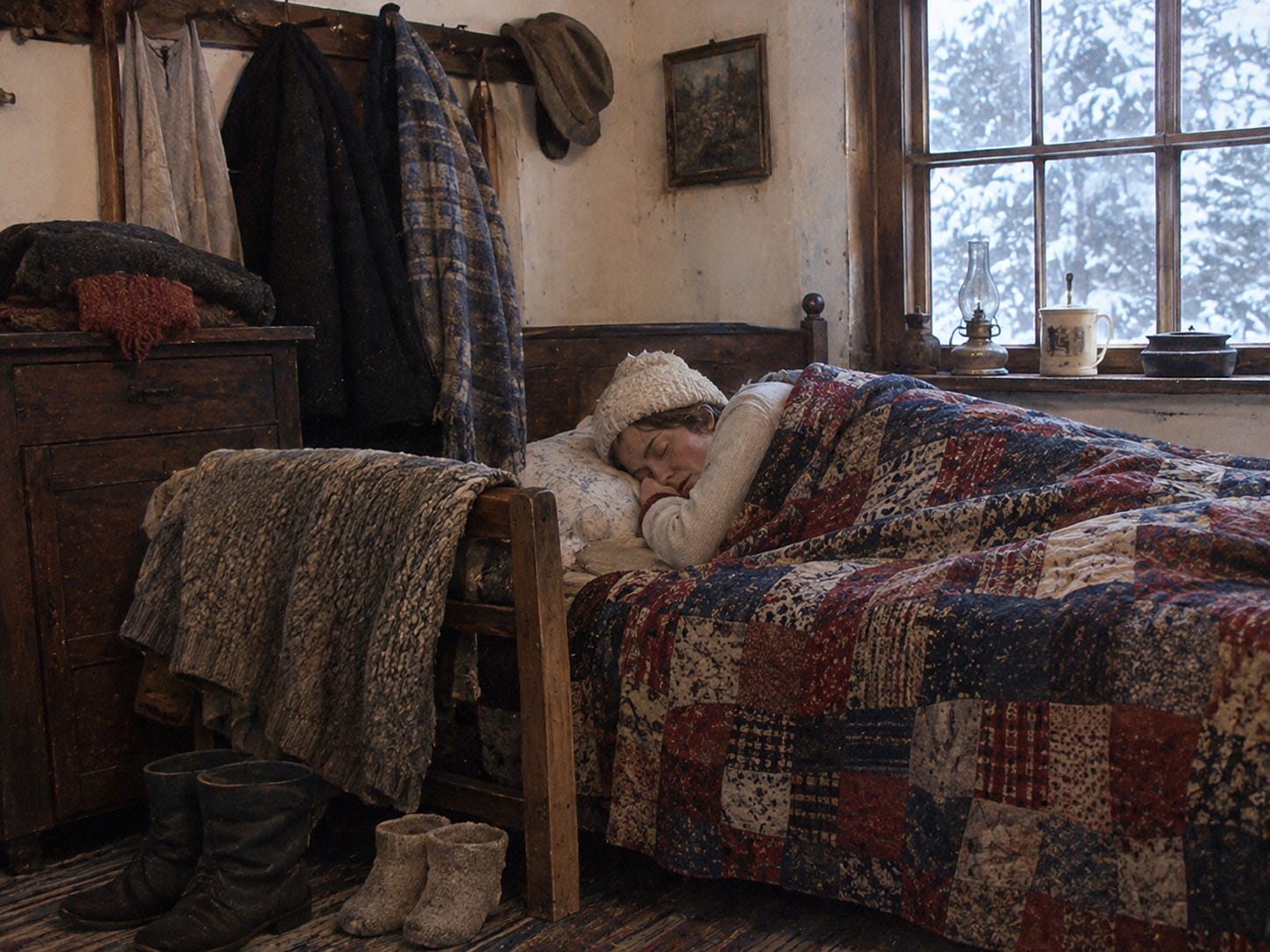
Sleeping clothes need to be dry, loose and warm, which is the opposite of the modern habit of sleeping in whatever was worn during the day. A dry base layer, wool socks and a hat let a person sleep in a cold room without shivering, and shivering is expensive, burning calories a household under rationing does not have to spare. Overdressing to the point of sweating is the other failure, so the hat comes off before sleep in a room above about fifteen degrees and stays on below ten, and the middle layer comes off if the sleeper wakes damp.
Daytime dress has a psychological function that is easy to dismiss and hard to replace. Perceived cold falls once a person feels dressed, and the nervous energy spent dreading a room drains away when the body is committed to a defence. Households that dress completely in the morning, as if leaving the house, stay functional hours longer than households that stay in pyjamas until noon, shivering and waiting for something to change.
Hygiene adapts rather than stops. A strip wash at a basin with water heated on the stove replaces the daily shower with no meaningful sanitary loss, provided the skin is dried immediately and completely and underclothes are changed every second day and dried at the fire. A long shower in a cold bathroom is the most efficient way to chill yourself voluntarily, since water evaporates off the skin and takes heat exactly when the body has least to spare.
Children need supervision in both directions. They overheat quickly when running and chill quickly when still, and they report neither. A child in three layers indoors needs the middle one removed before active play and restored afterwards, and a wet child gets changed completely, socks included, before anything else happens.
6. Borrowed heat: communal sleeping, dogs in the bed, and what a human body is worth in watts
The expression “three dog night,” a night cold enough to need three dogs in the bed, travelled through English-speaking cultures from peoples who counted the nights by how many animals they brought in. A body of thirty or forty kilos, human or animal, emits eighty to a hundred watts at rest, which makes a dog a small radiator that consumes no fuel and produces no flue gas. Animals supplement a heated room rather than replacing one, since eighty watts will not carry a house through a night, and they also add dander, hair and a competing claim on the covers.
Children slept together in the older practice, heads at opposite ends, under one quilt, on one bed or on platforms pushed together. Servants slept in the kitchen beside the hearth, and the old slept in the same room as grandchildren, partly for shared warmth and partly so somebody would hear them in the night. A bed for one person was a rich man’s luxury rather than a standard, and privacy was purchased rather than assumed.
Crowding has costs that romance tends to skip. Lice and fleas were endemic, and the historical answer was regular scalding of linen and the shaving of heads in bad seasons. Sleep quality falls with movement and noise, and a household of six in one room wakes each other repeatedly. Fights over space are normal within three days and settle only when the arrangement is made explicit.
Setting it up now takes an evening. All the beds move into the one room with the flue, mattresses go on the floor where frames do not fit, and quilts overlap sideways as well as lengthwise so the seams are covered. Small children go in the middle rather than at the edge, and a dog helps while taking up more room than its owner expects. Anyone who has camped in cold weather recognises the arrangement immediately.
Air quality is the part that needs management. A crowded room climbs in humidity and carbon dioxide and the air turns heavy within three hours, which calls for the same short airing as an enclosed bed, once before sleep and once at dawn, with everyone under the covers. A febrile child is isolated where possible, since one of them can ruin the night for all, and a coughing adult sleeps facing away from the others.
Infants need more care than the rest of the household. Room-sharing is recommended for the first six months to a year, and the safest place for a baby is a separate sleep surface such as a cot or a bedside crib rather than an adult mattress shared with other people and animals. The baby goes down on its back, with no loose blankets or pillows in the sleeping space, and a hat indoors is sensible without becoming a reason to overheat: the back of the neck is the check, and a baby who is sweaty there is over-layered. A room near sixteen to twenty degrees suits an infant, which is achievable in a well-managed winter room and not achievable in a bad one.
Floor sleeping loses by conduction, and a layer of heavy cardboard, a straw tick or a folded blanket underneath changes the balance entirely. A wooden frame with a headboard has a cold point at every edge the body touches, and a shoulder resting against it is stiff by morning, so a rolled jumper goes against the frame.
7. Contraction: the one warm room, the sealed doorway, the foundation banked with leaves, and the volume you stop paying for
The European peasant house kept a chamber where heat was kept, and cooking, eating, working and sleeping all happened there through the winter while the rest of the building stood shut. Door edges were stuffed with rags, passages were hung with heavy cloth, unused rooms stayed at outdoor temperature with the taps drained. Heating the volume you occupy rather than the volume you own was ordinary competence, not poverty.
The shell received the same treatment. Houses were banked in autumn, with leaves, straw, soil or manure heaped against the foundation to the level of the basement windows so that wind could not move underneath the floor. Lofts were packed with straw and corn cobs, windows took double shutters, and the ones nobody used were boarded and stuffed. Call it a refusal to let cold air move through a structure that could have been sealed.
Modern banking has to respect two constraints that manure did not care about. The material must be removable, because termites and rot both enjoy a permanent skirt of organic matter against a sill, and the foundation vents must stay clear or the crawl space grows mould and the floor joists above it rot from underneath. Mineral wool batts pressed against the wall and protected with a membrane are the modern version, and the top edge stops below the siding so water can still run off. Ground contact is fine for wool and fatal for straw.
Air sealing comes before insulation and costs less. Outlet gaskets on exterior walls, foam in the obvious gaps around pipes and sill plates, a brush strip on the letterbox, a door sweep. Window film drawn tight with a hairdryer cuts infiltration through a sash window by a good margin for four dollars, and caulk around the frame before the film goes on or the film seals nothing but itself.
Circulation follows a single rule, since warm air climbs and pours down the stairwell. The stair door stays shut, and where there is no door a quilt goes up on a tension rod, to the floor. Upstairs is for sleeping, downstairs for living, the cellar for stores, and leaving the stair open puts the whole output into the ceiling.
Contraction has a psychological cost, since living in one room with a dark, cold house around you presses on people. It is offset with light, order and rhythm: the same room, the same hours, the same activities, and explicit corners for working, cooking and resting. A family that moves into one space without organising it is at war within three days.
Two refinements are worth the trouble and one has a caveat. A ceiling fan on its lowest setting, running in the direction that pulls air up and pushes the warm layer down, makes a high ceiling survivable for a fraction of what a second stove costs. A stretched sheet or a sheet of rigid foam fixed a metre below the ceiling halves the heated volume and goes up in an hour with battens and clips, provided the fixings clear the light fittings and the foam never touches a hot flue, where it will melt. Foam in a steamy kitchen will sag within a season.
Condensation is the hidden bill. Every room shut off for the winter grows damp, and damp becomes mould at the cold corners, usually behind furniture. The closed rooms get opened once a week for a ten-minute airing and a look at the ceiling corners, and furniture is pulled off the outside walls before the weather turns.
8. Draft, damper, and the shape of a firebox: what Rumford knew, what the chimney decides, and why a bad flue eats a good woodpile
The deep colonial hearth with its cavernous flue burned wood atrociously, sending most of the heat up the chimney and warming only the front of the person standing at it while his back froze. Count Rumford reduced the depth, narrowed the opening and angled the side walls so that air entered beneath the wood and the flame radiated into the room instead of into the stack. A small opening, reflecting cheeks and controlled air sit inside every modern stove with secondary combustion, where a baffle and a second air inlet burn the gases leaving the firebox and lift efficiency from roughly forty percent to over seventy.
Damper practice is where confident advice goes wrong most often, because appliances differ. A damper is a flap in the flue collar or the stovepipe, fitted to some stoves and absent on many, and its job is to reduce the pull of the chimney once the fire is established. Where one is fitted, the manufacturer’s manual governs: usually open for lighting and reloading, part-closed once the fire is burning well, and closed fully only when the fire has burned down and no appreciable smoke is being produced. Close it with a live, gassing load and the room fills with smoke; leave it wide with a cold fire and the stack pulls the room’s heat out all night.
Draft depends on flue height, diameter, insulation and the pressure balance of the house, and very little on how much wood is thrown in. A short stack will not pull, an exterior chimney runs cold and sluggish, and a sealed house with a sealed stack suffocates the fire. A kitchen extractor or a bathroom fan can reverse a weak flue outright. Cracking a window a couple of fingers’ width in the fire room, away from the hearth, feeds air without chilling the firebox, and it works as a diagnostic as much as a fix: a fire that only draws with a window open is telling you the flue or the air supply is undersized, and the window is treating a symptom.
Cold-start reversal has its own remedy. A cold flue full of dense air pushes smoke into the room on the first light, so a sheet of newspaper rolled into a torch and held up at the damper for thirty seconds establishes the pull before any wood goes on. Half a minute saves a room full of smoke and a bad temper.
Wood seasons twelve months, split, under a roof open on all sides, ends facing the wind. Green wood loses up to half its energy to evaporating its own water, and a moisture meter is the only honest test: below twenty percent reads as dry, and twenty-five percent still hisses at the ends. Hardwoods such as beech, oak, hornbeam and black locust give long coals, softwoods give a fast flame and lay creosote, and the softwoods therefore serve for kindling rather than for the night. Roadside wood, caked in soil, gets its lower bark knocked off before stacking, and a stack against the house needs a ventilated gap behind it.
Creosote is the product of every shortcut taken above, since smouldering, unseasoned wood, a cold flue and a choked air supply all deposit it, first as soot, then as crust, then as a tar glaze that ignites at a lower temperature each time. A chimney swept twice a season of heavy use, and once more after any period of overnight damping, is the cheapest insurance in the house, and a certified sweep once a year catches the liner defects an owner cannot see.
Clearances are fixed by listing and by local code rather than by rule of thumb, though unlisted stoves commonly sit thirty to forty-five centimetres from combustibles, more against timber framing, with a ventilated steel shield and a non-combustible hearth pad beneath and in front. Double-wall pipe clears closer than single-wall, but only to the distance its listing allows. Curtains, kindling baskets, firelighters and the woodpile all creep nearer through the winter, and all of them burn.
Ash goes out daily into a metal pail and stands outdoors two days on concrete, because embers survive under ash for longer than anyone believes. A smoke alarm on the ceiling of the fire room, a carbon monoxide alarm on the wall at sleeping height and a dry-powder extinguisher by the door belong to the installation rather than to the accessories. A chimney fire is met by closing the air, shutting the damper and calling the fire service, and by keeping water off a hot flue.
Ventilation for combustion is a separate matter from draughts. A tightly sealed house with a large stove, a kitchen fan and a tumble dryer can pull harder than the flue and drag products of combustion back into the room. A dedicated outside air connection to the stove, or a permanently open trickle vent near it, is the proper repair when that pattern appears, and an improvised gap under a distant door is not.
Closing the account: what a household has to build before the ice arrives, in what order, and what the second week actually costs
Everything described above assumes a person actively administering heat, in short cycles, with hands and eyes and ears, and the thermal civilisation of the past half century removed exactly that administration. A programmable thermostat moved the decision into a chip, a heat pump moved it into a compressor, and a monthly bill moved it into an account. Once all three vanish at the same moment, the occupant stands in a house he does not understand holding a stock of energy he cannot evaluate.
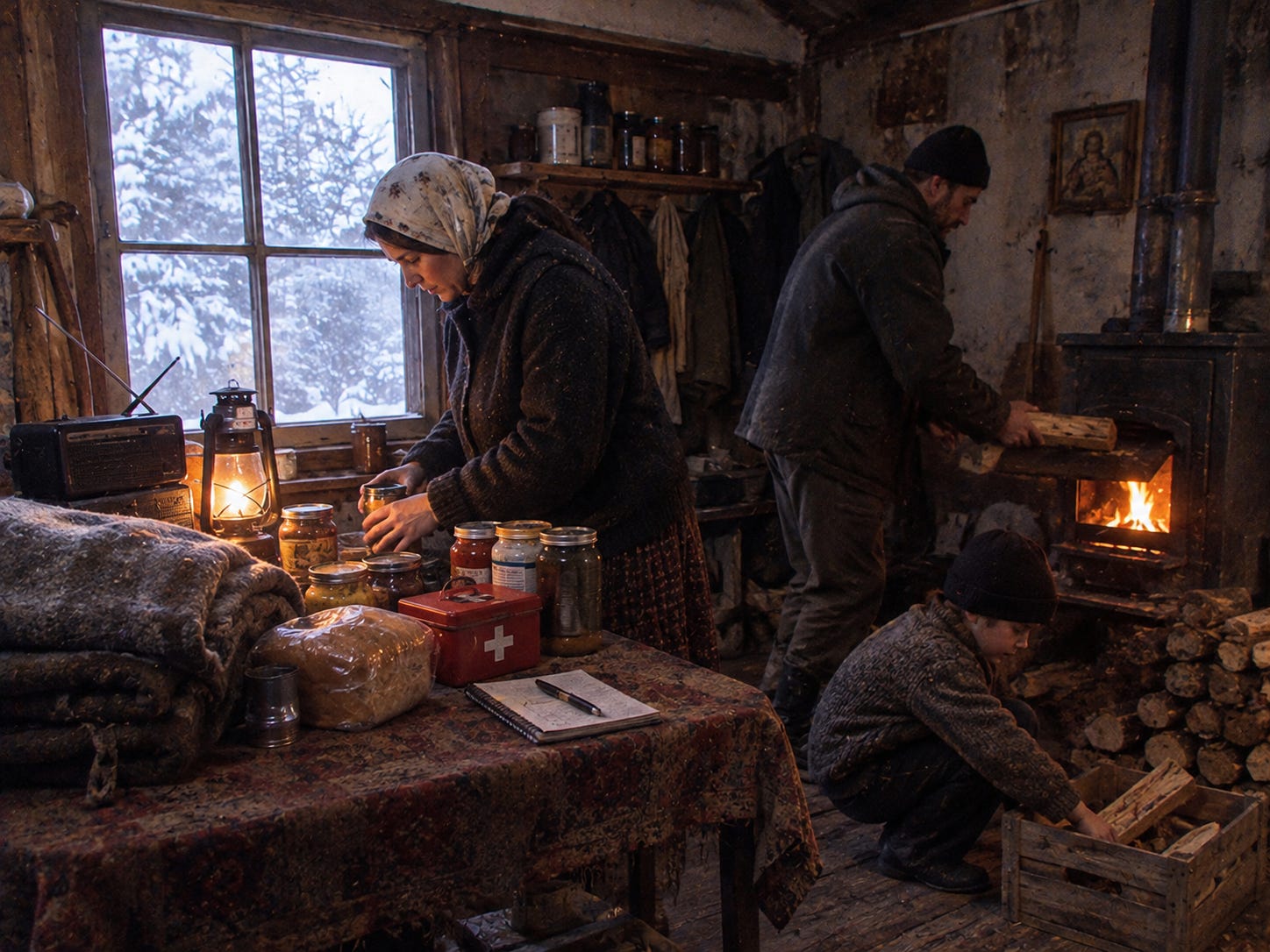
What separates a family that comes through a fortnight of ice from one that does not is rarely money and usually the order of operations. Dry split wood bought in July costs a fraction of panic buying in January and burns twice as well. Window film, batteries, water, food that needs no cooking, a hand-crank radio, a carbon monoxide alarm, an extinguisher, a first-aid kit and wool blankets rather than synthetics all get bought unhurried, stored sealed and inventoried on a sheet with dates. A written list beats an expensive tool chest purchased in October.
Three days in, people run on adrenaline and stores; between the fourth and the seventh, accumulated fatigue arrives and with it the handling errors, the fuel dosing mistakes and the lapses in hygiene. A healthy adult needs two to two and a half thousand calories a day in cold, ten to thirty percent above room-temperature requirements, and food that cooks itself in a cast-iron pot on the stove, beans, rice, oats, potatoes, counts for more than cold tins. Melting snow for water burns fuel heavily, so fifty litres stored before the storm saves an entire fire every day.
Four priorities hold up a household that intends to pass a winter off-grid, and they go up in reverse order of urgency. Envelope work comes first, with film on the windows, heavy curtains, an insulated sill, sealed doors and one room to live in. The heat source follows, which means dry wood and a safe stove, or a liquid-fuel appliance with correct venting where there is no flue. Thermal storage comes third, in brick, stone or water, and it stretches every fire while cutting the number of loadings. Redundancy comes last, in the form of a second heating method, a second light source, a second water source and a second trained adult.
Site the reserve by the number of outside walls rather than by comfort. The living room is usually the largest and coldest space in the house, with a high ceiling and three cold faces, and it is where people instinctively camp. A small interior chamber with one cold wall, near the flue or the kitchen, beats it, and where none exists one is made with curtains, heavy furniture against the cold faces and rugs layered on the floor.
Generators belong outdoors, and an attached garage does not count as outdoors even with the door open, because the exhaust finds the house through the connecting door and the ceiling void. Twenty feet from doors, windows and vents is the usual guidance, with the unit on a dry surface and the cord run through a door that closes behind it. A generator in a basement has killed more people than frost. Camp fires belong in a fireplace or a stove and not on a metal disc on the carpet, electric heaters on thin extension leads melt insulation, and a fourteen-gauge cord rated for a fifteen-amp circuit carries about 1,800 watts, which is one appliance and no more. Candles stand on a wide metal base, away from anything hanging, and are not left burning in a room with sleeping children.
Water fails before heat does in most real events. Pumps stop, treatment plants lose pressure, and a boiled-water advisory follows the outage by a day. Fifty litres in sealed containers, a bottle of unscented household bleach for disinfection at the rate printed on the label for clear water, a bucket and a lidded container for waste, and a toilet plan that does not involve flushing carry a household through the fortnight the mains cannot. Local authorities publish dosage tables and they vary with concentration, so the label outranks memory.
Medicine and the specific vulnerabilities need a written sheet rather than recall. Refrigerated drugs move to a cooler with frozen bottles rotated twice a day, a printed list of doses, prescriber numbers and allergies goes into a zip bag with the first-aid kit, and anyone with cardiac, respiratory or thyroid disease is watched for confusion, since cold masks the early signs of a crisis in exactly the people least able to describe them. Hypothermia announces itself with shivering, then with clumsiness and slurred speech, then with the shivering stopping altogether, and a person who has stopped shivering in a cold room is in more danger than one who is shaking.
Signals degrade in a way that catches people out. Mobile networks congest within the first hour and fail as batteries die, so a paper list of landline and neighbour numbers, agreed check-in times with somebody outside the affected area and a physical meeting point for the household are worth more than a charged phone. The hand-crank radio is the only receiver that keeps working when everything else is flat, and it is how a household learns when the roads reopen and where the water point is.
Rationing by schedule rather than mood is how fuel lasts. Two loadings a day in a mass stove, morning and evening with the room closed between them, holds a small chamber above freezing in most American winters, while an iron box needs three or four. Wood comes indoors a day ahead only, since a large indoor pile brings insects and damp, and the rest stays covered outside. The chainsaw runs on the mix in the can, so the can is filled in autumn rather than drained in February.
Sleep gets defended rather than indulged. Two-hour watches in rotation keep one adult rested and one alert, and they stop the fire from being either abandoned or over-fed by somebody half asleep. Whoever holds the watch wears the warmest clothes in the house and sits with their back to the mass, and a watch log on the door frame records loading times and flue temperatures, which is how a household learns its own consumption curve instead of guessing at it.
Money moves in ways that surprise people. Card terminals die with the power and the line, so cash in small notes kept in the house buys fuel and food on day three when nothing else will. Suppliers prioritise contract customers and hospitals, and a household with a filled tank in September does not queue in February. Photographs of the roof, the flue and the fuel store, taken in autumn, shorten every insurance claim that follows.
One item on the sheet is the one nobody likes to write, and it concerns leaving. A house is a shelter until it is a trap, and the decision point is fixed in advance by temperature and by the state of the occupants rather than improvised at midnight. Below a set indoor figure, with no means of arresting the fall, with an infant, an elder or an illness in the household, the correct move is the shelter and the house can freeze. Half the deaths in the record above belong to people who stayed too long in a building they trusted more than their own judgement.
The eight practices need no rural property, no woodlot and no hand pump. Every one of them works in a rented apartment with a window and a chair, which is the point of recovering them, since they belonged to people who had to be warm without being able to buy warmth. Whether the knowledge outlives the conditions now arriving depends on who learns it while the thermostat still works, and on how many households rehearse the sequence in October rather than meeting it in January with wet wood and a cold flue.
Anyone can join.
Anyone can contribute.
Anyone can become informed about their world.
"United We Stand" Click Here To Create Your Personal Citizen Journalist Account Today, Be Sure To Invite Your Friends.
Before It’s News® is a community of individuals who report on what’s going on around them, from all around the world. Anyone can join. Anyone can contribute. Anyone can become informed about their world. "United We Stand" Click Here To Create Your Personal Citizen Journalist Account Today, Be Sure To Invite Your Friends.
LION'S MANE PRODUCT
Try Our Lion’s Mane WHOLE MIND Nootropic Blend 60 Capsules
Mushrooms are having a moment. One fabulous fungus in particular, lion’s mane, may help improve memory, depression and anxiety symptoms. They are also an excellent source of nutrients that show promise as a therapy for dementia, and other neurodegenerative diseases. If you’re living with anxiety or depression, you may be curious about all the therapy options out there — including the natural ones.Our Lion’s Mane WHOLE MIND Nootropic Blend has been formulated to utilize the potency of Lion’s mane but also include the benefits of four other Highly Beneficial Mushrooms. Synergistically, they work together to Build your health through improving cognitive function and immunity regardless of your age. Our Nootropic not only improves your Cognitive Function and Activates your Immune System, but it benefits growth of Essential Gut Flora, further enhancing your Vitality.

Our Formula includes: Lion’s Mane Mushrooms which Increase Brain Power through nerve growth, lessen anxiety, reduce depression, and improve concentration. Its an excellent adaptogen, promotes sleep and improves immunity. Shiitake Mushrooms which Fight cancer cells and infectious disease, boost the immune system, promotes brain function, and serves as a source of B vitamins. Maitake Mushrooms which regulate blood sugar levels of diabetics, reduce hypertension and boosts the immune system. Reishi Mushrooms which Fight inflammation, liver disease, fatigue, tumor growth and cancer. They Improve skin disorders and soothes digestive problems, stomach ulcers and leaky gut syndrome. Chaga Mushrooms which have anti-aging effects, boost immune function, improve stamina and athletic performance, even act as a natural aphrodisiac, fighting diabetes and improving liver function. Try Our Lion’s Mane WHOLE MIND Nootropic Blend 60 Capsules Today. Be 100% Satisfied or Receive a Full Money Back Guarantee. Order Yours Today by Following This Link.


| Visits: | 1,839,824,134 |
| Stories: | 8,744,495 |
Whistler Blowers, Insiders

