

How Nighttime Online Communities Are Helping People Feel Less Alone

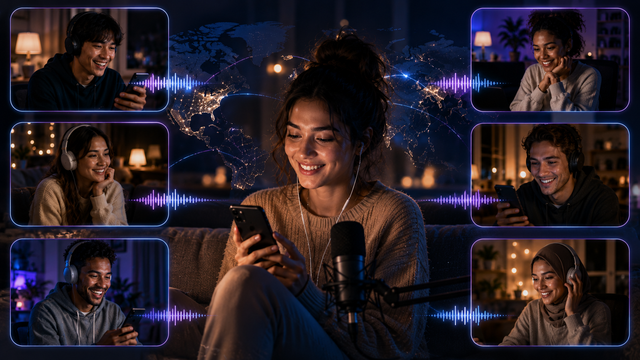
Loneliness is not a nighttime problem specifically. But it gets worse at night. The daytime has structure. Work, errands, obligations. Things that keep you moving and occasionally talking to other people, whether you particularly wanted to or not. When the day ends and that structure disappears, whatever was quietly sitting in the background tends to come forward.
For a large number of people, what comes forward is the feeling that they are going through something without anyone nearby who understands it. Friends are asleep. Family is unavailable. The group chat has gone quiet. And the particular loneliness of lying awake at midnight with too many thoughts and no one to share them with is something that is hard to explain to someone who has not experienced it.
Nighttime online communities did not set out to solve this problem. They formed because people who were awake at the same hour kept finding each other on voice platforms and discovering that they had more in common than just insomnia. What started as coincidence has become, for many people, one of the more reliable sources of genuine connection in their lives.
The Psychology Behind Seeking Connection at Night
There is real science behind why nighttime feels different emotionally and why the urge to connect intensifies after dark for so many people.
The brain’s prefrontal cortex, which handles things like social judgment and self-editing, becomes less dominant as the evening progresses and fatigue sets in. What this means practically is that people are less guarded at night. Less concerned with how they come across. More likely to say something honest rather than something polished. That shift in self-presentation, small as it sounds, changes the texture of conversations in ways that make late-night interactions feel more real than their daytime equivalents.
There is also a particular vulnerability that comes with being awake when the world appears to be sleeping. It creates a kind of exposure that daytime social interaction does not. When you reach out to someone at 2 AM, you are implicitly admitting that you wanted to. That admission, even when it goes unspoken, gives late-night connections a different kind of weight.
People who struggle with anxiety or depression often report that nights are the hardest part. The absence of distraction makes everything feel larger. Having somewhere to go, even virtually, even just to hear other voices and know that other people are also awake, can shift that experience in ways that are hard to quantify but easy to understand if you have ever been on the receiving end of it.
How Voice Chat Creates Bonds That Text Simply Cannot
Send a message at midnight and you might get a reply. If you are lucky, it will be warm and genuine. But it will still be words on a screen, stripped of tone, delivered at whatever point the other person happened to check their phone. The connection is real, but it is partial. Something is always missing.
Voice chat at midnight is a completely different experience. You can hear when someone is tired in the same way you are. You can catch the half-laugh before they finish a sentence. When the conversation dips into something more personal and their voice shifts slightly, you notice. Not because you were watching for it but because voice carries that information automatically, in ways that text never will.
That informational richness is what makes voice the superior medium for building actual closeness. Researchers who study social bonding have found that vocal cues carry a disproportionate share of the emotional content in human communication. When you remove those cues, you are not just losing convenience. You are losing a large part of what makes connection feel like connection.
Late-night voice conversations tend to go longer than daytime ones. Partly because there is nowhere to be. Partly because the intimacy of the medium encourages depth over efficiency. People who have spent hours talking in a voice room late at night often describe it as one of the more memorable conversations they have had with someone they had never met in person. That says something about what the medium makes possible.
What Makes a Nighttime Online Community Actually Welcoming
Not every online space feels safe at night. Some platforms develop reputations for late-night hostility, where the absence of moderation and the disinhibition that comes with tiredness produces behavior that drives people away rather than drawing them in. A welcoming nighttime community does not happen automatically. It is built deliberately, through the culture that hosts and regular members create over time.
The tone of the host matters enormously. A room run by someone who is genuinely warm, who welcomes arrivals, who creates space for people to participate at whatever level they are comfortable with, sets a standard that the community tends to follow. Rooms where the host is dismissive or performatively edgy attract a particular type of participant and repel the kind of people who are actually looking for somewhere they can relax.
Consistency creates safety in a way that sporadic activity cannot. When a community meets regularly, at predictable times, the same people tend to show up. Familiarity builds. New arrivals are welcomed by regulars who have established the culture. Over time, the room develops a personality of its own that persists even when any individual member is absent.
Moderation standards that are actually enforced matter more at night than during peak hours. The people most likely to disrupt a late-night space are also often the ones who have been removed from other communities. A welcoming nighttime community is one where the people running it take that responsibility seriously, because the members who need the space most are often the ones least equipped to deal with hostility when they encounter it.
Real-Time Connection and Why It Matters Most in Quiet Hours
There is a specific comfort in knowing that someone is there right now. Not that they were there earlier and left a message. Not that they will be there tomorrow. That they are present in this moment and the conversation is happening live.
Asynchronous communication has genuine value. But it does not provide that particular comfort. Reading a message someone sent three hours ago while you are lying awake does not give you the sense of company that a real-time voice conversation does. The timing matters. Being heard in the moment is different from being heard eventually.
For people going through difficult periods, that distinction can be significant. Having a space where you can show up, speak, and receive a response in real time, from people who are actually awake and present, fills a gap that even well-maintained text threads cannot. It does not replace professional support when that is what someone needs. But it provides something that is real and valuable on its own terms.
Voice platforms that stay active through the night, across time zones, give users something that purely local communities cannot: the certainty that someone will be there regardless of when you need them. That reliability is what turns a platform from something you use occasionally into something you actually depend on.
How SUGO Helps Users Feel Genuinely Connected After Dark
SUGO was built around the idea that meaningful social interaction does not follow a schedule. The platform’s voice-first approach, combined with a global user base spread across time zones, means that the rooms active at 3 AM in one part of the world are supplemented by users coming online from regions where the evening is just getting started.
For people who find late nights the hardest hours, nighttime communities on SUGO offer something that most social apps quietly fail to provide actual presence. Not a feed of old content. Not notifications about things that happened while you were asleep. Real people, in real time, willing to talk.
The platform’s design supports the kind of community culture that makes late-night spaces welcoming rather than draining. Hosted rooms with consistent moderators, virtual gifting that lets users express appreciation in real time, and discovery tools that surface active communities rather than burying them under daytime content all contribute to an experience that works at midnight as well as it does at noon.
People who have found their communities on SUGO during the quiet hours tend to describe those connections differently from other online relationships they have. More honest. More sustained. More like something that actually matters. That outcome is not accidental. It is what happens when a platform takes late-night social needs seriously rather than treating them as a secondary use case.
Conclusion
The loneliness that comes at night is real, and it is widespread in ways that most public conversations about mental health and social connection have been slow to acknowledge. People manage it in different ways. Some read. Some work. Some lie awake and wait for morning.
And some of them find a voice room where other people are awake too, and they talk, and by the time they sign off the night feels less heavy than it did when they opened the app. That outcome is not trivial. For the people who experience it, it is sometimes the thing that gets them through to morning. The platforms that make it possible are doing something genuinely useful, even if it rarely gets described in those terms.
Anyone can join.
Anyone can contribute.
Anyone can become informed about their world.
"United We Stand" Click Here To Create Your Personal Citizen Journalist Account Today, Be Sure To Invite Your Friends.
Before It’s News® is a community of individuals who report on what’s going on around them, from all around the world. Anyone can join. Anyone can contribute. Anyone can become informed about their world. "United We Stand" Click Here To Create Your Personal Citizen Journalist Account Today, Be Sure To Invite Your Friends.
LION'S MANE PRODUCT
Try Our Lion’s Mane WHOLE MIND Nootropic Blend 60 Capsules
Mushrooms are having a moment. One fabulous fungus in particular, lion’s mane, may help improve memory, depression and anxiety symptoms. They are also an excellent source of nutrients that show promise as a therapy for dementia, and other neurodegenerative diseases. If you’re living with anxiety or depression, you may be curious about all the therapy options out there — including the natural ones.Our Lion’s Mane WHOLE MIND Nootropic Blend has been formulated to utilize the potency of Lion’s mane but also include the benefits of four other Highly Beneficial Mushrooms. Synergistically, they work together to Build your health through improving cognitive function and immunity regardless of your age. Our Nootropic not only improves your Cognitive Function and Activates your Immune System, but it benefits growth of Essential Gut Flora, further enhancing your Vitality.

Our Formula includes: Lion’s Mane Mushrooms which Increase Brain Power through nerve growth, lessen anxiety, reduce depression, and improve concentration. Its an excellent adaptogen, promotes sleep and improves immunity. Shiitake Mushrooms which Fight cancer cells and infectious disease, boost the immune system, promotes brain function, and serves as a source of B vitamins. Maitake Mushrooms which regulate blood sugar levels of diabetics, reduce hypertension and boosts the immune system. Reishi Mushrooms which Fight inflammation, liver disease, fatigue, tumor growth and cancer. They Improve skin disorders and soothes digestive problems, stomach ulcers and leaky gut syndrome. Chaga Mushrooms which have anti-aging effects, boost immune function, improve stamina and athletic performance, even act as a natural aphrodisiac, fighting diabetes and improving liver function. Try Our Lion’s Mane WHOLE MIND Nootropic Blend 60 Capsules Today. Be 100% Satisfied or Receive a Full Money Back Guarantee. Order Yours Today by Following This Link.


| Visits: | 1,816,601,331 |
| Stories: | 8,662,584 |
Whistler Blowers, Insiders

