

How AI Overview Citation Works in 2026

An AI Overview citation is the source link Google attaches to a page when its AI Overview pulls information from it to build an answer. The mechanics differ enough from ordinary ranking that treating the two as the same target is where most content teams lose ground. This guide covers how a citation gets chosen, what separates it from a backlink or a featured snippet, and where it splits from Google’s other AI surface, AI Mode.
What Is an AI Overview Citation?
An AI Overview citation is a source reference, a numbered link or source card, that Google’s AI Overview attaches to a claim in its generated summary. It’s Google showing its work instead of leaving an AI answer unsourced.
|
Trait |
AI Overview citation |
Regular backlink |
Featured snippet |
|
Who controls it |
Google’s retrieval system |
Site owners earn it |
Google, one best-match page |
|
Sources involved |
Several, merged |
N/A |
One page only |
|
Lifespan |
Can change per query run |
Stays until removed |
Relatively stable |
A page can rank on page one and still get skipped for citation and, increasingly, earn a citation without a page-one ranking at all.
How Google Selects Sources for AI Overview Citation
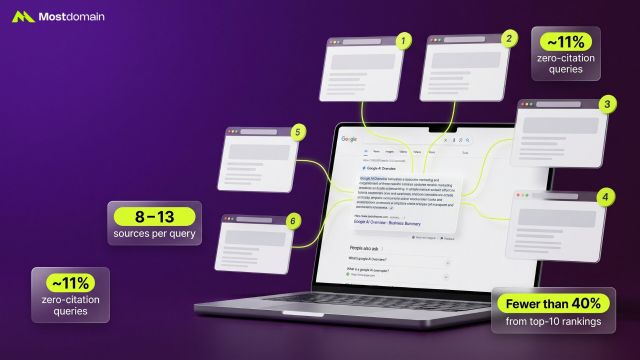
Google first narrows candidates to pages eligible for standard search results, then runs a query fan-out: the query splits into sub-questions, each retrieved separately, and the results merge into one answer with source credit attached. A page can get pulled in for answering a sub-question well, regardless of its ranking for the main query. The full retrieval pipeline is covered in how source citation works in AI search.
|
Metric |
Reported range |
|
Sources cited per query |
Roughly 8–13 |
|
Unique domains cited |
Roughly 7.7–9.8 |
|
Queries with zero citations |
Around 11% |
Numbers vary by study, but the pattern holds: an AI Overview answer rarely leans on one page, shown as numbered chips or a source carousel beside the generated text.
AI Overview Citation Eligibility Factors
A page qualifies the same way it qualifies for a standard snippet: by being indexed and technically eligible. Google’s developer documentation confirms no separate “AI SEO” ruleset or special markup is required, the baseline is the same helpful-content bar Search has always used. What happens after that baseline, though, has shifted fast.
|
Period |
Share of citations from top-10 organic results |
|
Mid-2025 |
Roughly 76% |
|
Early-to-mid 2026 |
As low as 38%, by some measurements |
Studies disagree on the exact figure but agree on direction: as fan-out matures, it reaches further into subtopic pages that never ranked for the head query.
Other correlating factors: author bylines with visible credentials, first-hand experience described in checkable detail, outbound links to primary sources, recently updated content, and clear headings/tables that make a passage easy to extract. On schema: Google doesn’t require it, but FAQ, HowTo, and Article schema still show up disproportionately among cited sources, likely by reinforcing structure Google already rewards.
AI Overview Citation vs. AI Mode Citation
AI Overview and AI Mode run on different citation logic, so a page cited in one often doesn’t appear in the other for the same query.
|
Aspect |
AI Overview |
AI Mode |
|
How it appears |
Inline, automatic |
Separate, opt-in tab |
|
Fan-out depth |
Fewer sub-queries |
Up to 16 related queries |
|
Avg. domains cited |
~7.7 |
~9.2 |
|
URL overlap between surfaces |
— |
As low as 13.7% in some studies |
A study covering over 700,000 AI responses found only a small fraction of URLs cited in AI Overview also appear in AI Mode for the same query. So AI Overview visibility tells you nothing reliable about AI Mode visibility, and vice versa, AI Overview favors concise, directly answerable pages, while AI Mode favors deeper, multi-entity content built for follow-ups. See AI platforms citation patterns for how this compares across other AI systems.
How to Optimize Content for AI Overview Citation
Every section should open with a standalone answer, match its format to the query type, and cover the topic deeply enough to surface across multiple fan-out sub-queries.
|
Query type |
Format that tends to get cited |
|
Definitional (“what is X”) |
Short direct definition, then detail |
|
Process-based (“how to X”) |
Numbered steps |
|
Comparative (“X vs Y”) |
Side-by-side table |
|
Data-driven |
Original figures in a table, clearly sourced |
Put the actual answer in the first sentence of each section, skip brand throat-clearing, and answer the obvious follow-up questions a reader would ask next, fan-out sub-queries often target exactly those narrower angles.
How to Track Your AI Overview Citations
Tracking comes down to two approaches: manual checks against target queries in a logged-out session, watching for your domain among the citation chips, or reading indirect signals, unexplained referral spikes tied to specific queries, cross-checked against engagement metrics. Citation sets shift more than rankings do, so repeat checks periodically rather than once.
Common Mistakes That Cost You an AI Overview Citation
Opening with brand messaging instead of an answer gives the fan-out system nothing extractable, pages that start with “we’re a leading provider of…” get passed over, so move the actual answer to the first sentence. Treating AI Overview and AI Mode as one target is the other common trap: optimizing only for AI Overview’s tighter format can leave a page invisible in AI Mode’s longer responses, and the reverse is just as true. Tracking the two surfaces separately catches this before it costs visibility on one side.

FAQ
What is an AI Overview citation?
A source link Google’s AI Overview attaches to a claim in its summary, crediting the page the information came from.
Why did my page stop appearing in AI Overview citations?
Citation sets shift with each fan-out run. A drop doesn’t necessarily signal a quality problem, another page may have answered a sub-question more directly this time.
Does ranking on page one guarantee a citation?
No. Some measurements now put top-10 citation overlap as low as 38%, down from roughly 76% a year earlier.
Can a page get cited without ranking at all for the main query?
Yes, a fan-out sub-query can pull in an indexed, snippet-eligible page even if it never ranks for the head term.
Do I need special schema markup to get cited?
Not officially, but FAQ, HowTo, and Article schema still correlate with higher citation rates in practice.
How is an AI Overview citation different from an AI Mode citation?
They’re separate systems, some studies show as little as 13.7% URL overlap for the same query, with AI Overview citing fewer, more curated sources.
How often do AI Overview citations change?
Often enough that one check shouldn’t be treated as stable, each fresh fan-out pass can shift the source mix.
References
-
Google for Developers, “AI features and your website”
-
Fast.io, “Google AI Overview: How It Works, How to Use It, and What It Means for Search”
-
StrideC, “How to Get Cited in AI Overviews (2026 Guide)”
-
DiscoveredLabs, “Google AI Overviews citation tracking: How to measure your visibility”
-
DesignRush, “New Study by Victorious Shows Diverging Citations Between AI Overviews and AI Mode”
-
Outpace SEO, “Citation Differences in Google AI Overviews vs AI Mode”
Anyone can join.
Anyone can contribute.
Anyone can become informed about their world.
"United We Stand" Click Here To Create Your Personal Citizen Journalist Account Today, Be Sure To Invite Your Friends.
Before It’s News® is a community of individuals who report on what’s going on around them, from all around the world. Anyone can join. Anyone can contribute. Anyone can become informed about their world. "United We Stand" Click Here To Create Your Personal Citizen Journalist Account Today, Be Sure To Invite Your Friends.
LION'S MANE PRODUCT
Try Our Lion’s Mane WHOLE MIND Nootropic Blend 60 Capsules
Mushrooms are having a moment. One fabulous fungus in particular, lion’s mane, may help improve memory, depression and anxiety symptoms. They are also an excellent source of nutrients that show promise as a therapy for dementia, and other neurodegenerative diseases. If you’re living with anxiety or depression, you may be curious about all the therapy options out there — including the natural ones.Our Lion’s Mane WHOLE MIND Nootropic Blend has been formulated to utilize the potency of Lion’s mane but also include the benefits of four other Highly Beneficial Mushrooms. Synergistically, they work together to Build your health through improving cognitive function and immunity regardless of your age. Our Nootropic not only improves your Cognitive Function and Activates your Immune System, but it benefits growth of Essential Gut Flora, further enhancing your Vitality.

Our Formula includes: Lion’s Mane Mushrooms which Increase Brain Power through nerve growth, lessen anxiety, reduce depression, and improve concentration. Its an excellent adaptogen, promotes sleep and improves immunity. Shiitake Mushrooms which Fight cancer cells and infectious disease, boost the immune system, promotes brain function, and serves as a source of B vitamins. Maitake Mushrooms which regulate blood sugar levels of diabetics, reduce hypertension and boosts the immune system. Reishi Mushrooms which Fight inflammation, liver disease, fatigue, tumor growth and cancer. They Improve skin disorders and soothes digestive problems, stomach ulcers and leaky gut syndrome. Chaga Mushrooms which have anti-aging effects, boost immune function, improve stamina and athletic performance, even act as a natural aphrodisiac, fighting diabetes and improving liver function. Try Our Lion’s Mane WHOLE MIND Nootropic Blend 60 Capsules Today. Be 100% Satisfied or Receive a Full Money Back Guarantee. Order Yours Today by Following This Link.


| Visits: | 1,834,761,138 |
| Stories: | 8,719,941 |
Whistler Blowers, Insiders

