

The Real Reason Your Marketing Spend Keeps Going Up and Your Results Keep Going Down

- If you don’t know what your business needs, someone will tell you — and charge you for the answer. Learning how to avoid wasting money on marketing starts with knowing that the pitch is designed around your fear, not your business.
- Only 18% of small-business owners said they felt very confident in their marketing effectiveness in 2025 — down from 27% the year before. That confidence gap is exactly where aggressive pitches land hardest. (Constant Contact/Ascend2, September 2025)
- After reading this, you’ll have nine questions that work like a filter between your wallet and every pitch that hits your inbox — plus a one-page worksheet that gives you permission to walk away.
The most reliable way to avoid wasting money on marketing is to know what problem you’re solving before anyone sells you the solution. A legitimate tool, a well-reviewed course, a reputable agency — any of them can still be the wrong expense if your business isn’t ready for it, hasn’t validated the customer need behind it, or lacks the operational support to make it work. Product quality and business fit are two completely different questions. Most pitches only answer the first one.
I’m going to get on my soapbox here, because what I see happening to small business owners makes me genuinely angry. Not at marketers — most of them are trying to help. What I’m angry about is the architecture. The inbox full of “your competitors are already doing this.” The pitch that tells you serious business owners invest in themselves. The guru whose client made $100,000 and now you’re supposed to expect the same.
By 8am on any given Tuesday, you’ve been told you’re behind in at least six different ways. And if you’re already short on customers and tight on cash, that fear is an easy button to push. That’s what I want to change. Not whether you buy marketing help — sometimes you absolutely should. But whether you buy it because it fits your business or because someone scared you into it.
How to avoid wasting money on marketing: recognize the pitch first
Every marketing pitch works by triggering something — fear of falling behind, shame about not investing in your business, anxiety that everyone else is growing while you’re stuck. These triggers aren’t accidental. They’re built into the pitch itself.
The nine patterns below are the most common ones. They’re not indictments of the sellers — many of whom believe in what they’re offering. They’re signals to slow down. The FTC explicitly warns that high-pressure tactics, inflated success stories, and upsells are patterns to watch for in business and coaching offers. That doesn’t make every pitch a scam. It means you deserve time to think — and the nine questions below give you that time.

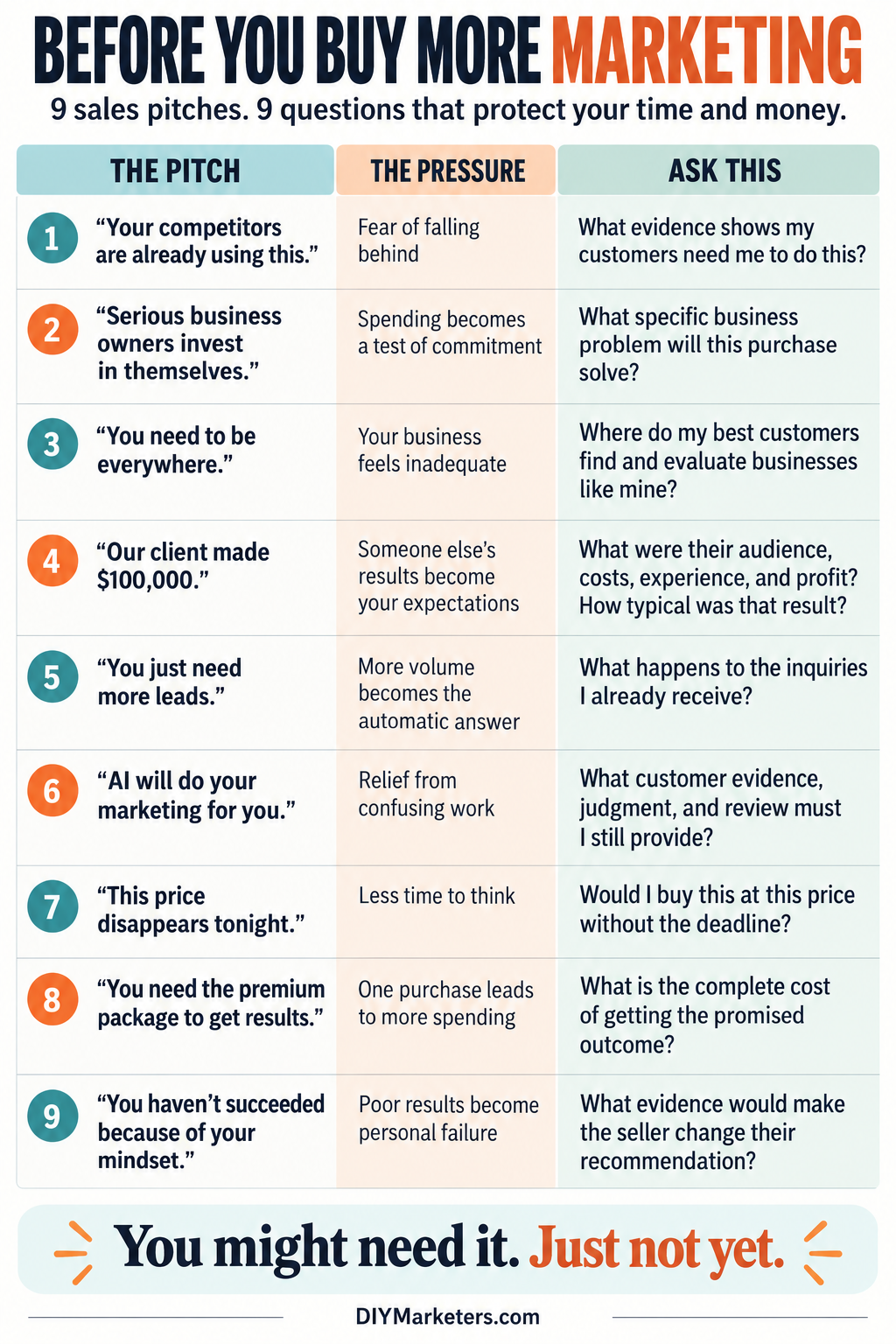
That last question is the one most sellers won’t answer. A recommendation that has no exit condition — no result that would change the advice — isn’t a recommendation. It’s a subscription to keep buying.
What you need to know about your customers before you spend a dollar
Every channel, every tool, and every tactic works better when it’s built on real customer knowledge — not assumptions, not AI-generated personas, not what worked for someone else’s business. Real conversations with real humans who have given you money, or decided not to.
Before you buy any marketing service, software, or course, answer these five questions from your own data:
- Who has this problem, and what makes solving it urgent right now? Not “small business owners.” Which specific ones, in which situations, at which point in their year?
- What outcome do they want, in their exact words? Not your paraphrase. The phrase they actually use — this matters more for marketing copy than almost anything else.
- What do they use or pay for now, including doing nothing? “Doing nothing” is a competitor. So is the spreadsheet they’ve been running for three years.
- What makes them choose, delay, or walk away from an offer like yours? If you don’t know the real objections, you can’t address them. If you address the wrong ones, you lose.
- What economic or industry conditions affect their demand, timing, or budget right now? Your customers feel the economy before you do.
A practical starting point: review your last ten transactions, talk to five customers or recent prospects, and look at three competing alternatives they considered. Include at least one person who didn’t buy and one who left unhappy. Ask what actually happened — not what they’d hypothetically do. This isn’t a research study. It’s reconnaissance.
AI tools help organize notes and identify patterns. They do not replace the conversation. A generated persona is a hypothesis. A real customer is evidence. The two are not interchangeable, no matter how confident the AI sounds.
Want to do this without spending anything? Start here: How to Find Out What Customers Really Want. If the research process feels overwhelming, here’s how to research your target market in five coffee-break moves.
How to know if a marketing tool is worth it for your business right now
Good marketing tools don’t fail because they’re bad. They fail because the business buying them isn’t ready. The subscription price is visible. Everything underneath it usually isn’t.
Think of it as an iceberg. The monthly fee sits above the waterline. Below it: the data that needs to be clean before the tool functions, the workflow that has to change, the person who needs to own setup and maintenance, the integrations with other software, the training time, and the migration cost when you eventually move on.
Before any purchase, work through this checklist out loud:
- What data must already be clean and structured for this to work?
- What workflow in my business has to change?
- Who owns setup, ongoing review, and handling exceptions?
- What other tools or integrations does this require?
- How long until this is used routinely — not just installed?
- Which existing cost disappears if this actually works?
- What’s the exit cost: data migration, retraining, customer disruption?
A 2026 Statistics Canada analysis found that AI adopters initially appeared significantly more productive than non-adopters. Once researchers accounted for prior R&D investment, analytics infrastructure, and ICT training already in place, the productivity premium dropped to a level that was no longer statistically significant. The most successful AI users weren’t successful because of the tool. They were already better-run businesses. The tool accelerated what was already working.
That is the single most important thing I can tell you about how to avoid wasting money on marketing tools: you may be copying the stack of a high-performing business without copying the conditions that made that stack productive.
For a deeper look at this: Small Business Marketing Budget Risk in 2026 and How to Reduce It.
Why buying before testing is the most expensive marketing mistake
Here’s a pattern I see constantly. A business owner buys an annual software subscription, a full agency contract, or a complete funnel build-out before confirming that anyone wants to buy what they’re selling at the price they’re charging. When it doesn’t work, they assume the tool failed. Often, the tool worked fine. The offer or the audience was wrong — and a $50 test would have revealed that before the $5,000 commitment.
Research published in the Strategic Management Journal (Camuffo et al., 2024, four randomized controlled trials with 759 firms) found that entrepreneurs trained in scientific decision-making — writing down assumptions, testing them cheaply, and being willing to stop — were significantly more efficient at finding viable ideas than those who didn’t test. The discipline to stop an unpromising path early protects everything that comes after.
Here’s an illustrative example that works for service businesses: offer a clearly scoped paid pilot to ten well-matched prospects via direct personal email, with one follow-up. Fixed scope. Specific price. Defined outcome. Cap your time at three hours and your costs at $50. Set a review date that fits your normal buying cycle. Track paid commitments and what you actually earn after delivery. The result isn’t a conversion rate. It’s directional evidence — enough to decide whether a larger commitment makes sense.
If your marketing keeps producing nothing, the problem usually isn’t the tool you chose. Read: Why Your Marketing Keeps Failing When You Keep Trying Different Tactics.
Questions to ask before buying marketing tools, courses, or coaching
The pitch addresses your pain. Your job is to check whether the product addresses your business. These are the questions that create that separation.
About the offer itself:
- What specific business problem will this solve — and what evidence do I have that this is the right problem to solve right now?
- What result would make this a success, and by what realistic date?
- What result would make me stop using it? (If you can’t name one, that’s a red flag.)
About the proof they’re showing you:
- What were the audience size, starting conditions, total costs, and timeline behind that case study?
- How many people tried this and didn’t get that result?
- Is this independent evidence, or did it come from someone with a stake in selling you?
About the total commitment:
- What is the total cost — money, my hours, and ongoing obligations?
- What must already be true in my business for this to deliver results?
- What’s the smallest test I can run before a full commitment?
Most sellers answer the first set readily. The second set is where things get uncomfortable — and where your most important information lives. If you’re not sure which questions to prioritize, understanding the difference between marketing strategy and marketing tactics tells you what level of help you actually need.
When professional marketing help is the right call
I want to be direct here, because I don’t want this article to read as “do everything yourself and trust no one.” That’s not the point.
Professional marketing help — a consultant, a strategist, a coach, an agency — is exactly the right investment when you have a validated offer, a defined customer, a working channel, and a specific bottleneck you need to break through. Good experts challenge your assumptions. They tell you what’s not working before confirming what is. Paid diagnostic help is appropriate. Paid research interpretation is appropriate.
What expertise is not: a substitute for knowing what your business needs. If you walk into a marketing engagement without a clear problem statement and customer evidence, the engagement becomes an expensive discovery process — and you’re funding the discovery. There’s a meaningful difference between hiring someone to help you execute a strategy and hiring someone to figure out your strategy for you while also selling you the implementation.
The simple marketing process every small business needs walks you through the steps in order, so you arrive at any expert conversation knowing what you need — and what you don’t.
The purchase decision worksheet — use this before every marketing spend
This is the practical tool I want you to keep. Screenshot it. Paste it into your notes. Use it every time a pitch lands in your inbox and you feel that pull toward clicking Buy.
Fill in every line before you spend:
- The problem: What is actually happening in my business right now?
- The evidence: What customer behavior or business data confirms that diagnosis?
- The prerequisites: What must already be working for this purchase to deliver results?
- The full commitment: What is the total cost — money, my hours, ongoing obligations?
- The smallest test: What can I try before a larger commitment?
- The decision rule: What result, by what realistic date, would justify continuing?
- The choice: Buy, test, or defer — with a written reason.
If you reach “the problem” and can’t write a specific, evidence-backed sentence, stop. Your immediate next step is diagnosis, not purchase. A marketing audit is the fastest way to find out what’s actually broken before you spend money fixing the wrong thing.
And if the worksheet reveals that you don’t know enough about your customers to fill it in, here’s how to read and interpret the research you already have before you commission anything new.
Frequently asked questions about avoiding marketing waste
The most reliable way to avoid wasting money on marketing is to identify the specific problem you’re solving before evaluating any tool or service. Run every purchase through three checks: Does this solve a named business problem? Does my business have what it needs to make this work? What’s the smallest test I can run before committing to the full investment? If you can’t answer all three, the purchase is premature — regardless of how compelling the pitch sounds.
A marketing tool is worth buying when you can name the specific problem it solves, confirm your business has the prerequisites to use it (clean data, workflow changes, a person who owns it), and define a measurable result with a realistic timeline. The subscription price is not the cost of adoption — it’s the entry fee. Training time, workflow changes, integrations, and maintenance are the real investment. Test the underlying strategy manually first before automating it with software.
Ask for the specific process, what results are realistic in your timeframe, what the total cost is including your own time and required tools, and what result would make the seller change their recommendation. Any coach or course provider who can’t tell you what would change their advice is selling you a subscription, not a solution. The FTC maintains specific guidance on evaluating business coaching offers — worth reading before any significant investment.
Small businesses often buy marketing tools that don’t work because the pitch is built around fear and urgency rather than business fit. The tool may work perfectly — for a different business, at a different stage, with different customers. The problem isn’t product quality; it’s timing and fit. World Bank research on digital adoption found that buying technology without corresponding workflow changes, training, and integration creates “shallow digitalization” — tools that are installed but never produce results.
Start with your customers, not more marketing. Talk to five people who bought from you and five who didn’t. Ask what happened between when they recognized the problem and when they made a decision. That conversation typically reveals whether the issue is awareness, message clarity, offer fit, or follow-through — and tells you which one to fix first. A marketing audit gives you a structured framework for that diagnosis.
- How to Do a Marketing Audit When Nothing Is Working
- Simple Marketing Process for Small Business: 5 Steps That Stop the Overwhelm
- Why Your Marketing Keeps Failing When You Keep Trying Different Tactics
- How to Find Out What Customers Really Want: A $0 Research Approach
- Small Business Marketing Budget Risk in 2026
Constant Contact / Ascend2: The State of Small Business Marketing, September 2025
Federal Reserve Banks: 2026 Report on Employer Firms
FTC: When a Business Offer or Coaching Program Is a Scam
Camuffo et al. (2024): A Scientific Approach to Entrepreneurial Decision-Making — Strategic Management Journal
NIST: Generative AI Risk Management Profile (AI 600-1)
Low budget marketing strategies for CEOs with no marketing department. Join DIYMarketers.com for free marketing tips.
Source: https://diymarketers.com/how-to-avoid-wasting-money-on-marketing/
Anyone can join.
Anyone can contribute.
Anyone can become informed about their world.
"United We Stand" Click Here To Create Your Personal Citizen Journalist Account Today, Be Sure To Invite Your Friends.
Before It’s News® is a community of individuals who report on what’s going on around them, from all around the world. Anyone can join. Anyone can contribute. Anyone can become informed about their world. "United We Stand" Click Here To Create Your Personal Citizen Journalist Account Today, Be Sure To Invite Your Friends.
LION'S MANE PRODUCT
Try Our Lion’s Mane WHOLE MIND Nootropic Blend 60 Capsules
Mushrooms are having a moment. One fabulous fungus in particular, lion’s mane, may help improve memory, depression and anxiety symptoms. They are also an excellent source of nutrients that show promise as a therapy for dementia, and other neurodegenerative diseases. If you’re living with anxiety or depression, you may be curious about all the therapy options out there — including the natural ones.Our Lion’s Mane WHOLE MIND Nootropic Blend has been formulated to utilize the potency of Lion’s mane but also include the benefits of four other Highly Beneficial Mushrooms. Synergistically, they work together to Build your health through improving cognitive function and immunity regardless of your age. Our Nootropic not only improves your Cognitive Function and Activates your Immune System, but it benefits growth of Essential Gut Flora, further enhancing your Vitality.

Our Formula includes: Lion’s Mane Mushrooms which Increase Brain Power through nerve growth, lessen anxiety, reduce depression, and improve concentration. Its an excellent adaptogen, promotes sleep and improves immunity. Shiitake Mushrooms which Fight cancer cells and infectious disease, boost the immune system, promotes brain function, and serves as a source of B vitamins. Maitake Mushrooms which regulate blood sugar levels of diabetics, reduce hypertension and boosts the immune system. Reishi Mushrooms which Fight inflammation, liver disease, fatigue, tumor growth and cancer. They Improve skin disorders and soothes digestive problems, stomach ulcers and leaky gut syndrome. Chaga Mushrooms which have anti-aging effects, boost immune function, improve stamina and athletic performance, even act as a natural aphrodisiac, fighting diabetes and improving liver function. Try Our Lion’s Mane WHOLE MIND Nootropic Blend 60 Capsules Today. Be 100% Satisfied or Receive a Full Money Back Guarantee. Order Yours Today by Following This Link.


| Visits: | 1,834,733,146 |
| Stories: | 8,719,720 |
Whistler Blowers, Insiders

