

The Silver Smash: A Little Too Coincidental to Be a Coincidence

Gold gets hammered. Silver gets massacred. Bitcoin gets crushed. Wall Street calls it forced liquidation. But what if the real objective is to make investors terrified of leaving the financial system?
November 3, 2026
Here we go again.
As of early Tuesday morning, silver was trading around $48.82 an ounce, down another 3.38% on the day. Gold was near $3,904, down another 1%. Bitcoin was struggling in the $76,500–$77,000 range. And the financial press was once again explaining why the very assets people purchase to protect themselves against monetary and financial instability were behaving as though the world had suddenly become a much safer place.
Silver has now lost nearly 60% of its value since reaching $121.60 in January. Gold has fallen approximately 30% from its peak near $5,600. Meanwhile, the United States has accumulated more than $40 trillion in federal debt, inflation remains stubborn, and the Federal Reserve is contemplating additional interest-rate increases even as growing financial stress threatens to undermine the economy.
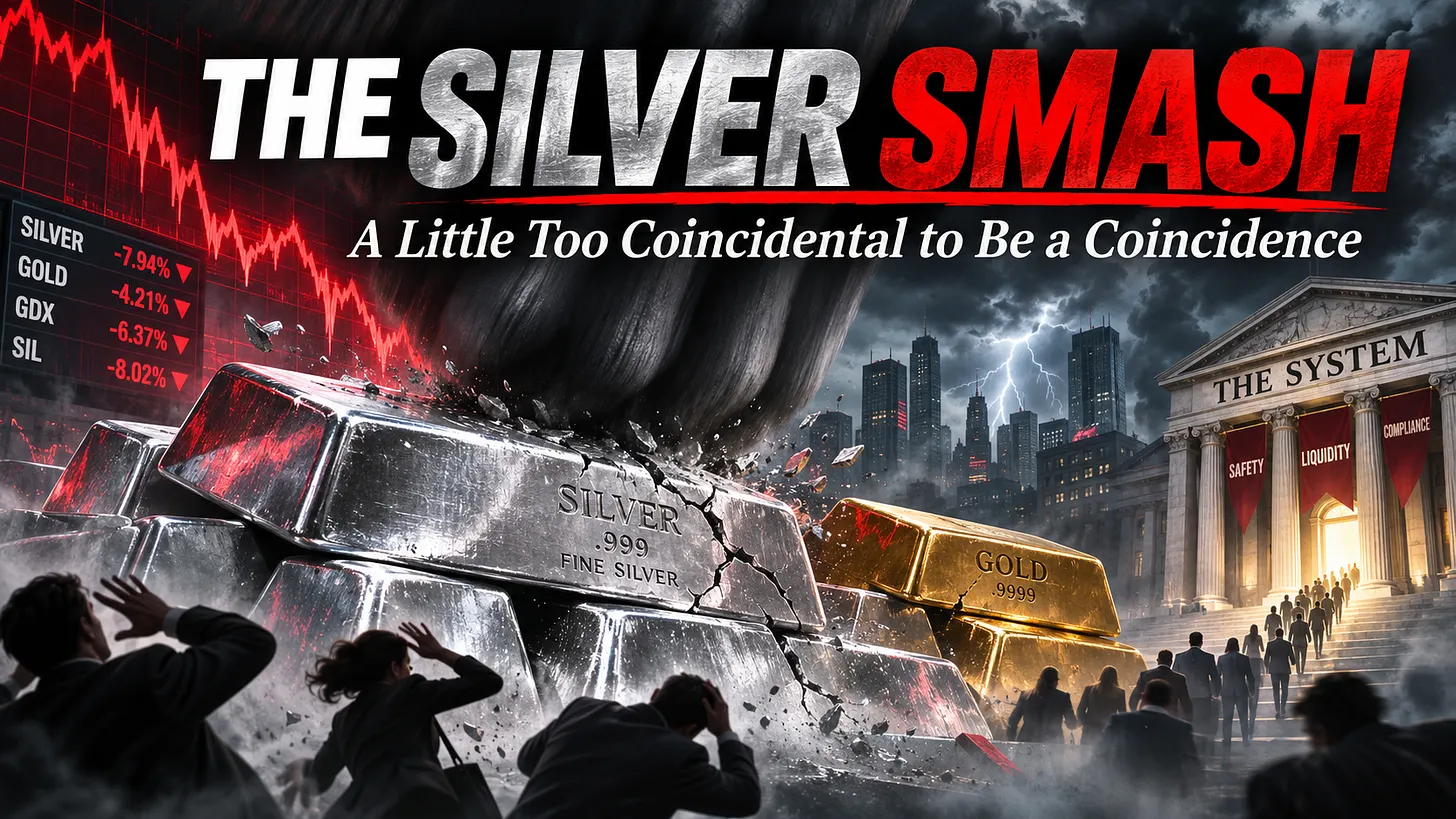
Does anybody see the irony? The assets people purchase because they don’t trust the financial system are being punished just as the reasons for not trusting it appear to be multiplying. I’ve watched this movie before. In fact, I’ve watched several versions of it during my decades following financial markets. And whenever gold and silver suffer one of these spectacular collapses, Wall Street reaches for its favorite explanation.
Forced liquidation. Hedge funds need cash. Investors are meeting margin calls. Computerized trading programs are accelerating the decline. Institutions are selling their winners to pay for their losers. Nothing unusual, nothing suspicious, nothing worth investigating.
I’m not disputing the existence of forced liquidation. It’s real, and anyone who’s ever traded on margin knows exactly how merciless it can be. But forced liquidation explains the mechanics of a market collapse. It doesn’t necessarily explain what sets it in motion, why the timing can be so convenient, or who benefits from the resulting panic.
And that brings me to a theory I’ve been developing. What if the real objective isn’t simply to suppress the prices of gold, silver, and Bitcoin? What if it’s something far more effective: making the alternatives to the conventional financial system so frightening that ordinary investors become terrified of owning them? You don’t have to prohibit people from leaving the system if you can convince them that whatever lies outside is even more dangerous.
Who Starts the Avalanche?
Consider how a modern futures market actually operates. Billions of dollars in contracts change hands, often supported by relatively small amounts of collateral. Hedge funds and institutional traders employ leverage. Stop-loss orders accumulate around obvious technical levels. Computerized trading systems automatically react when prices begin moving sharply.
Now suppose a substantial selling event occurs. It might originate with a large financial institution, a highly leveraged investment fund, an unexpected policy decision, or some other actor capable of producing a significant initial price decline. I’m deliberately using the word actor rather than trader. Whoever sets the process in motion doesn’t necessarily have to execute the subsequent selling.
Once the first important support level gives way, the machinery can take over. Stop-loss orders execute. Leveraged investors receive margin calls. Brokers liquidate accounts that can no longer meet collateral requirements. Algorithms detect the breakdown and accelerate the selling. More positions are liquidated, which pushes prices still lower.
The process feeds upon itself until virtually everybody who can be forced to sell has sold. And here’s the interesting part. An actor who understands how that machinery operates doesn’t need to manipulate every transaction. Under the right conditions, a sufficiently powerful initial disturbance can set off a cascade that produces far greater damage than the original selling.
Could this occur naturally, without any deliberate manipulation? Absolutely. Crowded trades, excessive leverage, and changing economic expectations can produce precisely that result. But that doesn’t mean powerful actors are incapable of exploiting the process.
We already know that precious-metals manipulation is real. In September 2020, JPMorgan agreed to pay more than $920 million to resolve government actions involving unlawful trading in precious-metals and Treasury markets. Federal regulators documented years of spoofing, in which traders placed orders they intended to cancel, creating false impressions of supply and demand.
The Commodity Futures Trading Commission found that the misconduct sometimes produced artificial prices. This wasn’t a conspiracy theory circulating on an obscure message board. It was an enforcement action against one of the world’s largest financial institutions.
Does that prove someone engineered the current silver collapse? Of course not. But it establishes that deliberate manipulation of precious-metals markets has happened, and that the people responsible understood precisely how to exploit the behavior of other market participants. So perhaps we should be a little less eager to accept forced liquidation as the complete explanation every time silver gets taken out behind the woodshed.
The 2008 Rehearsal
David Erfle, the respected precious-metals analyst behind Junior Miner Junky, has been drawing some fascinating parallels between today’s market and the financial crisis of 2008.
He’s looking in the right place. In March 2008, silver reached approximately $20.92 an ounce. By late October, it had collapsed to $8.88, a decline of nearly 58%. Gold suffered its own severe correction, falling roughly 30% from its high.
Think about what was happening during that period. Bear Stearns had failed. Lehman Brothers collapsed. The mortgage market was disintegrating. Banks were discovering that assets they had valued at enormous sums were worth considerably less than advertised. The global financial system was approaching the edge of the abyss.
This was precisely the environment in which gold and silver were supposed to provide protection. Instead, silver got absolutely slaughtered. And what was the explanation? You guessed it. Forced liquidation.
Investors needed dollars. Hedge funds were meeting margin calls. Financial institutions were selling whatever they could to raise cash. Perfectly reasonable explanations that described what was happening in the markets.
But the story didn’t end in October 2008. Governments and central banks eventually embarked upon extraordinary rescue operations. Interest rates were slashed. Financial institutions received emergency support. The Federal Reserve adopted policies that would have seemed inconceivable only a few years earlier.
And the monetary consequences soon became apparent. Gold eventually climbed above $1,900 in 2011. Silver approached $50. Investors who concluded during the 2008 liquidation that precious metals had permanently failed missed one of the most extraordinary recoveries in modern financial history.
The initial panic destroyed confidence in monetary alternatives. The subsequent policy response helped restore demand for them. Now consider the situation confronting us in 2026. Our federal debt is more than $40 trillion. The government’s interest burden is becoming increasingly difficult to ignore. Inflation has not disappeared. The enormous investment boom surrounding artificial intelligence depends upon expectations of future profits that may or may not materialize.
And higher borrowing costs are putting additional pressure on a financial structure already dependent upon enormous amounts of debt. If something breaks, does anybody seriously believe the authorities will simply allow the entire system to collapse rather than intervene?
I don’t. The financial crisis of 2008 taught us something about the priorities of governments and central banks. When forced to choose between monetary discipline and preserving the financial system, they tend to preserve the system. The bill for that decision comes later.
Make the Lifeboats Look Dangerous
But there’s another dimension to the current metals massacre that I think almost everybody is overlooking. Forget the technical indicators for a moment. Forget the latest pronouncements from Federal Reserve officials. Forget whether silver’s next support level is $48, $45, or $40.
Consider the psychology of an ordinary American investor. He’s worked his entire life, accumulated some savings, and watched the purchasing power of his money steadily deteriorate. He sees a government borrowing trillions of dollars while politicians explain that everything is under control.
He’s beginning to suspect that everything is not under control. So he decides to protect himself. He buys some physical gold. He accumulates silver. Maybe he purchases Bitcoin. He’s not necessarily trying to become rich overnight. He’s trying to reduce his dependence upon institutions whose judgment he increasingly questions.
Then the punishment begins. His silver loses half its value. Bitcoin gets hammered. Gold, supposedly the ultimate safe haven, declines 30%. Every financial television commentator explains that he has made a terrible mistake. His financial adviser recommends Treasury bills. His spouse wants to know what happened to the retirement money. He starts questioning his own judgment.
Eventually, he sells. And where does the money go? Back into the conventional financial system. Back into the banks, Treasury securities, and traditional investment products he was trying to diversify away from in the first place.
Mission accomplished.
Now ask yourself a simple question: Who benefits from that outcome? Governments need buyers for their debt. Banks need deposits. Financial institutions need customers. Money managers need investors to continue purchasing the assets they sell and manage.
A population increasingly interested in holding physical precious metals or decentralized digital assets represents competition for that capital and confidence. Nobody needs to issue a secret directive. The incentives are already there.
As I’ve learned from more than four decades studying human behavior, first as an attorney and later as a financial commentator, incentives matter more than intentions.
And there’s an even more troubling possibility. Suppose the real objective isn’t to keep silver permanently suppressed. That would be an enormously difficult undertaking. Suppose the objective is merely to make owning silver so psychologically painful that most investors won’t touch it again for years. You don’t need to destroy the alternatives to the financial system. You only need to destroy public confidence in them.
You don’t have to lock the exits when you’ve convinced everybody that the lifeboats are more dangerous than the sinking ship.
Sometimes the timing of an event deserves as much scrutiny as the event itself. And when it comes to the precious-metals markets, I’ve observed a recurring pattern that I find increasingly difficult to dismiss. Financial instability grows. Investors begin questioning the monetary system. Gold and silver attract attention as alternatives. Then a violent correction occurs, accompanied by explanations involving margin calls, leveraged speculation, and forced liquidation.
The mechanics are explained. The timing is largely ignored. But why should we stop asking questions simply because somebody has explained the mechanics? Who initiated the selling? Were large orders concentrated during periods of unusually thin liquidity? Did margin changes amplify the decline? Were stop-loss levels deliberately targeted? Who accumulated positions after the weakest investors had been forced out?
These are questions that can be investigated through exchange data, futures positioning, regulatory records, and order-flow analysis. Without that evidence, we cannot establish that the current decline was deliberately engineered. But neither should we pretend that the existence of forced liquidation automatically excludes the possibility of an actor taking advantage of it.
After all, we already know market manipulation has occurred repeatedly in the past. We know highly leveraged markets can experience extraordinary chain reactions. And we know that violent losses can frighten ordinary investors away from an asset class for years. The question is whether those forces occasionally interact by design rather than entirely by accident. I think it’s a question worth asking.
What Happens When the Trouble Finally Arrives?
Here’s where the current situation becomes especially interesting. Silver is approaching levels that David Erfle has identified as potentially significant support. Gold is struggling to hold the $3,900 area after breaking below the psychologically important $4,000 level. And the broader financial markets are wrestling with the consequences of high borrowing costs, enormous leverage, and increasingly uncertain economic expectations.
Today is November 3, the day Americans vote in the midterm elections. Markets are already dealing with uncertainty surrounding monetary policy, fiscal spending, and what the next two years might bring. Erfle believes the precious-metals correction bears an important resemblance to the 2008 experience, and that a major bottom could develop during the coming weeks or months.
I think his analysis has considerable merit. But my concern goes beyond whether silver bottoms at $48 or $40. What if the conditions responsible for the current metals massacre are the same conditions that will eventually force policymakers to reverse course? What if tightening credit, excessive leverage, and growing financial stress ultimately produce another monetary rescue? And what if the public has already been frightened out of gold, silver, and Bitcoin before the consequences of that rescue become obvious?
That’s the possibility I believe investors should be examining. Because when the next serious financial disturbance arrives, the monetary authorities may discover that preserving confidence in the financial system requires exactly the policies that undermine confidence in the currency.
That contradiction has been with us for generations. It isn’t going away simply because silver has fallen another 3% this morning. In fact, the greater the financial pressure becomes, the more difficult it may be to postpone the eventual reckoning.
None of this guarantees that silver has reached its bottom. It could fall considerably further. Markets are perfectly capable of remaining irrational, overleveraged, or fundamentally mispriced long enough to ruin investors who mistake a sound long-term argument for a reliable short-term trading signal.
But I believe the most important question isn’t how much further silver might fall. It’s what happens after the liquidation exhausts itself, when the financial problems that supposedly justified the selling are still sitting there, waiting to be addressed.
Maybe the current metals massacre is nothing more than a conventional market correction. Maybe the timing is entirely accidental. Maybe the same extraordinary pattern keeps repeating because leverage, panic, and institutional behavior produce predictable results without anybody deliberately pulling the strings.
Or maybe an actor understands exactly how to exploit that process, recognizing that the most effective way to prevent investors from abandoning a troubled financial system is to make the alternatives look even more terrifying.
Either possibility should make investors think carefully about what’s happening. Because forced liquidation tells us how the selling occurs. It doesn’t necessarily tell us why the selling began, who benefits from it, or what comes next.
And if the financial system is approaching another 2008-style reckoning, today’s silver smash may eventually be remembered very differently.
As Yogi might have said, it’s a little too coincidental to be a coincidence.
And I have a nagging suspicion that when the real trouble finally arrives, the people who frightened everyone out of the lifeboats may discover that they need one themselves. And just like when the Titanic hit that iceberg, those holding unsinkable US Dollar based assets will find that there aren’t enough of them available to go around.
Source: https://www.financialsurvivalnetwork.com/p/the-silver-smash-a-little-too-coincidental
Anyone can join.
Anyone can contribute.
Anyone can become informed about their world.
"United We Stand" Click Here To Create Your Personal Citizen Journalist Account Today, Be Sure To Invite Your Friends.
Before It’s News® is a community of individuals who report on what’s going on around them, from all around the world. Anyone can join. Anyone can contribute. Anyone can become informed about their world. "United We Stand" Click Here To Create Your Personal Citizen Journalist Account Today, Be Sure To Invite Your Friends.
LION'S MANE PRODUCT
Try Our Lion’s Mane WHOLE MIND Nootropic Blend 60 Capsules
Mushrooms are having a moment. One fabulous fungus in particular, lion’s mane, may help improve memory, depression and anxiety symptoms. They are also an excellent source of nutrients that show promise as a therapy for dementia, and other neurodegenerative diseases. If you’re living with anxiety or depression, you may be curious about all the therapy options out there — including the natural ones.Our Lion’s Mane WHOLE MIND Nootropic Blend has been formulated to utilize the potency of Lion’s mane but also include the benefits of four other Highly Beneficial Mushrooms. Synergistically, they work together to Build your health through improving cognitive function and immunity regardless of your age. Our Nootropic not only improves your Cognitive Function and Activates your Immune System, but it benefits growth of Essential Gut Flora, further enhancing your Vitality.

Our Formula includes: Lion’s Mane Mushrooms which Increase Brain Power through nerve growth, lessen anxiety, reduce depression, and improve concentration. Its an excellent adaptogen, promotes sleep and improves immunity. Shiitake Mushrooms which Fight cancer cells and infectious disease, boost the immune system, promotes brain function, and serves as a source of B vitamins. Maitake Mushrooms which regulate blood sugar levels of diabetics, reduce hypertension and boosts the immune system. Reishi Mushrooms which Fight inflammation, liver disease, fatigue, tumor growth and cancer. They Improve skin disorders and soothes digestive problems, stomach ulcers and leaky gut syndrome. Chaga Mushrooms which have anti-aging effects, boost immune function, improve stamina and athletic performance, even act as a natural aphrodisiac, fighting diabetes and improving liver function. Try Our Lion’s Mane WHOLE MIND Nootropic Blend 60 Capsules Today. Be 100% Satisfied or Receive a Full Money Back Guarantee. Order Yours Today by Following This Link.


| Visits: | 1,837,031,829 |
| Stories: | 8,731,230 |
Whistler Blowers, Insiders

