

This US Defense Stock Just Had Its First Q With Positive Cash Flow. It Trades at 8 Cents

Wi2Wi Corporation YTY – TSXV no OTC or PINK sheet
This small cap company is a nimble and high quality maker of some of the most basic–and invisible–key parts for the US defense sector. Some big customers count on them to make specialized parts very quickly. And with a new CEO just putting up her first quarter with positive cash flow, the turnaround that I’ve been waiting for–for over two years–may finally be at hand.
I had a great chat with CEO Sue Amarin a few weeks ago. She has brought in a great discipline to this 45-person business in Wisconsin–and reworked some legacy contracts that are now generating profits and confidence.
But make no mistake–turnarounds take time and never go up in a straight line. However, Wi2Wi has to report its next quarterly by the end of this month–which is only 12 days away. Hopefully the new momentum can continue.
I am long the stock, but I think this new report by me and Claude, my new best friend, is even-handed with the risks here. At 8 cents a share and a green shoot of positive cash flow, the rewards are obvious. Here’s the story:
Besides Sue herself, the other change in the last year is…US President Trump. Over the last year the Trump administration pushed the Pentagon budget past $1 TRILLION for the first time ever, and — on July 22 — signed an executive order that basically forces the big defense contractors to buy their parts from American factories instead of overseas.
Wi2Wi is an already-qualified, Made-in-Wisconsin parts factory selling to the exact companies that order was written for.
When the government hands a tiny supplier a tailwind like that, I pay attention.
The company reports its Q2 before the end of August—very near term.
But before you get excited, I want to do something different with this report. Wi2Wi makes products with intimidating names — crystal oscillators, TCXOs, cavity filters. It sounds like rocket science. It isn’t.
By the time you finish reading, a Grade 10 student will understand exactly what this company does and why the U.S. military can’t build a fighter jet without parts like theirs. Then I’ll walk you through the numbers — and the very real risks, starting with the fact that this is the company’s THIRD CEO in five years.
QUICK FACTS

The Business: A ‘Pick-and-Shovel’ Supplier to Defense
Here’s the simplest way to think about Wi2Wi. During a gold rush, the people who reliably got rich weren’t the miners — it was the folks selling the picks and shovels. Wi2Wi sells the picks and shovels of the electronics world.
They don’t make the fighter jet, the satellite, or the guided missile. They make a tiny, boring-looking component that goes INSIDE all of those things — and without it, none of them work. The company operates out of a 50,000-square-foot factory in Middleton, Wisconsin, with about 45 employees, and sells under a well-known 30-year-old brand called Precision Devices (PDI). Everything is designed and built in the USA.
A couple of years ago Wi2Wi was really three businesses: timing/frequency parts, WiFi modules, and GPS/navigation modules. In early 2025 management did the smart thing and KILLED the side projects. Today it’s one focused business: precision timing and frequency control. That’s where 100% of the revenue comes from, so that’s where we’ll spend our time.
Dumbing Down The Tech (Grade 10 Edition)
Every product Wi2Wi sells does one of two jobs: it either keeps time, or it cleans up a signal. That’s it. Let me break down the whole product line into plain English.
1. The Crystal — an electronic tuning fork
It starts with quartz crystal — the same mineral in a cheap wristwatch. Quartz has a magic property: when you run a little electricity through a precisely cut piece of it, it vibrates at an EXACT, unchanging rhythm. Squeeze it and it makes electricity; zap it with electricity and it flexes.
Engineers call this the piezoelectric effect. You can just think of it as an electronic tuning fork. Strike a tuning fork and it always hums the same note. A quartz crystal does the same thing millions of times per second, and it basically never drifts off-pitch.
Here’s how CEO Sue Amarin described it to me when we spoke on July 28: Wi2Wi buys the raw, uncut crystal (mostly from Japan and Korea — almost never China) the way “a jeweler buys gold. You get the blocks from somewhere, and then you make them into what you want to make them into.” On its own, she says, it’s “dumb material that can’t do anything.”
Wi2Wi’s factory chisels and cuts that raw quartz — and in her words, “they become alive,” then get built into the oscillator or filter. That transformation, done in Wisconsin, is the whole value-add.
2. The Oscillator — the drummer that keeps the band in time
Take that vibrating crystal, wrap some circuitry around it, and you get a clock oscillator. This is the heartbeat of any electronic device.
Picture a band. You’ve got a guitarist, a bass player, a singer — and if they don’t all play to the same beat, you get noise, not music. The oscillator is the drummer. It sits on the circuit board and pounds out a steady beat — billions of times a second — so every other chip knows exactly when to act. In a computer that beat is the ‘gigahertz’ number you see advertised. In a radio, a GPS unit, or a missile, the drummer is even more important, because two devices talking to each other from miles apart have to agree on the beat down to the billionth of a second, or the message turns to garbage.
3. TCXO, VCXO, OCXO — keeping the drummer perfect in a war zone
Here’s the problem: a plain tuning fork changes its pitch a tiny bit when it gets hot or cold. On your kitchen counter, who cares. Strapped to the wing of a jet at 40,000 feet, or on a satellite baking and freezing in orbit, that tiny drift can wreck the whole system. So Wi2Wi sells ‘souped-up’ oscillators that fight temperature. The alphabet soup is simpler than it looks:
● TCXO (Temperature-Compensated) — a self-correcting drummer. It senses the temperature and automatically adjusts to stay on beat.
● VCXO (Voltage-Controlled) — a drummer with a volume/speed dial. You can nudge the beat up or down on command.
● OCXO (Oven-Controlled) — the gold-plated version. It literally keeps the crystal inside a tiny built-in OVEN so the temperature never changes at all. Most stable of the bunch, and the most expensive.
The harsher the environment and the more precision the customer needs, the more they pay. Defense, aerospace and space customers need the very best — which is exactly the high-margin corner Wi2Wi plays in.
4. Filters — the bouncer and the coffee filter
The other half of the business cleans up signals. The airwaves are crowded — WiFi, radio, radar, cell signals, static — all jammed together. A filter’s job is to let the ONE signal you want through and block everything else.
A crystal filter is like a bouncer at a nightclub who only lets in guests wearing exactly the right outfit. Because a crystal only responds to its own precise frequency, it waves that one signal through and turns everyone else away.
An RF or microwave filter is more like a coffee filter: the good stuff pours through, the grounds stay behind. Wi2Wi makes two grades. The cavity filter is the precise, high-end one for very high frequencies (think a fine espresso filter). The LC filter is the cheap-and-cheerful one for jobs where you don’t need perfection (a basic paper filter). Same idea, different price points.
So why does any of this matter?
Because timing and clean signals are INVISIBLE until they fail. GPS only works because satellites carry ultra-precise clocks. A radar only sees the enemy if its timing is razor-sharp. A guided missile only hits the target if every chip inside is marching to the same beat. Wi2Wi makes the drummers and the bouncers that keep those systems honest — and it makes them to military spec, in America.
The Moat: Boring Parts, Sticky Business
Let me be straight with you, because I always am: there is nothing magically proprietary about a crystal oscillator. Multi-billion-dollar giants like Microchip, Kyocera and Murata make similar parts. If Wi2Wi’s story were ‘we invented something nobody else has,’ I’d pass.
That’s NOT the story. The story is WHERE they sit and HOW they sell. Their edge comes from four things:
● Made in the USA. Everything is designed and built in Wisconsin. For defense and aerospace programs, that’s not a nice-to-have — it’s increasingly the LAW.
● The certifications. Wi2Wi carries military-grade approvals — QPL, MIL-PRF-55310, MIL-STD-790, ISO 9001 and a certified cleanroom. Getting a part ‘qualified’ onto a defense program takes years and a mountain of paperwork. Once you’re in, you’re very hard to rip out.
● Speed. They can design a custom part in as little as 2 DAYS and get it into production fast — something the offshore giants won’t bother doing for a small order.
● Long life + stickiness. A jet or missile program can run for 20+ years, buying the same qualified part the whole time. Management says 90%+ of business is repeat, with orders of roughly US$0.5M–$1M each.
When I put the ‘commodity’ word to Sue directly, she pushed back — and it’s worth hearing her out. “I wouldn’t say our product is commoditized,” she told me. “Think of us as a machine shop… a specialized shop. You can’t just go out to any other supplier and say, hey, buy it off the shelf.” Her point: a rival can’t simply hand a customer an identical part. They’d have to design a DIFFERENT part to the same spec, prototype it (6–8 weeks), and then the customer has to re-qualify it in their system — “that whole process could take a whole year.”
That’s the real moat, and it’s why customers don’t leave. Wi2Wi carries roughly 15,000 different part numbers on its books — most of them ‘legacy’ parts kept alive for programs designed decades ago. As Sue put it, a Boeing black-box design doesn’t change; “a lot of our customers will come back to us and ask for something they bought from us five years ago, ten years ago,” and Wi2Wi still makes it. Only about 500 of those SKUs are ‘volume runners.’ A truly brand-new part — cut from a raw crystal at a new frequency — happens fewer than 10 times a year; the rest is tweaking proven designs.
So the honest synthesis is this: the raw materials are commodities, but the finished, qualified, board-specific part is NOT easily swapped out. The relationships and the requalification wall are the whole bet.
Who Actually Buys This Stuff
This is the part that made me a shareholder. For a company you’ve never heard of, the customer list is a who’s-who of American defense and aerospace:
BAE Systems • Boeing • Raytheon (RTX) • L3Harris • Collins Aerospace • Honeywell • Motorola • Garmin • Baker Hughes
These are the prime contractors building the fighter jets, missiles, satellites and radios the Pentagon buys. Wi2Wi’s parts end up in avionics, radar, satellite comms, GPS navigation, guided munitions and industrial systems. When you see headlines about the U.S. ramping up production of Patriot interceptors, Javelins, Tomahawks and hypersonic missiles, remember: every one of those needs precision timing parts inside. That’s the pond Wi2Wi is fishing in — a global frequency-control market estimated at roughly US$5–7 billion and growing 6–7% a year.
One useful nuance Sue gave me: defense is only about 30–35% of revenue today (she expects that to climb this year), with the rest coming from ‘industrial’ — the Boeings and Caterpillars of the world, and even some medical (their parts can sit in MRI machines). So this isn’t a pure defense play; it’s a precision-parts play with a defense turbocharger bolted on.
Channel To Market: How A Tiny Shop Sells To Giants
One thing I wanted to nail down with Sue was HOW a 45-person shop in Wisconsin actually gets its parts into a Raytheon missile. The answer is refreshingly simple, and it tells you a lot about why the business is sticky.
It’s all business-to-business, and about 85–90% is sold DIRECT. The U.S. government, Sue explained, “doesn’t necessarily build anything. They buy from the Honeywells of the world, or the BAEs, or L3Harris.” Wi2Wi sells straight to those primes and subcontractors (the ‘OEMs’).
The customer shows up with a specification — or Wi2Wi writes one for them — then it’s schematics, design, prototypes, the customer tests and qualifies it internally, and only then do they buy in volume and bolt it into their system. That qualification step is exactly the year-long wall we just talked about.
The other 10–15% runs through manufacturers’ reps and the occasional distributor. Reps carry Wi2Wi alongside a portfolio of non-competing parts and earn a commission. But Sue was candid about the limits of that channel: reps “would probably rather focus on the companies that’ll get them 10, 20 million in revenue… versus somebody like us who’s much smaller.” So direct sales — where she has the relationships and control — is “the bread and butter.”
The catch: a rebuilt sales team of THREE
Here’s a risk the glossy investor deck won’t tell you, and I’d rather you hear it from me. This is a turnaround, and the sales engine is still tiny. When the old management chased the WiFi dream, they gutted the frequency-control sales team.
Today Sue is rebuilding from almost nothing: ONE full-time direct sales executive (a 25-year industry veteran, 18 of them at the company) plus two inside salespeople. That’s it. She’s signing up more reps and wants to get to two — ideally three — direct salespeople by the end of this year.
Read that two ways.
1. The bear case: three salespeople is thin, and growth is bottlenecked by hiring specialized people who aren’t cheap.
2. The bull case, in Sue’s own words: “We haven’t even scratched the surface yet at our customers,” precisely BECAUSE there hasn’t been a real sales team to work them. If she staffs up, there’s low-hanging fruit inside accounts they already sell to. I lean toward the bull case here — but it hinges on execution.
The Numbers: A Real Turnaround Is Underway
For years Wi2Wi was stuck. Revenue that once hit $14M back in 2015, and $10M pre-COVID, collapsed to $6–7M and just sat there. The company carried a ‘going concern’ warning and hadn’t raised money in a decade. Not a great look.
But the last few quarters are the best I’ve seen from this company. Here’s Q1-2026 (the three months to March 31) versus a year ago:
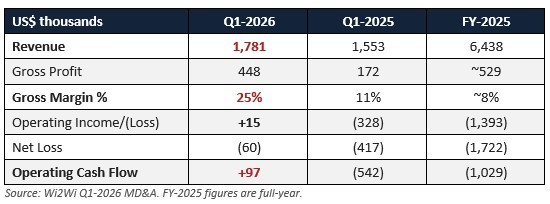
Look at what happened. Revenue up 15%. But the REAL story is the margin: gross margin jumped from 11% to 25% — more than doubling — because management cleaned up the product mix and squeezed out costs. That flipped the company from an operating LOSS to a small operating PROFIT, cut the net loss by 86%, and produced actual positive cash flow of $97,000.
For a company that’s bled cash for years, that’s a genuine turning point.
And when I asked Sue WHY the margin was so terrible before, her answer was eye-opening — and it tells you this is a fixable problem, not a broken business. She found the company had barely raised prices in years.
One five-year contract with a big defense customer had prices “locked at the 2020 prices,” even as raw materials and tariffs climbed. On some parts, she says, they were literally “selling below our cost. And that’s why our margins for the whole company were at 8% last year.”
That contract expired at the end of March, she’s renegotiated it to step-pricing with margin protection, and she’s put a hard rule in place: no new part gets quoted below a minimum gross margin. Simple blocking and tackling that nobody had done.
And the momentum is continuing. In Q2-2026 the company said manufacturing yields improved more than 30% year-to-date on flagship products — which is a fancy way of saying they’re throwing away fewer parts, so each good part costs less to make. That drops straight to the bottom line.
Sue gave me a real example that ties it all together — the yield fix, the pricing fix, and the demand — in one product (she asked me to keep the customer’s name off the record, but it’s a major defense prime). Last year the company was shipping about 1,400 of this specialized part per week on an older design that had quality problems.
With the redesigned, higher-yield version, they’re now doing about 1,700 a week — and the customer wants them to DOUBLE it. On price, the old design went out around $25; the cleaner new design moved to about $35; and Sue says the current negotiation puts it “north of 40.” Same part, better yields, ~60% more revenue per unit. That’s the whole turnaround thesis in a nutshell.
How much can this grow — and what does it cost?
This is the question I really wanted answered, so I asked Sue point-blank: can this company grow 30–50% a year, or is it a 20–25% compounder?
She’s too disciplined to hand out a projection this early — “I am not ready to give a projection” — but on capability she didn’t hedge: “We definitely are capable of doing that as a company. With the right staffing, with the right equipment, I don’t see any reason why we wouldn’t. The market is there. It’s just a matter of time.”
And the beauty is she doesn’t need a new factory to do it. Today’s ~$6–7M of revenue is being done on ONE shift; the plant has run TWO shifts in its past and can do well over $20M. Filling up the building she already has is the entire near-term growth plan. Her stated first milestone is $2.5M per quarter — $10M a year — which she believes is break-even to cash-flow positive.
What does getting there cost? Less than you’d think, and that’s the encouraging part. Sue says a second shift could come as early as Q1 next year and needs roughly two more salespeople and some production hires, plus equipment.
She’s already ordered the one major machine that’s the bottleneck — and, tellingly, negotiated it onto monthly installments instead of the usual half-upfront/half-on-delivery, which let her order it AHEAD of the cash flow rather than waiting. “This is the time to invest,” she told me. “I don’t want to wait until we’re super profitable and life is great.”
On whether she needs to raise money: she’d like a cushion but isn’t desperate for one. More capital, she says, would “make me sleep better at night” and let her grow FASTER and hire the right people — but the plan can also be funded organically, just more slowly. Her stance: “I would love capital, but I’ll wait for end of Q2, Q3, see how we’re doing.” For existing shareholders, that’s the right answer — she’s not rushing to dilute us at a nickel. (More on that razor-thin balance sheet in the risks.)
Where does the growth come from? Next 12 months, Sue is doubling down on defense — missiles and their guidance systems, interceptor drones, and communications gear for the Navy — riding the replenishment wave whether or not the shooting stops. Beyond that she wants to push into industrial automation and robotics (think Caterpillar-style equipment) and, further out, low-earth-orbit satellites — though that one needs a radiation-testing lab she’d have go source. Defense is where the money is TODAY, and she’s smart to chase it first.
On margins, she’s not shy about the ceiling either. Wi2Wi sits at 25% today; Sue points out a larger listed competitor in the same space runs 45–47% gross margins (its stock, she noted, trades near US$95 versus our nickel), and says “I don’t see why we shouldn’t be able to improve” toward those levels over time, targeting gains quarter on quarter. If she’s even half right, the earnings power on $10M+ of revenue looks very different from today.
The Macro: Trump’s Defense Boom Is The Whole Setup
Here’s why I think the timing on this tiny stock is right, and it has almost nothing to do with Wi2Wi itself. It has to do with what’s happening in Washington over the LAST YEAR. Two things are lining up — a wall of money, and a law that practically writes ‘Made in USA’ onto the order form. Wi2Wi sits right where those two forces meet.
Force #1: The money — a $1 TRILLION Pentagon
The Trump administration pushed the FY2026 national-defense request to roughly $1 trillion — the first time in history the number has a ‘T’ in front of it — and has floated a FY2027 plan as high as $1.5 trillion, citing ‘dangerous times.’ (Fair warning: Congress is squabbling over the exact math, and some of that topline leans on a one-time reconciliation package, so treat the biggest headline numbers with a grain of salt.) Either way, the DIRECTION is unmistakable: up and to the right.
And it’s not just a bigger number — it’s WHERE the money is pointed. Three of the stated priorities are munitions production, shipbuilding, and ‘revitalizing America’s defense industrial base,’ plus a giant new ‘Golden Dome’ missile-defense program. Munitions, missiles, ships, radar, satellites — every single one of those is stuffed with the exact timing and frequency parts Wi2Wi makes. When the Pentagon says ‘build more missiles,’ somebody has to build more of the tiny drummers and bouncers inside them.
Force #2: The rulebook — ‘buy it at home’ is becoming law
This is the part that really matters for a company like Wi2Wi. On July 22, 2026, President Trump signed an executive order to secure U.S. defense supply chains. In plain English, it does three things:
● It slams the door on easy waivers. For years, if a contractor couldn’t find a U.S. source, it could get a ‘waiver’ to buy the part from overseas — often from China. The new order says those free passes are going away, effective January 1, 2027.
● It forces contractors to trace every part to its roots. Primes like Raytheon and BAE now have to map their supply chains all the way down to the raw materials, write plans to onshore what’s foreign, and actively qualify NEW domestic suppliers — or risk having contracts modified or terminated.
● It clears red tape to add American suppliers. The order specifically tells the Pentagon to REMOVE the bureaucratic barriers that make it slow to qualify a new domestic source.
Read that last point again and think about who benefits. Wi2Wi is an already-qualified, already-certified, already-Made-in-Wisconsin supplier. When the biggest defense companies in America are suddenly REQUIRED to find home-grown sources for their parts — and the government is greasing the skids to make that easier — a shop like Wi2Wi is exactly the kind of name that lands on the ‘approved domestic vendor’ short list.
That’s a structural tailwind you can’t manufacture; the government just did it for them.
The honest other side
Now let me keep myself honest, because macro tailwinds cut both ways. First, the defense industry’s own trade group (the Aerospace Industries Association) warned that in some cases the domestic sources simply ‘do not exist’ or lack capacity — which is bullish for a supplier like Wi2Wi, but also a reminder that these shifts take YEARS to show up in a small company’s revenue, not quarters.
Second, the same ‘buy American’ pressure applies to Wi2Wi itself: they buy mined quartz and some inputs too, and they’ll have to keep their OWN supply chain clean and compliant. And third — government budgets are political footballs. A shutdown, a continuing resolution, or a change in Washington’s mood can slow the money down. This is a real, powerful tailwind, but it’s a multi-year story, not a light switch.
The Risks — And They Are Real
This is a Tiny, Speculative Micro-Cap,
and there are several things that can go wrong
1. Three CEOs in five years — the big one
This is the risk that keeps me up at night. Wi2Wi is now on its THIRD chief executive in about five years. The long-time founder-era leadership gave way to Ted Clark, who took over February 1, 2024. Clark stepped down November 18, 2025 — less than two years in — ‘to spend more time with family.’ On the same day, Sue Amarin became CEO.
When I first wrote this stock up, the entire bull case rested on Ted Clark executing the turnaround. He’s now gone. That’s a gut-check. A revolving door in the corner office makes it hard to trust that any single strategy will see itself through, and it can spook the very defense customers who value stability and long relationships.
The flip side: Amarin’s résumé is legitimately strong — 20+ years in semiconductors with senior roles at Intel, Micron and Blaize, and a track record scaling revenue in industrial and defense. And the numbers didn’t fall apart during the handoff — Q1-2026 was the best quarter in years. But make no mistake: you are betting on a brand-new driver, again.
2. A thin cash cushion
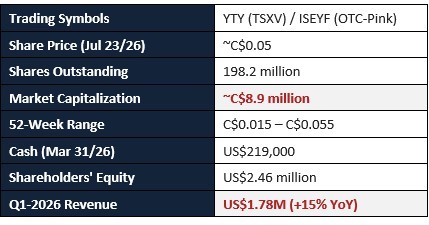
The company had just US$219,000 in cash at March 31, 2026 — down from $422K a year earlier. Working capital of $2.45M and positive equity of $2.46M give some breathing room, and they finally turned cash-flow positive, but there’s very little margin for error. One bad quarter, a big inventory build, or a customer hiccup and they could be back tapping the market. Wi2Wi has carried a ‘going concern’ flag in the past — keep that in mind.
3. Commodity products & big competitors
As I said up top, there’s nothing here that Microchip, Kyocera or Murata couldn’t also make. Wi2Wi’s protection is its certifications, its Made-in-USA status and its relationships — not patents. If a giant decided to chase these small defense orders, Wi2Wi is the minnow.
4. Micro-cap liquidity & dilution
At ~C$0.05 and a ~C$9M market cap, this stock is thinly traded — it can move hard on small volume, in both directions. There are also 198M shares out, plus roughly 9.9M options and 29.5M warrants that can add to the count. And notice: my original write-up pegged it near $0.08; it now trades around $0.05. This has NOT been a straight line up. Size your position accordingly.
5. Customer concentration & long cycles
Defense and aerospace revenue is lumpy. Orders are large but infrequent, sales cycles are long, and losing even one major program or customer would hurt. Revenue growth here is measured in years, not weeks.
The Bottom Line
Wi2Wi is a tiny, overlooked company selling humble parts into a market that MATTERS, at a moment when the macro winds — reshoring and rising defense budgets — are finally at its back. After years of flat, frustrating results, the turnaround is showing up in the numbers: 15% revenue growth, gross margins more than doubling to 25%, an operating profit, and real positive cash flow. On a single shift, in a plant that can do 3x the revenue.
But this is a speculative micro-cap, and the CEO merry-go-round is a legitimate yellow flag. You’re backing a brand-new leader — the third in five years — to keep the momentum going. If Sue Amarin can do for Wi2Wi what her predecessor started, and simply fill up that factory toward $10M+ in revenue, this $9M company looks cheap. If the turnaround stalls or the leadership churn continues, it stays a sub-nickel lottery ticket.
I’ve owned it for four years and I’m still holding. But I’m watching that corner office very closely.
To get our latest picks, Subscribe HERE
IMPORTANT DISCLAIMER
This report is for information and educational purposes only and is not investment advice, nor an offer or solicitation to buy or sell any security. The author owns shares of Wi2Wi Corporation and is therefore not independent; his views are biased by that position. Micro-cap stocks are highly speculative, illiquid and can lose their entire value. Financial figures are drawn from Wi2Wi’s public filings on SEDAR+ and third-party data providers and may contain errors or become outdated; the stock price reference is as of July 23, 2026. Forward-looking statements are subject to significant risk. Always do your own due diligence and consult a licensed financial advisor before investing.
Source: https://oilandgas-investments.com/2026/latest-reports/this-us-defense-stock-just-had-its-first-q-with-positive-cash-flow-it-trades-at-8-cents/
Anyone can join.
Anyone can contribute.
Anyone can become informed about their world.
"United We Stand" Click Here To Create Your Personal Citizen Journalist Account Today, Be Sure To Invite Your Friends.
Before It’s News® is a community of individuals who report on what’s going on around them, from all around the world. Anyone can join. Anyone can contribute. Anyone can become informed about their world. "United We Stand" Click Here To Create Your Personal Citizen Journalist Account Today, Be Sure To Invite Your Friends.
LION'S MANE PRODUCT
Try Our Lion’s Mane WHOLE MIND Nootropic Blend 60 Capsules
Mushrooms are having a moment. One fabulous fungus in particular, lion’s mane, may help improve memory, depression and anxiety symptoms. They are also an excellent source of nutrients that show promise as a therapy for dementia, and other neurodegenerative diseases. If you’re living with anxiety or depression, you may be curious about all the therapy options out there — including the natural ones.Our Lion’s Mane WHOLE MIND Nootropic Blend has been formulated to utilize the potency of Lion’s mane but also include the benefits of four other Highly Beneficial Mushrooms. Synergistically, they work together to Build your health through improving cognitive function and immunity regardless of your age. Our Nootropic not only improves your Cognitive Function and Activates your Immune System, but it benefits growth of Essential Gut Flora, further enhancing your Vitality.

Our Formula includes: Lion’s Mane Mushrooms which Increase Brain Power through nerve growth, lessen anxiety, reduce depression, and improve concentration. Its an excellent adaptogen, promotes sleep and improves immunity. Shiitake Mushrooms which Fight cancer cells and infectious disease, boost the immune system, promotes brain function, and serves as a source of B vitamins. Maitake Mushrooms which regulate blood sugar levels of diabetics, reduce hypertension and boosts the immune system. Reishi Mushrooms which Fight inflammation, liver disease, fatigue, tumor growth and cancer. They Improve skin disorders and soothes digestive problems, stomach ulcers and leaky gut syndrome. Chaga Mushrooms which have anti-aging effects, boost immune function, improve stamina and athletic performance, even act as a natural aphrodisiac, fighting diabetes and improving liver function. Try Our Lion’s Mane WHOLE MIND Nootropic Blend 60 Capsules Today. Be 100% Satisfied or Receive a Full Money Back Guarantee. Order Yours Today by Following This Link.


| Visits: | 1,831,585,251 |
| Stories: | 8,702,146 |
Whistler Blowers, Insiders

