

A Tale of Two Colonels: Drake, Lee and the Two Revolutions of 1859

Today is so-called “Election Day.” I use quote marks because voting is now a season, and campaigns are permanent. Tonight, people will tally the ballots and tomorrow — or next week, or maybe December, cuz… California — we’ll know more about who will hold power in Washington come January 2027.
So, let’s NOT discuss current politics. That’s for others, and other days.
Instead, let’s discuss 1859.
The Colonels Who Changed the World
In an odd coincidence of time and geography, in 1859 two American colonels stepped onto history’s stage. One used rank as a promotional title: Edwin Drake, a former railroad conductor whose backers understood marketing, even if their guy wasn’t a real O-6. But the other was the genuine article: Robert E. Lee, a West Point-trained Army officer, battle-tested in Mexico.
At Titusville, Pennsylvania, Drake changed the world; and at Harpers Ferry, Virginia, Lee confronted a national crisis. (Note: In 1859 Harpers Ferry was part of Virginia; West Virginia was created later, during the Civil War.) These places are just 190 miles apart as the crow flies across the Appalachians; and each in its own way, they led to two very different kinds of upheaval.
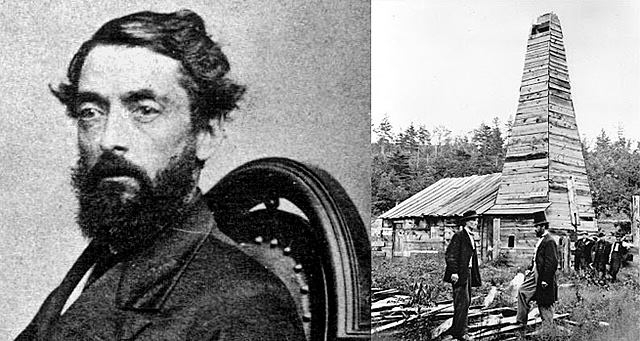
Edwin Drake and Titusville oil well. Credit National Archives.
On August 27, 1859, Drake’s rig struck commercial amounts of oil at a depth of 69½ feet. If you’re wondering, he wasn’t “drilling” a hole with a rotating bit; he was pounding a hole into rock with a cable-tool device (long story; not here). The point is, Drake dug to very modest depth and created very immodest consequences.
Seven weeks later, on October 16, militant abolitionist John Brown and his followers seized the federal arsenal at Harpers Ferry. And the U.S. government sent Army Col. Lee with a contingent of U.S. Marines – they were handy and immediately available, so he grabbed them – to end the raid.
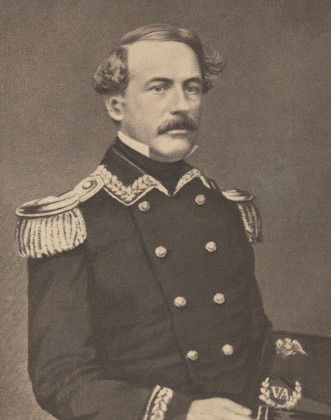
Col. Robert E. Lee, U.S. Army, 1859. Credit National Archives.
One event opened an entirely new age of energy for mankind. The other intensified a political crisis that led to America’ Civil War and remade the Union.
Two colonels. Two revolutions. One quiet, one loud. And both are still with us.
The Courtesy Colonel and the Rock
Even in 1859, petroleum was no novelty. Native Americans had gathered seep oil for centuries; bottled oil later found a market as medicine, salve and waterproofing. But collecting what leaked onto the surface of creeks and streams was one thing. Delivering a dependable industrial supply was another.
Below ground, oil occupies pores and fractures in rock, not some vast subterranean lake. Seeps are clues to a buried system. Drake’s practical question was whether he could tap in and lift oil in useful quantities.
The answer was fieldcraft, not grand theory. Drake borrowed a method from salt-well drilling and used steam power to raise and drop a chisel-like tool suspended from a cable. Then, he ran iron pipe down the opening to prevent loose material from collapsing into the hole. That is, Drake utilized existing tools and tech, rearranged for a new purpose; aka “innovation.”
Oh, and Drake was persistent. His backers’ money was nearly gone; local confidence had evaporated. The enterprise was called “Drake’s Folly,” right up until the well filled with oil and everyone then wanted in on the action.
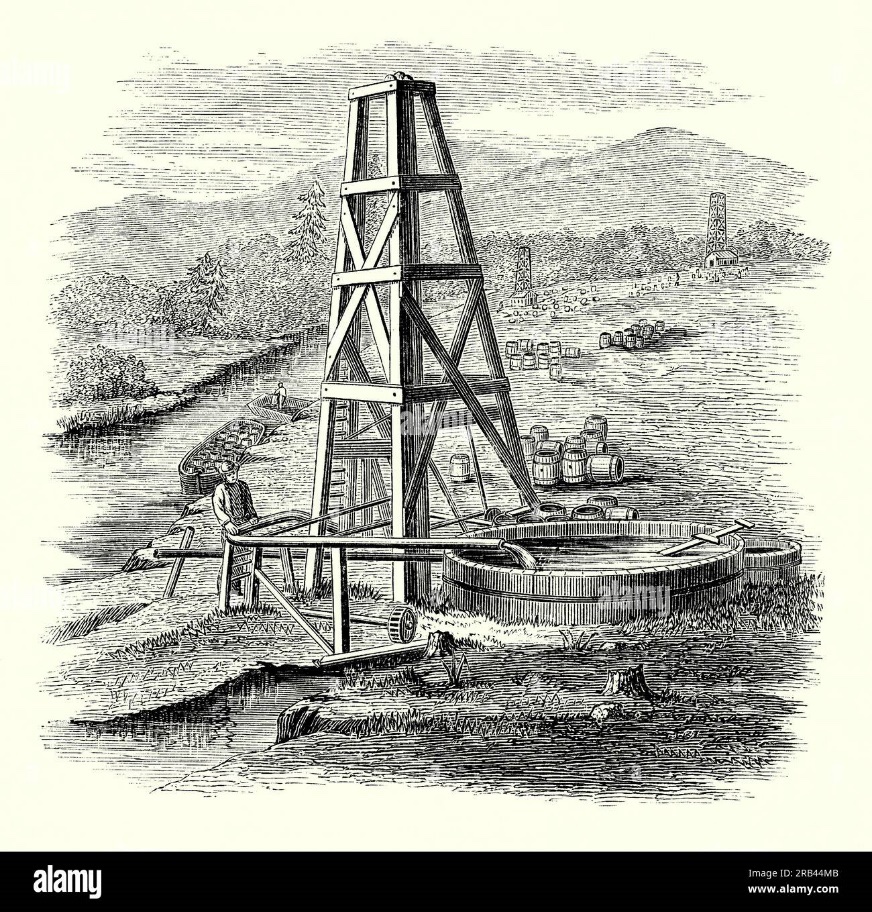
Early oil well, flowing crude into a vat. Cradit National Archives.
The breakthrough created a business proposition: drill, produce crude oil, sell it to refiners, and they in turn could sell useful products to customers. A geological occurrence became an industrial resource. The rock had not changed; but the tech and economics had evolved.
The first benefit from oil was illumination via kerosene, which pushed back the night. Then came petroleum lubricants which helped an increasingly mechanized economy turn its wheels. Decades later, refined fuels enabled internal-combustion engines. Plus, oil led to an array of industries built around petrochemicals, plastics, synthetic fibers, asphalt and much else that modern life takes for granted.
Think of petroleum as a geological inheritance: organic matter buried in sediments, transformed by heat over immense spans of time, during which hydrocarbons migrate into reservoir rock. And Col. Drake tapped that inheritance with a shallow hole and nineteenth-century machinery. He put ancient, stored energy within reach of human enterprise.
The Real Colonel and the Arsenal
Seven weeks after Drake’s well came in, John Brown and 21 followers attacked and seized the federal arsenal at Harpers Ferry. Brown et al intended to distribute weapons and ignite an uprising. Instead, he and his gang were trapped in the armory’s engine house, with hostages.
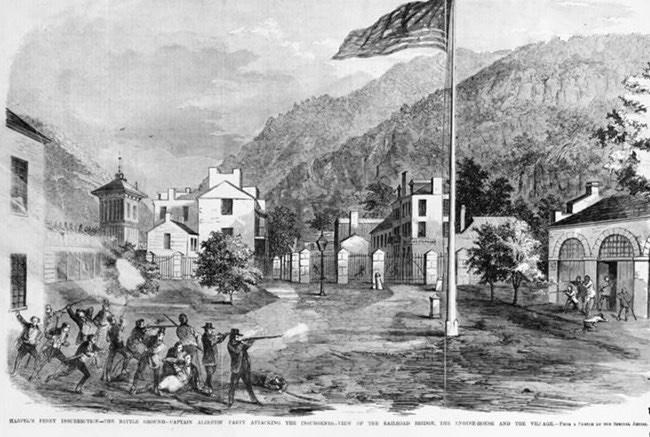
Brown’s raid at Harpers Ferry. Credit National Park Service.
Col. Lee and his Marines rode from Washington, D.C., confronted Brown and demanded a full surrender. When Brown refused, Lee’s Marines stormed the building and captured him. The raid was crushed, but the fuse of national rebellion was lit and burning.
Harpers Ferry terrified the slaveholding South, while Brown became a martyr to many Northern abolitionists. And at this stage of American development, slavery — the South’s so-called “peculiar institution” — was a fault line that political compromise could no longer bridge.
Indeed, and as is the case with true geological faults, apparent stability can conceal immense levels of built-up stress. So, while it’s not accurate to say that Harpers Ferry “caused” the Civil War, the episode revealed how close the country stood to fracturing.
The war of 1861–65 settled secession by force. Wartime emancipation and post-war constitutional amendments abolished slavery and expanded citizenship and federal reach. A more consolidated Union emerged, purchased at catastrophic cost.
And here comes the irony. At Harpers Ferry, Col. Lee of the U.S. Army enforced federal authority. Then less than two years later, in 1861 he resigned his commission and took up arms for Virginia and the Confederacy against that same United States. The man who suppressed one rebellion joined another.
After the Revolutions
The lives of Drake and Lee offer another lesson; namely, that being a change-agent of history is no guarantee of a comfortable retirement.
Drake launched an industry that created immense fortunes, yet he captured very little of the wealth. He failed to patent his methods. And bad investments and poor health followed; although Pennsylvania eventually granted him a pension. He died impoverished, in Bethlehem, Pennsylvania in 1880.
Later, Standard Oil’s Henry Rogers funded a grand monument at Woodlawn Cemetery in Titusville. In 1901, Drake’s remains returned to oil country, honored by wealth his work helped create for others. So, the industry remembered him… eventually.
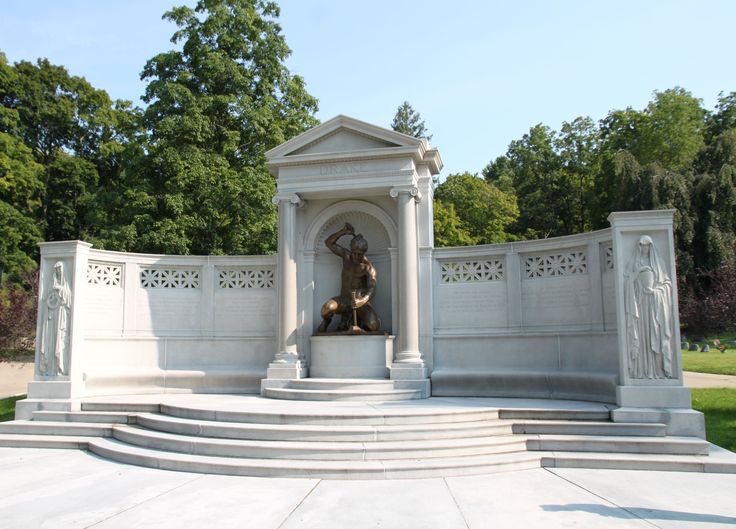
Drake’s Tomb. Credit Commonwealth of Pennsylvania.
Lee went from military prominence to Confederate defeat, then spent his final years as president of Washington College in Lexington. He urged his former soldiers to accept the results of Appomattox, return home and rebuild. Lee focused on education and reunion, not another campaign. He died in 1870 and is interred within a college chapel on today’s Washington and Lee campus.

Tomb of Robert E. Lee. Credit Washington & Lee College.
So, Drake’s handsome monument speaks to a new and world-changing industrial order; while Lee’s elegant tomb sits amid the contested memory of a nation he first served, then fought against, and afterward finally sought to reconcile.
Then and Now
Today, the world still changes in ways both dramatic and quiet. Headlines blare, “Blah-Blah-Blah!” While other truly important work proceeds quietly in labs, machine shops, data centers and resource-development companies.
New energy technology, especially, does more than substitute one fuel for another. It reorganizes power. As history shows, after 1859 petroleum remade transportation, agriculture, industry, finance and foreign policy. Looking ahead, it’s apparent that new systems will again leapfrog past material limits; we’ll get around ore grades, mineral processing, fuel supplies and the infrastructure needed to connect resources with customers.
Slick-talking politicians can announce a new, say, “energy policy” in about one minute. But developing a mineral deposit, building a mine or plant, or replacing a fleet is another matter. Geology doesn’t read press releases. Nor does engineering bend automatically to election returns.
As you watch developments, keep first principles in mind. Harpers Ferry exposed a moral and constitutional crisis that Drake’s new form of energy and improved process could not cure. Or in more current terms, a nation may possess splendid technology yet still divide bitterly over what people ought to do, and how to run the place. See Harpers Ferry.
Also remember that information is not understanding, let alone wisdom. Today, news arrives fast in a world where attention is scarce. Collectively, we know more sooner; but often as not, people understand less and less. The challenge is to distinguish durable change from daily noise.
With this, let me offer a few takeaways:
- Look for the marginal experiment. The next consequential enterprise may appear as folly before it transforms into investment. And always ask what stubborn problem it solves.
- Follow material constraints. Ambitions require energy, resources, machinery and time. Look beneath the slogan to the supply chain; and peer past the supply chain to the rocks and reservoirs.
- Think beyond the immediate moment. Drake’s disappointment and Lee’s defeat remind us that achievement is only one chapter. Persistence, humility and rebuilding matter afterward.
Our Future Is Rising Through the Pipe
So now, back to 2026; we live in a country – and a “Union” – still formatively shaped in 1859; remade by its long-ago Civil War and the industrial world petroleum helped build.
And as for the elections? Look beyond today’s campaign noise and tonight’s vote counts. Because somewhere out across the dark plains of the Republic, someone is adapting an old tool, testing a new idea, and solving a problem that experts long ago wrote off. It’s just another “folly,” perhaps, until it works… and everyone wants in on the action.
Indeed, as was the case with Drake’s oil well long ago, the future may already be rising through the pipe.
That’s all for now. Thank you for subscribing and reading.
This story originally appeared in the Daily Reckoning
Source: https://dailyreckoning.com/post/a-tale-of-two-colonels-drake-lee-and-the-two-revolutions-of-1859
Anyone can join.
Anyone can contribute.
Anyone can become informed about their world.
"United We Stand" Click Here To Create Your Personal Citizen Journalist Account Today, Be Sure To Invite Your Friends.
Before It’s News® is a community of individuals who report on what’s going on around them, from all around the world. Anyone can join. Anyone can contribute. Anyone can become informed about their world. "United We Stand" Click Here To Create Your Personal Citizen Journalist Account Today, Be Sure To Invite Your Friends.
LION'S MANE PRODUCT
Try Our Lion’s Mane WHOLE MIND Nootropic Blend 60 Capsules
Mushrooms are having a moment. One fabulous fungus in particular, lion’s mane, may help improve memory, depression and anxiety symptoms. They are also an excellent source of nutrients that show promise as a therapy for dementia, and other neurodegenerative diseases. If you’re living with anxiety or depression, you may be curious about all the therapy options out there — including the natural ones.Our Lion’s Mane WHOLE MIND Nootropic Blend has been formulated to utilize the potency of Lion’s mane but also include the benefits of four other Highly Beneficial Mushrooms. Synergistically, they work together to Build your health through improving cognitive function and immunity regardless of your age. Our Nootropic not only improves your Cognitive Function and Activates your Immune System, but it benefits growth of Essential Gut Flora, further enhancing your Vitality.

Our Formula includes: Lion’s Mane Mushrooms which Increase Brain Power through nerve growth, lessen anxiety, reduce depression, and improve concentration. Its an excellent adaptogen, promotes sleep and improves immunity. Shiitake Mushrooms which Fight cancer cells and infectious disease, boost the immune system, promotes brain function, and serves as a source of B vitamins. Maitake Mushrooms which regulate blood sugar levels of diabetics, reduce hypertension and boosts the immune system. Reishi Mushrooms which Fight inflammation, liver disease, fatigue, tumor growth and cancer. They Improve skin disorders and soothes digestive problems, stomach ulcers and leaky gut syndrome. Chaga Mushrooms which have anti-aging effects, boost immune function, improve stamina and athletic performance, even act as a natural aphrodisiac, fighting diabetes and improving liver function. Try Our Lion’s Mane WHOLE MIND Nootropic Blend 60 Capsules Today. Be 100% Satisfied or Receive a Full Money Back Guarantee. Order Yours Today by Following This Link.


| Visits: | 1,837,046,054 |
| Stories: | 8,731,330 |
Whistler Blowers, Insiders

