

What Is LNG and Why It Matters: A Global Markets Guide (2026)

LNG is liquefied natural gas: natural gas cooled to about minus 162 degrees Celsius until it becomes a liquid roughly 600 times denser than its gaseous form. That shrink-to-fit property lets countries without pipelines buy gas from across the world, which is why LNG shapes household bills, power generation, shipping rates and commodity markets. Understanding what is LNG and why it matters starts with one simple idea: gas became a globally traded fuel.
What Is LNG and Why Does It Matter?
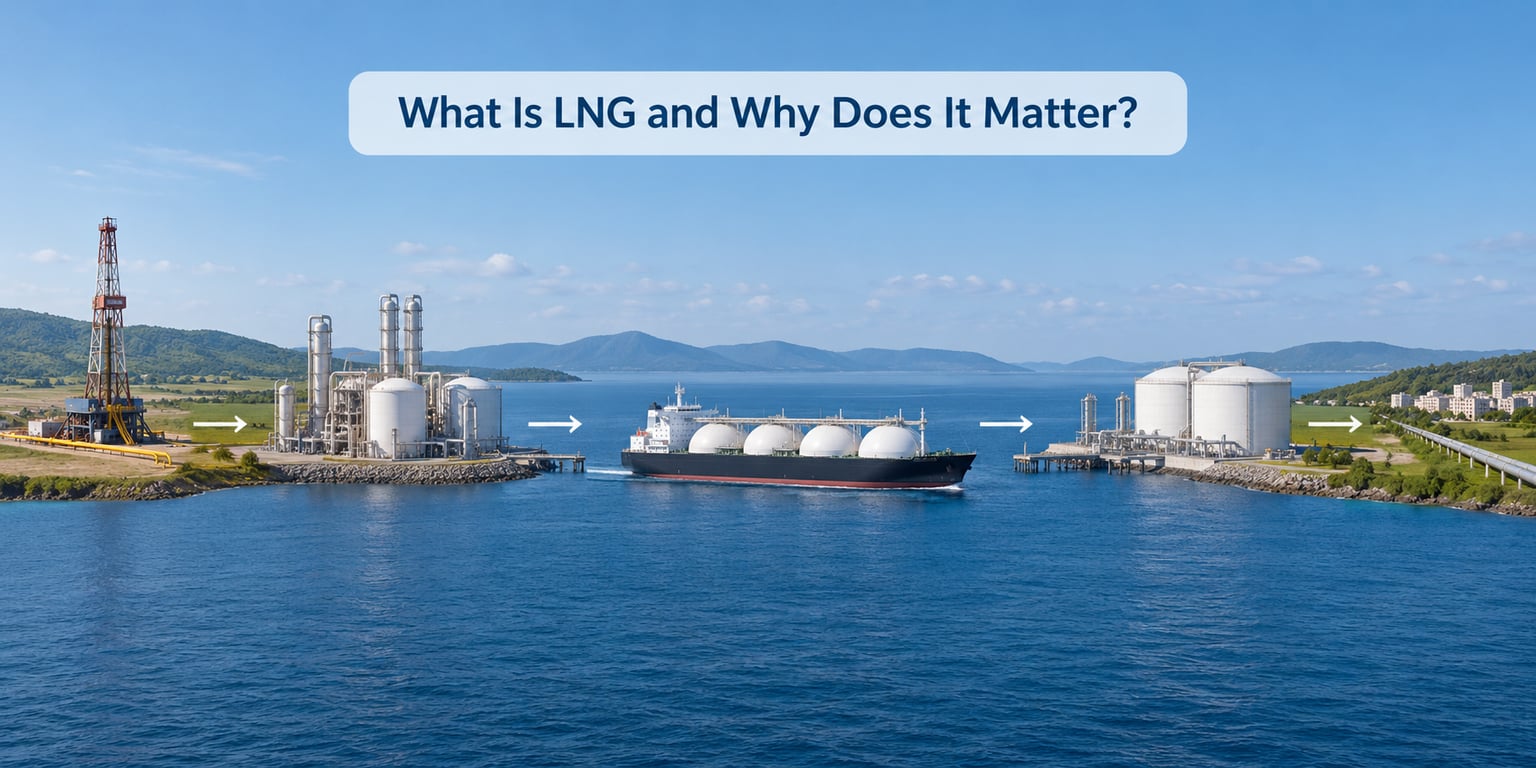
Most natural gas is methane, typically 85 to 95 percent of the mix, with smaller amounts of ethane, propane and heavier hydrocarbons. Cooling it to minus 162 degrees Celsius compresses it into a liquid that fits in a ship. Without that trick, moving gas across an ocean would need pipelines across every continent in between.
LNG matters for four groups at once. Households feel it through heating and power costs. Industrial users — glass, ceramics, chemicals, fertiliser — depend on it as both fuel and feedstock. Governments treat it as energy security and foreign policy. Financial markets trade the molecules, the ships, the terminals and the contracts that deliver them.
What makes LNG different from other gas products
Confusion here is common, so it is worth separating the names. LNG is manufactured and traded as a commodity. Natural gas liquids, or NGLs, are hydrocarbons that come out of the ground already liquid. LPG is propane and butane sold in cylinders. CNG is gas compressed for vehicles in tanks. Only LNG travels across oceans in bulk.
How LNG Is Made and Delivered
The chain runs from wellhead to burner tip, and each stage has a failure point that traders watch closely.
Purification. Raw gas arrives carrying water, carbon dioxide, hydrogen sulphide, mercury and other compounds. Liquefaction trains remove them, because impurities freeze and block equipment at cryogenic temperatures. Mercury removal in particular is a non-negotiable step.
Liquefaction. The purified gas is chilled in stages. Propane pre-cooling takes it to around minus 40 degrees Celsius, a mixed refrigerant cycle carries it to roughly minus 80, and a nitrogen expander finishes the job down to minus 162. Staged cooling matters: dropping straight to the final temperature in one step would waste enormous amounts of energy.
Storage and shipping. LNG is held in insulated, double-hulled tanks at around atmospheric pressure, boiling gently. Dedicated carriers take it across the water; a modern membrane-type vessel can hold roughly 174,000 cubic metres, close to 120,000 tonnes.
Regasification. At the destination terminal the liquid is warmed back into gas, usually by using the fuel itself as a heat source, and injected into the pipeline grid. From there it is distributed like any other domestic gas.
Most end users never touch LNG itself. A power station, factory or home burns regasified gas that was liquid for a few weeks. The exception is heavy-duty trucking and marine bunkering, where LNG or its vapour is used directly as a fuel.
Why LNG Became a Global Energy Trade
Pipelines are cheap over short distances and hopeless over long ones. LNG exists because gas markets grew faster than the pipe networks joining them, and because most gas sits in places that consume very little of it.
Three forces did most of the work. First, pipeline constraints: a producer with a surplus cannot easily reach a distant buyer without a new line, so a ship is a second route. Second, energy diversification: importers that depend on one pipeline supplier treat long-term LNG contracts as insurance, whatever the spot market is doing that month.
Third, demand growth. Gas-fired power generation expanded across Asia, and heavy trucking fleets in China and Central Asia switched to LNG because diesel is expensive locally and methane burns clean enough to meet emissions rules. On the supply side, shale drilling turned the United States from a buyer into a major exporter within about a decade.
That is also why new terminals attract so much argument. A liquefaction train takes years to permit, finance and build, and then runs for decades. Long-lived infrastructure tied to a fuel some analysts expect to fade is exactly the argument you will hear in climate debates.
How LNG Affects Natural Gas Prices
LNG is a price setter, not just a price taker. When a cargo clears at a hub in Asia, that print shows up in contract formulas, power generation decisions and eventually in retail tariffs thousands of kilometres away.
| Driver | What it does to gas prices |
|---|---|
| Winter weather in importer markets | Cold snaps lift heating demand and pull buyers to the spot market fast |
| Summer heat and power burn | Air-conditioning load can tighten the same market the heating season just loosened |
| Plant outages and maintenance | A single liquefaction train down removes a material slice of export supply |
| Shipping capacity | Tight carrier availability adds freight cost to every cargo regardless of gas price |
| Shipping-route disruption | Longer voyages tie up vessels and effectively remove tonnes from the market |
| Storage levels | Low inventories leave buyers with no buffer and little resistance to a price spike |
| Domestic production strength | More pipeline supply from the wellhead usually caps regional prices |
| Currency and interest rates | Buyers priced in dollars face a local bill that moves with the exchange rate |
Contract pricing works differently. Long-term agreements are usually indexed to something else: Henry Hub for US-origin supply, the Japan Korea Marker or oil-linked formulas for Asia-Pacific cargoes, and the Dutch Title Transfer Facility for much of European pricing. The buyer gets volume security and pays something close to a long-run average plus a premium. The seller gets a predictable revenue line. Spot cargoes clear at whatever the marginal buyer will pay that day, and they set the mood for everything else.
Why a global market can cut both ways
The US case is the one people notice first. Export terminals add a destination for domestic gas, which historically meant higher domestic prices, and that has driven years of argument over building permits. The counter-argument is that export volumes are contractually fixed years ahead and that new supply has kept arriving alongside them. Both points are true; which one dominates depends on the year and the weather.
It helps to remember why futures fall or rise on an apparently ordinary news day. A warm forecast, a maintenance notice, a mild storage report, softer power demand or a pause in export nominations can each push a contract lower in minutes.
The Main Markets and Companies Connected to LNG
Investors meet LNG through a chain of distinct businesses, each with different risk.
- Upstream producers supply the gas feedstock and carry drilling risk.
- Liquefaction operators own the trains, sell long-term contracts and carry project risk from financing to politics.
- Shipping companies earn from charter rates per cubic metre per mile; a tight vessel market lifts their margins independently of the gas price.
- Terminal and infrastructure operators earn regulated or contracted fees for regasification capacity.
- Utilities and independent power producers pay for the fuel and convert it into electricity, where the spread between power and gas price decides the margin.
- Traders and banks warehouse cargoes, price forward curves and finance everything else in the chain.
Alongside them sit adjacent businesses that quietly depend on the same infrastructure. Helium used for medical imaging and data centre cooling is often a by-product of gas separation, so supply shocks in LNG plants show up as shortages far from the energy market. Fertiliser producers buying urea, and chemical plants feeding on ethane and propane, sit on the same supply chain too.
What Is LNG and Why It Matters for Investors?
Because LNG is a commodity with a physical delivery chain, it shows up in public markets in several distinct ways, and they rarely behave alike in the same week.
Shipping rates are a separate cycle from the gas price. Carriers can be earning record rates while gas itself is flat, if vessels are scarce. Analysts therefore watch vessel orderbooks and long-term charter coverage, not just the gas curve.
Liquefaction contracts bank the future. An operator with a full contract book sells most output on oil- or hub-indexed terms for many years, so current spot prices matter less to earnings than sentiment around them.
Utilities are the other side of the trade. A power producer buying spot LNG is exposed to gas price spikes, while a regulated utility passes more of the cost through and depends on rate-case decisions instead.
Project risk is real and political. Permits, sanctions, port access and community opposition can delay a train by years. For a long-lived asset, financing costs matter as much as commodity assumptions.
Currency cuts both ways. Commodity prices are quoted in dollars while many buyers pay in local currency, so exchange rate moves can matter more than a modest change in the gas price itself.
None of this is investment advice, and the same exposure behaves differently for a pension fund and a leveraged trader. What matters for a general reader is that LNG is not one number — it is a linked chain, and each link reports its own news on its own schedule.
LNG vs Pipeline Gas: What Is the Difference?
The two arrive at the same burner, but they get there by completely different routes with different economics.
| Factor | LNG | Pipeline gas |
|---|---|---|
| Delivery method | Shipped in insulated carriers, re-gassed at a terminal | Flows continuously through steel pipelines |
| Route constraint | Any port with a terminal, once a ship can sail | Only where a pipeline physically exists |
| Flexibility | Cargoes can be redirected, but vessels take weeks to reposition | Almost instant response within the connected grid |
| Upfront cost | Very high — liquefaction trains, carriers and terminals | High per route, but no liquefaction step |
| Running cost | Liquefaction and boil-off consume roughly a tenth of the cargo’s energy | Compression and line maintenance only |
| Scale advantage | Strong for huge remote resources and new demand centres | Strong for high-volume, short-distance trade |
| Emissions profile | Combustion is cleaner than coal or oil, plus liquefaction and shipping emissions | Lower total emissions because there is no liquefaction stage |
| Market exposure | Sets prices globally; hub-indexed and spot | Regional, often linked to domestic production |
Both keep their place. Pipelines still win on cost and reliability over short distances, which is why the US Gulf Coast builds both LNG plants and pipelines out of the same gas field.
Key Risks and Misunderstandings
The “clean fuel” framing needs context. Burning methane emits roughly half the carbon dioxide of coal per unit of energy and produces almost no soot or sulphur dioxide. That is genuinely better than coal. It is still a fossil fuel, and critics on forums like r/environment argue that new LNG plants lock in emissions for the life of the asset, which can be 30 to 40 years. Both readings are consistent with the same physical facts.
Clean at the burner does not mean clean at the source. Methane is a far stronger greenhouse gas than carbon dioxide over short horizons, and leakage during production, liquefaction and shipping partially offsets the combustion advantage. How large that penalty is depends heavily on how well a specific project controls leaks.
LNG does not always lower prices. Adding expensive liquefaction, shipping and regasification to gas that was cheap at the wellhead can produce an imported fuel that costs more than the domestic alternative. That has happened in several markets during tight supply.
Liquid LNG will not ignite from a spark. It is methane at minus 162 degrees, far below its ignition temperature. To burn, it must first mix with air and warm. That is why carriers can be loaded with LNG in port without ignition risk, and why the industry’s safety record focuses on vapour clouds and cryogenic burns rather than burning liquid.
Build timelines are long and lumpy. Permitting, financing and construction typically run several years, and then a train operates for decades. Expecting the market to respond quickly to a supply shortage through new capacity is a mistake; short-run supply responds to weather and outages, not to construction.
Shipping creates chokepoints. Tensions around the Strait of Hormuz or disruptions in major shipping lanes raise freight costs and lengthen voyages, tying up carriers and effectively removing tonnes from the market without a single barrel being lost.
Frequently Asked Questions
LNG stands for liquefied natural gas. It is ordinary natural gas, mostly methane, cooled to about minus 162 degrees Celsius until it becomes a liquid roughly 600 times denser than its gaseous state. That compression in liquid form allows gas to be carried across oceans in purpose-built tankers and re-gasified at the destination.
The answer changes with the year and with how volumes are counted. Australia, the United States, Qatar and Russia have all ranked among the largest exporters in recent years, with Russia climbing sharply as European buyers diverted away from pipeline supply. Ranking by export volume, by capacity or by revenue gives different orders, so any figure should name its source and date.
Inside the United States, gas comes from the Gulf Coast, Appalachia, the Permian Basin and the Bakken, moved to export terminals by pipeline. As an importer, the country is largely self-sufficient. Its LNG exports leave from terminals along the Gulf Coast and travel mainly to Europe, East Asia and Latin America.
Long-term cargoes are priced off published benchmarks: Henry Hub for US-origin supply, the Japan Korea Marker for much Asia-Pacific trading, and the Dutch Title Transfer Facility for European gas, often with an oil linkage. Spot cargoes clear at the day’s marginal price. Weather, plant outages, storage levels and shipping availability all move those benchmarks quickly.
Most opposition comes down to two arguments. The first is that new LNG plants lock in fossil fuel infrastructure for 30 to 40 years, and a ship or train sunk today still operates for decades. The second is methane leakage, which partly offsets the lower carbon dioxide emissions at the burner. Climate groups and some local communities have organised around both points.
Several years is typical, and that is the optimistic case. Permitting and environmental review come first, then financing, then construction of the liquefaction trains and jetty. Once operating, the facility will typically run for 30 to 40 years. The long lead time is the core reason developers argue about demand forecasts and schedule risk.
What to Take Away
Start with the physical fact: cooling gas to minus 162 degrees makes it 600 times denser, and that single change turns a pipeline fuel into a global commodity. From there, everything else follows — the shipping market, the price benchmarks, the contracts, the infrastructure debate and the emissions argument.
For anyone following the markets, the useful habit is to watch the chain rather than the headline. Production strength, storage, weather, vessel availability and terminal outages explain most of the price moves that get reported as news.
Source: https://www.pgm-blog.com/what-is-lng-and-why-it-matters/
Anyone can join.
Anyone can contribute.
Anyone can become informed about their world.
"United We Stand" Click Here To Create Your Personal Citizen Journalist Account Today, Be Sure To Invite Your Friends.
Before It’s News® is a community of individuals who report on what’s going on around them, from all around the world. Anyone can join. Anyone can contribute. Anyone can become informed about their world. "United We Stand" Click Here To Create Your Personal Citizen Journalist Account Today, Be Sure To Invite Your Friends.
LION'S MANE PRODUCT
Try Our Lion’s Mane WHOLE MIND Nootropic Blend 60 Capsules
Mushrooms are having a moment. One fabulous fungus in particular, lion’s mane, may help improve memory, depression and anxiety symptoms. They are also an excellent source of nutrients that show promise as a therapy for dementia, and other neurodegenerative diseases. If you’re living with anxiety or depression, you may be curious about all the therapy options out there — including the natural ones.Our Lion’s Mane WHOLE MIND Nootropic Blend has been formulated to utilize the potency of Lion’s mane but also include the benefits of four other Highly Beneficial Mushrooms. Synergistically, they work together to Build your health through improving cognitive function and immunity regardless of your age. Our Nootropic not only improves your Cognitive Function and Activates your Immune System, but it benefits growth of Essential Gut Flora, further enhancing your Vitality.

Our Formula includes: Lion’s Mane Mushrooms which Increase Brain Power through nerve growth, lessen anxiety, reduce depression, and improve concentration. Its an excellent adaptogen, promotes sleep and improves immunity. Shiitake Mushrooms which Fight cancer cells and infectious disease, boost the immune system, promotes brain function, and serves as a source of B vitamins. Maitake Mushrooms which regulate blood sugar levels of diabetics, reduce hypertension and boosts the immune system. Reishi Mushrooms which Fight inflammation, liver disease, fatigue, tumor growth and cancer. They Improve skin disorders and soothes digestive problems, stomach ulcers and leaky gut syndrome. Chaga Mushrooms which have anti-aging effects, boost immune function, improve stamina and athletic performance, even act as a natural aphrodisiac, fighting diabetes and improving liver function. Try Our Lion’s Mane WHOLE MIND Nootropic Blend 60 Capsules Today. Be 100% Satisfied or Receive a Full Money Back Guarantee. Order Yours Today by Following This Link.


| Visits: | 1,833,986,209 |
| Stories: | 8,715,663 |
Whistler Blowers, Insiders

