

Secret Emails Reveal Sketchy Tactics in California Public Health's Tobacco Ban 'Endgame'


Let’s say a government agency pays for a study and is involved in the design, data collection, analysis, writing, and interpretation of that study. Would you find it plausible that the agency had zero influence on the results?
In 2025, the academic journal Tobacco Control published just such a study. The paper investigated what happened when two California towns, Beverly Hills and Manhattan Beach, became the first U.S. cities to ban all tobacco products.
The study tried to determine prohibition’s impact on sales of both tobacco and non-tobacco products, both in the cities themselves and in surrounding neighborhoods. It was funded by the California Department of Public Health (CDPH), and co-author Nita H. Mukand also received a National Institutes of Health grant.
The study’s dataset included only chain stores, which accounted for a mere 16 percent of California’s cigarette sales. The sample comprised just seven retailers in two of America’s wealthiest zip codes, with some of the lowest rates of tobacco use. The ban also went into effect on January 1, 2021, when California was still operating under some of the country’s strictest COVID-19 rules. Despite the unrepresentative nature of these towns and this time, the authors concluded that the “results suggest the viability of tobacco sales bans as an effective tobacco control strategy.”
At a seminar on the findings, Adam Leventhal of the University of Southern California told the authors, “This is kind of the logical end of the tobacco control policy spectrum. We have flavor bans, higher taxes, indoor smoking laws. But this is outright banning it.”
The study is one piece of a decadeslong effort to fully ban tobacco and nicotine products. Emails obtained by Reason through public records requests reveal the extent that CDPH funds and collaborates with campaigns for tobacco prohibition: sharing confidential data with favored activists, recruiting its own employees to design political messaging, and celebrating the passage of local tobacco bans as “victories,” all under the guise of public health “education.”
The Registered Lobbyist on California’s Public Health Payroll
“Endgame” is the anti-tobacco movement’s melodramatic term for prohibiting all commercial tobacco products: cigarettes, cigars, nicotine pouches, e-cigarettes, hookahs, pipe tobacco, and heated tobacco products. Some of these products are authorized for sale by the Food and Drug Administration (FDA) as “appropriate for the protection of public health” because they’re safer than cigarettes and help smokers quit. But CDPH’s ultimate goal isn’t just to reduce death and disease from smoking; it wants an almost completely nicotine-free California. (They do make an exception for Native Americans using tobacco for spiritual reasons, much in the same way sacramental wine was exempt from alcohol prohibition.)
CDPH awarded Tim Gibbs, a Sacramento-based consultant and registered lobbyist, a five-year contract running from July 2025 through June 2030 for “Training and Technical Assistance for Endgame Community Education.” The project is called the Endgame Messaging Hub. It is not the only endgame grantee. CDPH also funds the American Heart Association’s “California Tobacco Endgame Center for Organizing and Engagement” and the Northern California Center for Well-Being’s “Community and Youth Engagement for Tobacco Endgame.”
Gibbs worked for the American Cancer Society Cancer Action Network (ACS CAN) throughout 2025, receiving $45,900 for the year, according to California lobbying disclosure filings. His highest quarterly payment, $18,600, came in July through September 2025, the exact quarter his CDPH contract began. For roughly six months, he was drawing a paycheck simultaneously from one of America’s largest anti-tobacco advocacy organizations and from California taxpayers for tobacco policy work.
In a training webinar in February 2026, Gibbs gave advocates a primer in prohibition campaigning. He described an effort to ban flavored tobacco in Sacramento, where advocates “developed a door knocker, flyer, put it on every single door in the neighborhood. So to give the illusion that there were, you know, that the public was demanding that the city council take action.” A council member, he noted approvingly, held the flyer up during a hearing. Gibbs ended by flatly stating his goal: making the ask “that is going to move the needle in our ultimate goal to end commercial tobacco in California.”
The Revolving Door Between California’s Health Agency and Anti-Tobacco Allies
Emails obtained by Reason show that the Endgame Messaging Hub does not operate at arm’s length from CDPH. Gibbs and his project coordinator, Debra Kelley, appear on CDPH’s internal project management system. They are copied on weekly CDPH communications, participate in Communities of Practice calls, and attend meetings of the Endgame Advisory Committee. In August 2025, as the project began, Kelley asked Amber Valenzuela, a senior program consultant at the California Tobacco Prevention Program, for a list of local agencies and grantees “working on policies to eliminate the sale of tobacco products,” which she described as “high priorities” for outreach. Valenzuela obliged, forwarding the target list and adding the Hub to the calendar of CDPH’s “Ending Tobacco Sales Workgroup.”
Personnel flow in both directions. In September 2025, Liz Hendrix, chief of the Strategic Planning and Policy Unit of the California Tobacco Prevention Program, housed within CDPH, announced she was leaving to become the government relations director for ACS CAN in Northern California—the same organization that contracted with Gibbs. Kelley congratulated her in an email and noted that the Endgame Messaging Hub would be “reaching out to ACS CAN, and the other voluntaries, for input as we identify, test, and promote effective messaging for various endgame policies.” Hendrix replied that she was “excited to be able to continue this great work with people who I love working with but now as a voluntary.“
In October 2025, Valenzuela, a senior program consultant at the California Tobacco Prevention Program, arranged a meeting. She connected Gibbs, Kelley, and two CDPH colleagues to discuss “an Endgame Factsheet that Elizabeth has been working on.”
Elizabeth Andersen-Rodgers, CDPH’s Evaluation Unit Chief and a co-author of the Beverly Hills study, titled the fact sheet “Ending Tobacco Sales for Healthier California Communities.” She used a draft for what she called “consumer testing with policymakers.” Essentially, she was workshopping its messages with elected officials to see what stuck.
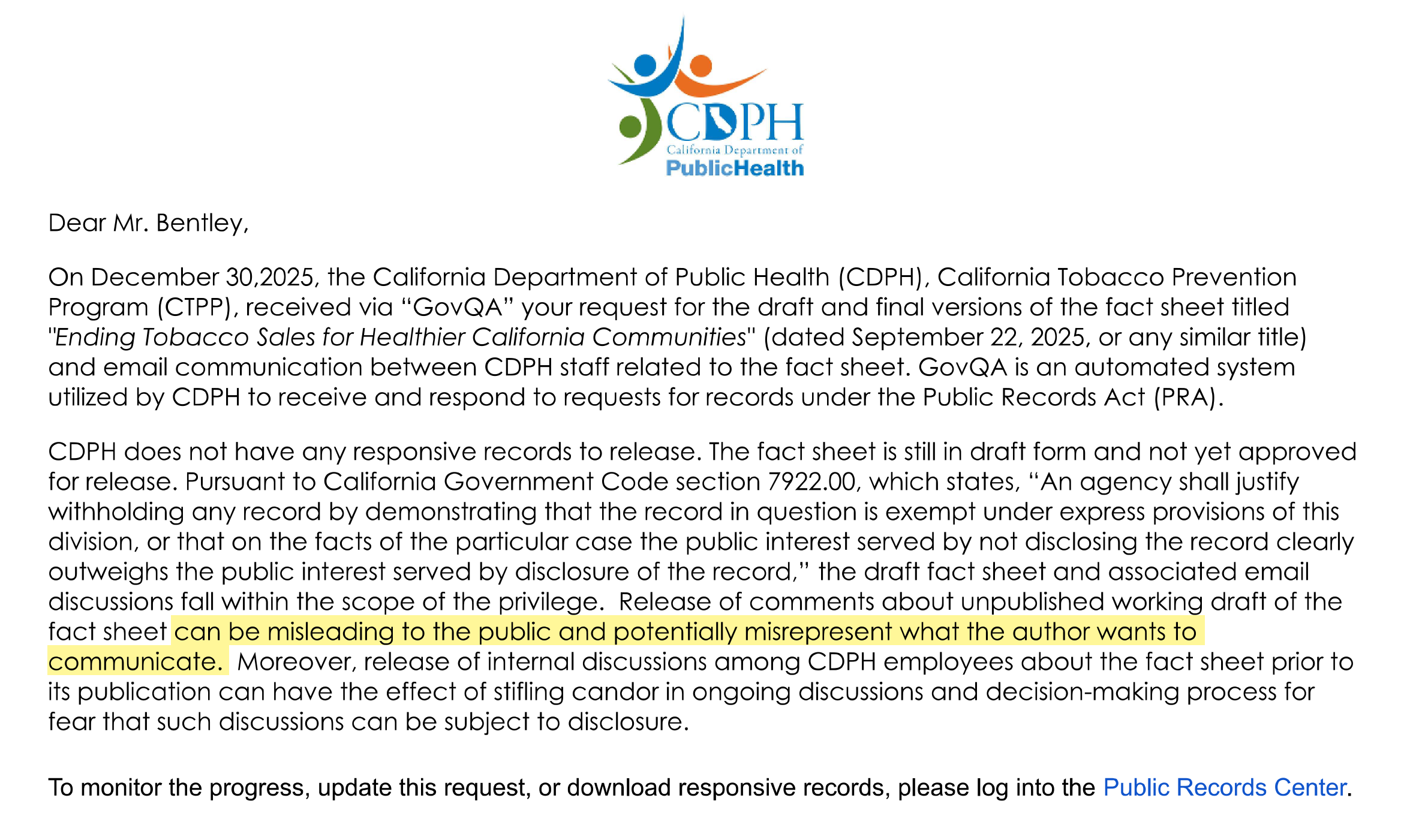
Reason requested the fact sheet and related emails. CDPH denied the request under “deliberative process privilege,” claiming release could “be misleading to the public.” It’s hard to take seriously the idea that the public would be misled by the draft fact sheet and related emails. Voters might be irked, however, to see public employees freelancing controversial policy advocacy on taxpayers’ time.
Through November 2025, the collaboration intensified. Kelley organized meetings with CDPH employees to discuss tobacco product waste messaging. Valenzuela set up another review of focus group results with Gibbs and Kelley, calling it “an action item from our last meeting.” CDPH employees and contractors worked side by side on messaging strategy, sharing documents and calendars.
‘For Your Eyes Only’
On November 18, 2025, Julie Lautsch, a CDPH employee, shared confidential polling data with Kelley. Lautsch sent a nicotine presentation and tobacco harm reduction message polling fielded in early 2023. Her instructions were: “Please don’t share the survey. It is confidential. Would love keep sharing information as long as we know that it’s meant for your eyes only.”
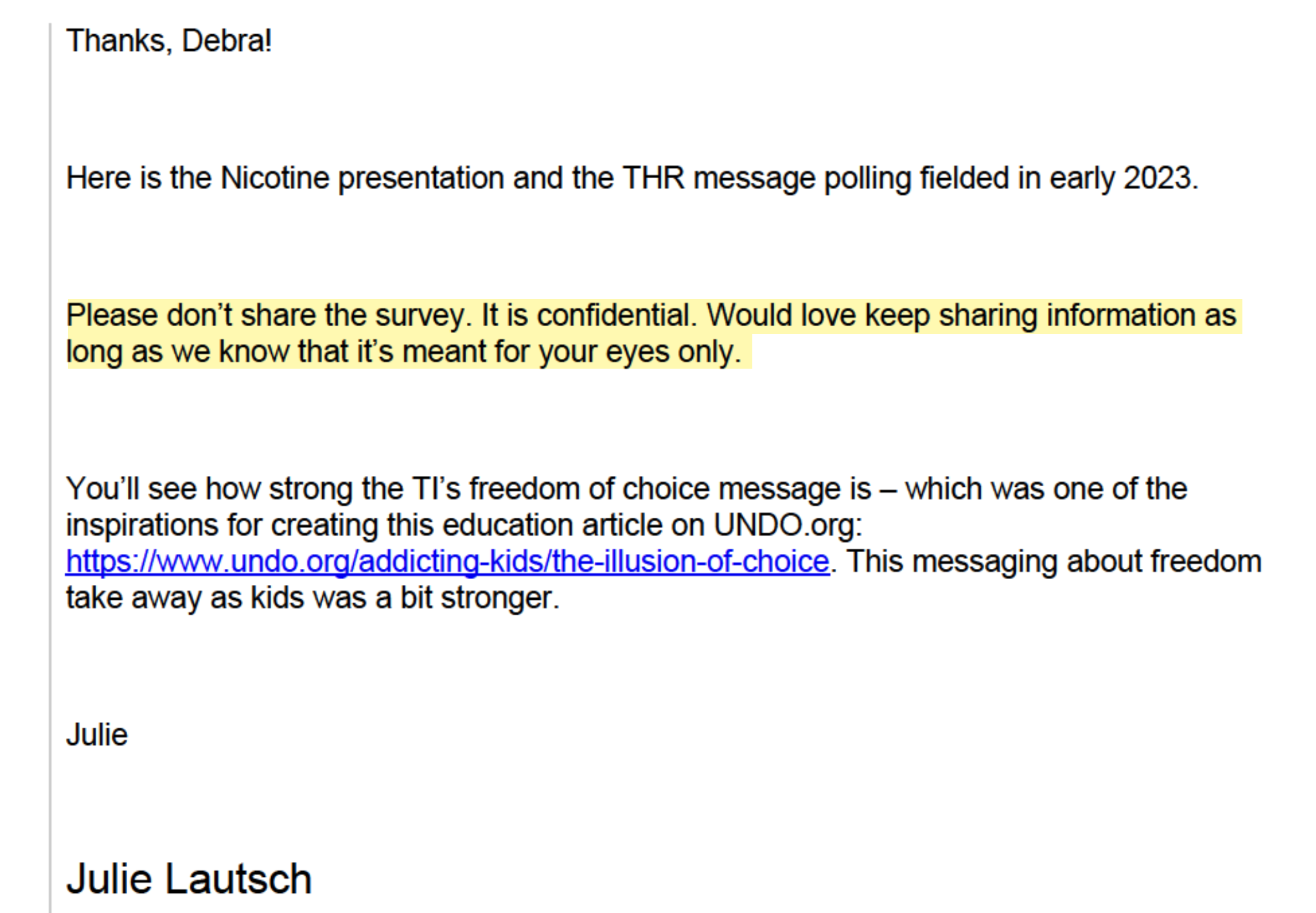
Lautsch explained why the data were strategically useful, noting how effectively the tobacco industry’s “freedom of choice” message had performed in the polling. She pointed to content on CDPH’s anti-tobacco campaign website that had been inspired by the results, and she observed that messaging about freedom being taken away from children through nicotine addiction “was a bit stronger.”
So a government employee shared confidential polling data with a nongovernmental contractor under the condition of secrecy. The data told Gibbs’s team which counterarguments to prepare for and which emotional appeals to use. Through this back-channel relationship, a government agency gave strategic intelligence to allies while shielding the info from the public and from anyone who might take an opposing view.
Designing the Taxpayer-Funded Poll for Opposition Research
A few days later, Gibbs was assembling a working group to design a new survey.
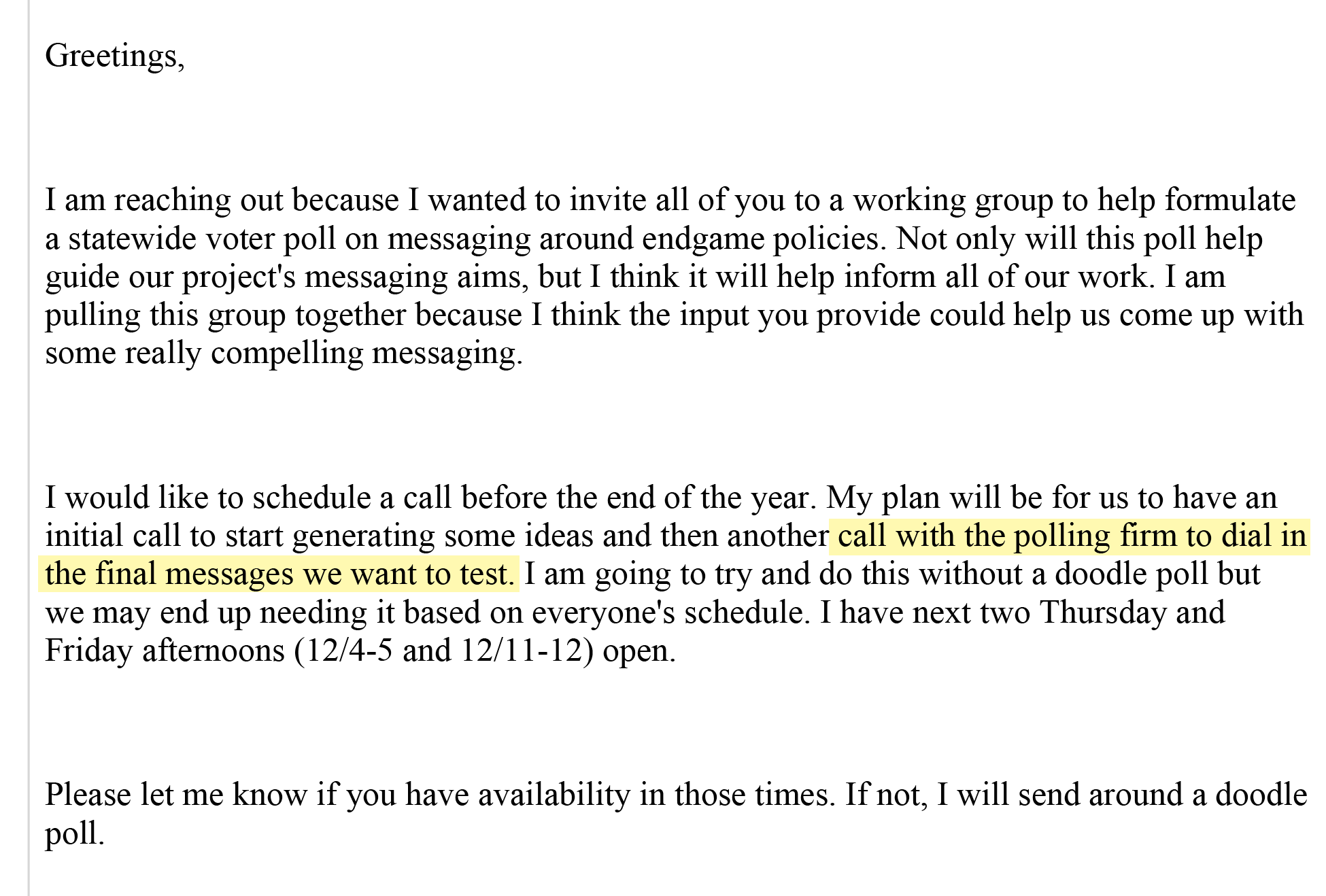
On November 24, 2025, Gibbs emailed a “Statewide poll working group” inviting them to help “formulate a statewide voter poll on messaging around endgame policies.” The group included three CDPH employees: Lautsch, Valenzuela, and Tonia Hagaman, alongside American Heart Association staff and Rachael Record, a San Diego State University professor whose published research explicitly aimed to develop community-specific messaging strategies to build support for tobacco prohibition. Gibbs explained the poll would “help guide our project’s messaging aims” and that a follow-up call with “the polling firm” would be needed to “dial in the final messages we want to test.”
This isn’t public health education or an effort to survey how many minors are using tobacco products and how they’re getting them. Through CDPH, California taxpayers are paying for public relations campaigns that attempt to convince them to give up their freedom to visit a cigar or hookah lounge, to vape, to smoke, or to pop a nicotine pouch.
Three employees from the state agency funding his contract helped design the poll. Gibbs’ November invoice included $10,000 for a polling firm.
The Tobacco Bans That Are ‘Not Actually Banning Anything at This Point’
On November 17, 2025, Kelley emailed Marin County health officials and copied Gibbs and CDPH’s Valenzuela to congratulate them on a new ban on tobacco sales in the small town of Ross, California. “Congratulations on your second victory!” she wrote, referring to the nearby town of Tiburon’s earlier ban. “I watched the Ross Town Council meeting last week and found council members’ perspectives on the ordinance very interesting. There was a moment when I wondered if the votes were there, but fortunately it passed, as you know.”
She asked if the Endgame Messaging Hub should send congratulatory letters to the town councils and the county health department. She also inquired about “work underway in any other towns in Marin County.” She noted they were “meeting with Ruth Malone this week to learn about her plans.” Malone is a prominent booster of prohibition or, as she has tastelessly and unsuccessfully tried to rebrand it, “abolition.”
Kelley thanked a county official for tipping them off about opposition arguments: “We are now developing counter-messaging to address that situation if it arises.”
Neither Tiburon nor Ross had any tobacco retailers at the time of the votes. (Ross has just over 2,000 residents, while Tiburon has under 9,000.) As Ross’s mayor pro tem, Elizabeth Robbins, acknowledged after voting for the ban, “Our tiny town doesn’t even have tobacco sales, so we’re not actually banning anything at this point.” The sole dissenting councilmember called it a “feel-good measure.” These bans had no practical effect on any resident, any business, or any smoker. Their value is in producing talking points to, in Gibbs’ words, “give the illusion” of public support and momentum.
Real Data Show Tobacco Bans Don’t Work
Contrary to the Beverly Hills study, punitive tobacco policies are not all upside.
Australia has punishing cigarette taxes and de facto e-cigarette prohibition, and this has created an illicit market that the government’s tobacco commissioner estimates is roughly half of all cigarettes purchased. The consequences are $2 billion (USD) in lost excise revenue in a single year and more than 200 arson attacks in recent years as criminal networks fight over territory.
California’s own flavored tobacco ban, enacted in 2023, costs the state between $300 million and $400 million in tax revenue per year, with no initial change in self-reported teen use of flavored e-cigarettes—and with most young people reporting no difficulty getting flavored products.
With limited and declining resources, would CDPH’s money not be better spent elsewhere, such as improving the state’s poor air quality or strengthening emergency preparedness? Instead, cash flows to manufactured evidence under conditions designed for success, to workshopped political messaging hidden behind privilege claims, and to funds for activists.
There’s nothing nefarious about private sector advocacy organizations raising money and engaging lawmakers on whatever issue they choose. But the public shouldn’t be forced to fund activists who mask a lobbying campaign behind the language of “education.”
Co-designing voter polls, sharing confidential data under conditions of secrecy, and embedding employees in working groups whose explicit purpose is to develop “compelling messaging” for prohibition is not typically what comes to mind when voters think of what they want public health officials to do. California’s laws banning agencies from lobbying, but permitting advocacy and education, are so permeable as to have become meaningless.
If CDPH employees want to ban nicotine, they’re free to leave their posts and join Malone, Gibbs, and Hendrix in the private sector. But the paternalist doublethink that says prohibition is liberation, choice is slavery, and coercion is freedom doesn’t need a subsidy from the taxpayer.
The post Secret Emails Reveal Sketchy Tactics in California Public Health’s Tobacco Ban ‘Endgame’ appeared first on Reason.com.
Source: https://reason.com/2026/06/22/secret-emails-reveal-sketchy-tactics-in-california-public-healths-tobacco-ban-endgame/
Anyone can join.
Anyone can contribute.
Anyone can become informed about their world.
"United We Stand" Click Here To Create Your Personal Citizen Journalist Account Today, Be Sure To Invite Your Friends.
Before It’s News® is a community of individuals who report on what’s going on around them, from all around the world. Anyone can join. Anyone can contribute. Anyone can become informed about their world. "United We Stand" Click Here To Create Your Personal Citizen Journalist Account Today, Be Sure To Invite Your Friends.
LION'S MANE PRODUCT
Try Our Lion’s Mane WHOLE MIND Nootropic Blend 60 Capsules
Mushrooms are having a moment. One fabulous fungus in particular, lion’s mane, may help improve memory, depression and anxiety symptoms. They are also an excellent source of nutrients that show promise as a therapy for dementia, and other neurodegenerative diseases. If you’re living with anxiety or depression, you may be curious about all the therapy options out there — including the natural ones.Our Lion’s Mane WHOLE MIND Nootropic Blend has been formulated to utilize the potency of Lion’s mane but also include the benefits of four other Highly Beneficial Mushrooms. Synergistically, they work together to Build your health through improving cognitive function and immunity regardless of your age. Our Nootropic not only improves your Cognitive Function and Activates your Immune System, but it benefits growth of Essential Gut Flora, further enhancing your Vitality.

Our Formula includes: Lion’s Mane Mushrooms which Increase Brain Power through nerve growth, lessen anxiety, reduce depression, and improve concentration. Its an excellent adaptogen, promotes sleep and improves immunity. Shiitake Mushrooms which Fight cancer cells and infectious disease, boost the immune system, promotes brain function, and serves as a source of B vitamins. Maitake Mushrooms which regulate blood sugar levels of diabetics, reduce hypertension and boosts the immune system. Reishi Mushrooms which Fight inflammation, liver disease, fatigue, tumor growth and cancer. They Improve skin disorders and soothes digestive problems, stomach ulcers and leaky gut syndrome. Chaga Mushrooms which have anti-aging effects, boost immune function, improve stamina and athletic performance, even act as a natural aphrodisiac, fighting diabetes and improving liver function. Try Our Lion’s Mane WHOLE MIND Nootropic Blend 60 Capsules Today. Be 100% Satisfied or Receive a Full Money Back Guarantee. Order Yours Today by Following This Link.


| Visits: | 1,821,557,070 |
| Stories: | 8,672,475 |
Whistler Blowers, Insiders

