

Social Security’s $5.1 Trillion Debt Contribution

Romina Boccia and Ivane Nachkebia

The release of the annual Social Security Trustees report has once again focused attention on the program’s projected trust fund exhaustion date, now just six years away. But that emphasis on trust fund solvency perpetuates a common misconception: that Social Security has accumulated assets set aside to pay promised benefits and that its financing challenges are a future problem.
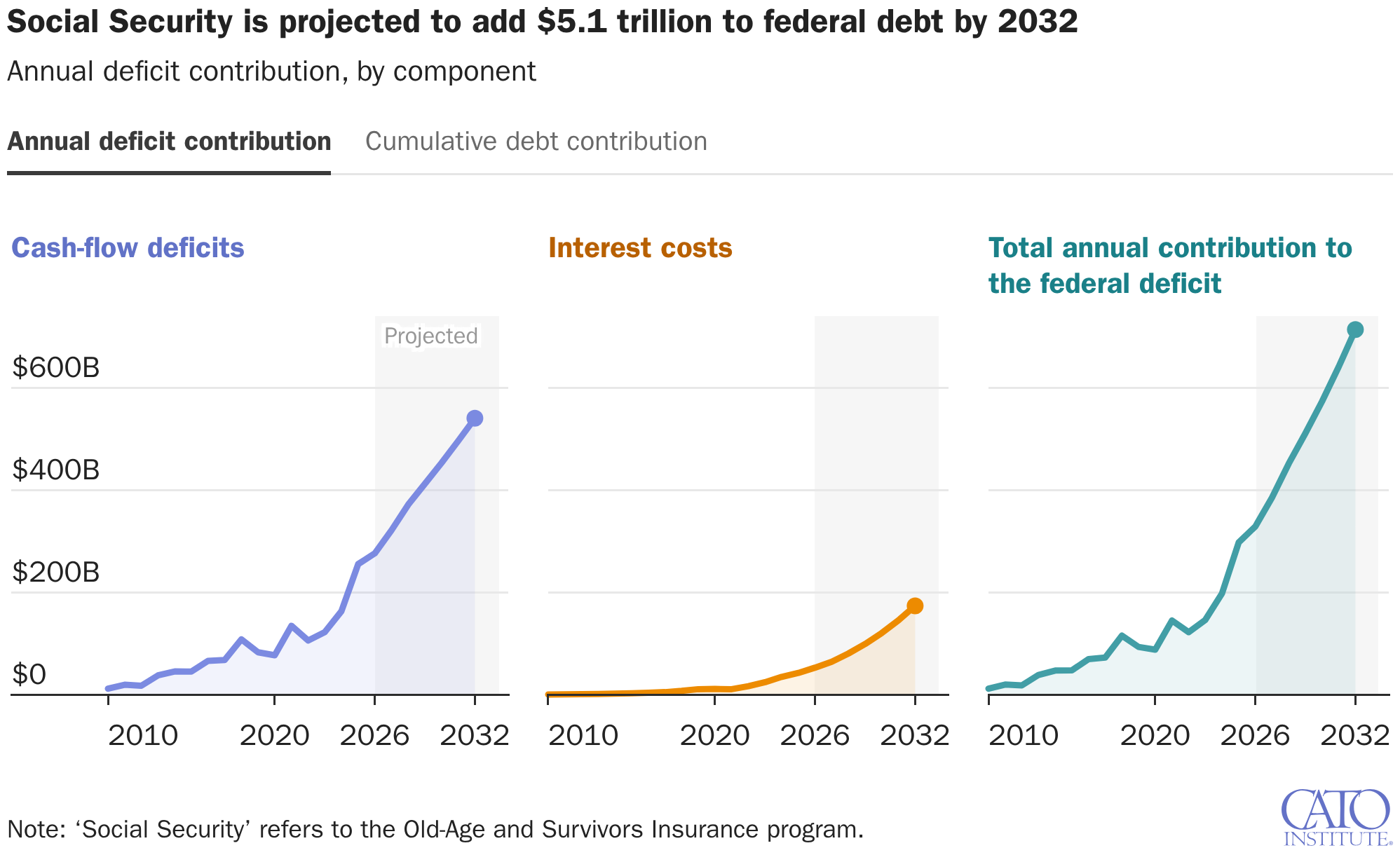
In reality, Social Security is already contributing to federal deficits and debt today. In 2026 alone, Social Security is projected to add roughly $328 billion to federal deficits—a figure rarely cited in discussions of the program’s finances.
That estimate reflects more than the program’s annual cash-flow shortfall. It also incorporates the interest costs associated with the debt Social Security has added to the federal balance sheet since the program began running cash-flow deficits in 2010. To capture Social Security’s full impact on the federal budget, we developed a comprehensive approach that first calculates the program’s annual contribution to deficits, excluding intragovernmental transfers, and then adds the interest costs associated with the cumulative debt those deficits have generated. Under this approach, Social Security’s contribution to the deficit in 2026 includes about $52 billion in interest costs.
The Congressional Budget Office (CBO) does not currently publish a measure of Social Security’s debt contribution that accounts for the interest costs of financing the program’s cash-flow deficits. To fill that gap, we are publishing our methodology for calculating these interest costs and Social Security’s full contribution to federal deficits and debt.
Download accompanying spreadsheet
How Social Security Adds to Deficits and Debt Already
Social Security is a pay-as-you-go program, largely financing today’s benefits from payroll tax revenues collected from today’s workers. Between 1983 and 2009, tax revenues exceeded benefit payments, generating about $3 trillion in cumulative cash flow surpluses. Congress did not save these surpluses for future retirees; instead, it spent them on other programs. In exchange, the Treasury credited the trust fund with special-issue Treasury securities—promises to repay the program (IOUs)—when the program would begin running cash-flow deficits.
Importantly, these surpluses likely didn’t improve the government’s overall fiscal position and may have increased publicly held debt by giving Congress room to increase spending and cut taxes elsewhere. Since 2010, when Social Security began running cash-flow deficits, the program has relied partially on redeeming those IOUs and the associated interest. Those payments have been financed through borrowing from the public, as the Treasury has repaid the Social Security program by issuing new bonds.
As a result, from 2010 through 2025, OASI’s annual cash-flow deficits added over $1.5 trillion to federal debt, including associated interest costs on the accumulated deficits. Absent reform, the program is projected to add another $3.6 trillion between 2026 and the trust fund’s exhaustion date in 2032, bringing Social Security’s total contribution to federal debt to roughly $5.1 trillion over this period (see chart below).
Measure Cash-Flow Effects, not Trust Fund Solvency
The annual Trustees report encourages policymakers and the public to focus on a single date: the year the trust fund runs out. But trust fund accounting obscures a more important reality. Social Security is already adding to federal deficits and debt today, and those contributions will continue to grow long before the trust fund is exhausted.
Measuring Social Security’s impact through annual cash flows and the debt they generate provides a clearer picture of the program’s fiscal consequences than assessing the trust fund balance. By that measure, Social Security has already added more than $1.5 trillion to federal debt since 2010 and is projected to add another $3.6 trillion by 2032.
Policymakers should assess not only whether a proposal improves trust fund solvency, but also whether it reduces the program’s contribution to federal deficits and debt. To facilitate that analysis, the Cato Social Security Model estimates the annual effects of reform proposals on Social Security’s cash-flow balances, in addition to trust fund balances. Doing so can shift the debate away from accounting conventions and toward the program’s real impact on the nation’s fiscal outlook.
Source: https://www.cato.org/blog/social-securitys-51-trillion-debt-contribution
Anyone can join.
Anyone can contribute.
Anyone can become informed about their world.
"United We Stand" Click Here To Create Your Personal Citizen Journalist Account Today, Be Sure To Invite Your Friends.
Before It’s News® is a community of individuals who report on what’s going on around them, from all around the world. Anyone can join. Anyone can contribute. Anyone can become informed about their world. "United We Stand" Click Here To Create Your Personal Citizen Journalist Account Today, Be Sure To Invite Your Friends.
LION'S MANE PRODUCT
Try Our Lion’s Mane WHOLE MIND Nootropic Blend 60 Capsules
Mushrooms are having a moment. One fabulous fungus in particular, lion’s mane, may help improve memory, depression and anxiety symptoms. They are also an excellent source of nutrients that show promise as a therapy for dementia, and other neurodegenerative diseases. If you’re living with anxiety or depression, you may be curious about all the therapy options out there — including the natural ones.Our Lion’s Mane WHOLE MIND Nootropic Blend has been formulated to utilize the potency of Lion’s mane but also include the benefits of four other Highly Beneficial Mushrooms. Synergistically, they work together to Build your health through improving cognitive function and immunity regardless of your age. Our Nootropic not only improves your Cognitive Function and Activates your Immune System, but it benefits growth of Essential Gut Flora, further enhancing your Vitality.

Our Formula includes: Lion’s Mane Mushrooms which Increase Brain Power through nerve growth, lessen anxiety, reduce depression, and improve concentration. Its an excellent adaptogen, promotes sleep and improves immunity. Shiitake Mushrooms which Fight cancer cells and infectious disease, boost the immune system, promotes brain function, and serves as a source of B vitamins. Maitake Mushrooms which regulate blood sugar levels of diabetics, reduce hypertension and boosts the immune system. Reishi Mushrooms which Fight inflammation, liver disease, fatigue, tumor growth and cancer. They Improve skin disorders and soothes digestive problems, stomach ulcers and leaky gut syndrome. Chaga Mushrooms which have anti-aging effects, boost immune function, improve stamina and athletic performance, even act as a natural aphrodisiac, fighting diabetes and improving liver function. Try Our Lion’s Mane WHOLE MIND Nootropic Blend 60 Capsules Today. Be 100% Satisfied or Receive a Full Money Back Guarantee. Order Yours Today by Following This Link.



| Visits: | 1,821,811,776 |
| Stories: | 8,672,862 |
Whistler Blowers, Insiders


Trustees of the S Trust have violated their Fiduciary responsibilities. They all go to prison. Simple really.