
$10 Billion in Improper SNAP Payments Reflects the Program’s Broken Incentive Structure

Romina Boccia and Tyler Turman

Last month, the US Department of Agriculture (USDA) released its Supplemental Nutrition Assistance Program (SNAP, formerly known as Food Stamps) payment error rate report for fiscal year 2025.
The report confirms what has long been true: SNAP is structurally prone to waste, fraud, and abuse, and the states running it have little financial incentive to fix it.
The Problems with Spending Other People’s Money
According to the report, SNAP made $10.1 billion in improper payments last year, more than 1 of every 10 dollars spent on the program, at a national error rate of 10.62 percent. More than 87 percent of this total was from overpayments — beneficiaries receiving more money than they were owed — which cost federal taxpayers $8.8 billion.
This marks the fourth consecutive year that improper payments have been in the double digits, with the FY 2025 rate nearly three times its historic low in FY 2013 (Figure 1).
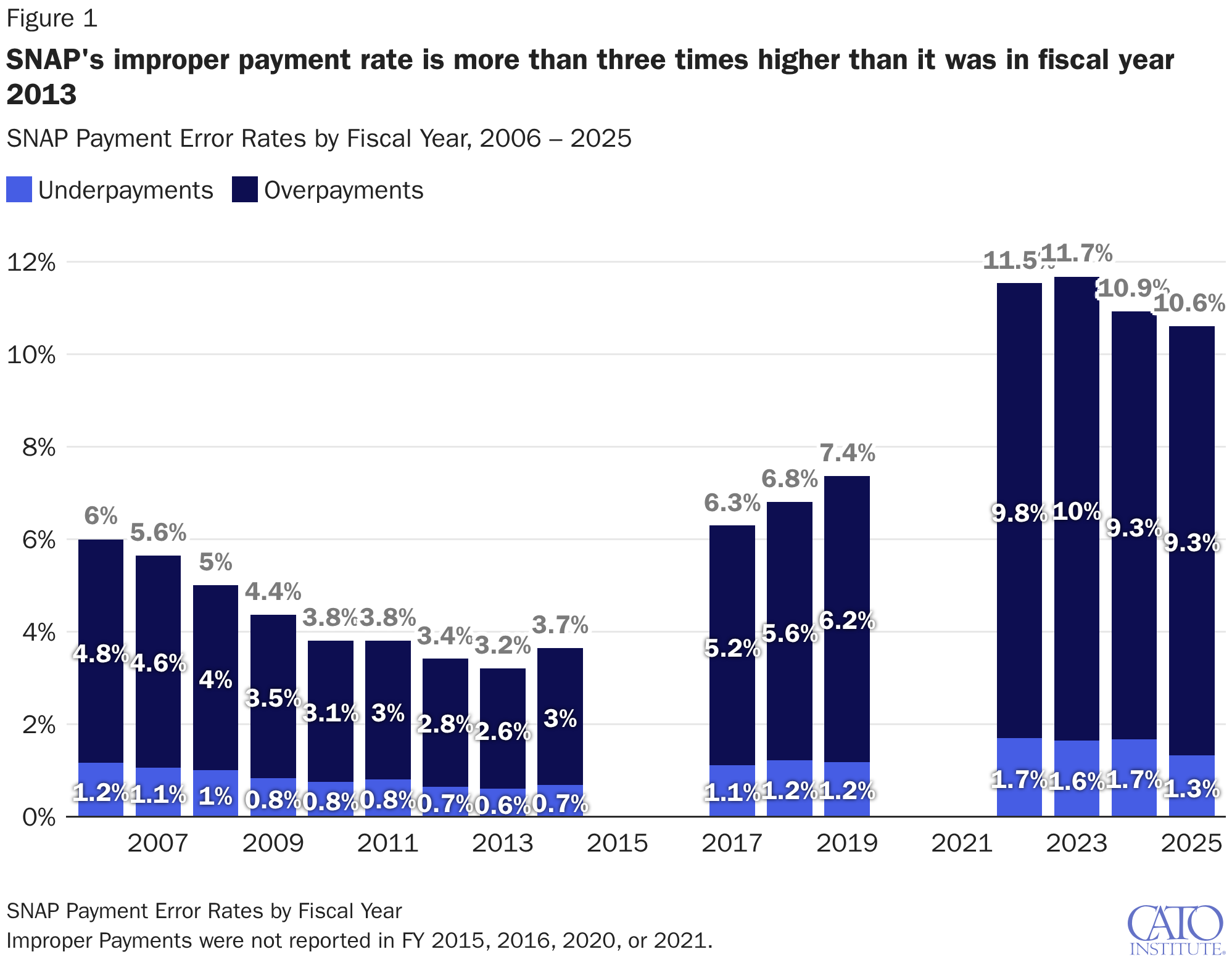
This is a marginal improvement over last year’s error rate (10.93 percent). But as USDA Secretary Brooke Rollins put it, “These payment error rates are further proof that state accountability is severely lacking in SNAP.”
That problem traces back to a mismatch in how the program is financed. The states administer SNAP, but federal taxpayers foot the bill for more than 90 percent of the program’s costs. This gives states an “all gain, no pain” arrangement in which the financial consequences of lax oversight and administrative inefficiency fall almost entirely on federal taxpayers.
Giving States Skin in the Game
The One Big Beautiful Bill Act (OBBBA) aimed to address this by requiring states to pay a share of the SNAP benefits they distribute when their error rates exceed 6 percent.
States may elect to use either their FY 2025 or FY 2026 error rate to calculate that share, making this report the opening benchmark for what states will owe when the cost-sharing requirements take effect in FY 2028.
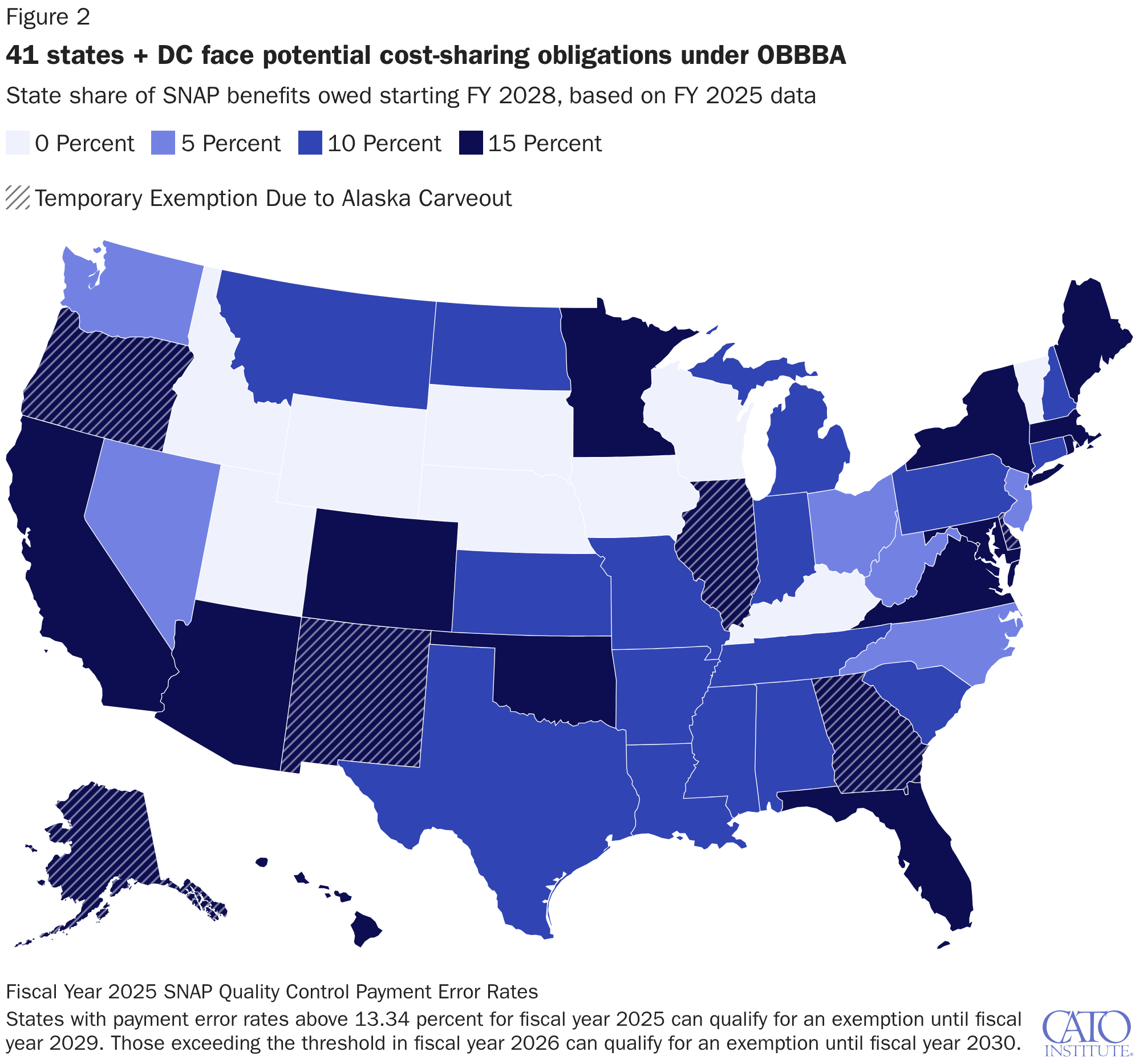
Based on FY 2025 data, 41 states and the District of Columbia face potential cost-sharing obligations (Figure 2).
Some states showed improvements in their FY 2025 error rates. New Jersey saw the largest decline, reducing its error rate from 14.33 percent in FY 2024 to 6.86 percent, potentially reflecting the state’s efforts to work more closely with county offices and implement additional quality control protocols.
Meanwhile, Hawaii’s error rate shot up from 6.68 percent to 10.92 percent, likely due to dropping net income limits for some households and absorbing caseload increases from extending eligibility to Compact of Free Association (COFA) residents.
How the Alaska Carveout Undermines OBBBA
However, six states and DC qualify for a temporary exemption under the Alaska Carveout, a policy shoehorned into OBBBA to secure Senator Lisa Murkowski’s (R‑AK) vote. It grants states with improper payment rates above 13.34 percent up to a two-year exemption from financial penalties, rewarding the worst-performing states while penalizing those working to reduce their error rates.
Case in point: Florida, Maryland, Massachusetts, New Jersey, and New York no longer qualify for an exemption and now face cost-sharing requirements because their error rates dropped below the 13.34 percent threshold.
Meanwhile, states that saw an increase in their payment errors, such as Delaware and Illinois, are granted a reprieve until at least FY 2029. To qualify for the exemption, officials in New Mexico admitted to slowing down efforts to tighten the state’s verification standards, while in Maryland, whistleblowers allege that officials conspired to leave correctable errors uncorrected to keep their improper payment rates elevated.
States have exploited the system in the other direction, too. In 2014, the USDA flagged quality control issues in 42 of 53 state SNAP agencies, with many gaming their review processes to artificially lower their reported error rates.
It is also worth noting what the FY 2025 data cannot show. The report covers October 2024 through September 2025. OBBBA did not pass until July 2025, meaning states had at most two months to respond to the new requirements before the measurement period closed. The FY 2026 report will offer a clearer picture of how OBBBA’s SNAP reforms, including the Alaska Carveout, affect state behavior — for better or for worse.
How States Are Racing to Cut Errors
The more telling signal is what states have done in anticipation of those penalties in the year since OBBBA passed. With financial penalties potentially hitting their budgets, many states have pursued a wide range of approaches to drive down their error rates:
- Virginia’s “SNAP Forward” initiative is eliminating applicants’ ability to self-attest their eligibility information, contracting with third parties to help improve the state’s payment processes, and creating a quality assurance team to identify and correct payment errors.
- Louisiana is offering cash bonuses to staff who spot payment errors, intensifying case reviews, and updating its verification systems to automate wage checks.
- Kansas is bringing in outside consultants to reduce its error rate, is participating in a mandatory federal corrective plan to address errors driven by high staff turnover and complex casework, and has proposed $4.4 million in upgrades to its verification system, including a chatbot to help staff apply eligibility rules.
- Mississippi is updating its antiquated, 40-year-old eligibility and case management software by installing new IT systems to cross-check SNAP recipient information against other programs in real time. The state is also piloting an income verification program to check SNAP recipients’ incomes against credit bureau data.
- Arkansas is investing in AI tools to improve its eligibility systems to reduce human data errors and free up caseworkers to identify mistakes in other areas. It has also allocated an additional $5 million in its FY 2027 budget to the state inspector general’s office to detect vulnerabilities in the program.
- Minnesota lawmakers allocated $90 million to replace the 35-year-old software counties use to process SNAP applications, which requires workers to manually re-enter the same eligibility data multiple times across disconnected systems, plus $15 million to upgrade fraud detection technology.
Congress Should Finish the Job It Started
What the early state responses to OBBBA make clear is that accountability changes behavior. States facing financial penalties for poor performance are investing in better verification systems and strengthening oversight.
Congress should build on this, ideally by leaving the provision of nutrition assistance up to the states. The best way to curb waste, fraud, and abuse in programs like SNAP is for states to pay for it. A program funded by state taxpayers is one that state officials have a far greater incentive to run carefully.
Short of that, Congress can help states modernize their fraud-prevention processes, including directing them to add chips to EBT cards to prevent benefit theft and to strengthen and expand their access to the Treasury’s Do Not Pay system. Congress can also eliminate error-prone policies like broad-based categorical eligibility, which is associated with disproportionately high improper payments compared to traditional eligibility, in part because states have used it to streamline program administration by weakening their verification protocols.
At a minimum, Congress should not compromise on its commitment to combating waste, fraud, and abuse in SNAP last year by delaying the start of OBBBA’s cost-sharing requirements, as some senators are pushing amid Farm Bill negotiations.
States may have made marginal improvements to their payment processes in FY 2025. But a mere 0.3 percentage-point decline shows that states still have a long way to go to rein in improper payments and comply with OBBBA’s requirements and that Congress has yet to fix SNAP’s structural integrity problems.
Source: https://www.cato.org/blog/10-billion-improper-snap-payments-reflects-programs-broken-incentive-structure
Anyone can join.
Anyone can contribute.
Anyone can become informed about their world.
"United We Stand" Click Here To Create Your Personal Citizen Journalist Account Today, Be Sure To Invite Your Friends.
Before It’s News® is a community of individuals who report on what’s going on around them, from all around the world. Anyone can join. Anyone can contribute. Anyone can become informed about their world. "United We Stand" Click Here To Create Your Personal Citizen Journalist Account Today, Be Sure To Invite Your Friends.
LION'S MANE PRODUCT
Try Our Lion’s Mane WHOLE MIND Nootropic Blend 60 Capsules
Mushrooms are having a moment. One fabulous fungus in particular, lion’s mane, may help improve memory, depression and anxiety symptoms. They are also an excellent source of nutrients that show promise as a therapy for dementia, and other neurodegenerative diseases. If you’re living with anxiety or depression, you may be curious about all the therapy options out there — including the natural ones.Our Lion’s Mane WHOLE MIND Nootropic Blend has been formulated to utilize the potency of Lion’s mane but also include the benefits of four other Highly Beneficial Mushrooms. Synergistically, they work together to Build your health through improving cognitive function and immunity regardless of your age. Our Nootropic not only improves your Cognitive Function and Activates your Immune System, but it benefits growth of Essential Gut Flora, further enhancing your Vitality.

Our Formula includes: Lion’s Mane Mushrooms which Increase Brain Power through nerve growth, lessen anxiety, reduce depression, and improve concentration. Its an excellent adaptogen, promotes sleep and improves immunity. Shiitake Mushrooms which Fight cancer cells and infectious disease, boost the immune system, promotes brain function, and serves as a source of B vitamins. Maitake Mushrooms which regulate blood sugar levels of diabetics, reduce hypertension and boosts the immune system. Reishi Mushrooms which Fight inflammation, liver disease, fatigue, tumor growth and cancer. They Improve skin disorders and soothes digestive problems, stomach ulcers and leaky gut syndrome. Chaga Mushrooms which have anti-aging effects, boost immune function, improve stamina and athletic performance, even act as a natural aphrodisiac, fighting diabetes and improving liver function. Try Our Lion’s Mane WHOLE MIND Nootropic Blend 60 Capsules Today. Be 100% Satisfied or Receive a Full Money Back Guarantee. Order Yours Today by Following This Link.


| Visits: | 1,820,266,693 |
| Stories: | 8,669,393 |
Whistler Blowers, Insiders

