
DHS Is Adding Another $100K Tax on H-1B Visas

The Department of Homeland Security (DHS) published a new proposed regulation today, requiring employers to pay a $103,265 fee—or more accurately, tax—merely for the right to file a petition requesting an H‑1B foreign worker. The H‑1B visa program is the most common way for employers to hire or retain high-skilled foreign workers in the United States because the green card caps are so low and the wait times are so prohibitively long.
It is not a fee because it is not a charge for a service. Rather, it is an attempt to reduce the hiring of H‑1B workers. The new fee-tax will crush the H‑1B program, resulting in the loss of hundreds of thousands of talented workers. This mass exodus will trigger a series of devastating effects for the US economy: disinvestment from the US economy, offshoring of US jobs, a decline in innovation and entrepreneurship, and an enormous blow to the US Treasury.
The New Fee-Tax Comes on Top of the Other Illegal $100K Fee-Tax
This fee comes on top of the $100,000 fee-tax that President Trump imposed via Presidential Proclamation 10973 on H‑1B employers last year. On its face, that fee-tax applied to any H‑1B worker who tried to enter the country—even if they were already approved and had temporarily traveled abroad. Ultimately, DHS limited the presidential proclamation to petitions for new H‑1B workers (set aside whether an agency can legally limit a presidential proclamation).
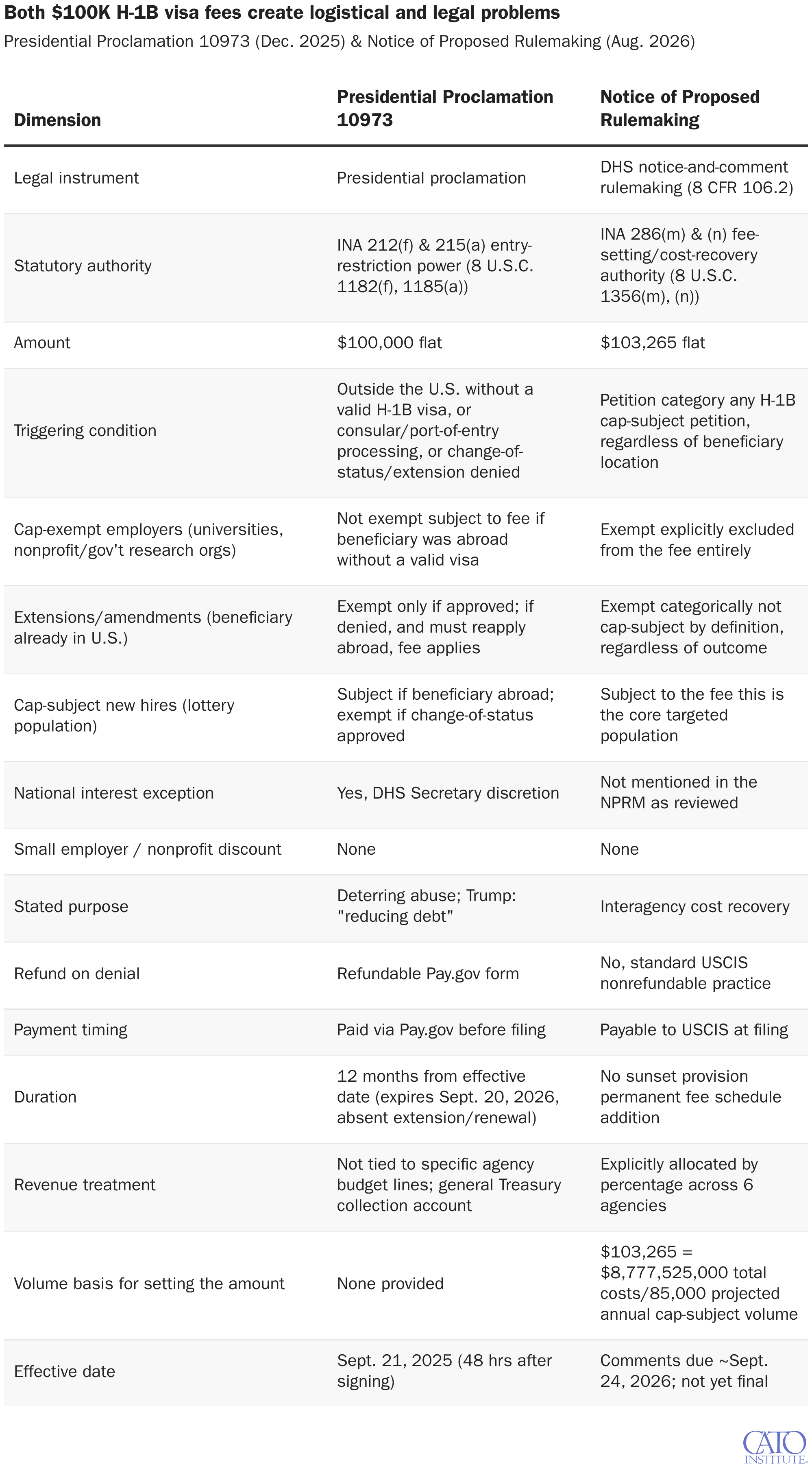
The new fee would apply to any cap-subject H‑1B visa petition whether on behalf of a worker inside or outside the United States. Cap-subject H‑1B petitions include all petitions except renewals and those by universities, affiliated nonprofits (such as hospitals), or research organizations at nonprofits or government positions. Here is a comparison of the two fees.
The First Circuit Court of Appeals has upheld a district court stay of the presidential proclamation on the grounds that it is an unconstitutional tax. Citing Skinner v. Mid-America Pipeline Co., the court said that Congress has to have “spoke[n] ‘clearly’ in conferring ‘discretionary authority to recover administrative costs not inuring directly to the benefit of regulated parties by imposing additional financial burdens, whether characterized as ‘fees’ or ‘taxes,’ on those parties.’” It found that Congress had not.
The New Fee-Tax Is Also Likely Illegal
Therefore, the first fee is not currently in effect. Nevertheless, DHS persists with a new legal basis. Presidential Proclamation 10973 used the president’s authority to limit entry of nonimmigrants to require the $100,000 payment for the worker to obtain entry. The new proposed $103,265 fee is instead based on a statute that states: “Fees for providing adjudication and naturalization services may be set at a level that will ensure recovery of the full costs of providing all such services.”
The fee has two legal deficiencies: It is neither intended “for adjudication and naturalization services” nor will it “ensure recovery of the full costs of providing all such services.” On the one hand, the rulemaking states that fee revenue will go toward Immigration and Customs Enforcement’s investigations and compliance activities, biometric screening at ports of entry, and actions of the immigration courts as well as components of the Department of Labor and State Department.
Equally fatal to the rule, however, is that DHS has already admitted in court that the first H‑1B fee under the presidential proclamation was “arguably prohibitive” and “does not raise revenue.” Indeed, its own analysis found that from September 21, 2025, to February 15, 2026, the H‑1B proclamation fee lost the US government $28 million in revenue after accounting for the revenue raised from the few employers that elected to pay the fee.
The New H‑1B Fee-Tax Would Nearly End the H‑1B Program
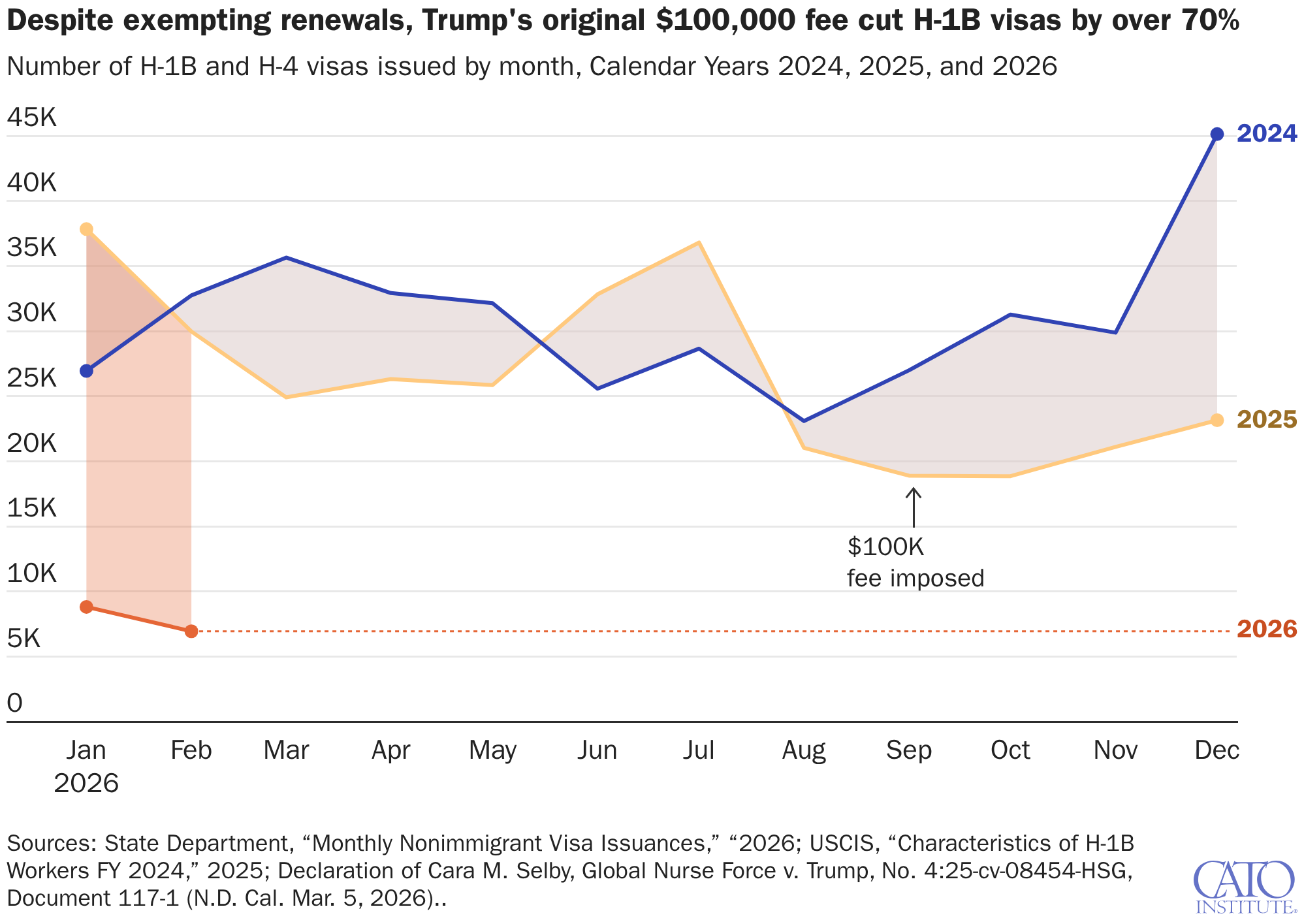
The decline in revenue occurred because the fee led to an approximately 87 percent decline in petitions subject to the fee. After the initial visa fee, despite the exemptions for H‑1B visa renewals, the total number of visa issuances to H‑1B workers and their families abroad fell by 77 percent.
This additional fee would be the death blow to the entire H‑1B visa program. Even if an employer is currently exempt, how can they trust the administration not to suddenly impose a new fee just like it is doing now?
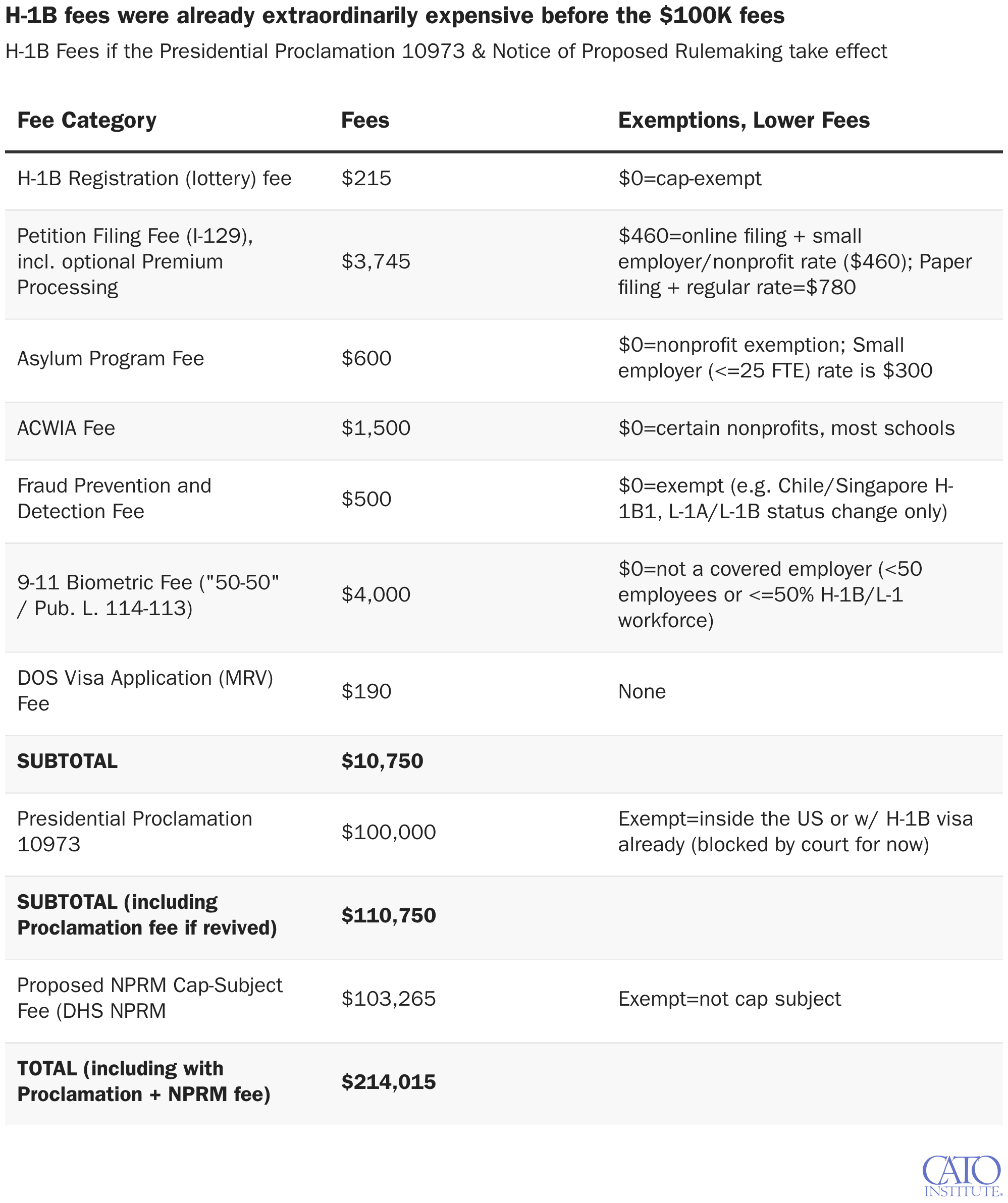
The table below lists the different types of H‑1B visa fees, showing that the process was already extraordinarily expensive before the presidential proclamation and the new proposed rule. Fees often cost over $10,000 for a single employee even before hiring an attorney to file the petition. If both the presidential proclamation and the pending rule come into effect, some employers would owe over $214,000 to hire a single employee.
Why Employers Won’t Pay the New Fee-Tax
The administration’s argument for employers’ willingness to pay is preposterous. DHS relies on a paper by economist George Borjas to assert that employers will pay the fee because, as Borjas claims, employers underpay H‑1B workers, so they are saving so much money that they’d be willing to pay the fee. DHS is claiming that it will be raising revenue based on the systematic underpayment of H‑1B workers, which is bizarre. But the experiment with the first fee-tax has already disproven Borjas’ assertion of willingness to pay, so the only question to ask is: Why was he wrong?
Economists Michael Clemens and Adam Ozimek have already raised serious doubts about Borjas’ underlying calculations of underpayment. Most other analyses find no underpayment for temporary foreign workers in the United States, and as I’ve pointed out, any “underpayment” that exists comes from the way in which the visa system prevents H‑1B workers from entering the labor market as quickly as US workers—not exploitation.
But even if Borjas’ calculations are correct, both $100,000 fees only apply to initial H‑1B petitions. This means that DHS is claiming that employers are paying the fee-tax to hire H‑1B workers explicitly so that they can underpay them. But then H‑1B workers can immediately change jobs—as 1.1 million have over the last 20 years—to receive the market wage from any employer without paying the fee. It’s even worse with this new fee-tax because the first one at least offered a refund if the petition was denied. In this case, employers are paying $103,265 just for the chance to get a decision, not even an approval.
Conclusion
The H‑1B fee will undermine American innovation, competitiveness, fiscal security, and ultimately prosperity. H‑1B workers are among the highest-skilled workers in the US economy, earning wages in the top 10 percent of workers. According to my analysis of government budgets, skilled foreign workers have reduced the deficit by more than $11.7 trillion over the last 30 years. As my colleague Alex Nowrasteh noted when the first Trump administration enacted a temporary H‑1B ban, these workers have also contributed disproportionately to innovation and patenting.
Moreover, the H‑1B visa is the entry point for workers who go on to start businesses. Cato adjunct scholar Stuart Anderson found in a paper for the National Foundation for American Policy that 59 percent (455 of 775) of America’s billion-dollar start-ups were founded or cofounded by immigrants. He writes that 234 of these founders came as international students who likely stayed after “gaining H‑1B status and/or an employment-based green card.” Without the H‑1B, hundreds of thousands of skilled workers will go to other countries where they will not only compete with Americans but also be less productive and less innovative, undermining the prosperity of not just America but the world.
If the courts fail to block this new draconian tax on innovation and competitiveness, Congress should intervene to ensure that America remains the most vibrant economy on Earth. Unfortunately, the administration is already moving forward with yet another $100,000 fee to hire international students after they graduate, so Congress should act now to send the message that America truly does want to stay competitive.
Source: https://www.cato.org/blog/dhs-adding-another-100k-tax-h-1b-visas
Anyone can join.
Anyone can contribute.
Anyone can become informed about their world.
"United We Stand" Click Here To Create Your Personal Citizen Journalist Account Today, Be Sure To Invite Your Friends.
Before It’s News® is a community of individuals who report on what’s going on around them, from all around the world. Anyone can join. Anyone can contribute. Anyone can become informed about their world. "United We Stand" Click Here To Create Your Personal Citizen Journalist Account Today, Be Sure To Invite Your Friends.
LION'S MANE PRODUCT
Try Our Lion’s Mane WHOLE MIND Nootropic Blend 60 Capsules
Mushrooms are having a moment. One fabulous fungus in particular, lion’s mane, may help improve memory, depression and anxiety symptoms. They are also an excellent source of nutrients that show promise as a therapy for dementia, and other neurodegenerative diseases. If you’re living with anxiety or depression, you may be curious about all the therapy options out there — including the natural ones.Our Lion’s Mane WHOLE MIND Nootropic Blend has been formulated to utilize the potency of Lion’s mane but also include the benefits of four other Highly Beneficial Mushrooms. Synergistically, they work together to Build your health through improving cognitive function and immunity regardless of your age. Our Nootropic not only improves your Cognitive Function and Activates your Immune System, but it benefits growth of Essential Gut Flora, further enhancing your Vitality.

Our Formula includes: Lion’s Mane Mushrooms which Increase Brain Power through nerve growth, lessen anxiety, reduce depression, and improve concentration. Its an excellent adaptogen, promotes sleep and improves immunity. Shiitake Mushrooms which Fight cancer cells and infectious disease, boost the immune system, promotes brain function, and serves as a source of B vitamins. Maitake Mushrooms which regulate blood sugar levels of diabetics, reduce hypertension and boosts the immune system. Reishi Mushrooms which Fight inflammation, liver disease, fatigue, tumor growth and cancer. They Improve skin disorders and soothes digestive problems, stomach ulcers and leaky gut syndrome. Chaga Mushrooms which have anti-aging effects, boost immune function, improve stamina and athletic performance, even act as a natural aphrodisiac, fighting diabetes and improving liver function. Try Our Lion’s Mane WHOLE MIND Nootropic Blend 60 Capsules Today. Be 100% Satisfied or Receive a Full Money Back Guarantee. Order Yours Today by Following This Link.


| Visits: | 1,831,532,002 |
| Stories: | 8,701,912 |
Whistler Blowers, Insiders

