

Idaho gets housing policy right and sets up future success

During the 2026 legislative session, Idaho enacted landmark housing bills addressing the state’s persistent housing challenges. As of June 2026, the median sale price of a home in Idaho had risen to $479,611. According to Federal Reserve Economic Data’s All Transactions House Price Index, home prices in the state increased nearly 71% between quarter one of 2020 and quarter one of 2026. A 2024 estimate finds that this rapid home price appreciation has left 28.3% of Idaho households cost-burdened, meaning they spend more than 30% of their income on housing. As affordability plummeted, legislative action became increasingly necessary.
Idaho’s housing challenges are largely driven by rapid population growth pressing against restrictive land-use regulations. A recent analysis from the Mercatus Center finds that Idaho had the highest net in-migration rate per 1,000 residents of any state in the country between 2018 and 2023. An analysis by the Gem State Housing Alliance found that, before the current reforms, Idaho’s municipalities had many varying restrictions that limited diverse housing types and were especially restrictive of infill and smaller units.
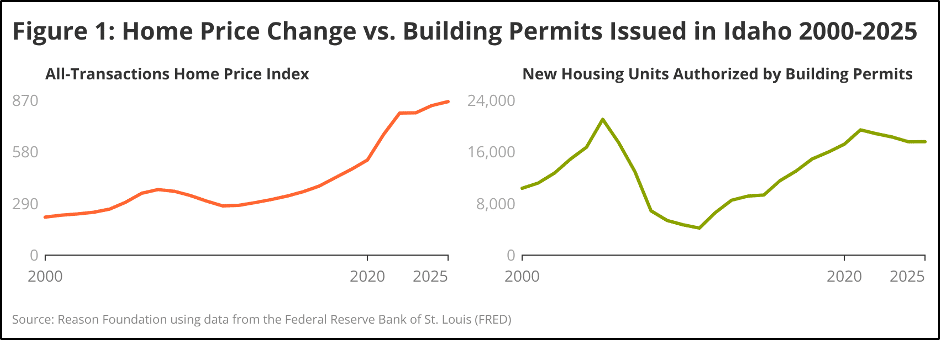
Idaho’s recent construction boom has not yet overcome years of supply constraints and stabilized or lowered home prices (see Figure 1). Recent estimates found that the state was short over 45,000 homes, despite leading the nation in per-capita housing growth. Recognizing this challenge, legislators liberalized housing markets to encourage the level of development needed to meet growing demand.
A restructuring of land use laws was necessary, not only to deal with current housing affordability concerns, but to create a resilient market capable of adapting to changing needs. States that act sooner rather than later will be better positioned to attract people looking for places to build their lives and careers without pricing them out of the market. Idaho’s sweeping reforms have poised the state for future success.
Idaho’s housing package
Senate Bill 1354: Accessory dwelling units
Idaho’s SB 1354 requires cities with more than 10,000 residents to allow homeowners to build at least one accessory dwelling unit (ADU) on a single-family lot. It also prohibits owner-occupancy requirements, additional parking requirements in most cases, excessive setbacks, or other development standards that are more restrictive than those applied to the primary residence.
The law also prevents local governments and homeowners associations (HOAs) from applying other overly restrictive regulations. Applying such restrictions to local governments is crucial, since that has been the source of the extreme supplier restrictions, but most states passing similar laws have allowed homeowners associations to restrict ADUs, which is appropriate since those are private contractual agreements that all property purchasers agreed to in advance.
This is a mostly well-designed example of state preemption. Beyond simply legalizing ADUs, the legislation anticipates and blocks many of the regulatory barriers that local governments have used to limit their construction following statewide housing reforms. This foresight creates an avenue for Idaho’s housing supply to keep up with demand in perpetuity while offering several advantages for both homeowners and lawmakers.
ADUs offer several advantages that make them an effective housing supply strategy. Because they are typically smaller than traditional single-family homes, they are a naturally more affordable housing option. They also serve as infill, meaning they do not require lots of additional infrastructure to facilitate their use. Their size and lower cost also make them well suited to households with distinct housing needs, such as college students seeking affordable accommodations or older adults who want to downsize while remaining close to family.
Further, where ADUs have been supported by comprehensive statewide reforms, they have been able to meaningfully increase housing supply. After easing ADU regulations, California permitted more than 139,000 ADUs between 2018 and 2024. California’s success suggests that well-designed state legislation enables significant new housing production.
Senate Bill 1352: Minimum lot size reform
The United States faces a nationwide shortage of starter homes, and Idaho is no exception. Starter homes are designed to provide an entry point to homeownership, but as home prices have climbed and the supply of smaller homes has dwindled, this first step has become increasingly out of reach.
SB 1352 addresses one of the regulatory barriers to building starter homes by reducing minimum lot size requirements for qualifying new starter-home developments. This step makes it easier for developers or parcel owners to build smaller and more affordable houses without the regulatory hurdles that typically make this endeavor too inconvenient or costly to take on.
For qualifying starter-home subdivisions of at least four acres, the law prevents municipalities with more than 10,000 residents from requiring lots larger than 1,500 square feet for single-family detached homes. It also standardizes front and rear setback minimums, allowing more of each lot to be used for housing.
Larger minimum lot size requirements are consistently associated with higher housing costs, requiring unnecessarily large land purchases and making the building of smaller homes unprofitable. Reducing these minimums can substantially increase the number of homes that can be built on available land. Estimates from the American Enterprise Institute (AEI) find that just by lowering the minimum lot size for new subdivisions to 1,200 square feet, Idaho could add roughly 6,200 additional homes annually at prices below the current median. While this bill sets the minimum slightly higher than 1,200 square feet, it takes a critical step toward making it legal to build smaller homes across the state.
Not every new home in Idaho will be built on the smallest possible lot, but SB 1352 creates the option where it may be desired. Evidence suggests there is growing nationwide demand for smaller homes on smaller lots. Although the national median lot size remains well above 1,500 square feet, it has been declining for decades. In a comparison of median lot sizes across different regions in the United States, the National Association of Home Builders (NAHB) finds that the Mountain division, which includes Idaho, already has among the smallest median lot sizes in the country, trailing only the Pacific division. Allowing even smaller lots builds on these long-term market trends and expands opportunities for more diverse housing types.
House Bill 707: Lot splits
HB 707 complements SB 1352 by extending small-lot housing reforms to existing residential properties. While SB 1352 applies to new starter-home subdivisions on undeveloped sites, HB 707 allows owners of qualifying existing residential lots to split their property if the resulting parcels meet applicable minimum lot-size requirements.
Rather than requiring the full subdivision platting process, which is the legal process of dividing a piece of land into individual lots, the bill creates a streamlined administrative process for dividing off a lot containing an existing ADU or other qualifying secondary structure. The bill is narrowly targeted, with the lot split needing to be supported by a lender’s letter demonstrating that separate financing or refinancing is needed, and it cannot create more density than local zoning already permits. It allows a homeowner to separate a backyard cottage or similar dwelling onto its own legal lot while retaining ownership of the primary home.
Previously, many ADUs and similar secondary dwellings could not be sold or financed separately from the main house, even when they functioned as independent homes. A backyard cottage or garage apartment might be physically complete and occupied, but without its own legal lot, it could not be bought, sold, or mortgaged on its own terms, effectively keeping that housing off the market. HB 707 creates a straightforward administrative path to separate that unit, giving lenders and buyers a clear process to work with. The result is that existing housing that was previously locked in place can now be on the market like any other home.
House Bill 800: Manufactured homes
HB 800 requires local governments to allow manufactured homes on any lot zoned for single-family or multifamily housing, unless an HOA in that area restricts it. The bill also lowers and standardizes the minimum size local governments can require for manufactured homes: 400 square feet for single-section homes, like single-wide or tiny homes, and 800 square feet for multi-sectional homes, including manufactured duplexes. It updates the legal definition of “manufactured home” to explicitly cover these multi-dwelling unit homes built to federal HUD standards.
Manufactured homes cost an estimated 48% less per square foot than comparable site-built homes. Despite these cost savings, many communities have historically restricted where they can be located through zoning and design standards, limiting them to designated parks or the outskirts of cities.
By requiring qualifying manufactured homes to be treated like site-built homes for zoning purposes, Idaho law reduces barriers to their placement. This change makes it easier for homebuyers to choose manufactured housing while limiting local zoning practices that have excluded these homes for reasons unrelated to community health or safety. Communities with an HOA can still choose to limit manufactured housing, preserving that option for homeowners.
House Bill 706: Single-stairway reform
HB 706 allows small apartment buildings up to six stories to be built with a single stairway instead of the currently required two. Apartments eligible to be built under this new rule are capped at four units per floor and 6,000 square feet per story. Automatic sprinklers and other fire protection must be included, with no more than two such buildings allowed per lot.
Research comparing fire death rates in existing single-stair buildings in New York City and Seattle to other residential buildings found no difference. This finding was further reinforced by separate research from the Netherlands, where single-stair buildings are common. Having the option to build without a second staircase opens new savings without compromising safety.
The intent is to continue to make it economically feasible to build smaller units, since the two-stairway requirement has been one of the biggest obstacles to constructing these more affordable buildings. For four- to six-story buildings, estimates indicate that a second staircase can add between 6% and 13% to construction costs. Having the option to avoid these additional costs can manifest in real savings for builders and buyers.
Notably, the bill doesn’t mandate the change, giving local governments the option to allow single-stairway buildings, while cities that prefer their current rules can keep them.
House Bill 585: Third-party inspections
HB 585 establishes statewide timelines for electrical, plumbing, heating, ventilation, and air conditioning inspections performed by state or local governments. If a requested inspection is not completed within 48 business hours, the permit holder may hire a qualified third-party inspector and receive a refund of the government inspection fee. The law also requires that when a building fails an inspection, the inspecting authority must provide the reason for the failure in writing within three business days or issue a partial refund. The legislation is intended to reduce inspection delays while preserving existing safety and inspection standards.
Long approval timelines at all stages of construction are a significant contributing factor to long home-building timelines. Research consistently finds that longer approval timelines are associated with higher costs for finished homes, which are passed down to the buyer. These delays also influence how much housing is ultimately built. Recent evidence from multifamily construction in Los Angeles found that reducing approval timelines by 25% could have increased housing production by 12.7% over the 12-year study period.
If city inspectors in Idaho cannot keep pace, builders can now turn to a credible third party. HB 585 eases the administrative burden on local governments and gives builders a path to keep projects moving in the event of a delay.
House Bill 583: Short-term rentals
HB 583 shows that Idaho is correctly diagnosing its housing problem and taking appropriate steps to deal with it. The state’s housing package takes direct steps to allow the development of new homes while making clear that increasing housing supply will not come at the expense of homeowners’ right to use their property as they see fit.
Under HB 583, local governments cannot ban short-term rentals (STRs) in residential zones, require a special-use or conditional-use permit specific to short-term rentals, cap the number of STRs allowed in a neighborhood, or mandate owner-occupancy as a condition of operating an STR. Additionally, local governments cannot place more-stringent rules on STRs than standard homes in many respects. For example, they cannot require more-stringent fire safety standards, additional parking, the reporting or use of additional data, or require that hosts purchase additional insurance.
The bill also requires STR platforms to register with the Idaho State Tax Commission to collect and remit applicable state and local taxes on the bookings they facilitate, while barring local governments from imposing taxes or fees specifically on the operation of a rental marketplace. By establishing a uniform statewide framework, the bill reduces regulatory fragmentation that makes it difficult for online STR platforms to operate. This approach considers the reality that these platforms play a huge role in facilitating the STR market, and that undermining their operation creates a real barrier to entry for hosts.
Cities can still enforce nuisance ordinances and set safety standards, so long as those rules apply equally to all residential properties. When STRs create genuine disturbances, neighbors retain avenues for recourse, while compliant properties are protected from unnecessary interference.
This vigilance on property rights and willingness to create laws that reflect what online platforms are built to handle is a model for how other states should approach this controversial issue.
STRs have faced increasing hostility from many state and local governments across the country because they can cause small increases in home prices. However, overly restrictive land use rules are largely to blame for the current housing crisis. Robust, well-functioning housing markets should be able to handle both the demands of the permanent housing market and the desire of some people to use their homes as STRs.
Idaho’s cumulative housing package, including HB 583, indicates lawmakers’ keen awareness of the causes of the housing crisis. It signals their willingness to address the challenges directly without encroaching on property rights.
Takeaways
Idaho’s 2026 housing package is the outcome of lawmakers treating housing affordability as a systemic supply problem caused by excessive regulation rather than a challenge that can be managed at the margins. Instead of searching for a single solution, or simply setting aside additional funding, the legislature systematically removed barriers that make it harder to bring new housing to market, while prioritizing property rights. These individual reforms work synergistically, creating a regulatory environment that allows housing supply to respond to changing market conditions. No state can predict future population shifts, but states can pass laws that allow supply to keep pace with changing demand. In doing the latter through this housing package, Idaho has created an exemplary model for other states.
The post Idaho gets housing policy right and sets up future success appeared first on Reason Foundation.
Source: https://reason.org/commentary/idaho-gets-housing-policy-right-and-sets-up-future-success/
Anyone can join.
Anyone can contribute.
Anyone can become informed about their world.
"United We Stand" Click Here To Create Your Personal Citizen Journalist Account Today, Be Sure To Invite Your Friends.
Before It’s News® is a community of individuals who report on what’s going on around them, from all around the world. Anyone can join. Anyone can contribute. Anyone can become informed about their world. "United We Stand" Click Here To Create Your Personal Citizen Journalist Account Today, Be Sure To Invite Your Friends.
LION'S MANE PRODUCT
Try Our Lion’s Mane WHOLE MIND Nootropic Blend 60 Capsules
Mushrooms are having a moment. One fabulous fungus in particular, lion’s mane, may help improve memory, depression and anxiety symptoms. They are also an excellent source of nutrients that show promise as a therapy for dementia, and other neurodegenerative diseases. If you’re living with anxiety or depression, you may be curious about all the therapy options out there — including the natural ones.Our Lion’s Mane WHOLE MIND Nootropic Blend has been formulated to utilize the potency of Lion’s mane but also include the benefits of four other Highly Beneficial Mushrooms. Synergistically, they work together to Build your health through improving cognitive function and immunity regardless of your age. Our Nootropic not only improves your Cognitive Function and Activates your Immune System, but it benefits growth of Essential Gut Flora, further enhancing your Vitality.

Our Formula includes: Lion’s Mane Mushrooms which Increase Brain Power through nerve growth, lessen anxiety, reduce depression, and improve concentration. Its an excellent adaptogen, promotes sleep and improves immunity. Shiitake Mushrooms which Fight cancer cells and infectious disease, boost the immune system, promotes brain function, and serves as a source of B vitamins. Maitake Mushrooms which regulate blood sugar levels of diabetics, reduce hypertension and boosts the immune system. Reishi Mushrooms which Fight inflammation, liver disease, fatigue, tumor growth and cancer. They Improve skin disorders and soothes digestive problems, stomach ulcers and leaky gut syndrome. Chaga Mushrooms which have anti-aging effects, boost immune function, improve stamina and athletic performance, even act as a natural aphrodisiac, fighting diabetes and improving liver function. Try Our Lion’s Mane WHOLE MIND Nootropic Blend 60 Capsules Today. Be 100% Satisfied or Receive a Full Money Back Guarantee. Order Yours Today by Following This Link.


| Visits: | 1,831,532,002 |
| Stories: | 8,701,912 |
Whistler Blowers, Insiders

