

Why the Congressional Budget Office’s Social Security Shortfall Looks Smaller

Romina Boccia and Krit Chanwong
The Congressional Budget Office (CBO), in its September 2026 forecasts, projects that Social Security (OASI) faces a shortfall of 4.55 percent of taxable payroll. The Social Security Administration also projected earlier this year that Social Security faces a shortfall of 4.55 percent of taxable payroll. This is a departure from previous years, when the CBO has typically projected a larger long-term shortfall than the Social Security Administration, and thus warrants a closer look.
Our analysis finds that much of the decline in CBO’s headline estimate reflects higher projected interest rates, which change how future shortfalls are valued in net present value terms. The smaller estimated payroll tax gap does not imply that the actual financing shortfall, the difference between what Social Security collects and what it is scheduled to pay, has narrowed.
What a 4.55 Percent of Taxable Payroll Gap Means
The implications of a 4.55 percent taxable payroll gap are simple: if Congress chose to close Social Security’s projected 75-year shortfall solely through a payroll tax rate increase, it would have to raise the current 12.4 percent rate by 4.55 percentage points, to 16.95 percent. We calculate that someone earning about $60,000 annually would have to pay $2,730 more in payroll taxes than they do now, for a total payroll tax burden of $10,170 (you can calculate your personal tax increase using Cato’s Payroll Tax Calculator).

If the CBO’s 2025 projections are correct, taxes would have to increase by 4.7 percentage points, or approximately $2,800 for a person earning $60,000. On the face of it, the CBO’s 2026 projections have become modestly more optimistic than last year’s.
How CBO and SSA Calculate Social Security’s Long-term Shortfall
A deeper dive into the CBO’s Social Security forecasts reveals that the reduction in Social Security’s projected shortfall does not result from a more optimistic view of the U.S. economy or improved Social Security finances. While it is true the CBO made modest modifications to its long-term economic and demographic assumptions, the CBO’s ‘more optimistic’ Social Security projections can be primarily attributed to higher interest rate forecasts.
The CBO’s and Social Security Administration’s projections for the Social Security shortfall are based on a simple question: what would the present value of all projected income minus cost be as a percent of taxable payroll, accounting for starting reserves and ending target reserves?
To answer this question, most forecasters use discounted cash flows. Both the CBO and the Social Security Administration use the interest rates of special issue Social Security bonds to discount future cash flows. The interest rates on these special issues are statutorily based on the interest rates of other Treasury securities. So, if the interest rates on Treasury securities go up, the interest rates on special issue Social Security bonds also go up.
Figure 1 shows the CBO’s 2025 and 2026 projections of interest rates on 10-year Treasuries. In the long run (2035 to 2056), the CBO now forecasts that interest rates on 10-year Treasuries will be approximately 4.4 percent. This is 0.6 percentage points higher than the CBO’s long-term interest rate projections in 2025. These estimates were revised upward because the CBO now projects that inflation will go up and global demand for U.S. Treasuries will decrease, both of which will drive up interest rates.
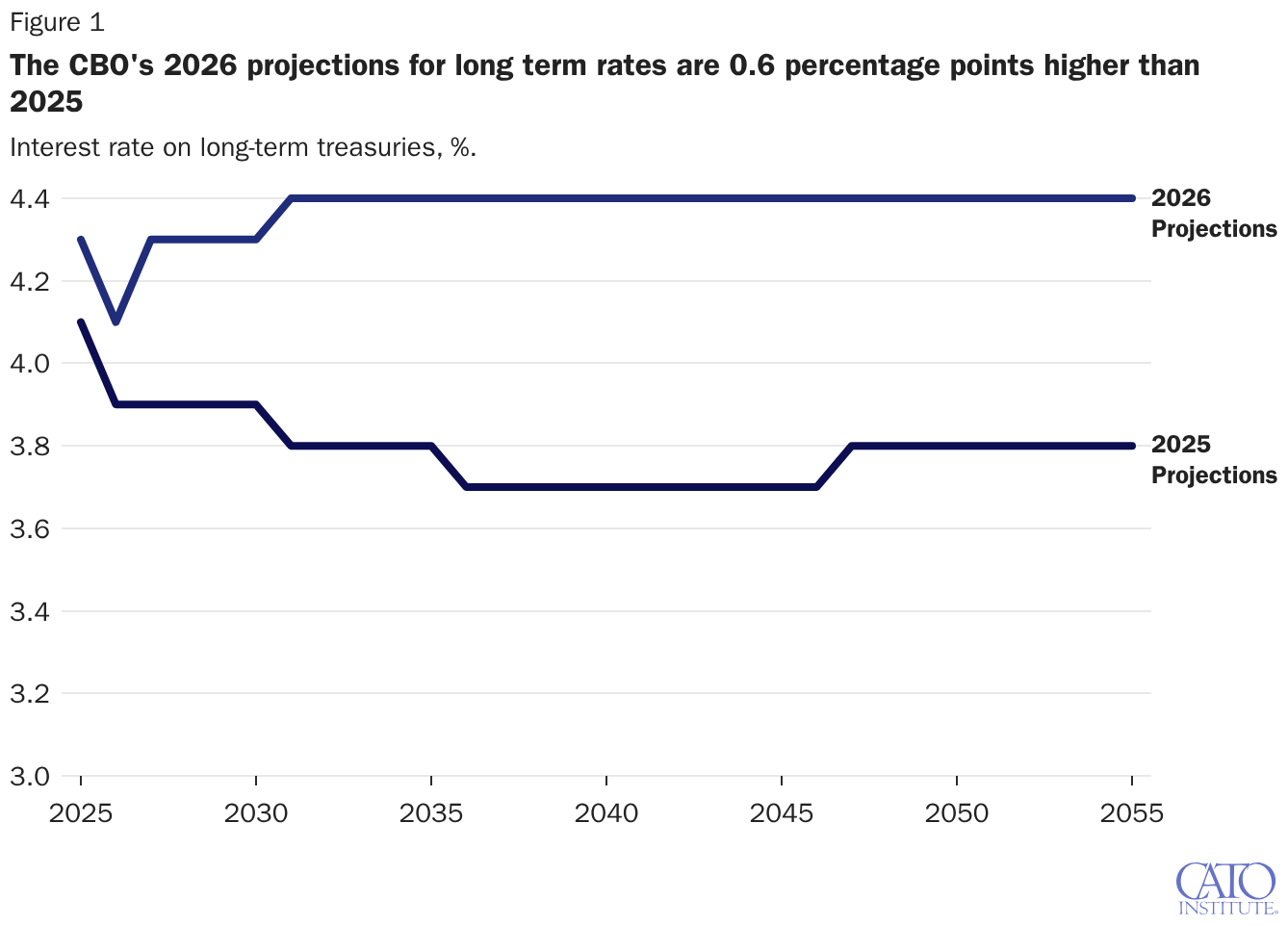
By increasing its estimated interest rates of special issue Treasuries, the CBO has lowered the present value of future scheduled benefits. To quantify this reduction, we discount the CBO’s 2026 individual cash flow projections using the CBO’s 2025 and 2026 nominal interest rate projections.
We then present two slightly different metrics of the Social Security shortfall. The first metric is what is called the actuarial balance, which accounts for interest income from the Social Security Trust Fund. The second metric focuses solely on Social Security’s cash flow, excluding any income derived from the Social Security Trust Fund, which represents claims on future taxpayer resources.
The result of this analysis is shown in Table 1. Using 2025 interest rate projections to discount CBO 2026 cash-flow projections yields a long-term shortfall of 4.82 percent of taxable payroll. In 2025, the CBO projected that Social Security’s long-term shortfall was 4.71 percent of taxable payroll. In other words, when discounted using the CBO’s 2025 interest rate forecasts, the CBO’s Social Security projections are more pessimistic than both CBO’s 2025 projections and the Social Security Administration’s 2026 projections.
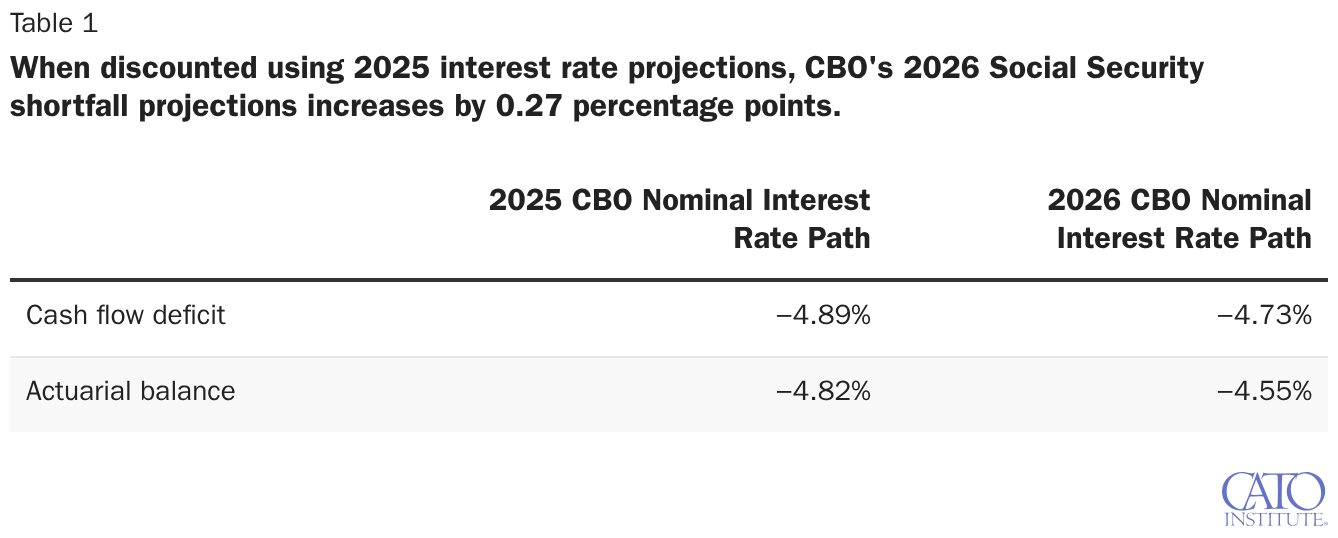
So the CBO’s apparent optimism over Social Security’s future is not driven by any significant improvements in fundamental economic or demographic variables. Rather, it is driven by a belief that U.S. government borrowing will become significantly more difficult in the future.
Higher projected interest rates reduce the present value of long-term Social Security shortfalls. They do not reduce the benefits Social Security is scheduled to pay or the gap between benefits and program income. Any improvement is based purely on assuming a higher future discount rate.
To illustrate, a $100 Social Security shortfall 30 years from now counts for about $32.67 in today’s dollars at a 3.8 percent interest rate, but only $27.50 at 4.4 percent. Social Security will still need the full $100 when the bill comes due, but that future amount is discounted by a higher interest rate and so looks smaller today.
Why Independent Modelling Matters
CBO’s revised estimate does not make Social Security’s financing problem less urgent. Projected annual program shortfalls are large and growing, even though higher interest rate assumptions make the 75-year actuarial deficit look smaller. That distinction is why policymakers should examine the assumptions behind headline estimates and why independent models that let researchers test those assumptions matter.
The Cato Social Security model, for example, allows lawmakers to test how various assumptions affect their constituents. In Cato’s Payroll Tax Calculator, we present two different payroll tax rate estimates for the current shortfall: the CBO/Social Security Administration rate, which arrived at the same shortfall calculations through different means, and an estimate from Cato’s Social Security model. The Cato Social Security model estimate adopts the Social Security Administration’s 2026 intermediate assumptions, as they are mostly reasonable. However, we change underlying fertility rates to match the CBO’s projections, because the Social Security Administration’s fertility projections are too optimistic.
This gives us a long-term shortfall estimate of ‑4.86 percent of taxable payroll if Congress chose to maintain benefits by raising the payroll tax rate on all workers. For a worker making $60,000 per year, Cato’s estimates imply that they would pay $2,916 more in taxes annually, for a total tax bill of $10,356 (compared to $2,730 and $10,170 under CBO/SSA assumptions).

Independent models, like the Cato Institute’s, allow lawmakers to dig deeper into model outputs and subject them to scrutiny. Such models can lead to a more informed discussion of Social Security reform as insolvency nears in 2032.
You can learn more about the Cato Social Security model here.
Source: https://www.cato.org/blog/why-congressional-budget-offices-social-security-shortfall-looks-smaller
Anyone can join.
Anyone can contribute.
Anyone can become informed about their world.
"United We Stand" Click Here To Create Your Personal Citizen Journalist Account Today, Be Sure To Invite Your Friends.
Before It’s News® is a community of individuals who report on what’s going on around them, from all around the world. Anyone can join. Anyone can contribute. Anyone can become informed about their world. "United We Stand" Click Here To Create Your Personal Citizen Journalist Account Today, Be Sure To Invite Your Friends.
LION'S MANE PRODUCT
Try Our Lion’s Mane WHOLE MIND Nootropic Blend 60 Capsules
Mushrooms are having a moment. One fabulous fungus in particular, lion’s mane, may help improve memory, depression and anxiety symptoms. They are also an excellent source of nutrients that show promise as a therapy for dementia, and other neurodegenerative diseases. If you’re living with anxiety or depression, you may be curious about all the therapy options out there — including the natural ones.Our Lion’s Mane WHOLE MIND Nootropic Blend has been formulated to utilize the potency of Lion’s mane but also include the benefits of four other Highly Beneficial Mushrooms. Synergistically, they work together to Build your health through improving cognitive function and immunity regardless of your age. Our Nootropic not only improves your Cognitive Function and Activates your Immune System, but it benefits growth of Essential Gut Flora, further enhancing your Vitality.

Our Formula includes: Lion’s Mane Mushrooms which Increase Brain Power through nerve growth, lessen anxiety, reduce depression, and improve concentration. Its an excellent adaptogen, promotes sleep and improves immunity. Shiitake Mushrooms which Fight cancer cells and infectious disease, boost the immune system, promotes brain function, and serves as a source of B vitamins. Maitake Mushrooms which regulate blood sugar levels of diabetics, reduce hypertension and boosts the immune system. Reishi Mushrooms which Fight inflammation, liver disease, fatigue, tumor growth and cancer. They Improve skin disorders and soothes digestive problems, stomach ulcers and leaky gut syndrome. Chaga Mushrooms which have anti-aging effects, boost immune function, improve stamina and athletic performance, even act as a natural aphrodisiac, fighting diabetes and improving liver function. Try Our Lion’s Mane WHOLE MIND Nootropic Blend 60 Capsules Today. Be 100% Satisfied or Receive a Full Money Back Guarantee. Order Yours Today by Following This Link.


| Visits: | 1,836,301,683 |
| Stories: | 8,727,749 |
Whistler Blowers, Insiders

