

There’s More to the Gospel than 'Just Preach the Gospel'

“Just preach the gospel.” How many times have you heard pastors and critics of social and political action scold Christians concerned about the moral direction the world is headed? The gospel is more than a life insurance program or a “Get Out of Hell Free” card. It is to transform everything we think about and act on. There is no neutrality, nor are any areas off-limits to the application of God’s Word.
The gospel renews a life for service in God’s kingdom — an ever-present reality — via a changed heart and changed mind (Rom. 12:1-2). What are we to do with these two renewals? Wait to be taken to heaven in something called a “rapture,” live in the world God created and called “good” (Gen. 1:31; 1 Tim. 4:1-4) and allow the enemies of God to exercise dominion over it, claim that since Jesus didn’t get involved in politics that Christians should follow His example, or learn how the Bible applies to every area of life and make it our life’s work to transform every part of it?
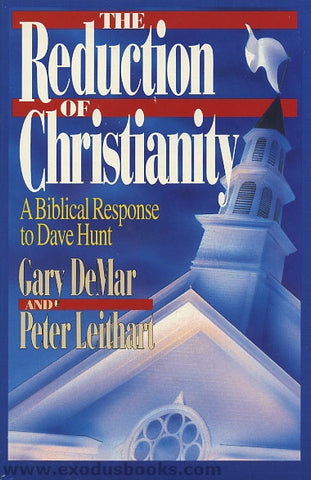
In this more than 400-page response to the cultural surrender theology of Dave Hunt (and Dispensationalism in general), Gary DeMar and Peter Leithart present an excellent overview of what true biblical Christianity looks like. Hunt teaches that Christ’s earthly power can only be manifested when He returns physically to set up a top-down bureaucratic kingdom in which Christians will be responsible for following the direct orders of Christ, issued to meet specific historical circumstances. DeMar and Leithart (and the Bible) strongly disagree.
The late Christian apologist Francis A. Schaeffer (1912-1984) wrote the following in the Preface to his 1974 book The Great Evangelical Disaster:
Throughout all of my work there is a common unifying theme, which I would define as “the Lordship of Christ in the totality of life.” If Christ is indeed Lord, he must be Lord of all life—in spiritual matters, of course, but just as much across the whole spectrum of life, including intellectual matters and the areas of culture, law, and government. I would want to emphasize from beginning to end throughout my work the importance of evangelism (helping men and women come to know Jesus Christ as Savior), the need to walk daily with the Lord, to study God’s Word, to live a life of prayer, and to show forth the love, compassion, and holiness of our Lord. But we must emphasize equally had at the same time the need to live this out in every area of culture and society.[1]
Schaeffer saw the problem decades ago in what he described as “a shift in worldview—that is, through a fundamental change in the overall way people think and view the world and life as a whole … to a world view based upon the idea that the final reality is impersonal matter or energy shaped into its present form by personal chance.”[2]
We have been told that the government can’t save us, and by government, they mean civil government, the State. Whoever said it could or should save us? The civil sphere of government was ordained by God and is said to be a “minister of God to you for good” (Rom. 13:4). How can civil government be “good” if good people are not involved and turn over civil governing authority to people who despise God’s moral standards (see Psalm 1)?
Without good self-government under God, the three governments (family, church, and civil) will fail, no matter how well conceived. Let us not forget that God is the Supreme Governor of all things and is the creator of family, church, and civil governments. These are God’s governments. He has not determined that they remain in the hands of those who hate His law, so they can be redesigned in the name of another god.
Evangelicalism has had a mixed history in applying the Bible to all of life. For years, I have heard that the Bible applies to every area of life, but I have rarely seen or heard evangelical leaders explain how it applies in the details. Many Christians have been taught, “We’re under grace, not law.” But when asked if this means that it is now OK for Christians to steal, murder, commit adultery, lie, and covet, these same Christians dismiss such an objection. They might say, “If a law is repeated in the New Testament, it still applies.” There is no such directive in the New Testament that says you should not curse the deaf or trip the blind (Lev. 19:14) or have sex with animals (18:23).
It is true that the law does not save anyone, nor does keeping a list of commandments make us holy, but this does not mean that God’s law is irrelevant. Paul writes the following to Timothy:
But we know that the Law is good, if one uses it lawfully, realizing the fact that law is not made for a righteous person, but for those who are lawless and rebellious, for the ungodly and sinners, for the unholy and profane, for those who kill their fathers or mothers, for murderers and immoral men and homosexuals and kidnappers and liars and perjurers, and whatever else is contrary to sound teaching, according to the glorious gospel of the blessed God, with which I have been entrusted (1 Tim. 1:8-11).
Note how the law and the gospel are not mutually exclusive because the proper use of the law is determined by the law and is “according to the glorious gospel of the blessed God, with which [Paul] had been entrusted.”
Like God’s creation, the Law is good. God’s commandments are good. Jesus said to His disciples, “If you love Me, you will keep My commandments” (John 14:15). John writes, “For this is the love of God, that we keep His commandments; and His commandments are not burdensome” (1 John 5:3). R. J. Rushdoony writes:
Lawless Christianity is a contradiction in terms: it is anti-Christian. The purpose of grace is not to set aside the law but to fulfill the law and to enable man to keep the law. If the law was so serious in the sight of God that it would require the death of Jesus Christ, the only-begotten Son of God, to make atonement for man’s sin, it seems strange for God then to proceed to abandon the law! The goal of the law is not lawlessness, nor the purpose of grace a lawless contempt of grace.[3]
Without an appreciation of God’s law, there is no way to combat lawlessness and the redefinition of everything from abortion to same-sex sexuality. Many of today’s churches have accepted homosexuality as a legitimate lifestyle choice and twist the Scriptures to justify their position. And why not? Christians have been taught that God’s law (just some of it) is either (1) just for the church or (2) grace supplants biblical law. It’s a double whammy, making the Christian message irrelevant this side of heaven.
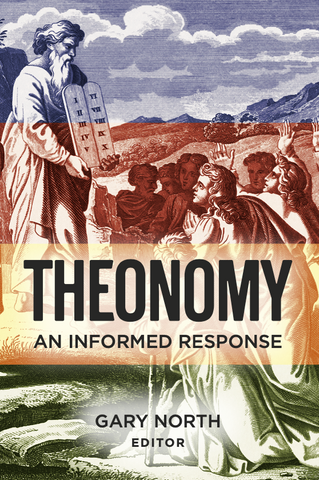
Christendom is a civilization—the kingdom of God in history—that is governed in every area, every nook and cranny, by God: a society whose lawfully anointed rulers govern in terms of God’s revealed law. In this view, God is not in retirement or on vacation; He is a King who has delegated to His officers the authority to exercise command. There are three covenantal institutions: family, church, and state. To deny that God’s covenant law applies to civil government in New Testament times is necessarily to abandon the ideal of Christendom.
Another popular belief that disengages Christians from applying God’s Word to every area of life and from pursuing long-term change is that we are at the point in history where the end is near. The world is in such bad shape that their only hope is the “rapture of the church” or some other series of end-times events. The world is a mess, but it’s not the end of the world as we know it.[4] You would never know this because of books like David Jeremiah’s foray into misapplying almost everything Jesus said about Bible prophecy—The World of the End: How Jesus’ Prophecy Shapes our Priorities—a study of the Olivet Discourse in Matthew 24.
William Edgar, a professor of apologetics at Westminster Theological Seminary, recounts the time in the 1960s he spent studying in L’Abri, Switzerland, under the tutelage of Francis Schaeffer:[5]
I can remember coming down the mountain from L’Abri and expecting the stock market to cave in, a priestly elite to take over American government, and enemies to poison the drinking water. I was almost disappointed when these things did not happen.[6]
Edgar speculates, with good reason, that it was Schaeffer’s eschatology that negatively affected the way he saw and interpreted world events. Schaeffer was good at diagnosing the disease, but he found it difficult to prescribe a cure because the patient was never going to get well. One of Schaeffer’s last books, A Christian Manifesto, did not call for cultural transformation but civil disobedience as a stopgap measure to postpone an inevitable societal decline.
The fact remains that Dr. Schaeffer’s manifesto offers no prescriptions for a Christian society…. The same comment applies to all of Dr. Schaeffer’s writings: he does not spell out the Christian alternative. He knows that you “can’t fight something with nothing,” but as a premillennialist, he does not expect to win the fight prior to the visible, bodily return of Jesus Christ to earth to establish His millennial kingdom.[7]
This view has been true for millions of Christians. There is no doubt that many Christians are otherworldly and have no interest in culture or the dirty business of politics. Many more Christians are eschatologically schizophrenic. They believe that we are living in the last days, but still engage society at some level as a form of theological schizophrenia.
Economic, political, moral, and religious conditions seemed to have set the world on the brink of destruction numerous times in history. Economic circumstances were so bad in Israel thousands of years ago that some people resorted to cannibalism (Deut. 28:53-57; 2 Kings 6:28-29; Jer. 19:9). Josephus relates an account of a woman who killed, cooked, and ate her own child during the siege of Jerusalem that ended in AD 70.
There have been other economic crises in the not-too-distant past, and we have weathered them: The Great Depression and Dust Bowl in the United States, and the hyperinflation in Germany, where the United States dollar was worth 4 trillion German marks. We can include two world wars, prime indicators used by the prophetic speculators, that the end was near.
As a result, dispensationalists argued, “The church is largely parenthetic, thus unimportant. The teachings of Scripture have largely to do with the Jews alone. The Sermon on the Mount is largely for the Jews. The Lord’s prayer is for the Millennium rather than for the Church.”[8] As a result, Christians check the hourglass of time running out and wait in vain for a rapture that is always promised but never comes. Dr. Gary North pointed out the problem:
To escape this inherent despair, fundamentalists have turned to their own version of the humanists’ escape hatch: an upper-story universe. This upper story is the world of faith, expectation, and hope: the heavenly realm. It is a hope in heaven — a world above and beyond this world of Christian powerlessness and defeat.
*****
Fundamentalism’s lower story is the world of work, economics, professional training, art, institutions, authority, and power, i.e., the “secular” realm. This realm is governed, not in terms of the Bible, but in terms of supposedly universal “neutral reason” and natural law.[9]
And that’s the problem. It didn’t used to be this way. Every area of life was seen as a place to apply God’s Word, even among those who did not embrace Jesus as Lord and Savior. The world worked the way it did because God made it that way. As a result, Western Civilization flourished. In time, however, many people came to believe that the impersonal cosmos was good enough to develop a moral worldview. Of course, natural law advocates used their understanding of Special Revelation to read Nature, otherwise “Nature, red in tooth and claw,” would have been the outcome.
Darwinism killed any lasting vestige of a link between nature and God. God was not needed in an unwound clockwork universe. Apparently, a blind watchmaker was in charge. That would be like having Stevie Wonder or Ray Charles drive a taxi. The Christian response was to reformulate theologically. A sacred-secular divide was developed, coupled with an eschatology that made this time and world irrelevant, anticipating a rapture at any moment to relieve them of the task and responsibility of cultural change.
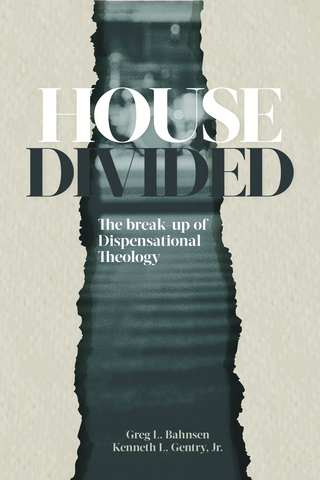
House Divided is a postmillennial book. It does not seek to fight something (dispensationalism) with nothing (amillennialism). You are not being asked to abandon hope in dispensationalism’s escape hatch in the future (the pre-tribulation Rapture) only to take up residence in amillennialism’s Fort Contraction, with a tribe of howling Darwinian Indians circling it, all armed with repeating rifles. You are being asked instead to join a victorious army led by Jesus Christ, who sits at God’s right hand, and who will remain seated there until He subdues all His enemies under His feet. ”Then cometh the end, when he shall have delivered up the kingdom to God, even the Father; when he shall have put down all rule and all authority and power. For he must reign, till he hath put all enemies under his feet” (1 Cor. 15:24-25).
[1] Schaeffer, The Great Evangelical Disaster (Westchester, IL: Crossway Books, 1984), 12.
[2] Schaeffer, The Great Evangelical Disaster, 36.
[3] Rousas J. Rushdoony, The Institutes of Biblical Law (Phillipsburg, NJ: Presbyterian and Reformed, 1973), 4.
[4] J.D. King, Why You’ve Been Duped Into Believing that Word is Getting Worse (Lees Summit, MO: Christos Publishing, 2019).
[5] Colin Duriez, Francis Schaeffer: An Authentic Life (Wheaton, IL: Crossway Books, 2008), 42.
[6] William Edgar, “Francis Schaeffer and the Public Square” in J. Budziszewski, Evangelicals in the Public Square: Four Formative Voices on Political Thought and Action (Grand Rapids, MI: Baker Academic, 2006), 174.
[7] Gary North and David Chilton, “Apologetics and Strategy,” in Tactics of Christian Resistance: A Symposium, ed. Gary North (Tyler Texas: Geneva Divinity School, 1983), 127-128. Emphasis in original.
[8] Peter E. Prosser, Dispensational Eschatology and Its Influence on American and British Religious Movements (Lewiston, New York: Edwin Mellen Press, 1999), 148.
[9] Gary North, Publisher’s Foreword, in Greg L. Bahnsen and Kenneth L. Gentry, House Divided: The Break-Up of Dispensational Theology (Powder Springs, GA: American Vision, [1989] 2022), xiii-xiv.
American Vision’s mission is to Restore America to its Biblical Foundation—from Genesis to Revelation. American Vision (AV) has been at the heart of worldview study since 1978, providing resources to exhort Christian families and individuals to live by a Biblically based worldview. Visit www.AmericanVision.org for more information, content and resources
Source: https://americanvision.org/posts/theres-more-to-the-gospel-than-just-preach-the-gospel/
Anyone can join.
Anyone can contribute.
Anyone can become informed about their world.
"United We Stand" Click Here To Create Your Personal Citizen Journalist Account Today, Be Sure To Invite Your Friends.
Before It’s News® is a community of individuals who report on what’s going on around them, from all around the world. Anyone can join. Anyone can contribute. Anyone can become informed about their world. "United We Stand" Click Here To Create Your Personal Citizen Journalist Account Today, Be Sure To Invite Your Friends.
LION'S MANE PRODUCT
Try Our Lion’s Mane WHOLE MIND Nootropic Blend 60 Capsules
Mushrooms are having a moment. One fabulous fungus in particular, lion’s mane, may help improve memory, depression and anxiety symptoms. They are also an excellent source of nutrients that show promise as a therapy for dementia, and other neurodegenerative diseases. If you’re living with anxiety or depression, you may be curious about all the therapy options out there — including the natural ones.Our Lion’s Mane WHOLE MIND Nootropic Blend has been formulated to utilize the potency of Lion’s mane but also include the benefits of four other Highly Beneficial Mushrooms. Synergistically, they work together to Build your health through improving cognitive function and immunity regardless of your age. Our Nootropic not only improves your Cognitive Function and Activates your Immune System, but it benefits growth of Essential Gut Flora, further enhancing your Vitality.

Our Formula includes: Lion’s Mane Mushrooms which Increase Brain Power through nerve growth, lessen anxiety, reduce depression, and improve concentration. Its an excellent adaptogen, promotes sleep and improves immunity. Shiitake Mushrooms which Fight cancer cells and infectious disease, boost the immune system, promotes brain function, and serves as a source of B vitamins. Maitake Mushrooms which regulate blood sugar levels of diabetics, reduce hypertension and boosts the immune system. Reishi Mushrooms which Fight inflammation, liver disease, fatigue, tumor growth and cancer. They Improve skin disorders and soothes digestive problems, stomach ulcers and leaky gut syndrome. Chaga Mushrooms which have anti-aging effects, boost immune function, improve stamina and athletic performance, even act as a natural aphrodisiac, fighting diabetes and improving liver function. Try Our Lion’s Mane WHOLE MIND Nootropic Blend 60 Capsules Today. Be 100% Satisfied or Receive a Full Money Back Guarantee. Order Yours Today by Following This Link.


| Visits: | 1,819,145,781 |
| Stories: | 8,667,593 |
Whistler Blowers, Insiders

