

Thomas Paine and the American Founding

Thomas Paine is often called a Founder of the American Republic. But is it the Paine of Common Sense or the Paine of The Rights of Man (1791) and The Age of Reason (1793-94)? Since Common Sense was written on the eve of the Revolution and The Rights of Man and The Age of Reason were written after the ratification of the Constitution, we should begin with Common Sense. Paine’s Common Sense put forth arguments for independence from Great Britain. How did he argue his case? What were his sources?
A. J. Ayer remarks that “the first argument that Paine brings against the institution of kingship is scriptural.”[1] Paine declared that “government by kings was first introduced into the world by the Heathens, from which the children of Israel copied the custom…. As the exalting of one man so greatly above the rest cannot be justified on the equal rights of nature, so neither can it be defended on the authority of scripture; for the will of the Almighty, as declared by Gideon and the prophet Samuel, expressly disapproves of government by kings [Judges 8:22-23; 1 Sam. 8]. All anti-monarchical parts of scripture have been smoothly glossed over in monarchical governments, but they undoubtedly merit the attention of countries which have their governments yet to form. ‘Render unto Caesar the things which are Caesar’s’ is the scriptural doctrine of courts, yet it is no support of monarchical government, for the Jews at that time were without a king, and in a state of vassalage to the Romans.”[2]
Paine has an extended discussion of Judges 8:22–23 where he describes “the King of Heaven” as Israel’s “proper sovereign.”[3] He then spends several pages quoting, discussing, and applying the importance of 1 Samuel 8 to the modern situation. He concludes this section of Common Sense with these words: “In short, monarchy and succession have laid (not this or that kingdom only) by the world in blood and ashes. ’Tis a form of government which the word of God bears testimony against, and blood will attend it.”[4] See the Appendix to my book The Case for America’s Christian Heritage.
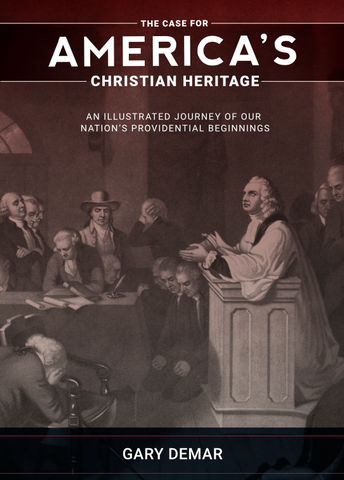
An Illustrated Journey of Our Nation’s Providential Beginnings. America’s original founding was rooted deeply in the things of Jesus Christ and His kingdom. The original charter given to Sir Walter Raleigh by Queen Elizabeth I in the 16th century was to establish “the true Christian faith.” John Rolfe at Jamestown sought to “advance the Honor of God and to propagate his Gospel.” The faithful Christians who wrote the Mayflower Compact stated that their mission was “for the Glory of God and advancements of the Christian faith.”
It seems that some historians trim this bit of history from Paine’s body of work. Instead, he only quotes from his later publications, which are anti-Christian but not atheistic. Consider his views of creation from his 1787 “Discourse at the Society of Theophilanthropists in Paris”:
It has been the error of schools to teach astronomy, and all the other sciences and subjects of natural philosophy, as accomplishments only; whereas they should be taught theologically, or with reference to the Being who is the Author of them: for all the principles of science are of divine origin. Man cannot make, or invent, or contrive principles; he can only discover them, and he ought to look through the discovery to the Author. When we examine an extraordinary piece of machinery, an astonishing pile of architecture, a well-executed statue, or a highly-finished painting where life and action are imitated, and habit only prevents our mistaking a surface of light and shade for cubical solidity, our ideas are naturally led to think of the extensive genius and talent of the artist. When we study the elements of geometry, we think of Euclid. When we speak of gravitation, we think of Newton. How, then, is it that when we study the works of God in creation, we stop short and do not think of God? It is from the error of the schools in having taught those subjects as accomplishments only and thereby separated the study of them from the Being who is the Author of them…. The evil that has resulted from the error of the schools in teaching natural philosophy as an accomplishment only has been that of generating in the pupils a species of atheism. Instead of looking through the works of creation to the Creator Himself, they stop short and employ the knowledge they acquire to create doubts of His existence. They labor with studied ingenuity to ascribe everything they behold to innate properties of matter and jump over all the rest by saying that matter is eternal. And when we speak of looking through nature up to nature’s God, we speak philosophically the same rational language as when we speak of looking through human laws up to the power that ordained them. God is the power of first cause, nature is the law, and matter is the subject acted upon. But infidelity, by ascribing every phenomenon to properties of matter, conceives a system for which it cannot account and yet it pretends to demonstrate.[5]
Could the above comments by Paine be worked into the curriculum of today’s public schools? I doubt it.
How much support did Paine get from the Founders in his later works, where he repudiated the Bible and Christianity but remained a theist? John Adams called him a “blackguard.” Samuel Adams wrote Paine a stiff rebuke, telling him, “[W]hen I heard you had turned your mind to a defence of infidelity, I felt myself much astonished and more grieved that you had attempted a measure so injurious to the feelings and so repugnant to the true interest of so great a part of the citizens of the United States.”[6] In his Introduction to Common Sense, Gregory Tietjen wrote that Paine’s “explicit expressions of disbelief roused the faithful to fury and earned Paine an enmity that destroyed the good reputation he enjoyed for his earlier activities in behalf of the American cause. . . . [H]is polemics against President Washington had lost him the loyalty of many patriots, and his religious beliefs had earned him the wrath of the Christian faithful.”[7] Even the usually tolerant Quakers refused him burial in a Quaker graveyard.
Geoffrey Stone, professor of law at the University of Chicago, describes the views of the later Paine as “shockingly blunt and ‘politically incorrect’ to modern ears, but they were in fact the views of many of our most revered Founders. The fable that the United States was founded as a Christian Nation is just that—a fable.” Paine’s Common Sense, with its biblical arguments from the Old and New Testaments, is direct testimony that Stone is incorrect.
Mark A. Noll, a research professor of history at Regent College, argues, “If Paine’s Age of Reason (with its dismissive attitude toward the Old Testament) had been published before Common Sense (with its full deployment of Scripture in support of republican freedom), the quarrel with Britain may have taken a different course. It is also likely that the allegiance of traditional Christian believers to republican liberty might not have been so thoroughly cemented. And it is possible that the intimate relation between republican reasoning and trust in traditional Scripture, which became so important after the turn of the new century, would not have occurred as it did.”[8]
Robert Royal comments that “for Paine—a skillful polemicist whose attachment to Christianity was always uncertain and seems eventually to have evaporated—to use an argument such as this at a delicate moment testifies, at the very least, to the power of religious arguments for liberty in America.”[9] John Orr’s remarks that Paine received a “cold reception … when he returned from France after publishing his deistic book The Age of Reason.” This reaction “does not suggest that deism was as popular in America as some” historical accounts “might lead one to suppose.”[10]
The answer to Paine’s Age of Reason was The Age of Revelation: The Age of Reason Shewn to be an Age of Infidelity by Elias Boudinot. In 1779, he was elected to the Continental Congress and then to its successor, the Congress of the Confederation, serving as President of Congress in 1782-1783, during the war’s final years.
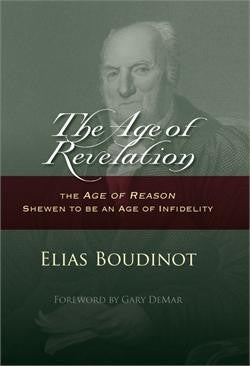
Paine is considered to be an American Founding Father, and yet, unlike Paine, Boudinot actually served in a civil capacity in the United States that included work on the Constitution. Paine’s only elective office was in France. Boudinot is a true American Founding Father. Paine had no role in the founding conventions of America and their documents. Boudinot waited some time before deciding to respond to Paine’s Age of Reason. His measured rejoinder to Paine’s work is contemplative and, contrary to Paine’s treatise, a work of sound scholarship. A great deal of thought and humility went into the well-argued reply.
After being elected to the first, second, and third U.S. Congresses, where he served from 1789 to 1795, Boudinot was appointed director of the United States Mint by President Washington and held the position through 1805 under the presidencies of John Adams and Thomas Jefferson. Boudinot, a devout Presbyterian, spoke out frequently against slavery, both as a member of Congress and as a private citizen. In 1816, he helped found the American Bible Society and served as its first president for five years. Paine’s only elective office was in France.
[1] A.J. Ayer, Thomas Paine (New York: Atheneum, 1988), 40. Ayer remarks that his appeal to the Old Testament is curious “in view of the want of respect he was later to show for the Old Testament” (40).
[2] Thomas Paine, Common Sense (New York: Barnes & Noble, [1776] 1995), 10.
[3] Paine, Common Sense, 11.
[4] Paine, Common Sense, 11-14.
[5] Thomas Paine, Life and Writings of Thomas Paine, ed. Daniel Edwin Wheeler, 10 vols. (New York: Printed by Vincent Parke and Company, 1908), 7:2-8, “The Existence of God,” A Discourse at the Society of Theophilanthropists, Paris. Also see Thomas Paine, “Discourse Delivered to the Society of Theophilanthropists at Paris” in The Theological Works of Thomas Paine (London: R. Carlile, 1818), 4-5.
[6] William V. Wells, The Life and Public Services of Samuel Adams (Boston: Little, Brown and Co., 1865), 3:372-373. Letter to Thomas Paine on November 30, 1802.
[7] Gregory Tietjen, “Introduction,” Common Sense, xii.
[8] Mark A. Noll, America’s God: From Jonathan Edwards to Abraham Lincoln (New York: Oxford University Press, 2002), 84.
[9] Royal, The God that Did Not Fail, 216.
[10] John Orr, English Deism: Its Roots and Its Fruits (Grand Rapids, MI: Eerdmans, 1935), 219.
American Vision’s mission is to Restore America to its Biblical Foundation—from Genesis to Revelation. American Vision (AV) has been at the heart of worldview study since 1978, providing resources to exhort Christian families and individuals to live by a Biblically based worldview. Visit www.AmericanVision.org for more information, content and resources
Source: https://americanvision.org/posts/thomas-paine-and-the-american-founding/
Anyone can join.
Anyone can contribute.
Anyone can become informed about their world.
"United We Stand" Click Here To Create Your Personal Citizen Journalist Account Today, Be Sure To Invite Your Friends.
Before It’s News® is a community of individuals who report on what’s going on around them, from all around the world. Anyone can join. Anyone can contribute. Anyone can become informed about their world. "United We Stand" Click Here To Create Your Personal Citizen Journalist Account Today, Be Sure To Invite Your Friends.
LION'S MANE PRODUCT
Try Our Lion’s Mane WHOLE MIND Nootropic Blend 60 Capsules
Mushrooms are having a moment. One fabulous fungus in particular, lion’s mane, may help improve memory, depression and anxiety symptoms. They are also an excellent source of nutrients that show promise as a therapy for dementia, and other neurodegenerative diseases. If you’re living with anxiety or depression, you may be curious about all the therapy options out there — including the natural ones.Our Lion’s Mane WHOLE MIND Nootropic Blend has been formulated to utilize the potency of Lion’s mane but also include the benefits of four other Highly Beneficial Mushrooms. Synergistically, they work together to Build your health through improving cognitive function and immunity regardless of your age. Our Nootropic not only improves your Cognitive Function and Activates your Immune System, but it benefits growth of Essential Gut Flora, further enhancing your Vitality.

Our Formula includes: Lion’s Mane Mushrooms which Increase Brain Power through nerve growth, lessen anxiety, reduce depression, and improve concentration. Its an excellent adaptogen, promotes sleep and improves immunity. Shiitake Mushrooms which Fight cancer cells and infectious disease, boost the immune system, promotes brain function, and serves as a source of B vitamins. Maitake Mushrooms which regulate blood sugar levels of diabetics, reduce hypertension and boosts the immune system. Reishi Mushrooms which Fight inflammation, liver disease, fatigue, tumor growth and cancer. They Improve skin disorders and soothes digestive problems, stomach ulcers and leaky gut syndrome. Chaga Mushrooms which have anti-aging effects, boost immune function, improve stamina and athletic performance, even act as a natural aphrodisiac, fighting diabetes and improving liver function. Try Our Lion’s Mane WHOLE MIND Nootropic Blend 60 Capsules Today. Be 100% Satisfied or Receive a Full Money Back Guarantee. Order Yours Today by Following This Link.


| Visits: | 1,825,545,223 |
| Stories: | 8,676,834 |
Whistler Blowers, Insiders

