

What Happens During Blockchain Congestion?

Blockchain networks are often described as fast, open, and available around the clock. Yet anyone who has used Bitcoin, Ethereum, or another popular network during a period of heavy activity may have experienced a very different reality. Transactions take longer to confirm, fees rise sharply, and some operations appear stuck for hours. This situation is known as blockchain congestion.
Blockchain congestion happens when more people want to use a network than it can process at that moment. Every blockchain has a limited amount of transaction capacity. Blocks can contain only a certain amount of data, and new blocks are produced at a defined pace. When incoming transactions exceed the available space, they begin waiting in a queue.
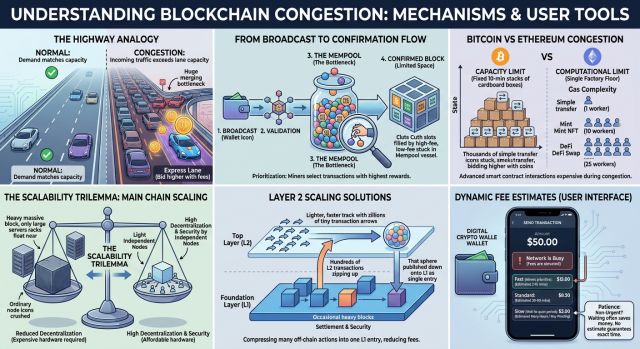
The easiest way to understand congestion is to imagine a busy highway. The road has a fixed number of lanes, and each lane can carry only so many cars. When traffic is light, vehicles move quickly. During rush hour, more cars enter the highway than it can comfortably handle. Traffic slows down, queues form, and drivers compete for limited road space. A blockchain experiences something similar when too many users submit transactions at once.
When a user sends cryptocurrency or interacts with a decentralized application, the transaction does not usually enter the blockchain immediately. It is first broadcast to network nodes, which check whether it follows the protocol rules. Valid but unconfirmed transactions are placed in a temporary waiting area commonly known as the mempool, short for memory pool.
Miners or validators select transactions from the mempool and include them in new blocks. Since block space is limited, they cannot always process every waiting transaction. During quiet periods, the mempool may remain relatively small, allowing most transactions to be confirmed quickly. During congestion, thousands or even hundreds of thousands of transactions may compete for inclusion.
Transaction fees become especially important at this point. Users normally attach a fee to their transaction, and miners or validators receive part or all of that fee as compensation for processing it. When block space is scarce, users who want faster confirmation offer higher fees. Block producers naturally prioritize transactions that provide the greatest reward.
This creates a fee market. Users are effectively bidding against one another for limited space in the next block. A transaction with a high fee may be processed quickly, while one with a low fee can remain unconfirmed for a long time. The transaction has not necessarily failed or disappeared. It is simply waiting because other users are offering more attractive fees.
This is why blockchain fees can rise dramatically during popular events. A major market movement may cause traders to rush coins to and from exchanges. A highly anticipated NFT launch can attract thousands of buyers at the same moment. A new token or decentralized finance opportunity can produce a sudden wave of smart-contract activity. Even a surge in simple transfers can overwhelm a network when demand rises faster than capacity.
Congestion affects different blockchains in different ways. Bitcoin has a limited amount of block space and produces blocks approximately every ten minutes on average. When demand increases, transactions accumulate in the mempool and users compete by raising fees. Because block discovery is probabilistic, the exact waiting time can be difficult to predict.
Ethereum also experiences congestion, but its transactions can be more complicated. Sending tokens, trading on decentralized exchanges, minting NFTs, borrowing funds, and interacting with smart contracts all require computational work. Ethereum measures this work using a unit called gas. More complex operations require more gas than simple transfers, which means congestion can make advanced smart-contract interactions particularly expensive.
A transaction involving a decentralized exchange may therefore cost far more than sending a token from one wallet to another. During intense congestion, the fee can become so high that completing a small transaction no longer makes financial sense. Someone trying to swap $30 worth of tokens may discover that the network fee is nearly as large as the transaction itself.
Congestion can also cause user confusion. A wallet may display a transaction as pending for hours, leading the user to believe that the funds have been lost. In most cases, the blockchain has not taken the money permanently. The transaction is waiting for confirmation or may eventually be dropped from the mempool if it remains unconfirmed for too long.
Users should avoid submitting the same payment repeatedly without understanding how the wallet handles pending transactions. On account-based networks, transactions from one wallet may need to be processed in a specific sequence. An earlier transaction with a fee that is too low can sometimes delay later transactions from the same address, even if those later transactions offer better fees.
Many wallets provide tools for dealing with this problem. On Bitcoin, a feature called Replace-by-Fee may allow the sender to replace a pending transaction with another version offering a higher fee. Child Pays for Parent is another method in which a second transaction pays enough to encourage miners to confirm both the new transaction and the older one it depends on.
On Ethereum and similar networks, users may be able to speed up or cancel a pending transaction by submitting a replacement with the same nonce and a higher fee. Cancellation does not erase the original request from existence. Instead, it usually sends a new transaction to the user’s own address, designed to be confirmed first and replace the pending operation.
However, users should be careful when attempting these methods. Incorrect settings can create additional delays or fees. The safest approach is usually to use the speed-up or cancel function built into a reputable wallet rather than manually adjusting advanced transaction details without understanding them.
Blockchain congestion does not normally mean that the network is broken. In fact, it can indicate strong demand for the network’s limited resources. The problem is that demand has exceeded available capacity. A secure and decentralized blockchain may intentionally limit how much data each block can contain because larger blocks require more storage, processing power, and bandwidth.
Increasing block capacity sounds like an obvious solution, but it involves trade-offs. If blocks become extremely large, operating a full node becomes more expensive. Fewer ordinary users may be able to verify the blockchain independently, potentially leading to greater centralization. Blockchain developers must therefore balance speed and capacity against security, decentralization, and accessibility.
Different networks attempt to solve congestion in different ways. Some increase block size or shorten block times. Others use alternative consensus mechanisms capable of processing more transactions. Many ecosystems rely on Layer 2 networks, which move activity away from the main blockchain while still using it for security or final settlement.
Bitcoin’s Lightning Network, for example, allows users to conduct many small payments outside the main chain and record only selected results on Bitcoin. Ethereum scaling solutions use technologies such as rollups to combine many transactions into a compressed batch before publishing the necessary information to the main network. This can reduce fees and increase capacity without requiring every transaction to consume full main-chain block space.
Sidechains and alternative blockchains offer additional options, although they may provide different security guarantees. Users often move between networks based on cost, speed, liquidity, and application availability. This creates a broader blockchain ecosystem in which the main chain is not expected to process every individual action directly.
From a practical perspective, users can reduce the impact of congestion by checking network conditions before making non-urgent transactions. Many wallets estimate the fees required for slow, standard, or fast confirmation. Blockchain explorers also display current fee levels, mempool size, and recent block activity.
Sending transactions during quieter periods can lower costs, although blockchain activity is global and does not always follow a predictable schedule. Users should also consider whether a Layer 2 network or lower-cost alternative is suitable for the transaction. For large transfers, paying a higher fee for prompt confirmation may be reasonable. For small or non-urgent transfers, waiting can be the better choice.
It is also important to set realistic fees. Offering too little may leave the transaction pending, while offering far more than necessary wastes money. Modern wallets usually provide dynamic estimates based on current network demand, although no estimate can guarantee the exact confirmation time.
Congestion matters beyond individual inconvenience. High fees can prevent smaller users from participating in decentralized applications, reduce the usefulness of cryptocurrency for everyday payments, and push activity toward centralized platforms. At the same time, transaction fees provide economic incentives for miners and validators, helping pay for network security.
The fee market therefore serves two purposes. It allocates scarce block space to users who value it most, and it rewards the participants who process and secure transactions. The challenge is designing networks that remain economically sustainable without making ordinary usage unaffordable.
Ultimately, blockchain congestion is the result of limited capacity meeting high demand. Transactions gather in the mempool, users compete through fees, and miners or validators prioritize the most profitable operations. Some transactions confirm quickly, while others wait or are eventually removed.
The experience can be frustrating, but it reveals an important truth about blockchain technology: decentralization does not create unlimited resources. Block space is valuable because thousands of independent participants must verify and store the information it contains. Understanding congestion, transaction fees, mempools, and confirmation priority allows users to make better decisions and avoid unnecessary panic when a blockchain becomes busy.
Anyone can join.
Anyone can contribute.
Anyone can become informed about their world.
"United We Stand" Click Here To Create Your Personal Citizen Journalist Account Today, Be Sure To Invite Your Friends.
Before It’s News® is a community of individuals who report on what’s going on around them, from all around the world. Anyone can join. Anyone can contribute. Anyone can become informed about their world. "United We Stand" Click Here To Create Your Personal Citizen Journalist Account Today, Be Sure To Invite Your Friends.
LION'S MANE PRODUCT
Try Our Lion’s Mane WHOLE MIND Nootropic Blend 60 Capsules
Mushrooms are having a moment. One fabulous fungus in particular, lion’s mane, may help improve memory, depression and anxiety symptoms. They are also an excellent source of nutrients that show promise as a therapy for dementia, and other neurodegenerative diseases. If you’re living with anxiety or depression, you may be curious about all the therapy options out there — including the natural ones.Our Lion’s Mane WHOLE MIND Nootropic Blend has been formulated to utilize the potency of Lion’s mane but also include the benefits of four other Highly Beneficial Mushrooms. Synergistically, they work together to Build your health through improving cognitive function and immunity regardless of your age. Our Nootropic not only improves your Cognitive Function and Activates your Immune System, but it benefits growth of Essential Gut Flora, further enhancing your Vitality.

Our Formula includes: Lion’s Mane Mushrooms which Increase Brain Power through nerve growth, lessen anxiety, reduce depression, and improve concentration. Its an excellent adaptogen, promotes sleep and improves immunity. Shiitake Mushrooms which Fight cancer cells and infectious disease, boost the immune system, promotes brain function, and serves as a source of B vitamins. Maitake Mushrooms which regulate blood sugar levels of diabetics, reduce hypertension and boosts the immune system. Reishi Mushrooms which Fight inflammation, liver disease, fatigue, tumor growth and cancer. They Improve skin disorders and soothes digestive problems, stomach ulcers and leaky gut syndrome. Chaga Mushrooms which have anti-aging effects, boost immune function, improve stamina and athletic performance, even act as a natural aphrodisiac, fighting diabetes and improving liver function. Try Our Lion’s Mane WHOLE MIND Nootropic Blend 60 Capsules Today. Be 100% Satisfied or Receive a Full Money Back Guarantee. Order Yours Today by Following This Link.


| Visits: | 1,835,504,283 |
| Stories: | 8,724,138 |
Whistler Blowers, Insiders

