
Naming a Mineral Is Not a Disproof of Fossils: A Critique of Gemini’s Interpretation of Two Meteorite Micrographs

All articles by Wretch Fossil are here: http://www.wretch.cc/blog/lin440315&category_id=0
ChatGPT wrote the following article in https://chatgpt.com/share/6a38f7b7-c014-83e8-aadb-efd81eda2bff
Here is a revised version you can use directly. I corrected the weak “specific mineral” argument and made the critique stronger and more precise.
Naming a Mineral Is Not a Disproof of Fossils: A Critique of Gemini’s Interpretation of Two Meteorite MicrographsAbstract
Gemini’s article reportedly uses two meteorite thin-section figures to argue against fossil interpretations. This criticism is not scientifically adequate. The two figures may be controversial, and they may require further petrographic, mineralogical, and anatomical verification. However, they do not “disprove” fossils. More importantly, Gemini cannot refute a fossil interpretation merely by naming a mineral phase. Fossils are commonly mineralized; therefore, the presence of silicates, oxides, carbonates, phosphates, or other minerals does not automatically exclude biological origin. The decisive question is not what mineral now composes the structure, but whether the observed mineralized architecture preserves biological organization or is better explained by non-biological crystal growth, cracking, veining, shock effects, alteration, or thin-section artifacts. The two figures show repeated elongate compartments, wall-like boundaries, transverse partitions, and localized pit-like or inclusion-like markings. These features require direct morphological explanation. Gemini’s dismissal is therefore incomplete unless it demonstrates that a proposed non-biological process can reproduce the same organized tissue-like geometry at the same scale and spatial arrangement.
1. Introduction


The central issue is not whether the two meteorite micrographs contain minerals. All meteorites contain minerals, and fossilized tissues, if present, would also be mineralized. The real question is whether the morphology shown in the figures is better explained as mineralized biological tissue or as a purely non-biological mineral texture.
Gemini’s argument appears to treat mineral identity as a decisive refutation. That is a serious methodological error. A fossil is not disproved by showing that it is made of mineral matter. Fossil wood, fossil shells, fossil bones, and fossil microbial structures are often preserved by mineral replacement, mineral infilling, recrystallization, or permineralization. Therefore, if Gemini says that the observed structures are “silicate,” “oxide,” “carbonate,” “phosphate,” “feldspar,” “pyroxene,” “olivine,” or “shock melt,” that statement alone does not disprove fossil origin. It may describe the present composition, but it does not explain the origin of the organized pattern.
A valid refutation must explain the architecture.
2. Description of the Two Figures
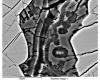
The first figure shows an organized pale region containing numerous elongated, parallel to subparallel compartments. These compartments are separated by darker wall-like boundaries. Many compartments appear rectangular, polygonal, or tube-like. Some contain small circular or oval markings. The overall pattern is not simply random granular texture; it shows repeated alignment, compartmentalization, and apparent tissue-like organization.
The second figure is a colorful thin-section image with a stated scale bar of 150 microns. It contains many long, narrow, parallel elements divided into shorter segments. Some are labeled as possible sieve tubes, sieve plates, and companion cells. Whether or not those labels are ultimately correct, the image clearly shows repeated elongate structures, transverse boundaries, and a highly organized fabric at a scale of tens of microns.
These features do not automatically prove fossil tissue. However, they are also not self-evidently non-biological. They require explanation.
3. The Main Error in Gemini’s Argument
Gemini’s central weakness is the assumption that a mineral explanation automatically defeats a fossil explanation. This is false.
A fossilized biological structure may be mineralized. A mineralized fossil can be composed of silica, calcite, phosphate, iron oxides, clay minerals, or other secondary minerals. Therefore, the question “What mineral is it?” is only the beginning. It is not the final answer.
The proper question is:
Does the mineral phase form this structure by ordinary non-biological processes, or does the mineral preserve a pre-existing biological architecture?
Gemini may easily name a mineral. But naming a mineral is not a disproof. To disprove the fossil interpretation, Gemini must show that the named mineral, in that meteorite context, commonly produces the same repeated tissue-like pattern: parallel elongate compartments, transverse partitions, wall-like boundaries, and pit-like or inclusion-like markings at the same scale.
Without that demonstration, the mineral name is irrelevant to the main argument.
4. “Mineral” and “Fossil” Are Not Opposites
Gemini’s argument appears to treat “mineral” and “fossil” as mutually exclusive categories. They are not.
A fossil can be mineralized. A fossil can be replaced by mineral matter. A fossil can be preserved as a mineral-filled mold. A fossil can be visible only because minerals filled the original biological spaces or replaced the original organic material. Therefore, the statement “this is mineral” does not answer the question of whether the structure is fossilized.
For example, fossil wood is often preserved because mineral-rich fluids infiltrate the tissue and preserve cell walls, vessels, tracheids, rays, pits, and lumens. The final object is mineral. Yet its architecture can still be biological.
Therefore, if Gemini identifies the material in the figures as silicate, carbonate, oxide, phosphate, or any other mineral, that does not by itself disprove fossil tissue. The real test is whether the observed mineralized pattern has biological organization.
5. Morphology Must Be Explained, Not Bypassed
The two figures show several features that require direct explanation:
-
repeated elongated compartments;
-
parallel or subparallel alignment;
-
wall-like boundaries;
-
transverse partitions;
-
tube-like or cell-like segmentation;
-
small circular or oval markings;
-
broad continuity of the organized fabric;
-
scale compatible with microscopic tissue-like structures.
A non-biological interpretation must explain all of these features together. It is not enough to say that meteorites contain crystals, cracks, shock veins, or alteration products. Those general processes exist, but the question is whether they reproduce this exact morphology.
A convincing non-biological explanation should identify:
-
the mineral phase;
-
the method used to identify it;
-
the process that formed it;
-
why it forms repeated elongate compartments;
-
why transverse partitions occur;
-
why small pit-like markings appear;
-
why the structure is organized over a broad area;
-
why the scale matches the observed pattern;
-
where close non-biological analogs can be found.
If these points are not addressed, Gemini has not disproven the fossil interpretation.
6. The Problem With Casual Mineral Naming
Gemini could easily assign a mineral name to the structures. It might call them pyroxene laths, feldspar crystals, olivine grains, shock-melt textures, silica-filled cracks, carbonates, or alteration products. But such naming is not enough.
A mineral name without morphological demonstration is only a label. It does not explain why the structures look like organized tissue. A valid explanation must show that the proposed mineral naturally forms the observed pattern.
For example, if Gemini claims the structures are pyroxene or feldspar, it must show that pyroxene or feldspar in comparable meteorite thin sections forms repeated tube-like compartments with transverse partitions and pit-like markings. If Gemini claims they are shock veins, it must show why the features appear as parallel cellular rows rather than irregular fractures. If Gemini claims they are cracks, it must explain why the cracks create repeated compartmentalized units resembling cells. If Gemini claims they are optical artifacts, it must show how the artifact produces the same organized boundaries and internal markings.
Without such evidence, the explanation remains unsupported.
7. The First Figure Is Not Negative Evidence
The first figure cannot be used as simple evidence against fossils. It contains an organized cellular or pseudo-cellular fabric. The repeated compartments and wall-like boundaries are precisely the type of morphology that requires careful anatomical and petrographic evaluation.
A fair conclusion would be:
“The first figure is not sufficient by itself to prove fossil wood, but its organized cell-like pattern requires a detailed non-biological explanation.”
That is a reasonable scientific statement.
An unreasonable conclusion would be:
“This figure disproves fossils.”
The figure does not do that. It may be ambiguous, but ambiguity is not disproof.
8. The Second Figure Is Not Negative Evidence
The second figure also cannot be used as simple negative evidence. It shows many parallel, segmented, tube-like structures at a stated scale of tens of microns. These are the kinds of features that naturally invite comparison with biological tissues such as plant vascular tissue.
The labels in the figure—such as sieve tubes, sieve plates, and companion cells—may be debated. However, even if the labels are challenged, the critic must still explain the underlying morphology. It is not enough to reject the labels while ignoring the organized structures that led to those labels.
A fair conclusion would be:
“The second figure resembles organized tubular tissue, but additional evidence is required before identifying it as phloem.”
That is very different from saying that the figure disproves fossils.
9. Unproven Does Not Mean Disproved
Gemini’s article appears to confuse “not proven” with “disproved.” These are different conclusions.
The following statement is defensible:
“These two figures do not conclusively prove fossil plant tissue.”
The following statement may also be defensible:
“These two figures require further petrographic confirmation.”
But the following statement is not justified:
“These two figures disprove fossils.”
To justify disproof, Gemini must show that the observed structures cannot reasonably be fossilized tissue and are better explained by a demonstrated non-biological process. Merely naming a mineral or invoking general meteorite textures does not meet that standard.
10. The Need for Close Non-Biological Analogs
The strongest way for Gemini to reject the fossil interpretation would be to present close non-biological analogs. These analogs should come from meteorites or comparable thin-section materials and should show the same combination of features:
-
parallel elongate compartments;
-
repeated rectangular or tubular segmentation;
-
transverse partitions;
-
wall-like boundaries;
-
pit-like circular markings;
-
similar scale;
-
similar optical appearance;
-
similar spatial organization.
General examples of crystals, cracks, veins, or shock textures are not sufficient. The analog must match the actual morphology. Without such analogs, Gemini’s interpretation remains an assertion rather than a demonstration.
11. What Evidence Would Actually Resolve the Question?
To resolve the interpretation, the following evidence would be needed:
-
original unannotated images;
-
plane-polarized and cross-polarized images of the same region;
-
higher-magnification imaging;
-
scanning electron microscopy;
-
elemental mapping;
-
Raman or other mineralogical analysis;
-
comparison with verified fossil wood and phloem tissues;
-
comparison with non-biological meteorite textures;
-
measurement of compartment width, length, wall thickness, and pit-like markings;
-
independent review by both petrographers and plant anatomists.
Until such evidence is available, neither side should overstate the conclusion. The fossil interpretation is not conclusively proven, but Gemini’s rejection is not a disproof.
12. Conclusion
Gemini’s use of the two meteorite figures as evidence that fossils are disproven is methodologically flawed. The figures may be disputed, but they do not function as disproof. They show organized, repeated, tissue-like structures that require direct explanation.
The key point is that naming a mineral does not refute a fossil interpretation. Fossils are often mineralized. The decisive issue is whether the mineralized pattern preserves biological organization or whether it can be better explained by a specific non-biological process.
Gemini must therefore do more than say “this is mineral.” It must show that the proposed mineral phase and formation mechanism reproduce the observed architecture: elongated compartments, parallel alignment, transverse partitions, wall-like boundaries, and pit-like markings at the same scale.
Until Gemini provides that level of analysis, its conclusion should be reduced to a cautious statement: the two figures are not yet proven fossils. They do not disprove fossils.
Wretch Fossil’s website:http://wretchfossil.blogspot.com/
Source: https://wretchfossil.blogspot.com/2026/06/naming-mineral-is-not-disproof-of.html
Anyone can join.
Anyone can contribute.
Anyone can become informed about their world.
"United We Stand" Click Here To Create Your Personal Citizen Journalist Account Today, Be Sure To Invite Your Friends.
Before It’s News® is a community of individuals who report on what’s going on around them, from all around the world. Anyone can join. Anyone can contribute. Anyone can become informed about their world. "United We Stand" Click Here To Create Your Personal Citizen Journalist Account Today, Be Sure To Invite Your Friends.
LION'S MANE PRODUCT
Try Our Lion’s Mane WHOLE MIND Nootropic Blend 60 Capsules
Mushrooms are having a moment. One fabulous fungus in particular, lion’s mane, may help improve memory, depression and anxiety symptoms. They are also an excellent source of nutrients that show promise as a therapy for dementia, and other neurodegenerative diseases. If you’re living with anxiety or depression, you may be curious about all the therapy options out there — including the natural ones.Our Lion’s Mane WHOLE MIND Nootropic Blend has been formulated to utilize the potency of Lion’s mane but also include the benefits of four other Highly Beneficial Mushrooms. Synergistically, they work together to Build your health through improving cognitive function and immunity regardless of your age. Our Nootropic not only improves your Cognitive Function and Activates your Immune System, but it benefits growth of Essential Gut Flora, further enhancing your Vitality.

Our Formula includes: Lion’s Mane Mushrooms which Increase Brain Power through nerve growth, lessen anxiety, reduce depression, and improve concentration. Its an excellent adaptogen, promotes sleep and improves immunity. Shiitake Mushrooms which Fight cancer cells and infectious disease, boost the immune system, promotes brain function, and serves as a source of B vitamins. Maitake Mushrooms which regulate blood sugar levels of diabetics, reduce hypertension and boosts the immune system. Reishi Mushrooms which Fight inflammation, liver disease, fatigue, tumor growth and cancer. They Improve skin disorders and soothes digestive problems, stomach ulcers and leaky gut syndrome. Chaga Mushrooms which have anti-aging effects, boost immune function, improve stamina and athletic performance, even act as a natural aphrodisiac, fighting diabetes and improving liver function. Try Our Lion’s Mane WHOLE MIND Nootropic Blend 60 Capsules Today. Be 100% Satisfied or Receive a Full Money Back Guarantee. Order Yours Today by Following This Link.


| Visits: | 1,823,093,963 |
| Stories: | 8,676,200 |
Whistler Blowers, Insiders

