

The Phylum Bryozoa is now known from the Cambrian. An updated set of posts.

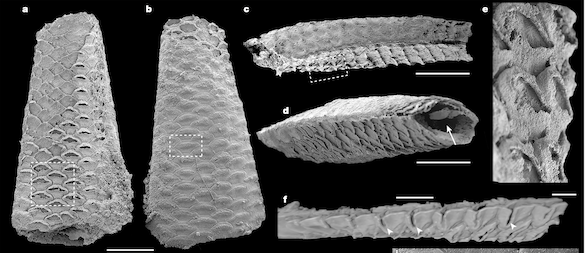 The vexing question of the earliest bryozoans has now been definitively answered. The Phylum Bryozoa appears first in early Cambrian rocks in China (Song et al., 2026). Until recently they were one of the few major animal phyla not represented in the Cambrian. Because I had a minor role in the story, I’ve twice updated a 2012 blog post of mine and made this composite entry to give a sense of the history of the Cambrian bryozoan issue. I start with the recent news and work back to 2012.
Editor’s Second Note: Yesterday (June 3, 2026) an article appeared in Nature by Song et al. (2026) with the decisive title: “High-fidelity modular skeletons authenticate a Cambrian origin for Bryozoa.” Here is its abstract:
The major animal body plans originated during the Cambrian explosion, yet the
phylum Bryozoa has remained a conspicuous exception to this pattern. The initial
discovery of Protomelission gatehousei provided compelling evidence for a Cambrian
origin for the Bryozoa, together with other major metazoan phyla and compatible
with independent molecular clock estimates. Nevertheless, the scarcity of definitive
soft-tissue anatomy and diagnostic skeletal microstructure has left its phylogenetic
affinities ambiguous and debated. Here we report exquisite fossils of P. gatehousei
and a new taxon, Dayingomelission hexaclitia gen. et sp. nov., from the early Cambrian
Xiannüdong Formation of China. These specimens preserve in situ phosphatized
soft tissues in modular skeletons, revealing critical anatomical structures, including
styles, annular muscles, membranous sacs and ring septa. This suite of traits provides
definitive evidence that these taxa belong to the Bryozoa. Phylogenetic analysis
incorporating these new features identifies them as crown group stenolaemates.
These results confirm a Cambrian origin for the phylum and reveal an unexpected
early disparity in colonial architecture, demonstrating that bryozoan diversification
was an integral component of the Cambrian radiation. Moreover, the early appearance
of a differentiated stenolaemate crown group indicates a still deeper origin for the
bryozoan stem lineage than was first apparent.
The top images are from Figure 1 (a-f) of Song et al. (2026): Specimen of Protomelission gatehousei from the Xiannüdong Formation in which the membranous sacs are preserved. Scale bars: 500 μm (a–d), 50 μm (e), 200 μm (f).
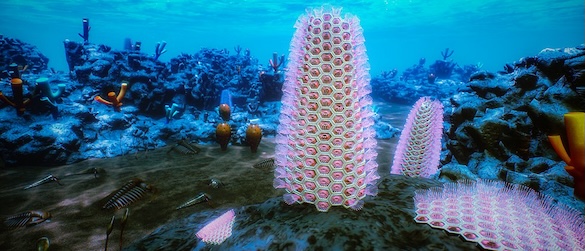 Image above from an Uppsala University press release: “The newly discovered bryozoans were only a few millimetres in size and lived attached to the seabed in shallow tropical seas. The image is a reconstruction of what they may have looked like. Illustration: Zhifei Zhang.”
We can now conclude that Protomelission gatehousei and Dayingomelission hexaclitia are Cambrian bryozoans, and Pywackia is not. The Phylum Bryozoa is known in the fossil record from the early Cambrian. Time to update textbooks and databases!
Editor’s First Note: The post below was written in December 2012 about a purported bryozoan found in Cambrian rocks. This would have been a major find because bryozoans, a major fossilized phylum, were notably missing from the Cambrian record, despite molecular evidence that they must have been there. The fossil described in this old post is almost certainly not a bryozoan, but NOW a recent publication describes clear and distinct bryozoans from the Early Cambrian of Australia and South China: Zhang, Z., Zhang, Z., Ma, J., Taylor. P.D., Strotz, L.C., Jacquet, S.M., Skovsted, C.B., Chen, F., Han, J. & Brock, G.A. 2021. Fossil evidence unveils an early Cambrian origin for Bryozoa. Nature; https://doi.org/10.1038/s41586-021-04033-w. (Note that friend of the department Paul Taylor is among the authors.) The new bryozoan fossil is erect, bilaminate, and secondarily phosphatized. Its taxonomic name is Protomelission gatehousei. Andrej Ernst and I wrote a Nature News & Views article about this fantastic story. Now we all must update our lectures on bryozoans and the Cambrian radiation!
The original December 2012 post (now more than 14 years old!) is below.
_______________________________________________
 DUBLIN, IRELAND — It was a great day of talks at the 56th Palaeontological Association Annual Meeting being held at University College Dublin. I learned many things, from new ideas about the Burgess Shale and its characteristic fauna to why there is no demonstrated sexual dimorphism among Mesozoic vertebrates. (I also learned that the students in this university must sit in very cramped spaces in chilly rooms. Wooster students: note your classroom comforts!) My favorite talk of the day was one on which I was a co-author: “Is the world’s oldest bryozoan actually the world’s oldest pennatulacean?” Our senior author and genius of the project, Paul Taylor, gave the lecture. I’m presenting here two slides from the PowerPoint presentation. We’ll have much more about this topic when we have our paper on it in press. In the top image you see on the left Pywackia baileyi, a putative Cambrian bryozoan recently described in a high-profile journal. This is a big deal because bryozoans are known as one of the very few phyla not found in the Cambrian. We looked at the evidence and the specimens and quickly concluded this Pywackia baileyi is not a bryozoan. (Tell your friends!). Instead it appears to be pennatulacean-like octocoral. The image in the top right is of Lituaria, a modern pennatulacean. Note how similar these structures are, except for almost an order of magnitude size difference (which is reduced when looking at the range of sizes in other pennatulaceans).
 In the above slide from Paul’s presentation you see Pywackia and Lituaria again on the left, and then a variety of living pennatulacean octocorals on the right. We have strong evidence, from the morphology to the possible original phosphatic composition, that Pywackia baileyi is not the earliest bryozoan. We have thus far a good case that it instead represents the earliest pennatulacean octocoral. Again, this story will be developed further later in this blog after our paper is accepted for publication.
 The day ended with the traditional, raucous annual Palaeontological Association dinner at the Jameson Distillery in downtown Dublin. In the above image you can see in the foreground on the right Wooster alumna Lisa Park Boush and her husband Carlton. We are among just a scattering of Americans at this European meeting. It was a very pleasant (if very loud) evening!
References:
Landing, E., English, A. and Keppie, J.D. 2010. Cambrian origin of all skeletalized metazoan phyla—Discovery of Earth’s oldest bryozoans (Upper Cambrian, southern Mexico). Geology 38: 547-550.
Song, B., Zhifei Z., Strotz, L.C., Topper, T.P., Ernst, A., Ma, J., Zhang, Z., Luo, M., and Holmer, L.E. 2026. High-fidelity modular skeletons authenticate a Cambrian origin for Bryozoa. Nature; https://doi.org/10.1038/s41586-026-10590-9
Taylor, P.D., Berning, B. and Wilson, M.A. 2012. Is the world’s oldest bryozoan actually the world’s oldest pennatulacean? Palaeontological Association 56th Annual Meeting, Dublin, Ireland, Programme and Abstracts, p. 52.
Zhang, Z., Ma, J., Taylor. P.D., Strotz, L.C., Jacquet, S.M., Skovsted, C.B., Chen, F., Han, J. & Brock, G.A. 2021. Fossil evidence unveils an early Cambrian origin for Bryozoa. Nature; https://doi.org/10.1038/s41586-021-04033-w.
Source: https://woostergeologists.scotblogs.wooster.edu/2026/06/04/cambrian-bryozoans-not-yet/
Anyone can join.
Anyone can contribute.
Anyone can become informed about their world.
"United We Stand" Click Here To Create Your Personal Citizen Journalist Account Today, Be Sure To Invite Your Friends.
Before It’s News® is a community of individuals who report on what’s going on around them, from all around the world. Anyone can join. Anyone can contribute. Anyone can become informed about their world. "United We Stand" Click Here To Create Your Personal Citizen Journalist Account Today, Be Sure To Invite Your Friends.
LION'S MANE PRODUCT
Try Our Lion’s Mane WHOLE MIND Nootropic Blend 60 Capsules
Mushrooms are having a moment. One fabulous fungus in particular, lion’s mane, may help improve memory, depression and anxiety symptoms. They are also an excellent source of nutrients that show promise as a therapy for dementia, and other neurodegenerative diseases. If you’re living with anxiety or depression, you may be curious about all the therapy options out there — including the natural ones.Our Lion’s Mane WHOLE MIND Nootropic Blend has been formulated to utilize the potency of Lion’s mane but also include the benefits of four other Highly Beneficial Mushrooms. Synergistically, they work together to Build your health through improving cognitive function and immunity regardless of your age. Our Nootropic not only improves your Cognitive Function and Activates your Immune System, but it benefits growth of Essential Gut Flora, further enhancing your Vitality.

Our Formula includes: Lion’s Mane Mushrooms which Increase Brain Power through nerve growth, lessen anxiety, reduce depression, and improve concentration. Its an excellent adaptogen, promotes sleep and improves immunity. Shiitake Mushrooms which Fight cancer cells and infectious disease, boost the immune system, promotes brain function, and serves as a source of B vitamins. Maitake Mushrooms which regulate blood sugar levels of diabetics, reduce hypertension and boosts the immune system. Reishi Mushrooms which Fight inflammation, liver disease, fatigue, tumor growth and cancer. They Improve skin disorders and soothes digestive problems, stomach ulcers and leaky gut syndrome. Chaga Mushrooms which have anti-aging effects, boost immune function, improve stamina and athletic performance, even act as a natural aphrodisiac, fighting diabetes and improving liver function. Try Our Lion’s Mane WHOLE MIND Nootropic Blend 60 Capsules Today. Be 100% Satisfied or Receive a Full Money Back Guarantee. Order Yours Today by Following This Link.


| Visits: | 1,831,114,705 |
| Stories: | 8,699,667 |
Whistler Blowers, Insiders

