
Golf Self-Talk Techniques: Build a Clearer Mind on the Course

What if the best thing to say to yourself on the golf course isn’t something positive, but something useful? After a poor shot, self-criticism can quickly take over. Under pressure, generic affirmations may feel unconvincing, while too many swing thoughts can make it harder to commit. Effective golf self-talk techniques don’t require you to feel confident every moment. They give your attention a clear, credible place to go.
You don’t need a perfect mindset to play your next shot well. You need a simple cue that fits the moment and brings you back to your process. “Choose a target,” “smooth start,” or “next shot” can be more grounding than trying to talk yourself into a mood you don’t feel.
In this article, you’ll learn how to choose and use practical self-talk cues before, during, and after a shot, including when frustration or distraction pulls you off course. You’ll also learn how to build a repeatable practice for your words, so they support focus and commitment rather than becoming another thought to manage.
- Distinguish automatic inner commentary from deliberate cues, so you can guide your attention instead of being pulled along by every thought.
- Build golf self-talk techniques around recurring pressure points and actions you can control, making your cues more believable and useful.
- Match your words to the moment: plan before the shot, use a brief cue to execute, and reflect afterward without judging yourself.
- When extra thoughts disrupt commitment, use a simple reset to regain focus and return to your routine.
- Practise your cues in low-pressure settings and review how they work, so self-talk becomes a consistent part of your mental game.
What Are Golf Self-Talk Techniques, and Why Do Your Words Matter?
Golf self-talk is the inner language you use to direct your attention, interpret what’s happening, and choose what to do next. It might be spontaneous commentary, such as “That’s another one left,” or a deliberate cue you’ve chosen to support your process, such as “Choose a clear target.” The first may simply arise; the second gives your attention a useful direction.
Golf self-talk is a trainable mental skill: noticing your inner language and choosing brief, useful words to support your next action. It sits within the broader field of sport psychology, where attention, interpretation, and performance are closely connected. A cue doesn’t control your swing or guarantee a result. It reminds you what you can do and helps you commit to the shot you’ve prepared to play.
How does self-talk affect attention during a golf shot?
Words can direct your focus toward a task or toward a worry. Standing over a shot, “I need to make up for that last hole” keeps attention on the score and what might go wrong. “Pick a landing spot” directs it to a decision you can make now. That shift doesn’t erase pressure, but it can make the next step clearer.
Keep your cue short enough to remember and relevant to the shot. It supports attention; it doesn’t replace physical skill, deliberate practice, or a suitable routine. Use language to prepare and commit, then allow your practiced movement to do its work.
Why can negative golf self-talk become a distraction?
After a poor shot, you may replay the mistake or predict the next one. Reflection can help when it leads to a useful decision, but repeated commentary can keep your attention on what has already happened while the next shot still needs a target, club choice, and routine. The problem isn’t that a negative thought appeared. It’s when you keep following it instead of returning to the task.
Notice the thought without treating it as an instruction or an established fact. “I’m worried about missing right” describes a feeling; it doesn’t determine where the ball will go. Acknowledge it, then bring your focus back to the next decision. This lets you learn from a mistake without carrying its commentary through the rest of the round.
How to Build Golf Self-Talk Techniques That Feel Believable
A useful cue doesn’t need to sound inspirational. It needs to make sense to you and point toward something you can do. Build it from your own thought patterns rather than borrowing a phrase that feels unnatural.
A good golf cue is brief, believable, and connected to an action you can control. Keep it short enough to remember without turning it into another swing thought.
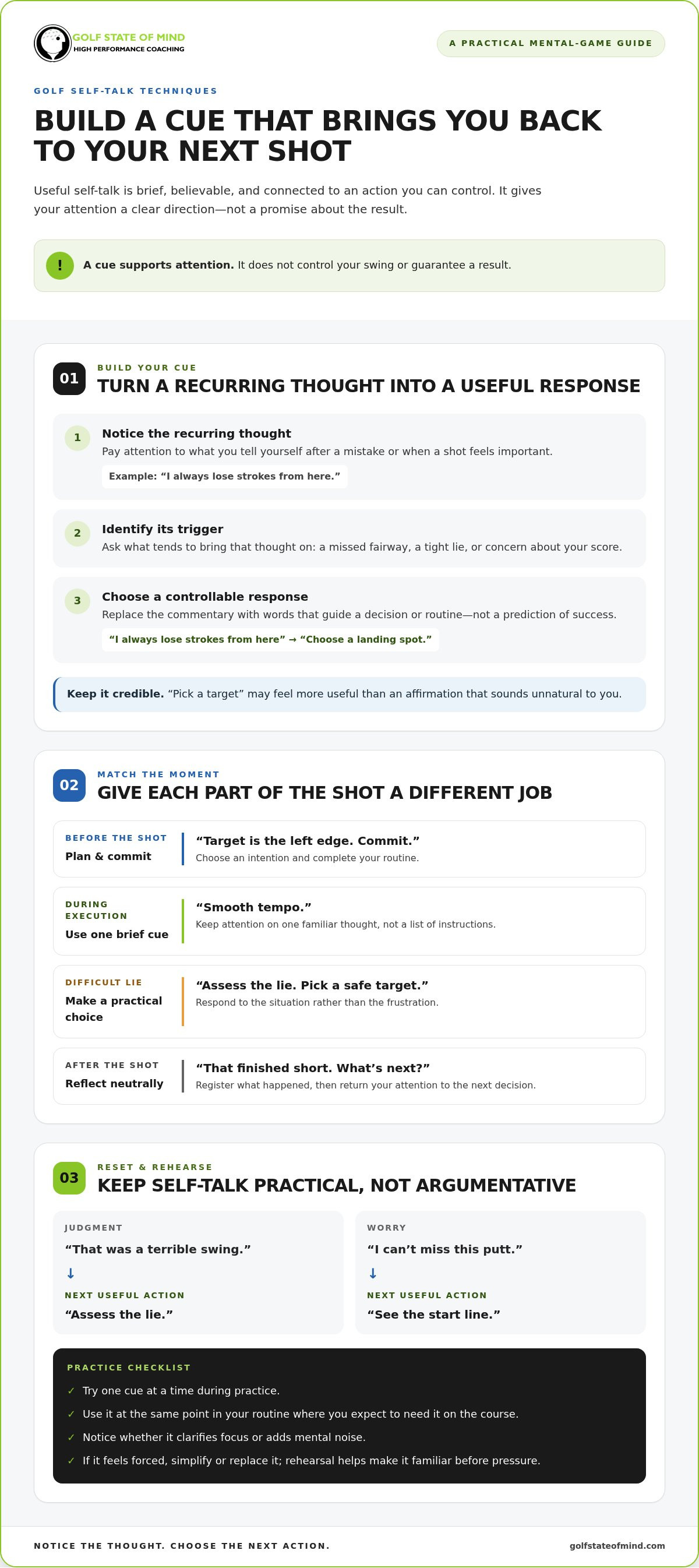
- Notice a recurring thought. Pay attention to the words that show up after a mistake or when a shot feels important. For example: “I always lose strokes from here.”
- Identify its trigger. Ask what tends to bring that thought on. Is it a missed fairway, a tight lie, or concern about your score? Recognizing the situation helps you prepare a response that fits.
- Choose a useful response. Direct your words toward a decision or routine. “I always lose strokes from here” might become “Choose a landing spot.” The goal isn’t to predict a good result, but to guide your next action.
Favor language that sounds like you. “Pick a target” may feel more credible than a sweeping affirmation about playing perfectly. A cue should support commitment, not promise confidence or control over the outcome.
How can you turn a negative thought into a useful cue?
Shift from judging yourself to choosing what comes next. “That was a terrible swing” can become “Assess the lie.” “I can’t miss this putt” might become “See the start line.” These replacements don’t require you to feel positive. Acknowledge the mistake or worry, then return your attention to the decision in front of you. That keeps self-talk practical rather than argumentative.
How should you practise a self-talk phrase before a round?
Try one cue at a time during practice. Use it at the same point in your routine where you expect to need it on the course, then notice whether it clarifies your focus or adds mental noise. If it feels forced or prompts extra analysis, simplify or replace it. Rehearsal makes a cue familiar before you use it under pressure.
Self-talk works best as part of a wider practice for focus, emotional regulation, and routine. For a structured approach, explore the Ultimate Mental Game Training System alongside your cue practice.
Which Golf Self-Talk Technique Fits Each Moment of the Round?
Self-talk has different jobs at different points in a hole. Planning language helps you make a decision; an execution cue keeps your attention from expanding into a list of instructions; reflection helps you register what happened and move on. One phrase may not work equally well in every situation. Match your words to the moment instead.
| Moment | Helpful cue type | Example | Intended focus |
|---|---|---|---|
| Before the shot | Planning and commitment | “Target is the left edge. Commit.” | Choose an intention and complete your routine. |
| During execution | Brief process cue | “Smooth tempo.” | Keep attention on one familiar thought. |
| Uncertain or difficult lie | Practical decision cue | “Assess the lie. Pick a safe target.” | Respond to the situation, not the frustration. |
| After the shot | Neutral reflection | “That finished short. What’s next?” | Take in useful information and return to the round. |
What should you say to yourself before a golf shot?
Use the planning stage to settle on your target, intended shot, and commitment. You might think, “Start it at the right side of the fairway,” then move through your golf pre-shot routine and use one short execution cue. Keep detailed technical analysis outside the final moment. Once you’re set, adding swing instructions can compete with the decision you’ve already made.
For a routine shot, a familiar cue such as “commit to the target” may be enough. If you’re unsure about the lie, assess your options before beginning the routine. Then choose a simple intention. Planning and execution are related, but they’re separate tasks.
What self-talk helps after a poor shot or under pressure?
Start with a neutral acknowledgment: “That missed right.” Then direct yourself toward a practical next step, such as checking the lie or selecting a target. Avoid turning one result into a prediction about your score, blaming yourself, or demanding that you feel calm immediately. You can feel frustrated and still make a clear next decision.
These golf self-talk techniques work alongside broader golf emotional control strategies. Use the words that fit the challenge: plan when you need to decide, simplify when it’s time to play, and reflect briefly before moving forward.
How to Use Golf Self-Talk Without Overthinking the Shot
A cue is useful only if it helps you return to the shot, not if it becomes another task to manage. Long instructions can crowd your attention, especially when you’re choosing a target, reading conditions, and following your routine. Keep the phrase brief and use it at the right time.
Self-talk should support your routine, then give way to execution. Once you’ve settled on a plan, let one simple cue remind you of your intention. Avoid repeating it or adding more instructions as you address the ball. The aim is commitment, not conscious control of every part of your movement.
Can positive self-talk make you overthink your golf swing?
It can, if “positive” means adding a string of technical instructions or insisting that you feel confident. A phrase like “keep my elbow here, rotate, and release” may compete with an established routine. Reduce it to one task or intention, such as “smooth tempo” or “start it at the target.” You don’t need to suppress every unwanted thought or replace it with forced optimism. Notice it, then return to the cue you chose.
How can you reset your self-talk after a mistake?
A poor result can be disappointing without dictating your next decision. Acknowledge it plainly, then shift your attention to what the next shot requires. Try this reset:
- Notice that your attention has moved to the mistake or a future outcome.
- Exhale and let your body settle before making another decision.
- Return to one chosen cue, such as “find the target” or “assess the lie.”
- Begin your routine when you’re ready to play.
Breathing can serve as a physical attention anchor, while a short phrase directs your focus back to the process. You don’t have to feel calm before continuing. You’re creating room to make the next decision without carrying the last shot into it.
Judge a cue by whether it helps you attend to your plan and commit to your routine, not by whether the shot produces a perfect result. The golf self-talk techniques that serve you best are practical reminders, not guarantees. For a structured way to practise mental skills alongside your routine, explore the Ultimate Mental Game Training System.
Turn Golf Self-Talk Techniques Into a Consistent Mental Training Practice
A cue that feels helpful in a quiet practice session may be harder to remember when a round gets tense. Rehearse it before you rely on it. Start in low-pressure settings, where you can notice how the words fit into your routine without expecting them to change the result of every shot.
How often should you practise golf self-talk?
Use a cue during ordinary range sessions and casual rounds, at the point where it belongs in your process. Keep your cue set small. Choose one phrase for a specific situation, such as beginning your routine or responding to a distraction, rather than switching among several options at once.
After using it, ask whether it felt natural and helped direct your attention to the task. If it triggered more analysis, shorten it or try different wording. There’s no fixed timeline for making a cue familiar, and practice doesn’t promise a particular score. Repetition helps you learn which language supports your process.
A short post-round review can make that learning more deliberate. Note:
- The cue: What did you say to yourself?
- The context: What was happening before you used it?
- The process: Did it help you return to your plan and commit to your routine?
Judge the cue by how it supported your attention and choices, not solely by the shot’s outcome. A well-chosen phrase can accompany a poor result and still help you stay with your intended process.
Where can golfers build a broader mental-game routine?
Self-talk is one part of mental preparation. It can work alongside skills for focus, emotional regulation, and pre-shot routines, giving you a more consistent way to respond across different situations. Practise each skill in manageable steps, then reflect on what serves you. This gradual approach builds awareness without promising instant change.
For golfers who want a structured way to develop these skills, the Ultimate Mental Game Training System provides digital mental-game training. Use it to build a steady practice around your golf self-talk techniques.
Make Your Next Round a Practice in Clearer Self-Talk
The most useful golf self-talk techniques aren’t demands to stay positive or guarantees of a better score. They’re brief, believable cues that help you direct attention toward a decision you can control. Match your words to the moment: plan before the shot, keep execution simple, and use neutral reflection to move on afterward.
Choose one cue that feels natural and practise it during routine sessions before relying on it under pressure. After a round, consider whether it helped you stay with your process, regardless of the result. That steady review turns self-talk into a skill you can refine over time.
For a broader structure for developing your mental game, explore the Ultimate Mental Game Training System, a digital mental-game offering from Golf State of Mind.
Start with one clear cue, then give yourself room to play. Build a more committed process through practice, one shot at a time.
Frequently Asked Questions What are the best self-talk techniques for golf?
The best self-talk techniques are brief cues that feel believable and direct attention toward a controllable action. Use planning language to choose a target, a simple cue to support execution, and neutral reflection afterward. For example, “pick a landing spot” can help organize a decision, while “smooth tempo” may be easier to carry into the shot than several technical instructions. Choose wording that fits your routine and sounds natural to you.
What should I say to myself before a golf shot?
Before a shot, use words that help you settle on a target and commit to your plan. You might think, “Aim at the center of the green,” then begin your familiar routine. Keep technical analysis in the planning stage rather than adding several swing instructions as you address the ball. Your final cue should be short enough to remember and focused on the intention you’ve chosen, not on predicting the result.
Can positive self-talk improve golf performance?
Positive self-talk may help direct attention and support commitment, but it doesn’t guarantee a better shot or score. The words are most useful when they feel credible and connect to something you can do. If “I’m going to play perfectly” feels unrealistic, try a practical cue such as “choose a clear target.” You don’t have to force confidence; focus on language that helps you follow your preparation and routine.
How do I stop negative self-talk during a golf round?
You don’t need to eliminate every negative thought. Notice it without treating it as a fact or an instruction, then redirect your attention to a decision you can make. For example, after thinking, “I always miss this shot,” pause, exhale, and return to your target or routine. Replaying a mistake repeatedly can distract from the next task, while acknowledging it briefly can leave room to move forward.
Can golf self-talk make me overthink my swing?
Yes, especially if your self-talk becomes a long list of technical instructions during execution. Too many thoughts can compete with your established routine and make commitment harder. Reduce the language to one simple intention, such as “smooth tempo,” or use a target-focused cue. The purpose isn’t to control each movement consciously. Choose your plan, use a brief reminder, and then allow your practiced swing to unfold.
How do I use self-talk after a bad golf shot?
Start by acknowledging the result neutrally, without pretending you aren’t disappointed. “That finished short” describes what happened; “I’ve ruined the round” adds a judgment and prediction. Once you’ve registered the shot, shift to the next practical task, such as assessing the lie or selecting a target. A short reset helps separate the previous outcome from the next decision, which still deserves your attention.
How often should I practise golf self-talk techniques?
Practise golf self-talk techniques during regular range sessions and casual rounds, rather than saving them for high-pressure moments. Keep your cue set small and try one phrase in a specific part of your routine. Afterward, note whether it felt natural and supported your focus, regardless of the shot’s outcome. Review and adjust the wording over time. There’s no guaranteed timeline or score change; consistency helps you learn what works for your process.
The post Golf Self-Talk Techniques: Build a Clearer Mind on the Course appeared first on Instruction For The Mental Game of Golf.
Source: https://golfstateofmind.com/golf-self-talk-techniques-build-a-clearer-mind-on-the-course/
Anyone can join.
Anyone can contribute.
Anyone can become informed about their world.
"United We Stand" Click Here To Create Your Personal Citizen Journalist Account Today, Be Sure To Invite Your Friends.
Before It’s News® is a community of individuals who report on what’s going on around them, from all around the world. Anyone can join. Anyone can contribute. Anyone can become informed about their world. "United We Stand" Click Here To Create Your Personal Citizen Journalist Account Today, Be Sure To Invite Your Friends.
LION'S MANE PRODUCT
Try Our Lion’s Mane WHOLE MIND Nootropic Blend 60 Capsules
Mushrooms are having a moment. One fabulous fungus in particular, lion’s mane, may help improve memory, depression and anxiety symptoms. They are also an excellent source of nutrients that show promise as a therapy for dementia, and other neurodegenerative diseases. If you’re living with anxiety or depression, you may be curious about all the therapy options out there — including the natural ones.Our Lion’s Mane WHOLE MIND Nootropic Blend has been formulated to utilize the potency of Lion’s mane but also include the benefits of four other Highly Beneficial Mushrooms. Synergistically, they work together to Build your health through improving cognitive function and immunity regardless of your age. Our Nootropic not only improves your Cognitive Function and Activates your Immune System, but it benefits growth of Essential Gut Flora, further enhancing your Vitality.

Our Formula includes: Lion’s Mane Mushrooms which Increase Brain Power through nerve growth, lessen anxiety, reduce depression, and improve concentration. Its an excellent adaptogen, promotes sleep and improves immunity. Shiitake Mushrooms which Fight cancer cells and infectious disease, boost the immune system, promotes brain function, and serves as a source of B vitamins. Maitake Mushrooms which regulate blood sugar levels of diabetics, reduce hypertension and boosts the immune system. Reishi Mushrooms which Fight inflammation, liver disease, fatigue, tumor growth and cancer. They Improve skin disorders and soothes digestive problems, stomach ulcers and leaky gut syndrome. Chaga Mushrooms which have anti-aging effects, boost immune function, improve stamina and athletic performance, even act as a natural aphrodisiac, fighting diabetes and improving liver function. Try Our Lion’s Mane WHOLE MIND Nootropic Blend 60 Capsules Today. Be 100% Satisfied or Receive a Full Money Back Guarantee. Order Yours Today by Following This Link.


| Visits: | 1,835,731,730 |
| Stories: | 8,725,648 |
Whistler Blowers, Insiders

