

Amateur golf tournament mental preparation for calmer play

A steady tournament round is built before the first tee shot, not rescued after a mistake. Effective amateur golf tournament mental preparation gives nerves structure: a repeatable pre-shot routine, a calm response to imperfect shots, and attention on the shot in front of you rather than the final score.
It’s understandable to feel pressure when a tournament matters. The goal isn’t to force that feeling away or expect perfect golf; it’s to prepare a process you can return to when tension rises. A consistent routine and patient focus can make each decision more manageable.
This article explains how to rehearse your routine, warm up with purpose, reset after poor shots, find a personal way to get psyched up, and use breathing to settle before play. Together, these steps give you a practical framework for approaching the first tee and staying composed as the round unfolds.
- Build a pre-shot routine you can rely on in practice and under tournament pressure.
- Use a constructive response to poor shots to reset your attention and keep the round enjoyable.
- Plan a purposeful warm-up that prepares your body and mind before the first tee.
- Find a pre-round approach that suits you, whether it includes visualization, stretching, or music.
- Use controlled breathing, especially a full exhale, to ease tension while you wait to tee off.
How a coach helps amateur golfers develop a repeatable pre-shot routine
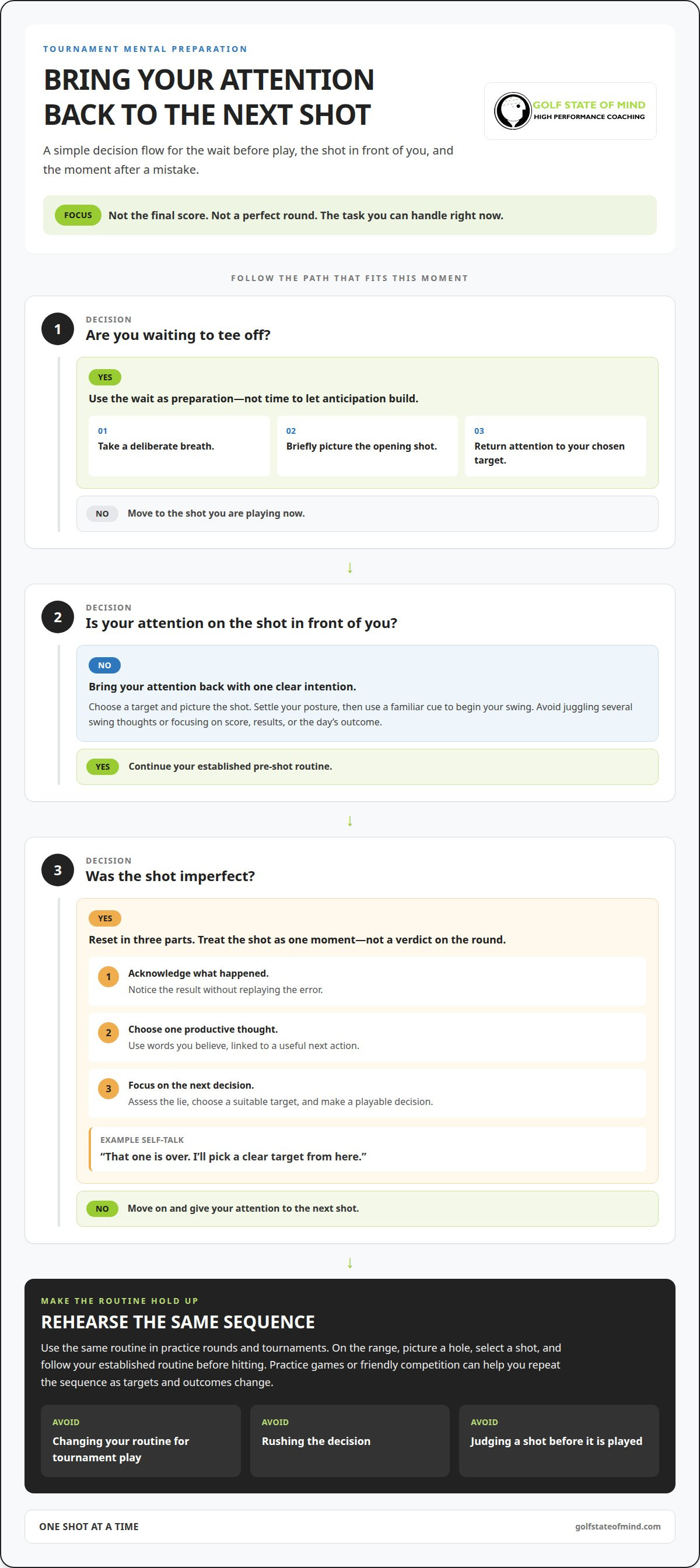
A golf mental coach can help make your pre-shot routine consistent, personal, and usable under tournament pressure. By looking at how you prepare in practice, a coach can help identify when your attention wanders and shape a sequence that suits you. It might include choosing a target, picturing the shot, settling your posture, and beginning your swing with a familiar cue. A repeatable routine is one part of amateur golf tournament mental preparation because it gives each shot a dependable structure.
Consistency matters across settings. Use the same routine during practice rounds and tournaments instead of introducing a new process on competition day. On the range, rehearse by picturing a hole, selecting a shot, and following your established routine before hitting. This connects your mental image with the actions that come before the swing.
Keep the sequence simple enough to recall when nerves rise. Settle on one clear intention, such as seeing the ball start toward your chosen target, rather than juggling several swing thoughts. A couple of deep breaths before the first tee can also become part of your preparation. Repeating a familiar cue directs attention back to the task and supports confidence.
During a round, keep your focus on the shot you’re playing. Thinking about your score, results, or the day’s outcome can pull attention away from the immediate decision. Instead, follow a repeatable path: assess the shot, commit to a target, make the intended swing, and move on. Patience matters because the next opportunity comes one shot at a time.
Common preparation mistakes include changing a routine for tournament play, rushing the decision, and judging a shot before it is played. A mental coach helps identify these patterns and replace them with clear cues that bring attention back to the current shot. The aim is not to control every outcome, but to give each shot the golfer’s best effort.
Another part of amateur golf tournament mental preparation is managing the wait before teeing off. After receiving your scorecard and meeting fellow competitors, you may have a few minutes before play begins. Use a practiced routine to fill that time: take a deliberate breath, briefly picture the opening shot, and return your attention to the chosen target. This keeps preparation steady instead of letting anticipation build unchecked.
To develop a routine that holds up in competition, rehearse with realistic practice games or friendly competition. Follow the same sequence as targets and outcomes change. Repetition can make the routine a reliable process, not a promise of perfect shots. That distinction helps you stay composed when a tournament presents an unexpected challenge.
How mental coaching helps golfers have fun and respond positively to poor shots
A mental coach helps a golfer treat an imperfect shot as one moment, not a verdict on the round. For example, after a tee shot misses the fairway, the coach can guide attention toward the ball’s lie, the next target, and a playable decision. This response replaces frustration with useful information. It also makes room to enjoy the challenge of the course without pretending every shot will be perfect.
A practical reset has three parts: acknowledge what happened, choose one productive thought, then focus on the next decision. You might say, “That one is over. I’ll pick a clear target from here.” Shape self-talk around words you believe, rather than forcing upbeat phrases that feel false. The goal is a composed response and a deliberate next step.
How can a golf mental coach help golfers build a tournament game plan and realistic goals? Match shot choices to your ability and playing style, then set goals around decisions and commitment rather than a promised score. For instance, emphasize choosing a sensible target and staying patient after a mistake. These practical standards give you something to return to during competition.
Visualization can also prepare a golfer for the opening hole and the shots that follow. A coach might guide a mental rehearsal of a par-4: picture the drive, then imagine the second shot with a 7 iron. The golfer can continue through each hole, visualizing a shot and the routine before it. This builds familiarity with the plan, while leaving room to adjust when the course presents a different situation.
After poor play, a coach can help the golfer identify one useful action instead of replaying the error. If an approach finishes short, the next focus might be assessing the lie and selecting a target that suits the player’s game. Positive self-talk can support that shift, but it should connect to an action. The player moves from judging the previous swing to engaging with the shot in front of them.
When setbacks repeatedly disrupt enjoyment or decision-making, structured mental game training can help golfers develop a more consistent response. The focus stays on practical skills: setting realistic goals, rehearsing course situations, and using productive self-talk after mistakes. A golfer can explore mental game training for tournament performance as a way to work on these skills systematically.
How a golf coach can help amateur golfers plan their warm-up and stretching before a tournament
A tournament warm-up should prepare you for the opening shots, not become another test of performance. Build a sequence around familiar movements, practice priorities, and the demands of the first hole. This connects physical readiness with tournament mental preparation by clarifying what to do before play begins. Allow time to stretch and warm up, start on the practice tee rather than the first tee, and leave time for work near the putting green.
The range portion can rehearse golf shots rather than chase perfect contact. For example, the coach can structure a simulated par-4: picture the drive, then rehearse the second shot with a 7 iron. The golfer can repeat swings to find a comfortable rhythm and move through clubs or targets with a clear purpose. The emphasis stays on preparation for competitive play, not hitting balls without a plan.
Include short-game practice near the putting green. Try different ways to get the ball up and down, preparing for varied lies and landing areas. This makes your warm-up more representative of course demands. Then transition from physical rehearsal to focused readiness, so the final practice shot doesn’t become a last-minute swing correction.
What can a golf mental coach help golfers plan for the night before and morning of a tournament? Organize your preparation, including equipment and travel logistics, a review of the opening hole, and a calm arrival with time to stretch. A defined plan reduces avoidable decisions on tournament morning and makes the transition into warm-up more orderly.
Sleep, nutrition, and warm-up can influence how alert and settled you feel. Build your plan around established habits rather than a rigid formula: choose familiar food and drink, follow a realistic bedtime routine, and warm up without rushing. Connecting these choices to amateur golf tournament mental preparation can reduce distractions and help you arrive focused on readiness.
Stretching belongs in that preparation, but it should be familiar and comfortable for the golfer. A coach can help place it before range work, then use repeated swings to build rhythm before moving to short-game shots. If the player feels hurried, the plan can clarify which preparation matters most: loosen up, rehearse representative shots, and arrive at the first tee mentally ready to compete.
A useful plan has a clear beginning, middle, and finish. The coach can help the golfer decide what to practice, how to transition between the range and putting green, and when to stop adding new swing thoughts. That structure makes tournament mental preparation part of a purposeful warm-up while keeping attention on readiness for the first shot.
How a golf mental coach can help golfers find a personal way to get psyched up
Getting psyched up doesn’t require copying another golfer’s habits. A mental coach helps you identify what leaves you alert and composed, then build a pre-round approach around those responses. For one player, quiet breathing may settle restless thoughts; another may feel more ready after stretching or listening to music. The aim is a useful state of readiness, not forced excitement.
A coach can help you assess your response to competitive events. Consider what happens before you tee off: do you feel flat, rushed, or overly focused on the result? Then test a practical adjustment, such as taking a few deliberate breaths, using music during preparation, or adding familiar stretches. Notice whether the change helps you feel focused enough to begin, rather than judging it by how energized you feel.
Experience across competitive rounds can reveal which preparation choices suit you. A coach can help you reflect on what you did before a composed round and what changed before a tense one. Perhaps a rushed arrival left little time to settle, or a quiet moment before the first tee helped you focus. These observations let you develop a personal routine from your own experience.
Pre-tournament nerves are normal. Instead of treating them as proof that you’re unprepared, a coach can help you channel that energy through positive thoughts and preparation. For example, recall a challenging situation you handled well, then picture yourself approaching the first hole with a clear plan. This grounds confidence in your ability to respond, rather than in a promise that every shot will go well.
Keep the routine specific and manageable. You might begin with stretching, take a few deep breaths, and visualize the first hole before play. A coach can help you decide the order and purpose of each activity, so you aren’t adding habits simply because another competitor uses them. The sequence should help you prepare, then let you turn attention toward the opening shot.
Review the approach after each event, not after every moment of discomfort. A competitive round can feel tense even when your preparation is working; the useful question is whether your routine helped you regain focus and play with intention. A coach can help you separate a difficult outcome from the preparation process. Keep the elements that support readiness, adjust those that distract, and build a method that feels like yourself.
Personal preparation is not a fixed script. A noisy event setting may call for a quiet pause, while a sluggish start may make familiar music or movement more useful. A mental coach can help you recognize these differences without abandoning the habits that anchor you. Over time, your approach becomes deliberate: choose an activity for a reason, use it consistently, and enter the tournament with attention on playing.
How a golf mental coach can teach breathing exercises to manage nerves
Make breathing a deliberate part of tournament preparation, not just an emergency response after tension builds. Notice when your thoughts race, pause, and use a controlled breath to return your attention to the next task. The point isn’t to force nerves away. It’s to create a simple action you can repeat before the opening shot or during a wait.
What pre-round routine can a golf mental coach recommend to help amateur golfers manage nerves? Include a couple of deep breaths in a familiar sequence before the first tee, alongside a clear image of the opening shot. Keeping the same order makes the routine easier to recall when tournament pressure rises.
One useful cue is to concentrate on fully exhaling. Release the breath without rushing, then allow the next inhale to come naturally. Practice while standing comfortably, then repeat during a quiet pause before play. Keep your focus on the exhale and the present moment, not on trying to control every feeling.
What breathing and visualization techniques can a golf mental coach teach to help with golf tournament anxiety? Pair a deliberate exhale with a clear mental picture of the first hole, such as the intended line of the opening shot. Use the same combination while waiting to tee off, returning to that image whenever your thoughts drift toward score or outcome.
Practice helps the technique feel familiar. A coach can include breathing in pre-round rehearsal, then ask the golfer to use it between shots or while waiting with fellow competitors. For example, take a moment to exhale fully, picture the target, and identify the immediate task. This is a compact reset, not another performance standard to judge.
The best cue is one the golfer can use without disrupting play. A long or complicated exercise may draw attention away from the shot; a simple exhale is easier to carry onto the course. A coach can help refine the wording and timing, then rehearse it in different tournament situations. The player learns when a breath supports focus and when it’s time to commit to the shot.
For structured support, explore mental game training for tournament focus. It can help golfers work on routines that connect breathing, visualization, and attention before competition.
Golf State of Mind
Golf State of Mind helps golfers build mental skills for tournament preparation, focus, and responding to pressure. Its digital training and 1:1 Mental Coaching can support players who want to develop a repeatable routine, recover more constructively after mistakes, or manage nerves with greater intention. Mental Game Audios offer another format for working on mental game skills.
Turn to this support when preparation feels inconsistent or tournament pressure keeps pulling attention away from the shot at hand. The focus is the psychological side of golf, giving you a structured way to work on the habits and responses discussed here. The right starting point depends on whether you want independent training or coaching tailored to your mental game.
To discuss your mental game goals, contact Golf State of Mind.
Make your next tournament a chance to grow
Your next event can be more than a test of your score. Treat it as a chance to learn how you respond to competition, what supports your focus, and where your preparation can become more deliberate. This perspective keeps progress within reach, even when a round doesn’t unfold as planned. Each tournament gives you experience to carry forward.
Effective amateur golf tournament mental preparation grows through reflection and steady practice, not a demand for flawless play. Choose one aspect of your performance to strengthen, then give it focused attention before your next event. A clear area for development makes preparation purposeful without turning every round into a judgment of your ability.
If you want structured support for your mental game, explore the mental game training system. Choose the next step that fits your goals, and approach your next tournament with patience, intention, and confidence in your ability to keep learning.
Frequently Asked Questions How can a golf mental coach help amateur golfers prepare mentally before a tournament?
A golf mental coach can turn general preparation into a plan that fits your pressure points. Identify situations that unsettle you, such as an unfamiliar opening tee or a long wait before play, and decide how to respond. Set process goals too, such as committing to each club choice, so preparation is guided by controllable actions rather than expectations about the final score.
How can a golf mental coach help golfers handle pressure and bad shots during a tournament?
A coach can help a golfer recognize when frustration is starting to influence the next decision. For example, after a penalty or missed short putt, the player can name the immediate challenge, choose a realistic response, and avoid carrying blame into the next hole. Practicing this approach before competition makes it easier to respond deliberately under pressure, even when the result of the previous shot remains disappointing.
What mental strategies can a golf mental coach teach golfers to stay focused over 18 holes?
Divide your attention between the current shot and the wider demands of a full round. Between shots, let go of swing analysis and attend to the walk, conversation, or next location. Before choosing a club, bring your attention back to the decision at hand. This rhythm helps prevent mental fatigue from constant evaluation and keeps your attention available for important choices.
How can a golf mental coach help amateur golfers prepare mentally for their first golf tournament?
For your first event, make the experience more familiar by talking through its sequence, from arrival and warm-up to playing alongside competitors. Identify what feels uncertain and prepare simple responses, such as what to do after losing track of a shot or feeling watched. This shifts attention from trying to appear experienced toward learning, making decisions, and completing the round with composure.
The post Amateur golf tournament mental preparation for calmer play appeared first on Instruction For The Mental Game of Golf.
Source: https://golfstateofmind.com/amateur-golf-tournament-mental-preparation-for-calmer-play/
Anyone can join.
Anyone can contribute.
Anyone can become informed about their world.
"United We Stand" Click Here To Create Your Personal Citizen Journalist Account Today, Be Sure To Invite Your Friends.
Before It’s News® is a community of individuals who report on what’s going on around them, from all around the world. Anyone can join. Anyone can contribute. Anyone can become informed about their world. "United We Stand" Click Here To Create Your Personal Citizen Journalist Account Today, Be Sure To Invite Your Friends.
LION'S MANE PRODUCT
Try Our Lion’s Mane WHOLE MIND Nootropic Blend 60 Capsules
Mushrooms are having a moment. One fabulous fungus in particular, lion’s mane, may help improve memory, depression and anxiety symptoms. They are also an excellent source of nutrients that show promise as a therapy for dementia, and other neurodegenerative diseases. If you’re living with anxiety or depression, you may be curious about all the therapy options out there — including the natural ones.Our Lion’s Mane WHOLE MIND Nootropic Blend has been formulated to utilize the potency of Lion’s mane but also include the benefits of four other Highly Beneficial Mushrooms. Synergistically, they work together to Build your health through improving cognitive function and immunity regardless of your age. Our Nootropic not only improves your Cognitive Function and Activates your Immune System, but it benefits growth of Essential Gut Flora, further enhancing your Vitality.

Our Formula includes: Lion’s Mane Mushrooms which Increase Brain Power through nerve growth, lessen anxiety, reduce depression, and improve concentration. Its an excellent adaptogen, promotes sleep and improves immunity. Shiitake Mushrooms which Fight cancer cells and infectious disease, boost the immune system, promotes brain function, and serves as a source of B vitamins. Maitake Mushrooms which regulate blood sugar levels of diabetics, reduce hypertension and boosts the immune system. Reishi Mushrooms which Fight inflammation, liver disease, fatigue, tumor growth and cancer. They Improve skin disorders and soothes digestive problems, stomach ulcers and leaky gut syndrome. Chaga Mushrooms which have anti-aging effects, boost immune function, improve stamina and athletic performance, even act as a natural aphrodisiac, fighting diabetes and improving liver function. Try Our Lion’s Mane WHOLE MIND Nootropic Blend 60 Capsules Today. Be 100% Satisfied or Receive a Full Money Back Guarantee. Order Yours Today by Following This Link.


| Visits: | 1,838,718,142 |
| Stories: | 8,738,041 |
Whistler Blowers, Insiders

