

Grandma Told You To Stop And Smell The Roses… Science Finally Caught Up

It’s true, people who spend a lot of time outdoors have learned to trust their noses more than most folks do.
You can smell rain riding in before the weather app gets around to mentioning it. You can catch the sour whiff of something wrong in the barn, smell hay that’s curing just right, or pick up the faintest thread of woodsmoke drifting across a dry August field.
Sometimes your nose knows something before the rest of you does.
And now scientists are discovering that may be true about something considerably bigger than rain, hay and smoke.
Your nose may know something about how well you’re aging.
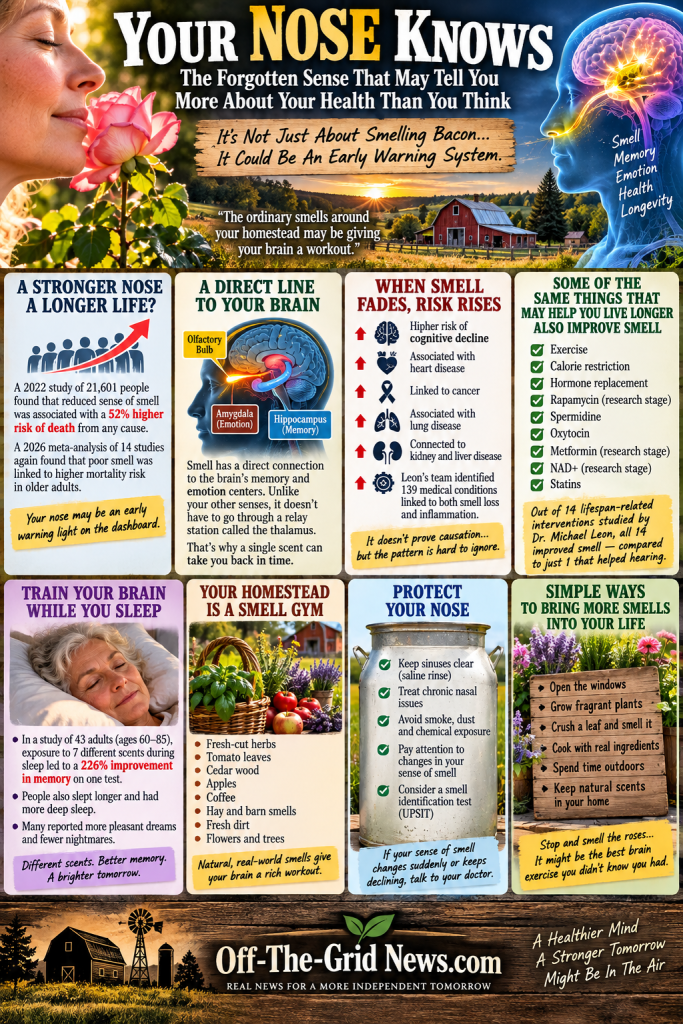
Researchers have repeatedly found that a declining sense of smell is associated with poorer health, cognitive decline and even a greater risk of dying. A 2022 systematic review and meta-analysis involving 21,601 people found olfactory impairment was associated with a 52 percent higher hazard of all-cause mortality.
More recently, a 2026 meta-analysis examined 14 eligible cohort studies and again found that poor smell was associated with higher all-cause mortality among older adults.
Now, that doesn’t mean losing your sense of smell causes an early death.
But it sure looks like the nose can be a warning light on the dashboard.
And that’s where this story gets interesting.
The Sense We Treated Like A Hood Ornament
Think about the five senses for a minute.
Ask somebody which one they’d surrender first and there’s a pretty good chance they’ll pick smell. Nobody wants to go blind. Nobody wants to lose their hearing. Touch would be terrible to lose.
But smell?
Eh.
We tend to treat it like the hood ornament on an old pickup — nice to have, but probably not essential to getting down the road.
Dr. Michael Leon has spent decades arguing otherwise. He’s a professor emeritus of neurobiology and behavior at the University of California, Irvine, where his work has focused heavily on the relationship between olfaction, memory and the brain. You can see UC Irvine’s summary of Leon’s research here.
And when you think about how humans used to live, his argument starts making a lot of sense.
Our ancestors inhabited a world absolutely soaked in smells.
Woodsmoke. Wet animals. Fresh dirt. Rotting leaves. Leather. Sweat. Cooking fat. Bread. Blood. Flowers. Manure. Rain. Wool. Horses. Herbs hanging from rafters. Apples in the cellar.
Then modern life came along and did something peculiar.
We sealed the windows.
Filtered the air.
Scrubbed the floors.
Deodorized the bathroom.
Wrapped our food in plastic.
And hung a little cardboard pine tree from the rearview mirror.
We may have cleaned up our world while accidentally turning down one of the richest streams of sensory information entering the brain.
Your Nose Has A Back Door Into Your Brain
Here’s where things get downright fascinating.
Smell is wired differently from your other senses. Olfactory information has unusually direct connections with brain regions involved in memory and emotion, including areas associated with the hippocampus and amygdala.
In other words, your nose doesn’t merely tell you, Yep, that’s cinnamon.
It can kick open a door marked MEMORY.
That’s why one whiff of an old barn can suddenly put you back beside your grandfather forty years ago. It’s why your grandmother’s perfume can appear in a crowded room and, for half a second, you’re eight years old again.
The memory doesn’t slowly arrive.
WHAM. You’re there.
Researchers have been fascinated by this smell-memory connection for decades, and Leon and his colleagues argue that the olfactory system’s unusually direct relationship with memory centers may help explain why declining smell so often travels alongside declining cognition.
And unfortunately, both tend to become more common with age.
When The Nose Gets Quiet, Pay Attention
Here’s the problem.
A sudden loss of smell gets your attention.
Millions of people learned that lesson during COVID. One morning the coffee smells like coffee, and the next morning you might as well be sniffing a fence post.
But gradual smell loss is sneaky.
It can happen slowly enough that you don’t realize anything has changed. The coffee still smells like coffee — just a little less. The lilacs still smell like lilacs — just not quite as strong.
Year after year, somebody keeps turning down the volume.
Meanwhile, research increasingly suggests that diminished smell can precede or accompany cognitive problems. A recent systematic review and meta-analysis of olfactory impairment and cognitive decline found that people with olfactory impairment had substantially greater risk of subsequent cognitive decline, with worse olfactory function generally associated with greater risk.
That doesn’t make your nose a crystal ball.
But it does make it something worth paying attention to.
Your Nose Is Standing Guard At The Gate
There’s another reason the olfactory system takes such a beating.
It lives right where the outside world meets the inside world.
Smoke, viruses, allergens, dust, pollution and chemicals all come marching through the front gate. Anybody who’s spent a dusty afternoon sweeping a barn, cutting lumber in a closed shop or following a diesel tractor across a dry field knows exactly how much stuff that nose has to deal with.
Meanwhile, chronic sinus disease has also been associated with cognitive problems. A large UK Biobank study reported an association between chronic rhinosinusitis and increased Alzheimer’s disease risk, although it did not find a significant association with overall dementia.
That’s an important distinction.
We’re talking about associations and risk markers here — not proof that a plugged nose causes Alzheimer’s.
Still, if your sense of smell suddenly disappears or keeps getting worse, shrugging it off may not be the smartest response.
139 Reasons Scientists Are Paying Attention
And then Leon’s team found something that really raises an eyebrow.
In a 2024 paper published in Frontiers in Molecular Neuroscience, Leon and his colleagues catalogued at least 139 medical conditions associated with both olfactory loss and inflammation.
One hundred and thirty-nine.
The list stretches across neurological, physical and congenital conditions.
Now, again, association doesn’t prove that smell loss causes those diseases. Leon and his coauthors themselves discuss several possibilities: disease might damage the olfactory system, inflammation might damage both, or reduced olfactory stimulation could conceivably contribute to problems elsewhere.
Nobody has that whole knot untangled yet.
But when 139 different roads keep passing the same weathered mailbox, you start wondering what’s living down that lane.
Maybe Your Brain Needs Exercise Too
This brings us to what may be the most useful idea in the whole story.
Think about what happens when you stop using your muscles.
They weaken.
That’s why nobody tells an 80-year-old who’s been sitting on the couch for ten years to start by deadlifting a tractor. You start with movement. Walk to the mailbox. Walk around the yard. Carry something. Use the machinery you’ve still got.
The brain appears to benefit from sensory input too.
We already know that correcting sensory deficits can matter for cognition and quality of life. So researchers have begun asking an intriguing question:
What happens if we deliberately give the aging brain more smells?
Not one smell.
Lots of them.
Different ones.
Enough variety to keep that olfactory machinery working.
In other words, maybe you can take your nose — and therefore part of your brain — for a walk.
Turns Out The Homestead Is A Smell Gym
And this is where people living close to the land may already have an advantage.
Walk around a working homestead with your nose turned on.
Crush a tomato leaf between your fingers.
Snap a sprig of mint.
Open the cedar chest.
Split an oak log.
Walk into the barn after fresh straw goes down.
Smell apples bruising in a wooden crate, coffee bubbling in the kitchen, onions hitting a cast-iron skillet, rain landing on hot dirt, fresh-cut grass, pine shavings in the workshop and lilacs blooming beside the porch.
That’s an enormous rotating library of natural odors.
And unlike the little cardboard pine tree hanging from your truck mirror, natural materials contain complicated mixtures of volatile compounds. Every plant, piece of fruit, pile of soil and handful of herbs presents the olfactory system with a slightly different puzzle.
So maybe “stop and smell the roses” wasn’t merely advice for stressed-out city people.
Maybe Grandma was prescribing brain exercise.
Then Researchers Tried Something While People Slept
This is where the story gets really strange.
Instead of asking older adults to spend an hour every day sniffing bottles, UC Irvine researchers wondered whether they could stimulate the olfactory system while people slept.
So they recruited 43 healthy adults between ages 60 and 85.
Participants in the olfactory-enrichment group were exposed to one of seven different odorants for two hours each night. The scent changed each evening, and the experiment continued for six months.
Then researchers tested their memories.
The result got everybody’s attention.
According to the published study, the enriched group showed a statistically significant 226 percent improvement compared with the control group on one verbal-learning memory measure. Brain imaging also detected improvement in the left uncinate fasciculus, a pathway involved in communication between regions associated with memory and emotion.
UC Irvine described the findings as evidence that nighttime olfactory enrichment might offer a remarkably low-effort way of supporting brain health.
Now keep your boots on the ground here.
It was 43 people.
That’s a fascinating study.
It’s not the Ten Commandments carved into stone.
Larger independent trials are needed before anybody claims we’ve found a magic trick for preventing dementia.
But 226 percent certainly earns another experiment.
From Seven Scents To Forty
That research eventually helped lead Leon and others toward a commercial system called Memory Air.
According to the company, the bedside device automatically rotates among 40 pleasant scents, providing olfactory enrichment while someone sleeps. Leon has also described subsequent work involving people with dementia who received dozens of odors and improved across several memory tests.
Those findings are intriguing, but there’s an important fence post to hammer into the ground here.
Leon has a financial interest in the company developing Memory Air. His 2024 scientific paper explicitly discloses that relationship.
That doesn’t make the research wrong.
It simply means independent replication becomes especially important.
That’s how good science works.
What About Sleep And Nightmares?
Leon has also recently discussed reports that nighttime olfactory enrichment may increase deep sleep, make dreams more pleasant and reduce nightmares.
He even recounts the striking story of a retired Marine who had served two tours in Iraq and suffered recurring nightmares. According to Leon’s account, the nightmares stopped after his first night using the scent system.
That’s an incredible story.
But right now it should be treated as exactly that — an anecdote, not proof of a PTSD treatment.
In fact, smell and traumatic memory have a complicated relationship. Research on combat veterans has shown that trauma-associated odors can actually trigger powerful memories and PTSD symptoms. One study involving veterans found that diesel odor produced distress and PTSD symptoms in affected participants. You can read the published research here.
So we’re standing near the beginning of this trail, not the end of it.
And that’s precisely why it’s so interesting.
Don’t Go Buying Rapamycin Because Your Roses Smell Better
There’s another fascinating piece to Leon’s argument.
A number of interventions being studied in aging research — things like exercise, calorie restriction, rapamycin, metformin, spermidine and NAD-related approaches — have also been investigated in connection with olfactory function.
That’s intriguing.
But don’t turn correlation into a shopping list.
The National Institute on Aging emphasizes that compounds such as rapamycin and metformin remain experimental as anti-aging interventions in humans. Some carry significant risks and absolutely aren’t something to start swallowing because somebody on the Internet said they might help your nose.
The much simpler lesson is sitting right outside the back door.
Use the senses God gave you.
Give Your Nose A Chore
So what can an ordinary person actually do with all this?
First, pay attention.
If your sense of smell suddenly disappears, becomes distorted or steadily deteriorates, mention it to your doctor rather than assuming you’re simply getting older. Persistent nasal obstruction deserves attention too, particularly if it’s interfering with normal breathing and smell.
Then start using the machinery.
Walk through the herb garden and actually smell what’s growing there. Pick up the rosemary. Crush the mint. Smell the basil before you toss it into supper.
Open the windows when the weather permits.
Pay attention to coffee, cedar, apples, flowers, fresh bread and turned soil.
And if you want something more systematic, standardized smell-identification tests exist, including the University of Pennsylvania Smell Identification Test — commonly called the UPSIT — which has long been used to objectively measure olfactory function.
You don’t have to turn your kitchen into a neuroscience laboratory.
You just have to start noticing again.
Maybe The Old-Timers Were Onto Something
For thousands of years people kept fragrant plants around sleeping areas.
Lavender.
Rosemary.
Mint.
Mugwort.
Cedar.
Maybe some of that was superstition. Maybe some was simply because a room smelled better with lavender hanging from the rafters than with six people, a dog and a woodstove packed inside it.
Fair enough.
But modern neuroscience is giving us another possibility worth considering.
Those old rooms were rich with sensory input.
Our world often isn’t.
We spend our days in climate-controlled houses, climate-controlled trucks, climate-controlled offices and stores engineered to smell like practically nothing.
Then we wonder why one of our oldest sensory systems isn’t getting much exercise.
Your Nose Knows
So tomorrow morning, when you step outside, don’t just look around.
Smell around.
Catch the coffee before you drink it. Smell the cold air coming through the screen door. Notice the damp dirt under your boots, the hay when you open the barn, the wood when you make the first cut.
Pay attention to whether those smells are still as strong and recognizable as you remember.
Because your nose isn’t merely decoration.
It isn’t just there to tell you when the bacon’s burning or when something died underneath the porch.
Increasingly, research suggests our sense of smell may serve as a surprisingly useful window into aging, inflammation, cognition and overall health.
Scientists are still figuring out exactly what that window shows us.
But there’s already enough evidence to make one old piece of advice sound considerably smarter than it used to:
Stop and smell the roses.
Not because you’re wasting time.
Because you might be exercising your brain.
Source: https://www.offthegridnews.com/alternative-health/grandma-told-you-to-stop-and-smell-the-roses-science-finally-caught-up/
Anyone can join.
Anyone can contribute.
Anyone can become informed about their world.
"United We Stand" Click Here To Create Your Personal Citizen Journalist Account Today, Be Sure To Invite Your Friends.
Before It’s News® is a community of individuals who report on what’s going on around them, from all around the world. Anyone can join. Anyone can contribute. Anyone can become informed about their world. "United We Stand" Click Here To Create Your Personal Citizen Journalist Account Today, Be Sure To Invite Your Friends.
LION'S MANE PRODUCT
Try Our Lion’s Mane WHOLE MIND Nootropic Blend 60 Capsules
Mushrooms are having a moment. One fabulous fungus in particular, lion’s mane, may help improve memory, depression and anxiety symptoms. They are also an excellent source of nutrients that show promise as a therapy for dementia, and other neurodegenerative diseases. If you’re living with anxiety or depression, you may be curious about all the therapy options out there — including the natural ones.Our Lion’s Mane WHOLE MIND Nootropic Blend has been formulated to utilize the potency of Lion’s mane but also include the benefits of four other Highly Beneficial Mushrooms. Synergistically, they work together to Build your health through improving cognitive function and immunity regardless of your age. Our Nootropic not only improves your Cognitive Function and Activates your Immune System, but it benefits growth of Essential Gut Flora, further enhancing your Vitality.

Our Formula includes: Lion’s Mane Mushrooms which Increase Brain Power through nerve growth, lessen anxiety, reduce depression, and improve concentration. Its an excellent adaptogen, promotes sleep and improves immunity. Shiitake Mushrooms which Fight cancer cells and infectious disease, boost the immune system, promotes brain function, and serves as a source of B vitamins. Maitake Mushrooms which regulate blood sugar levels of diabetics, reduce hypertension and boosts the immune system. Reishi Mushrooms which Fight inflammation, liver disease, fatigue, tumor growth and cancer. They Improve skin disorders and soothes digestive problems, stomach ulcers and leaky gut syndrome. Chaga Mushrooms which have anti-aging effects, boost immune function, improve stamina and athletic performance, even act as a natural aphrodisiac, fighting diabetes and improving liver function. Try Our Lion’s Mane WHOLE MIND Nootropic Blend 60 Capsules Today. Be 100% Satisfied or Receive a Full Money Back Guarantee. Order Yours Today by Following This Link.



| Visits: | 1,836,079,534 |
| Stories: | 8,726,747 |
Whistler Blowers, Insiders


Nose, ears, eyes, taste, all go before YUGO!