

They Found “Pfizer-Associated DNA” Inside A Heart Tumor… Now Come The Harder Questions

Every old homesteader knows there’s a difference between seeing smoke over the ridge and knowing exactly what’s burning. You don’t yell “barn fire” before you’ve crossed the field and looked, but you don’t sit on the porch pretending you can’t smell smoke, either.
And right now, there’s some smoke worth investigating.
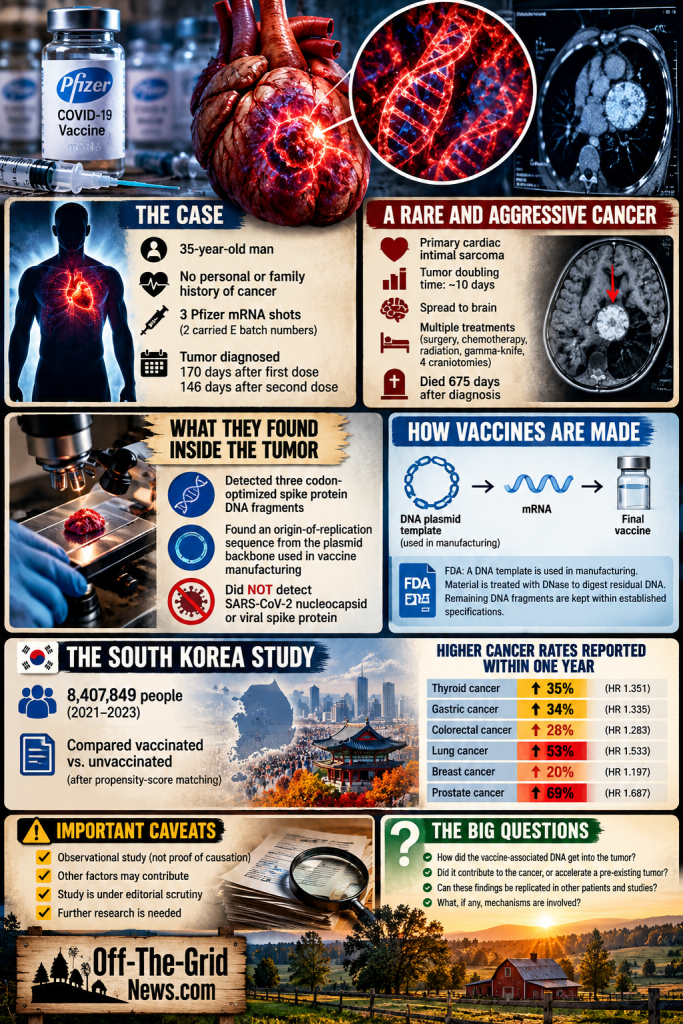
A newly released September 2026 preprint describes the case of a 35-year-old man who developed an extraordinarily rare and aggressive cancer called primary cardiac intimal sarcoma after receiving the Pfizer-BioNTech COVID-19 vaccine.
According to the researchers, the man had no known personal or family history of cancer and no identified hereditary cancer predisposition. His tumor was diagnosed 170 days after his first Pfizer dose and 146 days after his second.
But that’s only where this story begins.
A Cancer Growing Like A Weed After A Thunderstorm
The cancer started in the man’s heart and had already spread to his brain. According to the case report, researchers calculated that his metastatic tumors were growing at an extraordinary rate, with an estimated volume-doubling time of roughly ten days.
Think about that for a minute. Every ten days, roughly another doubling—like finding a thistle behind the barn, coming back a week and a half later, and discovering it has somehow become twice the problem.
Doctors threw nearly everything they had at it. The patient underwent surgical resection, doxorubicin-based chemotherapy, radiation, gamma-knife radiosurgery and eventually four craniotomies, but the disease continued progressing.
Finally, the man suffered bleeding into a brainstem tumor and died 675 days after his original diagnosis.
Thirty-five years old.
Then researchers went back and looked at archived tissue from the original heart tumor.
That’s when things got even more interesting.
What They Found Inside The Tumor
In 2025, researchers subjected preserved tissue from the man’s cardiac tumor to two research-use analyses. According to the preprint, polymerase-chain-reaction testing detected three codon-optimized spike-protein coding fragments that the researchers said were distinguishable from wild-type SARS-CoV-2.
They also reported detecting an origin-of-replication sequence associated with the plasmid backbone used in vaccine manufacturing. Meanwhile, a separate analysis reportedly found neither SARS-CoV-2 nucleocapsid protein nor viral spike protein, which the authors argued against ordinary COVID infection being the source of the genetic material they detected.
Now, that’s the part worth slowing down for.
Finding vaccine-associated genetic sequences inside a tumor is not the same thing as proving those sequences caused the tumor. Nor did this study demonstrate that those DNA fragments had integrated themselves into the man’s chromosomes.
Those are enormously important distinctions.
But finding those sequences inside the tumor raises an equally obvious question: How did they get there, how long had they been there, and did they have anything whatsoever to do with what happened next?
That’s the question worth answering.
The Manufacturing Question Nobody Should Be Afraid To Ask
Here’s where we need to understand how the sausage—or in this case the vaccine—is actually made. DNA isn’t some strange ingredient invented by critics after the fact; the FDA itself explains that a DNA template is used as starting material in manufacturing the mRNA portion of these vaccines.
As part of the purification process, the material is treated with DNase to digest residual DNA. The FDA says remaining DNA fragments are kept within established specifications and says its surveillance has not shown evidence of genomic harm or increased cancer rates attributable to mRNA vaccination.
So the argument isn’t over whether DNA is involved in manufacturing.
It is.
The important questions concern how much residual DNA remains, the form and size of those fragments, where they go after injection, how long they persist and whether they can produce biologically meaningful effects.
Those aren’t crazy questions.
They’re laboratory questions.
And that’s exactly why this heart-tumor case deserves independent replication rather than either instant canonization or instant dismissal.
The Timeline Creates Another Puzzle
The researchers did some biological detective work using the growth rate they observed. Based on the approximately ten-day tumor-doubling time, they estimated that growing the roughly 175-cubic-centimeter primary tumor from a single transformed cell would have required somewhere around 350 to 385 days.
Using previously published sarcoma growth rates, the process could have taken more than 900 days. Yet the cancer was diagnosed only 170 days after the man’s first Pfizer vaccination.
That’s why even the authors don’t simply say, “The vaccine created this cancer from scratch.”
Instead, they raise another possibility: acceleration of a pre-existing occult tumor.
Think about it like discovering a patch of thistles hiding behind the machine shed. The question may not be, “Who planted the first seed?”
The question may be:
What suddenly poured fertilizer on it?
That’s still a hypothesis.
But it’s a hypothesis you can test.
Then Came 8.4 Million People
And this is where the story moves from one extraordinary patient to an enormous population.
In September 2025, researchers published a large population-based cohort study in Biomarker Research, using South Korea’s National Health Insurance database. Their original dataset contained 8,407,849 people between 2021 and 2023.
Researchers then used propensity-score matching and statistical modeling to compare cancer diagnoses among vaccinated and unvaccinated populations. After matching, the primary analysis included 595,007 unvaccinated and 2,380,028 vaccinated individuals.
That’s not a handful of people answering an internet survey.
That’s a mighty big pasture.
And what researchers reported deserves a closer look.
Six Cancer Signals Appeared
Within one year, the researchers reported statistically significant associations between vaccination status and six cancer types.
The reported hazard ratios were 1.351 for thyroid cancer, 1.335 for gastric cancer, 1.283 for colorectal cancer, 1.533 for lung cancer, 1.197 for breast cancer and 1.687 for prostate cancer. Those figures and their confidence intervals can be read directly in the published study.
Put into ordinary English, the statistical model reported relative increases of roughly 35 percent for thyroid cancer, 34 percent for gastric cancer, 28 percent for colorectal cancer, 53 percent for lung cancer, 20 percent for breast cancer and 69 percent for prostate cancer.
Those aren’t numbers somebody scribbled on the back of a seed-corn envelope.
They’re the numbers reported by the researchers themselves.
But before anybody jumps the fence, there’s something important we need to understand.
Association Isn’t The Same Thing As Causation
A hazard ratio isn’t proof of what caused something. If vaccinated people are diagnosed with certain cancers more frequently during a particular observation period, researchers have found an association, but they haven’t necessarily found the reason for that association.
Maybe vaccination contributed. Maybe differences between the populations contributed, or perhaps health-care utilization, previous COVID infections, screening behavior or other confounding factors affected the results.
Maybe several things were operating at once.
That’s precisely why observational studies like this are generally the beginning of an investigation rather than the end of one. The authors themselves said further studies are warranted to investigate potential causal relationships and underlying molecular mechanisms.
Still, when a database containing millions of people throws up a signal, the proper response isn’t to shove the report into the bottom drawer.
You go look.
And The Researchers Found More Than One Trail
The researchers also separated participants according to vaccine type. They reported associations between cDNA vaccines and increased risks of thyroid, gastric, colorectal, lung and prostate cancers, while mRNA vaccines were associated with increased risks of thyroid, colorectal, lung and breast cancers.
Meanwhile, mixed—or heterologous—vaccination was associated with increased risks of thyroid and breast cancers. You can see those findings in the study’s results and supplementary materials.
The results also varied according to age and sex. Researchers reported different associations among men and women, while people under 65 showed stronger associations for thyroid and breast cancers and those 75 and older showed an association with prostate cancer.
Again, none of that proves mechanism.
But it gives researchers something enormously valuable:
A trail to follow.
And anybody who’s tracked something through the timber knows a trail matters.
Now The Korean Study Is Under Scrutiny
There’s another piece of this story readers deserve to know.
The journal Biomarker Research currently carries an editorial notice directly above the study. The notice, dated October 22, 2025, says concerns have been raised with the editors and that editorial action will be taken if appropriate after those concerns have been investigated.
That doesn’t mean the study has been disproven. And it doesn’t automatically mean the people raising objections are wrong, either.
It means exactly what it says:
The study is under scrutiny.
Good.
Let critics crawl underneath the hood with a flashlight. Let them challenge the matching, assumptions, confounders, statistical methods and conclusions, and then let the authors answer them.
Better yet, let independent researchers try to reproduce the findings using other giant national databases.
Because if the signal disappears under better analysis, we need to know that.
And if it doesn’t disappear, we really need to know that.
One Tumor Doesn’t Prove It. Eight Million Records Don’t Prove It Either.
This is where people on both sides of the COVID argument have a bad habit of jumping the fence.
One extraordinary cancer patient cannot prove that COVID vaccination causes cancer. Likewise, one observational database—even one containing millions of people—cannot establish biological causation by itself.
But put these two questions next to each other and you’ve got something worth investigating.
On one side of the workbench sits a rare heart tumor containing genetic sequences researchers identify as vaccine-associated plasmid DNA. On the other sits a massive observational study reporting statistically significant associations between vaccination and several cancers.
Neither is the final answer.
But neither belongs in the trash can.
The Old Homesteader Rule: Go Look
There’s an old rule anybody who lives outside town understands.
If you hear the chickens raising Cain at two in the morning, you don’t immediately announce there’s a fox in the henhouse. Maybe it’s a raccoon, maybe it’s a possum, or maybe that old rooster has finally lost what little sense God gave him.
But you sure don’t roll over and say, “There’s insufficient peer-reviewed evidence of a fox,” and go back to sleep.
You get your boots on and go look.
That’s what should happen here. The heart-tumor findings need independent replication, including testing other tumors, normal tissues from vaccinated individuals and appropriate controls.
Researchers also need to determine whether the sequences detected are simply present in tissue or actually integrated into human chromosomes. Then comes the really important question: is there a plausible and reproducible mechanism connecting those sequences with malignant transformation or accelerated tumor growth?
Meanwhile, the Korean population findings need replication in other countries with different databases, vaccination schedules, health-care systems and populations.
That’s how you find out whether you’re looking at smoke from somebody burning brush…
…or smoke rolling out of the barn.
What This Means Out On Your Homestead
For people who value independence, there’s a bigger lesson here than Pfizer, COVID or vaccines.
Don’t outsource your thinking.
That doesn’t mean assuming every pharmaceutical product is poison, and it doesn’t mean assuming every government health agency is lying. It means refusing to confuse authority with evidence—or suspicion with proof.
Read the South Korean study. Read the heart-tumor preprint. Read the FDA’s explanation of residual DNA and the manufacturing process.
Then compare what everybody says with what the evidence actually demonstrates.
Look at the sample size. Look at what researchers measured, what they didn’t measure and what alternative explanations might exist.
Most importantly, understand the difference between “associated with” and “caused by.”
That little distinction may not make exciting television, but it’s the fence line separating investigation from propaganda.
And it works both ways.
You shouldn’t call something harmless merely because an authority says so. But you shouldn’t call something deadly merely because somebody you trust says so, either.
Follow the evidence wherever it goes.
The Accountability Question Comes Later. The Evidence Question Comes First.
If future research demonstrates that a manufacturing contaminant caused or accelerated cancers, the questions about regulatory failure, liability and accountability would become enormous.
And they should.
If a feed company knowingly sold contaminated grain that killed cattle, we’d demand answers. If a chemical company poisoned a farm’s groundwater or a builder knowingly put dangerous materials into homes, we’d expect regulators, courts and juries to sort out who knew what and when.
Drug manufacturers shouldn’t get some magical exemption from that principle.
But first you establish what happened.
That’s the part that can’t be skipped.
Right now, the heart-tumor preprint gives researchers a startling observation: vaccine-associated plasmid DNA sequences were reportedly detected in archived tumor tissue from a 35-year-old man with an extraordinarily rare and aggressive cardiac cancer.
The Korean database gives researchers something different—a statistical signal involving several cancers among a very large population.
Neither establishes the complete causal chain necessary to say, “Here’s the weapon, here’s exactly how it worked and here’s who pulled the trigger.”
There are still missing links.
Go find them.
Don’t Bury It. Don’t Oversell It. Investigate It.
That’s where this story really stands.
A 35-year-old man developed an exceptionally rare cardiac cancer. The tumor grew with astonishing speed, and researchers subsequently reported finding vaccine-associated plasmid DNA sequences inside archived tumor tissue.
Separately, researchers analyzing millions of South Korean health records reported increased one-year hazard ratios for several cancers among vaccinated populations. Their observational design cannot establish causation, and their paper is now undergoing additional editorial scrutiny.
Those are facts worth discussing.
And the unanswered question is enormous:
Are we looking at two unrelated observations—or pieces of the same puzzle?
Nobody should pretend that question has already been settled. But nobody should be afraid to ask it, investigate it and demand good evidence before settling on an answer.
Because when you smell smoke coming across the back forty, there are two foolish things you can do. You can scream that the whole farm is burning before you’ve even left the porch, or you can shut the window and pretend you don’t smell anything.
The sensible fellow does something else.
He grabs his boots, walks toward the smoke… and finds out what’s actually burning.
Caption: “The homesteader’s rule: Trust what you can verify, not what you’re told.”
Source: https://www.offthegridnews.com/what-they-dont-want-you-to-know/they-found-pfizer-associated-dna-inside-a-heart-tumor-now-come-the-harder-questions/
Anyone can join.
Anyone can contribute.
Anyone can become informed about their world.
"United We Stand" Click Here To Create Your Personal Citizen Journalist Account Today, Be Sure To Invite Your Friends.
Before It’s News® is a community of individuals who report on what’s going on around them, from all around the world. Anyone can join. Anyone can contribute. Anyone can become informed about their world. "United We Stand" Click Here To Create Your Personal Citizen Journalist Account Today, Be Sure To Invite Your Friends.
LION'S MANE PRODUCT
Try Our Lion’s Mane WHOLE MIND Nootropic Blend 60 Capsules
Mushrooms are having a moment. One fabulous fungus in particular, lion’s mane, may help improve memory, depression and anxiety symptoms. They are also an excellent source of nutrients that show promise as a therapy for dementia, and other neurodegenerative diseases. If you’re living with anxiety or depression, you may be curious about all the therapy options out there — including the natural ones.Our Lion’s Mane WHOLE MIND Nootropic Blend has been formulated to utilize the potency of Lion’s mane but also include the benefits of four other Highly Beneficial Mushrooms. Synergistically, they work together to Build your health through improving cognitive function and immunity regardless of your age. Our Nootropic not only improves your Cognitive Function and Activates your Immune System, but it benefits growth of Essential Gut Flora, further enhancing your Vitality.

Our Formula includes: Lion’s Mane Mushrooms which Increase Brain Power through nerve growth, lessen anxiety, reduce depression, and improve concentration. Its an excellent adaptogen, promotes sleep and improves immunity. Shiitake Mushrooms which Fight cancer cells and infectious disease, boost the immune system, promotes brain function, and serves as a source of B vitamins. Maitake Mushrooms which regulate blood sugar levels of diabetics, reduce hypertension and boosts the immune system. Reishi Mushrooms which Fight inflammation, liver disease, fatigue, tumor growth and cancer. They Improve skin disorders and soothes digestive problems, stomach ulcers and leaky gut syndrome. Chaga Mushrooms which have anti-aging effects, boost immune function, improve stamina and athletic performance, even act as a natural aphrodisiac, fighting diabetes and improving liver function. Try Our Lion’s Mane WHOLE MIND Nootropic Blend 60 Capsules Today. Be 100% Satisfied or Receive a Full Money Back Guarantee. Order Yours Today by Following This Link.


| Visits: | 1,835,455,702 |
| Stories: | 8,723,846 |
Whistler Blowers, Insiders

