

Scientists Just Discovered Something Surprising About Vanilla… And It Has Nothing To Do With Baking Cookies

There’s a little brown bottle sitting in millions of American kitchens that most folks never give a second thought. You pull it out when you’re baking Christmas cookies, making homemade ice cream, or putting together Grandma’s favorite birthday cake. And when that warm, sweet smell starts drifting through the farmhouse, you know something good is coming out of the oven.
But here’s something you probably never expected.
Scientists are investigating whether the compound responsible for that wonderful vanilla smell could become an ingredient in the wound dressings and medical treatments of tomorrow. And we’re not talking about some backyard experiment involving vanilla extract and a Band-Aid.
We’re talking about biomedical research from Flinders University in Australia, where scientists are studying how a familiar food compound might help tackle harmful bacteria, persistent inflammation, and oxidative stress. For those of us who live out in the country, where the nearest medical clinic might be a long drive down a gravel road, that’s an interesting development.
And this one begins with a vanilla bean.
Grandma Used Vanilla For Cookies… Scientists Have Something Else In Mind
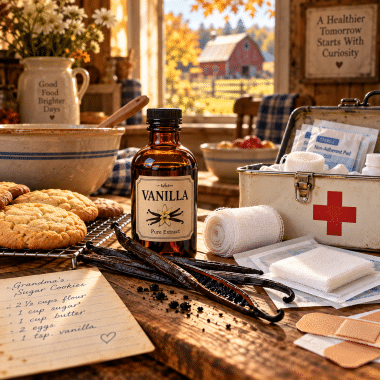
Most folks know vanilla as the ingredient that makes homemade ice cream taste like summer and sugar cookies smell like Christmas. But tucked inside the vanilla pod is a naturally occurring compound called vanillin, the chemical responsible for much of vanilla’s familiar flavor and fragrance.
According to researchers at Flinders University’s Biomedical Nanoengineering Laboratory, vanillin has several properties that make it interesting for medical applications. Experimental studies have reported antioxidant, anti-inflammatory, and antibacterial activity, giving scientists reason to investigate whether it might help protect damaged tissue.
When a wound refuses to heal, there’s often more going on than a simple break in the skin. Bacteria can move in, inflammation can hang around too long, and chemical damage can interfere with the body’s repair work. Scientists are interested in whether vanillin could help address several of those problems at once.
Vanillin doesn’t have to come from an expensive, exotic plant grown halfway around the world. Manufacturers can also produce it synthetically, which means it is relatively inexpensive and widely available.
The Surprising Trick That Could Turn Vanilla Into A Medical Material
Imagine you’re building a fence around the back pasture. You can have the finest posts and strongest wire in the county, but if nothing holds those pieces together, the first determined cow that leans against it will have the whole thing lying in the weeds.
Scientists face a similar problem when they’re building advanced wound dressings and materials that carry medicine into damaged tissue. They need ways to connect different ingredients so the finished material holds together and performs its intended job.
And that’s where vanillin may come in.
Researchers say vanillin can function as a dynamic crosslinker. That’s a fancy laboratory term for a substance that helps connect parts of a material, somewhat like the knots and fasteners holding a fence together.
Vanillin’s chemical structure also allows it to interact with different molecules, potentially making it useful in specialized coatings, wound dressings, and drug-delivery systems. In their 2026 scientific review, Borislav Stoilov, Vi Khanh Truong, Christopher Delaney, and Krasimir Vasilev examined how those properties might be put to work.
Of course, eating vanilla isn’t the same thing as putting it into a carefully engineered medical product. Not by a country mile.
When A Little Cut Turns Into A Big Problem
Anybody who’s spent a lifetime working around tractors, livestock, barbed wire, and old machinery knows how quickly an ordinary day can turn into a trip for stitches. One minute you’re repairing a gate, and the next you’ve caught your hand on a jagged edge and you’re digging through the first aid kit.
Fortunately, most minor cuts heal with proper care. But some wounds are a different story, especially when poor circulation, diabetes, or other conditions interfere with the body’s normal repair process.
Bacteria may establish an infection, inflammation can persist, and surrounding tissue may suffer additional damage instead of rebuilding. Then there’s something scientists call oxidative stress, which can make an already difficult situation worse.
Picture a fire in your hay barn. A little spark is one thing, but when the flames spread faster than you can haul water, you’ve got a problem that keeps getting worse.
Your body naturally produces highly reactive molecules as part of normal metabolism and its response to injury. In the right amounts, some help with healing and fighting infection. But when they’re produced in excess and overwhelm the body’s defenses, they can damage cells and interfere with repair.
That’s oxidative stress. Researchers are investigating whether materials containing vanillin might eventually help manage it while also addressing inflammation and bacterial growth.
The Oil-And-Vinegar Problem That Gives Medicine Makers Fits
Ever tried mixing oil and vinegar in a Mason jar? You can shake that thing until your arm gets tired, but leave it sitting on the counter long enough, and the two ingredients start separating again.
Some medicines present a similar problem. Certain therapeutic compounds don’t dissolve easily in water, making them difficult to formulate and deliver effectively inside the body. Scientists call them hydrophobic, which means they tend to avoid water.
Vanillin’s molecular structure allows it to interact with different chemical environments. Researchers believe those characteristics could make it useful in materials designed to carry certain poorly water-soluble drugs.
Think of it as helping engineers build a better delivery wagon. The medicine is the cargo, the engineered material is the wagon, and vanillin may help make that wagon sturdy enough to carry its load where it’s needed.
Scientists still have to prove that the system works safely and reliably. But possible applications include ulcer treatments, advanced wound dressings, targeted drug delivery, and materials intended to support tissue regeneration.
Before You Reach For The Vanilla Bottle… Read This
The vanilla extract in your pantry is NOT a government or big pharma wound treatment.
This research does not establish that pouring vanilla extract on a cut will help it heal. Ordinary baking extracts may contain alcohol and other ingredients that aren’t appropriate for an open wound, and they aren’t sterile medical preparations.
The Flinders research concerns vanillin as an ingredient in carefully designed biomedical formulations. That’s completely different from applying a grocery-store product directly to injured skin.
The review examines emerging evidence, not a proven treatment for patients. Specific vanillin-based wound products still need development, safety studies, and clinical testing before anyone can say they work.
For a minor wound, established first aid means cleaning it with clean running water, protecting it with an appropriate dressing, and watching for infection. Deep, contaminated, infected, or poorly healing wounds need professional attention, especially for people with diabetes or poor circulation.
A Scientist Chewed A Peppermint Leaf… And Started Asking Questions
Here’s a story that sounds like something your grandmother might have told you while picking mint beside the back porch. Professor Vasilev noticed that chewing peppermint leaves from his drink seemed to soothe his sore throat.
Most of us would have enjoyed the relief and gone back to whatever we were doing. But Vasilev started asking questions about the chemistry involved and whether peppermint-derived compounds could be incorporated into medical materials.
He turned to plasma processing, a technology he had studied for decades. Scientists can use it to modify surfaces and create extremely thin coatings, giving ordinary materials new properties.
Think about painting a barn. The wood underneath is still wood, but the coating changes how that surface responds to rain, sunlight, and wear. Medical coatings work on a much smaller scale, allowing researchers to engineer surfaces with particular biological and chemical properties.
In February 2026, the team reported related work in the journal Small involving a nanoscale coating derived from peppermint essential oil. In experimental testing, it showed antibacterial, anti-inflammatory, and antioxidant properties while remaining compatible with the cells evaluated.
Laboratory performance doesn’t automatically translate into better patient outcomes. Clinical studies would still be needed to establish whether such coatings safely prevent infections or improve healing. Nevertheless, the peppermint project shows why the team keeps investigating familiar natural compounds.
A Medical Breakthrough Isn’t Much Good If Nobody Can Afford It
We’ve all seen it happen. Somebody invents a remarkable new gadget that promises to make life easier, only to discover it costs more than the pickup truck parked in the driveway.
Medical technology can run into the same problem. A promising compound might work beautifully in a laboratory, but if it’s expensive or difficult to manufacture, turning it into an everyday medical product becomes a serious challenge.
That’s one reason vanillin stands out.
It’s already manufactured on a large scale for food, fragrance, and other industries. Its chemistry is relatively well understood, and synthetic vanillin can be produced without relying entirely on natural vanilla beans.
Those advantages could help researchers develop formulations that are practical to manufacture. Of course, the finished medical product would still have to meet strict standards for purity, safety, consistency, and effectiveness. Food-grade availability doesn’t automatically mean medical-grade suitability.
Discovering something useful is only the beginning. Turning it into a dependable treatment is where the real work starts.
What Grandma Understood About Nature… And What Modern Science Is Still Learning
There’s something wonderfully familiar about this whole story. A scientist notices something interesting about peppermint leaves, another line of research examines a compound found in vanilla beans, and before long sophisticated laboratories are studying ingredients that have been sitting in kitchen cupboards and herb gardens for generations.
That doesn’t mean every old-fashioned home remedy works. Some do, some don’t, and some can cause harm when used the wrong way.
The natural world is worth paying attention to.
Our grandparents watched what grew in the garden and passed along observations about food preservation and herbal preparations. Some of that knowledge proved useful; other traditional treatments didn’t hold up under careful scientific examination.
And that’s why research matters. Scientists can isolate compounds, study their chemistry, test their biological effects, and find out whether there’s a legitimate medical application hiding inside a familiar plant.
The Best Medicine In Your Homestead First Aid Kit Is Still Good Preparation
If you live 30 or 40 minutes from the nearest emergency department, the most important wound-care breakthrough for your household probably isn’t sitting in a research laboratory in Australia. It’s knowing what to do when somebody gets hurt.
It’s having clean dressings, appropriate wound-care supplies, and a well-stocked first aid kit. It’s understanding when a cut needs stitches, when a wound may be infected, and when a puncture injury calls for a tetanus vaccination review.
And it’s making sure somebody else in the house knows where those supplies are kept. Because accidents have a funny way of happening when the person who normally handles everything is the one who gets hurt.
The American Red Cross offers first aid training, and the CDC provides tetanus wound-management guidance. For anyone who spends time around soil, livestock, machinery, and old fencing, that’s knowledge worth having.
Meanwhile, researchers will keep doing their work. Perhaps one day they’ll develop an advanced wound dressing that uses vanillin to help protect damaged tissue, deliver medicine, or support healing. Until then, the vanilla belongs in the cookie dough.
From Grandma’s Cookie Jar To Tomorrow’s Medicine Cabinet
The next time you open a bottle of vanilla, take a second to appreciate that familiar smell. It brings back memories of warm kitchens, fresh-baked cakes, and Sunday afternoons when the whole family gathered around the table.
But now there’s another story behind that fragrance.
Scientists are investigating whether the compound responsible for much of that wonderful aroma might someday become part of a new generation of medical materials. Not because somebody discovered that vanilla extract magically heals cuts, but because researchers recognized useful chemical properties in an ordinary substance and started asking what else those properties might accomplish.
That’s how some important discoveries begin. Not necessarily with a giant machine or a billion-dollar invention, but with somebody paying attention to an ordinary thing and asking an extraordinary question.
Sometimes, they begin with a peppermint leaf, a vanilla bean, and somebody curious enough to ask one more question. And wouldn’t Grandma get a kick out of knowing that the same compound that helped make her kitchen smell so good might someday help doctors care for stubborn wounds?
That’s a mighty sweet possibility.
Research and Sources
Original scientific review: Stoilov, B., Truong, V. K., Delaney, C., and Vasilev, K. “Vanillin as a bioactive component in biomedical formulations for chronic wound healing and tissue regeneration.” International Journal of Pharmaceutics, 702, 127263 (2026). https://doi.org/10.1016/j.ijpharm.2026.127263
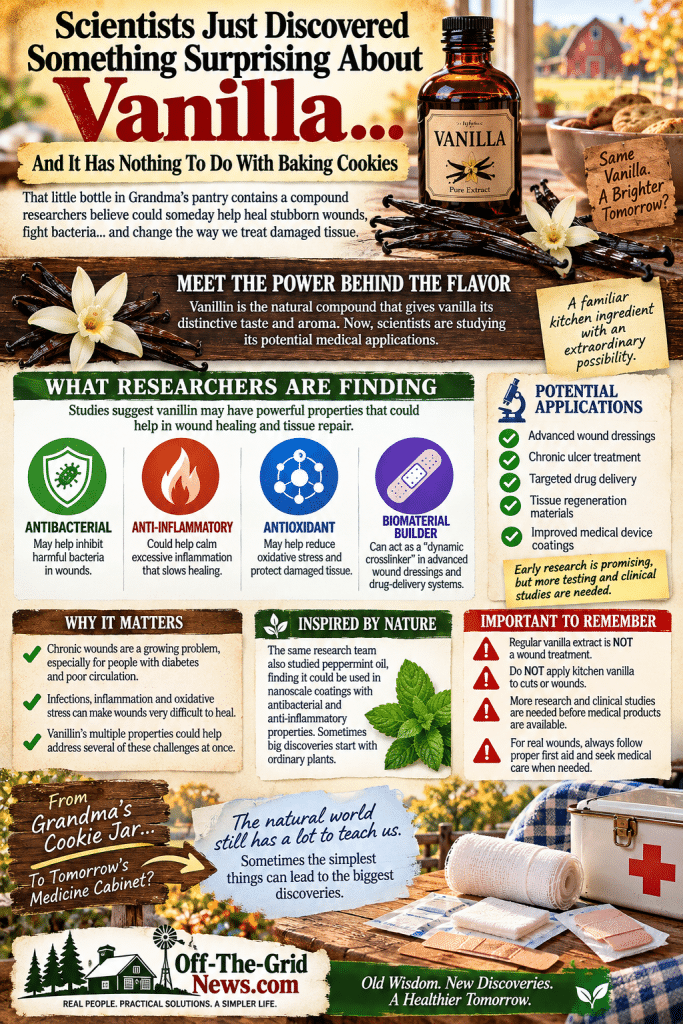
Source: https://www.offthegridnews.com/lost-ways-found/scientists-just-discovered-something-surprising-about-vanilla-and-it-has-nothing-to-do-with-baking-cookies/
Anyone can join.
Anyone can contribute.
Anyone can become informed about their world.
"United We Stand" Click Here To Create Your Personal Citizen Journalist Account Today, Be Sure To Invite Your Friends.
Before It’s News® is a community of individuals who report on what’s going on around them, from all around the world. Anyone can join. Anyone can contribute. Anyone can become informed about their world. "United We Stand" Click Here To Create Your Personal Citizen Journalist Account Today, Be Sure To Invite Your Friends.
LION'S MANE PRODUCT
Try Our Lion’s Mane WHOLE MIND Nootropic Blend 60 Capsules
Mushrooms are having a moment. One fabulous fungus in particular, lion’s mane, may help improve memory, depression and anxiety symptoms. They are also an excellent source of nutrients that show promise as a therapy for dementia, and other neurodegenerative diseases. If you’re living with anxiety or depression, you may be curious about all the therapy options out there — including the natural ones.Our Lion’s Mane WHOLE MIND Nootropic Blend has been formulated to utilize the potency of Lion’s mane but also include the benefits of four other Highly Beneficial Mushrooms. Synergistically, they work together to Build your health through improving cognitive function and immunity regardless of your age. Our Nootropic not only improves your Cognitive Function and Activates your Immune System, but it benefits growth of Essential Gut Flora, further enhancing your Vitality.

Our Formula includes: Lion’s Mane Mushrooms which Increase Brain Power through nerve growth, lessen anxiety, reduce depression, and improve concentration. Its an excellent adaptogen, promotes sleep and improves immunity. Shiitake Mushrooms which Fight cancer cells and infectious disease, boost the immune system, promotes brain function, and serves as a source of B vitamins. Maitake Mushrooms which regulate blood sugar levels of diabetics, reduce hypertension and boosts the immune system. Reishi Mushrooms which Fight inflammation, liver disease, fatigue, tumor growth and cancer. They Improve skin disorders and soothes digestive problems, stomach ulcers and leaky gut syndrome. Chaga Mushrooms which have anti-aging effects, boost immune function, improve stamina and athletic performance, even act as a natural aphrodisiac, fighting diabetes and improving liver function. Try Our Lion’s Mane WHOLE MIND Nootropic Blend 60 Capsules Today. Be 100% Satisfied or Receive a Full Money Back Guarantee. Order Yours Today by Following This Link.



| Visits: | 1,835,391,856 |
| Stories: | 8,723,068 |
Whistler Blowers, Insiders


All I know is it smells good and makes things taste a lot better.