

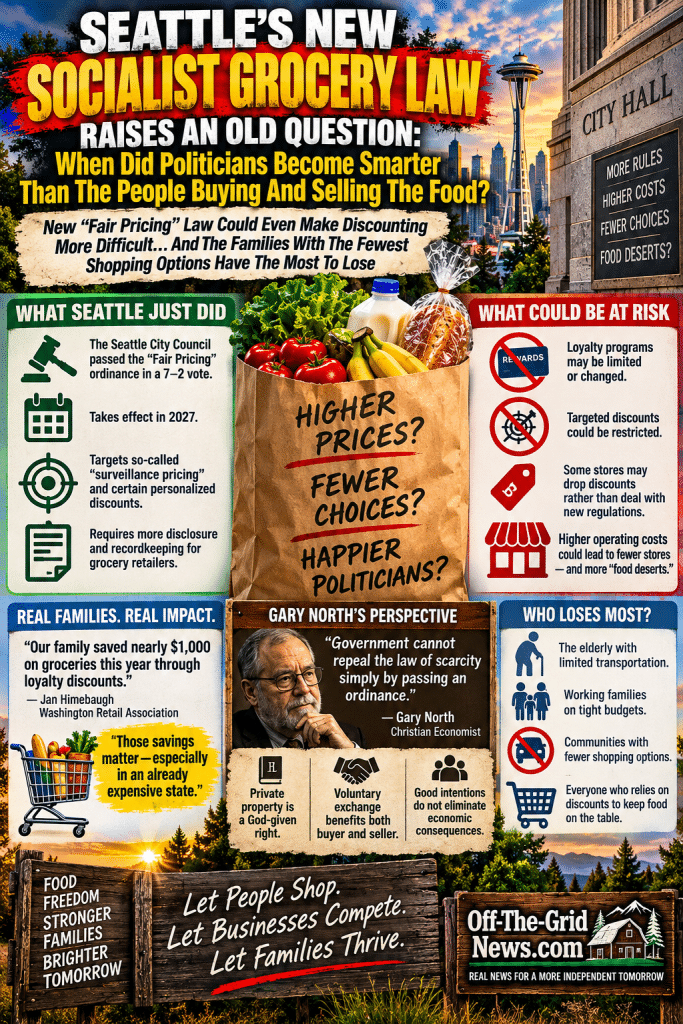
Seattle’s New Socialist Grocery Law Raises An Old Question: When Did Politicians Become Smarter Than The People Buying And Selling The Food?

There was a time when a grocery store owner knew his customers by name. He knew which families bought flour by the sack, which widows watched every penny, and which farmers came into town on Saturday afternoon looking for bargains.
And if he wanted to knock a few cents off the price of something to keep a good customer coming back, that was his business. Nobody needed a committee at City Hall to approve it.
Today, that same idea has a fancy name: personalized pricing. And in Seattle, politicians have decided certain forms of it need government supervision.
The Seattle City Council approved Mayor Katie Wilson’s “Fair Pricing and Transparency” ordinance by a 7–2 vote on September 22. Signed into law October 5 and scheduled to take effect September 1, 2027, the legislation targets what supporters call “surveillance pricing.”
The stated purpose sounds reasonable enough: protect consumers from businesses using personal information to manipulate prices. But there is a much bigger economic question hiding behind the language of consumer protection.
What happens when government interferes with the voluntary arrangements that allow businesses to compete for customers?
The late Christian economist Gary North spent decades answering questions just like that. And his answer was rarely flattering to politicians who believed another government regulation could somehow repeal the economic laws of supply, demand, and scarcity.
The Grocery Store Is Not A Government Department

North understood something modern politicians routinely forget. A price is not simply a number printed on a shelf; it is information that helps producers, retailers, and consumers coordinate their decisions.
Think about a simple gallon of milk. Behind that gallon stands a dairy farmer, a feed supplier, a truck driver, a processing plant, a refrigeration company, a grocery distributor, and the store owner who puts it on the shelf.
Every one of those people must make economic decisions, and prices help coordinate the entire chain. None of them needs the Seattle City Council deciding what constitutes the proper economic relationship between the farmer, the grocer, and the customer.
The economist Friedrich Hayek explained this coordination problem in his famous essay, The Use of Knowledge in Society. No central authority possesses all the scattered information necessary to manage an economy, yet prices allow ordinary people to respond to circumstances they may never fully understand.
North approached that same economic reality through a biblical framework. He believed that God established an orderly world in which human choices have consequences, property carries responsibilities, and government has limits.
Government cannot repeal the law of scarcity simply by passing an ordinance.
The Eighth Commandment Has Something To Say About Economics
North believed private property, honest dealing, personal responsibility, and voluntary exchange were not merely useful economic conventions. They were rooted in God’s moral order and reflected the responsibilities He placed upon individuals, families, businesses, and civil government.
The Eighth Commandment declares, “Thou shalt not steal” (Exodus 20:15). That commandment presupposes legitimate ownership, because stealing would have no meaning if nobody had a rightful claim to anything.
And ownership means more than having your name on a deed. It includes the authority to decide how your property will be used, exchanged, saved, or sold, within the boundaries of God’s moral law.
A grocer owns his inventory, and a customer owns his money. When they voluntarily agree to exchange one for the other, both expect to benefit from the transaction.
Of course, Scripture also condemns dishonest business practices. “Ye shall do no unrighteousness in judgment, in meteyard, in weight, or in measure” (Leviticus 19:35).
A retailer who lies about prices, conceals material terms, or cheats customers deserves criticism. But there is an important moral difference between deception and offering customers different discounts.
A coupon is not theft, and a loyalty reward is not necessarily exploitation. A business offering a discount to attract a customer is not automatically committing an injustice.
That distinction matters because once government begins treating ordinary competitive behavior as suspicious, the boundaries of legitimate private decision-making start shrinking.
The $1,000 Question Seattle Families Should Be Asking
The Washington Retail Association warned that Seattle’s ordinance could interfere with popular loyalty programs and targeted discounts. The association supports stopping retailers from using personal data to raise prices on individual shoppers, but argues that personalized discounts deserve protection.
One of its representatives, Jan Himebaugh, offered a revealing household example. Her family reportedly saved nearly $1,000 through grocery loyalty discounts this year, money that makes a meaningful difference in an expensive state.
For a household watching every penny, $1,000 might cover a substantial portion of a winter heating bill. It might purchase garden seeds, canning supplies, emergency food, or enough gasoline to keep the family vehicle running for months.
Now imagine being told that some of those discounts might disappear because politicians have decided the system used to offer them creates too much legal uncertainty. That is precisely the concern retailers raised while Seattle officials were preparing their legislation.
To be clear, the ordinance does not ban every loyalty program, coupon, or sale. It preserves traditional coupons, broadly available discounts, and certain loyalty rewards, while restricting individualized prices and discounts based on personal information.
But compliance requirements and potential legal liability can change business decisions. If offering targeted discounts becomes too expensive or legally risky, some retailers may abandon those promotions rather than fight over which customer information they are allowed to use.
Even Seattle Councilmember Maritza Rivera voted against the ordinance because of concerns that it could eliminate popular savings programs and increase grocery costs. Her opposition illustrates that the affordability question is not simply a disagreement between grocery corporations and City Hall.
That would be a strange accomplishment for a law advertised as an affordability measure.
The Politician Sees A Price. The Business Owner Sees A Thousand Decisions.
Here’s where North’s economic reasoning becomes especially useful. A politician looks at a grocery receipt and sees numbers, while a store owner sees inventory costs, transportation, spoilage, payroll, rent, insurance, electricity, and dozens of other expenses.
He also sees competition, because the store across town may be offering a better deal on hamburger. If he wants to keep customers coming through his doors, he must find some way to respond.
Maybe he lowers his regular price, offers a coupon, or rewards families who shop there every week. Maybe he accepts a smaller profit on one product because he hopes those same customers will purchase something else.
Those decisions are not necessarily evidence that the market has failed. They are often evidence that businesses are competing to satisfy customers, and the grocer bears the financial consequences when he gets those decisions wrong.
The politician doesn’t face those same consequences. He can vote for a regulation, hold a press conference, and claim credit for protecting consumers without personally covering the losses if his experiment backfires.
The business owner must persuade customers. The government can compel obedience.
When The Grocery Store Disappears, City Hall Won’t Be Selling Eggs
Seattle’s ordinance primarily targets larger grocery retailers and qualifying delivery services rather than every little neighborhood market. But large stores are important parts of local food distribution, and restrictions on their operations can affect shoppers, suppliers, and competition throughout a community.
The Seattle Times editorial board warned that the ordinance could encourage retailers to curtail discounts and coupons. It also raised the possibility that Seattle shoppers might take their business to neighboring communities where stores operate under different rules.
That is an important possibility because consumers are not prisoners of city boundaries. If shopping becomes more expensive or inconvenient in Seattle, families with transportation may simply drive somewhere else.
But what about the elderly widow who doesn’t drive? What about the working mother who depends on the grocery store near her apartment, or the family without enough gasoline to shop across town?
Those households have fewer alternatives when grocery access deteriorates. And although nobody can yet demonstrate that this particular ordinance will close stores, higher operating costs and weaker profitability can influence where retailers choose to invest.
Mayor Wilson has made grocery affordability and access central concerns of her administration. Her official announcement of the Fair Pricing policy presents the legislation as protection against businesses using sensitive personal information to manipulate grocery prices.
But there is a difference between promising affordable food and creating the economic conditions that make affordable food possible. A city cannot guarantee prosperity merely by telling businesses which pricing arrangements are acceptable.
You cannot keep adding costs and restrictions to an industry and assume those costs will never reach the customer.
God’s Economic Laws Don’t Disappear When Politicians Ignore Them
North repeatedly emphasized that economic choices carry consequences. His Christian economic writings challenged the notion that good political intentions could eliminate the responsibilities and tradeoffs built into human action.
Scripture expresses a broad principle of moral accountability in Galatians 6:7: “Be not deceived; God is not mocked: for whatsoever a man soweth, that shall he also reap.”
That verse is not a mathematical formula for grocery prices. Nevertheless, its reminder that actions have consequences should give every politician something to think about before experimenting with other people’s livelihoods.
Seattle’s leaders may sincerely want to protect struggling families from discriminatory pricing. They may have legitimate concerns about companies exploiting sensitive personal information, particularly when customers cannot see how their prices are determined.
But those concerns do not establish that every proposed restriction will improve affordability. And if regulations eliminate useful discounts, discourage investment, or weaken competition, ordinary households may eventually pay the price.
Good intentions do not repeal economic consequences.
The Lesson For Every Homesteader Watching Seattle
You don’t have to live in Seattle to understand what’s at stake. Every homesteader knows that the price of food reflects something real, whether that means the cost of seeds, fertilizer, animal feed, diesel, equipment, or the labor required to bring a harvest home.
Weather destroys crops, machinery breaks, and transportation costs rise. No amount of political enthusiasm can make those expenses disappear, although politicians can certainly make them harder to manage.
That’s one reason North placed such importance on private property, productive work, thrift, and decentralized economic decision-making. He believed families and communities should take responsibility for the resources entrusted to them rather than expecting government to manage every economic uncertainty.
A family with a productive garden, a stocked pantry, practical skills, and relationships with local farmers has more options when prices rise. That doesn’t mean everybody must become completely self-sufficient, but it does mean reducing dependence on systems you cannot control.
Economic independence begins when you stop assuming somebody in government can guarantee your prosperity.
Seattle’s ordinance takes effect September 1, 2027, and its ultimate impact on grocery bills remains to be seen. But the underlying question is much older than artificial intelligence, loyalty cards, or digital coupons.
Who should make the ordinary decisions of economic life: the people who own the property, bear the risks, and voluntarily exchange with one another, or politicians who believe they can produce better outcomes by writing another set of rules?
Gary North spent his career reminding Christians that God’s moral order includes property, responsibility, and consequences. Seattle may be about to provide another practical lesson in what happens when political ambition runs ahead of economic understanding.
Because when City Hall decides it knows better than the grocer how to sell groceries, the politicians get the applause.
And the customer may get the bill.
Source: https://www.offthegridnews.com/current-events/seattles-new-socialist-grocery-law-raises-an-old-question-when-did-politicians-become-smarter-than-the-people-buying-and-selling-the-food/
Anyone can join.
Anyone can contribute.
Anyone can become informed about their world.
"United We Stand" Click Here To Create Your Personal Citizen Journalist Account Today, Be Sure To Invite Your Friends.
Before It’s News® is a community of individuals who report on what’s going on around them, from all around the world. Anyone can join. Anyone can contribute. Anyone can become informed about their world. "United We Stand" Click Here To Create Your Personal Citizen Journalist Account Today, Be Sure To Invite Your Friends.
LION'S MANE PRODUCT
Try Our Lion’s Mane WHOLE MIND Nootropic Blend 60 Capsules
Mushrooms are having a moment. One fabulous fungus in particular, lion’s mane, may help improve memory, depression and anxiety symptoms. They are also an excellent source of nutrients that show promise as a therapy for dementia, and other neurodegenerative diseases. If you’re living with anxiety or depression, you may be curious about all the therapy options out there — including the natural ones.Our Lion’s Mane WHOLE MIND Nootropic Blend has been formulated to utilize the potency of Lion’s mane but also include the benefits of four other Highly Beneficial Mushrooms. Synergistically, they work together to Build your health through improving cognitive function and immunity regardless of your age. Our Nootropic not only improves your Cognitive Function and Activates your Immune System, but it benefits growth of Essential Gut Flora, further enhancing your Vitality.

Our Formula includes: Lion’s Mane Mushrooms which Increase Brain Power through nerve growth, lessen anxiety, reduce depression, and improve concentration. Its an excellent adaptogen, promotes sleep and improves immunity. Shiitake Mushrooms which Fight cancer cells and infectious disease, boost the immune system, promotes brain function, and serves as a source of B vitamins. Maitake Mushrooms which regulate blood sugar levels of diabetics, reduce hypertension and boosts the immune system. Reishi Mushrooms which Fight inflammation, liver disease, fatigue, tumor growth and cancer. They Improve skin disorders and soothes digestive problems, stomach ulcers and leaky gut syndrome. Chaga Mushrooms which have anti-aging effects, boost immune function, improve stamina and athletic performance, even act as a natural aphrodisiac, fighting diabetes and improving liver function. Try Our Lion’s Mane WHOLE MIND Nootropic Blend 60 Capsules Today. Be 100% Satisfied or Receive a Full Money Back Guarantee. Order Yours Today by Following This Link.


| Visits: | 1,835,504,283 |
| Stories: | 8,724,138 |
Whistler Blowers, Insiders

