

Hospitals Are Now Giving Flu Shots While Children Are Under Anesthesia

Your child needs ear tubes or a tonsil operation. You have finished the morning chores, arranged for somebody to feed the animals, and driven to the hospital before daylight. Now you are sitting beneath fluorescent lights, signing forms while your youngster watches every move you make.
Then comes another question: Would you like your child to get a flu shot while under anesthesia?
For some parents, that sounds like a welcome way to spare a frightened child another needle. For others, it is one more decision dropped into an already crowded morning, somewhere between the surgical consent and the explanation of when their child can eat again.
Either way, this is now a real practice. Several major children’s hospitals offer influenza vaccination during scheduled procedures, with parental agreement. The question for families is what is being offered, how permission is obtained, and whether they have enough time to make a decision before the operating-room doors swing shut.
Around the homestead, you check a gate before turning the livestock loose. Before a child’s surgery, a little advance checking can spare you an unpleasant surprise, too.
The Program Has A Name And The Numbers Are Real

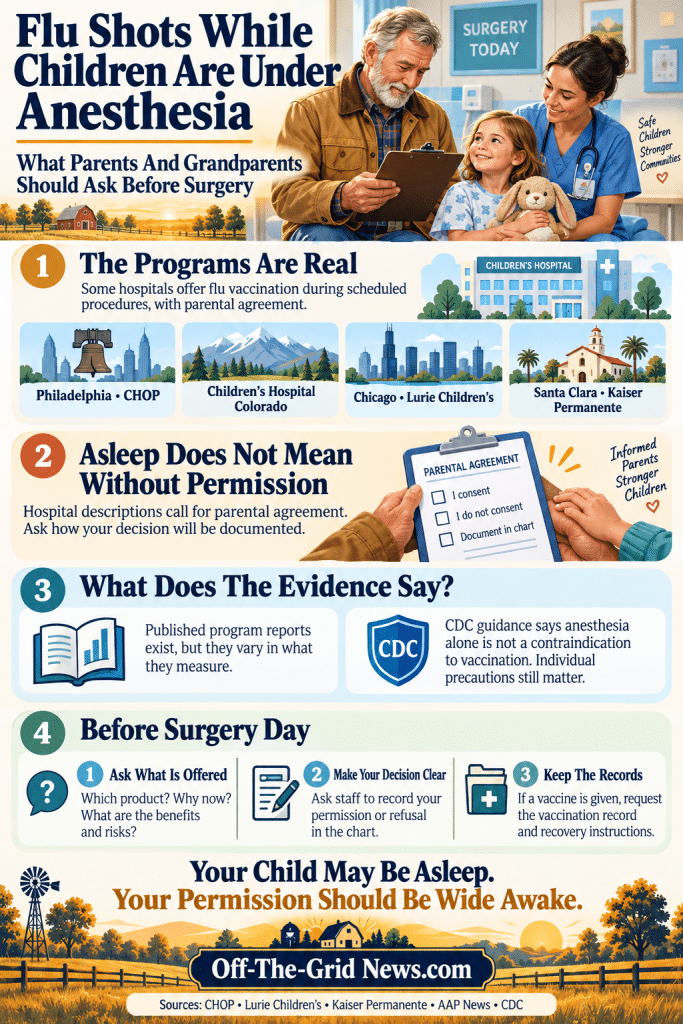
At Children’s Hospital of Philadelphia, the name is “Close Your Eyes, We’ll Immunize.” CHOP says it began offering influenza vaccination during sedation or anesthesia in 2023 and delivered 2,054 doses that way during the 2025–2026 flu season.
According to its account, roughly a third of participating families said their child otherwise would not have received the flu vaccine. The hospital also describes exploring additional immunizations, including COVID-19, RSV-related protection, and catch-up vaccination. Those possibilities deserve questions about the exact product, eligibility, and consent; an RSV antibody product, for example, is not the same thing as a vaccine.
Meanwhile, Children’s Hospital Colorado had already started offering flu vaccination during elective general anesthesia in October 2020. A computerized alert helped prompt staff to review eligibility and offer the vaccine, rather than waiting for a parent to bring it up.
The American Society of Anesthesiologists’ early report described an increase from about 30 vaccinations in the earlier comparison season to more than a thousand after the program began. That is a substantial change in how a surgical visit gets used.
Later, a March 9, 2026, AAP News article reported more than 18,000 patients vaccinated through Colorado’s approach since 2020. The article explains the model to other institutions, giving this practice a road map beyond the hospitals that pioneered it.
Now Chicago is on the list. In an October 19, 2026, announcement, Lurie Children’s said eligible patients six months and older could receive influenza vaccination during scheduled procedures at its main hospital and surgery centers in Westchester and Northbrook. Nurses ask caregivers on procedure day whether they want the vaccine given.
Out west, Kaiser Permanente’s Santa Clara Medical Center reported vaccinating 202 young surgical patients in its first season, beginning in 2023. Its account describes an opt-in process, with information supplied before the procedure and the decision confirmed on the day.
Four institutions, spread across the country, have publicly described versions of this approach. That establishes a recognizable practice, although it does not tell us what percentage of American hospitals offer it. Know this… it’s increasing.
A Saved Trip Can Matter When You Live Beyond The Last Stoplight
To understand the appeal, picture a child who panics at the sight of a needle. Now picture the parent facing another appointment, another missed morning of work, and another long drive into town.
For that family, combining an eligible vaccination with a procedure already requiring anesthesia may be useful. The child avoids experiencing the injection while awake, and the family avoids a separate visit. Hospitals also see a chance to reach children whose other medical needs or difficulties getting care might otherwise keep them from being vaccinated.
That argument deserves a hearing. A forty-minute drive looks different when you are also juggling school pickup, a sick calf, and a job that does not pay you for the hours you spend in a waiting room.
Still, saving a trip does not answer every question about a medical decision. Parents deserve to understand the proposed vaccine, the reason for offering it then, the expected benefits and side effects, and the option of arranging it separately.
Convenience is useful. A clear explanation is part of the job.
Permission Means More Than Another Mark On A Clipboard
Here is where the online version of this story can jump the fence. A child being unconscious when a vaccine is administered does not establish that a parent was unaware of it or refused permission.
CHOP describes advance information and a renewed discussion on surgery day, with vaccination when families agree. Colorado’s published program description also includes consent and, when applicable, the child’s assent. The other hospital accounts likewise describe asking caregivers or an opt-in process.
The material reviewed for this article does not substantiate a claim that these programs routinely vaccinate children over a parent’s refusal. That distinction matters, especially when a headline is traveling faster than the facts underneath it.
Even so, the timing deserves scrutiny. A parent waiting for a child’s operation may be tired, worried, and trying to remember instructions about medications and recovery. That is hardly the same setting as sitting at the kitchen table with time to read and ask questions.
A discussion on surgery morning is not automatically coercive. But a good process should give families a meaningful opportunity to learn about the offer beforehand and to decline without a sales pitch following them down the hall.
Colorado also offers a continuing-education course called “Give It Your Best Shot! Communicating with Vaccine Hesitant Parents.” Its stated purpose is to help professionals address concerns, build trust, and support informed decisions. The course listing itself does not demonstrate pressure in the operating-room program; what matters is how actual conversations with families are handled.
Parents should be able to ask a plain question and get a plain answer. No decoder ring required.
The Research Deserves A Closer Look Than A Hospital Slogan
Another claim making the rounds is that no research exists on vaccination around anesthesia. That goes too far: published studies and quality-improvement reports do exist, although they vary in what they examine and how much they can establish.
Some reports mainly ask whether a hospital can build vaccination into its workflow and increase the number of children vaccinated. Those are useful operational questions. They are also different from asking whether a large, controlled study has measured every possible safety outcome or compared immune responses under different timing arrangements.
Back in 2017, a review in Current Opinion in Anesthesiology raised concerns about possible interactions between immunization, surgery, and anesthesia. Its authors discussed potential effects on immune response and the difficulty of distinguishing vaccine-related fever from a postoperative complication.
The review proposed postponing elective surgery for a week after an inactivated vaccine and three weeks after a live vaccine. However, it also acknowledged a lack of consensus on timing. Those recommendations were the authors’ position in that review, not a universal rule that all hospitals now follow.
Importantly, the CDC’s guidance on contraindications and precautions takes a different position. It says available studies do not convincingly show that recent anesthesia or surgery significantly affects vaccine response, and that current, recent, or upcoming anesthesia or surgery is not, by itself, a contraindication to vaccination.
The same guidance allows for individual circumstances that warrant precautions. Moderate or severe acute illness is one reason to defer vaccination, and clinicians still need to review the child’s condition and the particular product involved.
Put plainly, an older review raised concerns, while CDC guidance does not treat anesthesia alone as a reason to rule vaccination out. Parents should hear that distinction instead of being handed whichever sentence makes the strongest social-media post.
A Fever After Surgery Still Needs An Explanation
The diagnostic question is easy enough to understand without a medical degree. If a child develops a fever or rash after a procedure, the care team needs to consider the timing, the operation, medications, infections, and any vaccination that was given.
Adding another exposure can add another possibility to investigate. That does not make the cause impossible to identify, and it does not prove that the combination is dangerous. It does make accurate records and clear discharge instructions especially useful.
Colorado’s early program reporting described no reported vaccine-related complications. That is reassuring within the limits of the observation, but it should be read for what it is: a report from the program, rather than proof that no uncommon problem could ever occur.
Around the farm, a season without a broken belt tells you something useful about the machinery. It does not tell you everything about how that machine will perform under every load. Medical reports also need to be read with an eye on what was measured, how long patients were followed, and how problems were identified.
If you choose vaccination during a procedure, ask which symptoms are expected afterward and which require a call or urgent attention. You should leave knowing whom to contact, rather than trying to sort out conflicting advice at midnight.
How Far Has This Spread
These examples show adoption at several institutions, but they do not provide a nationwide hospital count. They also concern planned procedures; they do not establish the emergency-surgery scenarios described in some viral posts.
Nevertheless, the route by which the practice spreads is visible. Professional meetings introduce an idea, publications explain how to organize it, and electronic reminders help make the offer routine.
CDC guidance now encourages hospitals to use any appropriate opportunities for vaccination. That broad guidance is not an instruction to give every child a shot during every anesthetic. Eligibility, the child’s health, the proposed product, and permission still matter.
For parents, the practical question is close to home: What does the hospital treating your child actually do?
Make The Decision Before The Truck Leaves The Driveway
First, call the surgeon’s office or pre-op clinic before procedure day. Ask whether vaccination is offered during anesthesia, how families receive information, and how permission or refusal is recorded. Request the relevant information early enough to discuss it with your child’s regular clinician.
You can say it just this plainly: “If a vaccine or other preventive injection might be offered while my child is under anesthesia, I want to know the exact product and make that decision before surgery morning.” Ask for the answer through the patient portal or another written channel, and keep a copy.
Next, make sure your decision reaches the people providing care. Confirm it with the pre-op nurse and anesthesia team, and ask that it appear clearly in the chart and relevant orders. If your decision changes, say so directly and ask for the record to be updated.
Then read what you sign carefully. If a form is unclear, ask somebody to explain the specific permission it grants before you put your name on it. A signature should follow an explanation, not substitute for one.
Finally, if a vaccine is given, request the vaccination record and ensure your child’s regular doctor receives it. Keep the product name, administration date, and other recorded details with your family’s medical paperwork, along with the recovery instructions.
If your child or grandchild reacts to the vaccination, be sure to report this to your child’s doctor and to the VAERS website.
The old homestead lesson still holds: check the latch before you walk away from the gate. When your child is headed into surgery, ask the questions early, make your decision clear, and keep the paperwork where you can find it.
Your child may be asleep for the procedure. Your permission should be wide awake.
Source: https://www.offthegridnews.com/what-they-dont-want-you-to-know/hospitals-are-now-giving-flu-shots-while-children-are-under-anesthesia/
Anyone can join.
Anyone can contribute.
Anyone can become informed about their world.
"United We Stand" Click Here To Create Your Personal Citizen Journalist Account Today, Be Sure To Invite Your Friends.
Before It’s News® is a community of individuals who report on what’s going on around them, from all around the world. Anyone can join. Anyone can contribute. Anyone can become informed about their world. "United We Stand" Click Here To Create Your Personal Citizen Journalist Account Today, Be Sure To Invite Your Friends.
LION'S MANE PRODUCT
Try Our Lion’s Mane WHOLE MIND Nootropic Blend 60 Capsules
Mushrooms are having a moment. One fabulous fungus in particular, lion’s mane, may help improve memory, depression and anxiety symptoms. They are also an excellent source of nutrients that show promise as a therapy for dementia, and other neurodegenerative diseases. If you’re living with anxiety or depression, you may be curious about all the therapy options out there — including the natural ones.Our Lion’s Mane WHOLE MIND Nootropic Blend has been formulated to utilize the potency of Lion’s mane but also include the benefits of four other Highly Beneficial Mushrooms. Synergistically, they work together to Build your health through improving cognitive function and immunity regardless of your age. Our Nootropic not only improves your Cognitive Function and Activates your Immune System, but it benefits growth of Essential Gut Flora, further enhancing your Vitality.

Our Formula includes: Lion’s Mane Mushrooms which Increase Brain Power through nerve growth, lessen anxiety, reduce depression, and improve concentration. Its an excellent adaptogen, promotes sleep and improves immunity. Shiitake Mushrooms which Fight cancer cells and infectious disease, boost the immune system, promotes brain function, and serves as a source of B vitamins. Maitake Mushrooms which regulate blood sugar levels of diabetics, reduce hypertension and boosts the immune system. Reishi Mushrooms which Fight inflammation, liver disease, fatigue, tumor growth and cancer. They Improve skin disorders and soothes digestive problems, stomach ulcers and leaky gut syndrome. Chaga Mushrooms which have anti-aging effects, boost immune function, improve stamina and athletic performance, even act as a natural aphrodisiac, fighting diabetes and improving liver function. Try Our Lion’s Mane WHOLE MIND Nootropic Blend 60 Capsules Today. Be 100% Satisfied or Receive a Full Money Back Guarantee. Order Yours Today by Following This Link.



| Visits: | 1,837,541,189 |
| Stories: | 8,733,359 |
Whistler Blowers, Insiders


If they are doing this, not only should they be sued into oblivion, they should be charged with assault and attempted murder.
Hospitals are the real Auschwitz right out in the open. They do not heal, they do not cure. Once there, everyone ends up with the next intervention of BS until they are dead and broke.
Why is snake venom in every jab? And why are we not enforcing the Nuremberg Code while these real Nazis are violating the code?