

The Christian Nationalist Persecution Of The Pilgrims

Before you pass the turkey this Thanksgiving, picture a very different family gathering: frightened people at a tidal creek near Boston, Lincolnshire, England, trying to get out of their own country.
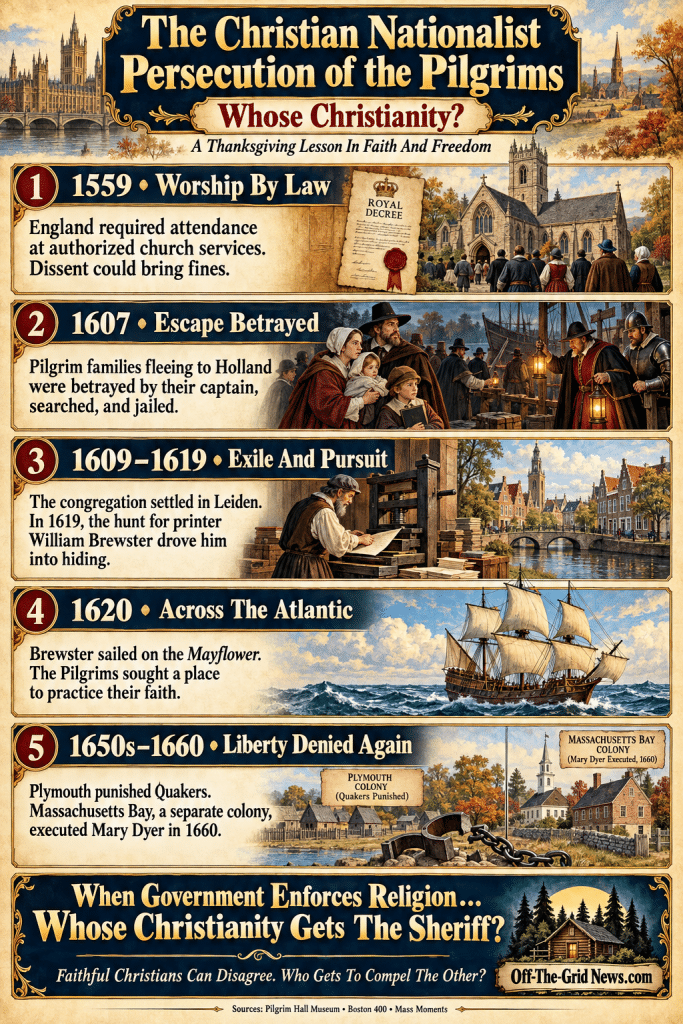
It’s in the fall, and it’s 1607. Members of a Separatist congregation from the farming country around Scrooby have arranged passage to Holland. They are leaving homes, work, and familiar ground because worshiping according to their understanding of the Bible has become dangerous.
Then the captain sells them out.
He takes their money, gets them and their possessions aboard, and delivers them to the authorities. Instead of freedom across the North Sea, they get searches, public humiliation, and jail. The Boston account of their attempted escape describes families stripped of money and dignity, most released after about a month while seven leaders remained to face further proceedings.
Now imagine explaining that to your children. The man you paid to carry your family to safety has handed you over to the very people you were escaping.
We tell our children the Pilgrims came to America for religious freedom. Fair enough. But the Thanksgiving version usually leaves somebody out of the picture: the Christians who helped drive them away.
These believers were fleeing a nation with an established National Christian church, a Christian monarch, and laws compelling Christian worship. The trouble began when they disagreed with the Christianity approved by the government.
England Already Had Christianity on the Books
Jacobean England did not need a campaign to put religion back into public life. Religion was already woven into its laws, its offices, and its machinery of punishment. The crown governed the established church, and religious conformity was public business.
Under Elizabeth’s Act of Uniformity of 1559, people were required to attend the authorized services on Sundays and holy days unless they had a lawful excuse. Missing church could mean a twelve-pence fine. Later legislation made persistent refusal much more expensive. In fact, the 1581 recusancy statute prescribed £20 for a month’s absence, a crushing sum for ordinary households (historical background). (English pounds sterling, £20 in 1581 was roughly equivalent to $7,000–$9,000 in today’s U.S. money)
Think of it as a hefty government bill arriving because your conscience would not sit in the government’s pew.
Then came James I, the king whose name still appears on the Bible in countless American homes. At the Hampton Court Conference in 1604, he made his attitude toward religious nonconformity plain. The famous account has him threatening to make dissenters conform or “harry them out of the land” (Christian History Institute).
So the fight was never simply over whether England would be Christian. It was over who got to define acceptable Christianity… and what happened to everybody who disagreed.
First Pick the Doctrine Then Send the Cops
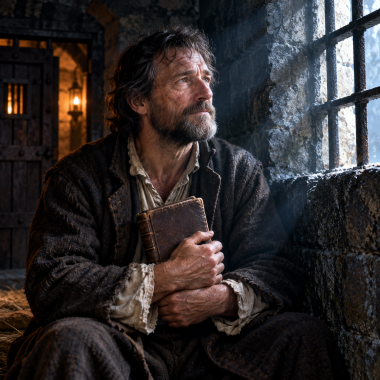
Here is where the pleasant talk about a Christian nation runs into the fence post. Once government starts enforcing religious truth, somebody must decide which religious claims deserve enforcement.
Bishops or elders? Infant baptism or baptism upon a profession of faith? A prescribed prayer book or a congregation ordering its worship differently? Those sound like questions for Christians to debate with open Bibles on the kitchen table.
Give the national, state authority to settle them, though, and the fellow on the other side of that table can bring a warrant.
The English Separatists learned how expensive that arrangement could become. Henry Barrowe and John Greenwood were hanged on April 6, 1593, after prosecutions involving allegedly seditious writings. John Penry followed to the gallows that May; the persecution of these men is documented in the Congregational Studies Conference’s historical account.
Their enemies dressed the charges in the language of the national public order. But the quarrel involved religious authority, the established church, and the right to gather outside its control. An argument over the church became a matter for the executioner.
Meanwhile, the Scrooby believers gathered secretly at William Brewster’s home. Bradford’s account describes imprisonment, watched houses, and people forced to abandon their livelihoods; Pilgrim Hall Museum’s account of their beliefs explains the religious separation behind their predicament.
For readers who work land, that word “livelihood” ought to land hard. Leaving a place means walking away from familiar soil, useful buildings, customers, neighbors, and all the little arrangements that keep a household running. You can’t simply pack an established life into a sea chest.
Now think carefully about this. These folks were not fleeing because they had grown tired of Christianity. They fled because they took their Christian convictions seriously enough to disobey officials claiming authority over them.
A Christian King Could Still Light the Fire
Eventually, the congregation escaped to the Netherlands, settling in Leiden in 1609. Yet England’s religious punishments continued, and James’s displeasure could reach beyond his own shoreline.
In 1612, Edward Wightman was burned at Lichfield for heresy. His prosecution involved several alleged doctrinal departures, including rejection of infant baptism and charges concerning the Trinity and Christ. Reducing the case to baptism alone would miss part of the record (account of the prosecution).
The first attempt to burn him ended when he appeared willing to recant. After the proceedings continued and no satisfactory retraction followed, he was taken back to the stake and killed. Wightman is remembered as the last person burned for heresy in England.
A Protestant king and an established Christian church presided over that punishment. You do not have to agree with Wightman’s theology to recognize what happened: the national government helped turn a doctrinal judgment into a death sentence.
That same year, Thomas Helwys answered royal religious power with a book and a handwritten message. Helwys belonged to the wider English Separatist world, returned from the Netherlands, and helped establish the first Baptist congregation on English soil.
His message to James included this blunt reminder: “The king is a mortall man and not God.” You can see the inscription itself.
Helwys argued that the king had no jurisdiction over immortal souls. His defense of conscience extended beyond his own congregation to people whose religious beliefs he rejected, including Jews and Muslims. That was a much bigger claim than asking the king to leave the Baptists alone (First Amendment Encyclopedia).
The authorities imprisoned him in Newgate. He probably died there around 1616, although the exact circumstances of his death remain uncertain.
There’s a Thanksgiving lesson worth keeping right next to all the fine food and fixins: religious liberty begins to mean something when it protects a neighbor whose theology you think is wrong.
Even Simply Having a Printing Press Could Bring the King’s Enforcers to Your Door
Back in Leiden, Brewster helped operate a small press producing controversial religious books. To modern eyes, it looks like an early version of a stubborn independent publisher working beyond the reach of the usual gatekeepers. Notice too, the Pilgrims weren’t simply trying to get away. They had a point they refused to give up. They published books, sent them back to England to prove up their cause.
Naturally, the gatekeepers noticed.
In 1619, the press printed Perth Assembly, attacking religious policies James was imposing on Scotland. The resulting hunt drove Brewster into hiding; the history of Brewster and the Pilgrim press recounts the English authorities’ pursuit. A year later, he sailed on the Mayflower.
The Pilgrims’ troubles didn’t just amount to a disagreement over whether faith should matter. Their faith mattered enormously. What endangered them was a ruler determined to make his preferred religious order everybody else’s obligation.
Nor did coercion disappear under James’s son, Charles I. In 1637, the Star Chamber punished the anti-episcopal writers William Prynne, Henry Burton, and John Bastwick with huge, ruinous fines, imprisonment, and mutilation. Prynne’s cheeks were branded by nationalists as well.
The contemporary account preserved by Newcastle University records punishment involving £5,000 fines for each man and the loss of their ears. Keep in mind, £5,000 in 1637 was worth approximately $1.1 million in today’s U.S. currency.
Under the Arminian Archbishop William Laud’s religious regime, opposition to the bishops could leave a man permanently marked.
So much for settling church arguments over coffee.
Four Hundred Years Later the Question Still Stands
Now bring that history into the present discussion of Christian nationalism. The useful question is specific: what power would the government actually receive over religious life?
Consider Stephen Wolfe’s The Case for Christian Nationalism, one of the movement’s so-called substantial statements. Wolfe advocates a Christian political order with a ruler he calls a “Christian prince.” In his own extended interview, he explains his view of a nation identifying itself as Christian and acting accordingly. Sounds okay on the surface, right?
The book’s proposals go further than encouraging Christian citizens to vote their convictions. A detailed review in Providence describes authority to call synods, give civil force to doctrinal decisions, promote uniform worship, and suppress false religion. A separate theological review examines his defense of religious establishment and civil punishment for religious offenses.
That should make anyone who remembers the Lincolnshire creek lean forward. Uniformity of worship, civil authority over religious teaching, compulsory attendance: these are recognizable tools from the system the Separatist Pilgrims fled.
Fairness matters here. People use “Christian nationalism” to mean different things, and a neighbor who uses the label may mean little more than public acknowledgment of God and affection for his country. Wolfe also rejects the suggestion that his proposal simply means autocracy; discussion of that distinction is part of the debate.
But those differences make definitions necessary. Loving your country, praying publicly, and handing officials authority to punish religious dissent are different proposals. A friendly label can’t do the work of explaining the law.
So ask the question before signing the deed: whose Christianity will the government enforce? Where does the Catholic farmer fit? What happens to the Orthodox family, the Lutheran congregation, or the Baptist whose reading of Scripture conflicts with the approved settlement?
And if the answer is that officials would never punish sincere Christian dissent, ask where that protection is written. A promise is a poor fence when the next officeholder owns the wire cutters.
Texas Put the Question in a Classroom Frame
For a smaller, present-day illustration of government choosing religious wording, look at Texas Senate Bill 10. It requires qualifying displays of the Ten Commandments in public-school classrooms and specifies the text, with a minimum display size of sixteen by twenty inches (enrolled statute).
In April 2026, the Fifth Circuit upheld the law in a closely divided decision. Some Christian, Jewish, Hindu, and nonreligious families challenging it then sought a Supreme Court review. As of October 25, 2026, the Supreme Court docket showed the petition pending, with the response deadline extended to November 10. Here’s the current status.
Here’s the religious question beneath the courtroom fight. Catholic, Lutheran, Reformed Protestant, and Jewish traditions do not all divide and number the commandments in the same way. The statutory wording follows a familiar Protestant form rather than leaving each family’s religious tradition to supply its own presentation.
That does not mean Texas has resolved centuries of theology, and a classroom poster is plainly different from a prison cell. The narrower point is enough: the legislature has chosen one religious text for compulsory public display. Even the choice of wording raises the question of who gets to speak for everybody’s faith.
You may like the poster. (I do) You may want the commandments taught faithfully in your home and church. (I do) But liking the government’s choice today still doesn’t explain what authority you want it to have tomorrow. That’s a pretty big deal, and it deserves some critical thought.
Now, most homesteaders understand that distinction with a property line. You can like your neighbor and still want the boundary marked before he starts moving the fence.
Keep the Bible Open and the Government Out of the Pulpit
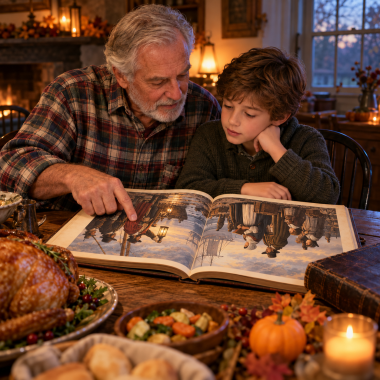
The Pilgrims didn’t hand us a finished blueprint for religious liberty. What they did leave is a history that exposes the cost of letting national or state officials police the conscience.
They also left a striking piece of pastoral counsel. Edward Winslow later recalled John Robinson’s farewell advice to the departing congregation in 1620: follow him only insofar as he followed Christ, and remain willing to receive further understanding from Scripture. Robinson believed God had “more truth and light yet to break forth out of his holy Word” (Pilgrim Hall Museum’s text).
Robinson was not telling them to treat every new notion as revelation. He urged them to examine what they heard against Scripture before accepting it. An open Bible required careful thinking, not a government stamp of approval.
That counsel does not settle every church-and-state question. But it ought to make any would-be national referee of Christianity pause before locking his own conclusions into civil law.
So this Thanksgiving, bow your head and give thanks for the freedom to worship according to conscience. Remember the families betrayed back in Boston, England, the Separatists sent to the gallows, Helwys imprisoned, and Brewster hunted down over the work of a printing press.
Teach your children why those stories belong beside the Mayflower. The danger was never confined to unbelievers attacking Christians from outside the church. It could also arrive carrying Christian credentials and permission from the state.
Keep your faith strong. Keep your Bible open. And before anybody promises to build you a Christian nation, ask what happens to the Christian who tells its Christian Nationalist rulers they are wrong.
Source: https://www.offthegridnews.com/religion/the-christian-nationalist-persecution-of-the-pilgrims/
Anyone can join.
Anyone can contribute.
Anyone can become informed about their world.
"United We Stand" Click Here To Create Your Personal Citizen Journalist Account Today, Be Sure To Invite Your Friends.
Before It’s News® is a community of individuals who report on what’s going on around them, from all around the world. Anyone can join. Anyone can contribute. Anyone can become informed about their world. "United We Stand" Click Here To Create Your Personal Citizen Journalist Account Today, Be Sure To Invite Your Friends.
LION'S MANE PRODUCT
Try Our Lion’s Mane WHOLE MIND Nootropic Blend 60 Capsules
Mushrooms are having a moment. One fabulous fungus in particular, lion’s mane, may help improve memory, depression and anxiety symptoms. They are also an excellent source of nutrients that show promise as a therapy for dementia, and other neurodegenerative diseases. If you’re living with anxiety or depression, you may be curious about all the therapy options out there — including the natural ones.Our Lion’s Mane WHOLE MIND Nootropic Blend has been formulated to utilize the potency of Lion’s mane but also include the benefits of four other Highly Beneficial Mushrooms. Synergistically, they work together to Build your health through improving cognitive function and immunity regardless of your age. Our Nootropic not only improves your Cognitive Function and Activates your Immune System, but it benefits growth of Essential Gut Flora, further enhancing your Vitality.

Our Formula includes: Lion’s Mane Mushrooms which Increase Brain Power through nerve growth, lessen anxiety, reduce depression, and improve concentration. Its an excellent adaptogen, promotes sleep and improves immunity. Shiitake Mushrooms which Fight cancer cells and infectious disease, boost the immune system, promotes brain function, and serves as a source of B vitamins. Maitake Mushrooms which regulate blood sugar levels of diabetics, reduce hypertension and boosts the immune system. Reishi Mushrooms which Fight inflammation, liver disease, fatigue, tumor growth and cancer. They Improve skin disorders and soothes digestive problems, stomach ulcers and leaky gut syndrome. Chaga Mushrooms which have anti-aging effects, boost immune function, improve stamina and athletic performance, even act as a natural aphrodisiac, fighting diabetes and improving liver function. Try Our Lion’s Mane WHOLE MIND Nootropic Blend 60 Capsules Today. Be 100% Satisfied or Receive a Full Money Back Guarantee. Order Yours Today by Following This Link.


| Visits: | 1,839,276,276 |
| Stories: | 8,741,562 |
Whistler Blowers, Insiders

