

Are Banks More Powerful Than Governments?

Authored by Mollie Engelhart via The Epoch Times,
Government is big. Elected and unelected officials wield enormous amounts of power. But lately I have found myself wondering whether we are paying attention to the wrong institution.
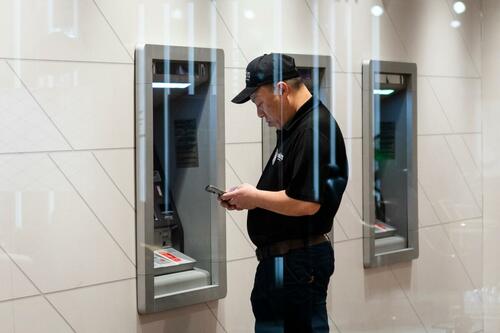
What if the most powerful institutions in America are not governments at all?
What if they are banks and payment processors?
A few years ago, during COVID-19, a friend of mine owned a small shop in Northern California. It was the kind of place many young mothers loved. They sold raw milk, organic cotton sheets, natural baby products, books, toys, and healthy foods. It felt like an old-fashioned mercantile reimagined for modern families.
One day, she made a comment on social media praising CBD. I do not remember the exact wording, but it was something along the lines of, “Of course, we can raise children without CBD, but why would we want to?”
Whether you think CBD is wonderful or terrible is beside the point. The issue is not whether she was right. The issue is whether she had the right to say it.
Not long afterward, her credit card processing company terminated her account.
The company processing her payments had nothing to do with the social media platform where she made the comment. Yet somehow, a statement made on one platform became a problem for an entirely different company that controlled her ability to process payments.
The fallout was immediate. Roughly $30,000 was frozen. She struggled to make payroll. Because the company handled other operational functions as well, portions of her business became difficult to run. It took months of legal back and forth before she finally regained access to her own money.
When this happened, I called my own credit card processing representative. Before I could even finish explaining the situation, he knew exactly what I was talking about.
He told me he had been flooded with calls from businesses looking to switch processors because similar things were happening across the country. Businesses were scrambling to regain access to money they believed was theirs.
It was part of a broader pattern that many people have already forgotten.
During COVID-19, I lost count of the number of conferences, organizations, and educational programs that suddenly found themselves unable to process payments or fundraising. Then came the Canadian trucker protests. Regardless of where someone stood politically, a lot of people suddenly realized that modern power does not always arrive wearing a government uniform. Sometimes it arrives as an email informing you that access to financial services has been suspended.
What concerns me is that all of this happened before we have even become a truly cashless society.
Last weekend, I was in Austin speaking at an event for the Brownstone Institute. As I walked around the city, I noticed a surprising number of businesses no longer accepted cash.
The answers were remarkably consistent. Cash creates more work. Cash can be stolen. Cash requires counting. Cash requires bank deposits. Cash slows things down. Cash creates security concerns for employees.
These are all legitimate concerns. In fact, I understand them better than most people because I have lived them.
My brother owns restaurants in California and has chosen to operate cashless businesses. His reasoning is efficiency. Most business owners making these decisions are trying to reduce theft, simplify accounting, and protect employees. The incentives are understandable.
That is what makes this conversation so interesting.
Rarely do we lose freedom because someone announces they are taking it away. More often, we surrender small pieces of it because convenience, safety, and efficiency seem like fair trade-offs in the moment.
I found myself standing in one Austin business that displayed signs supporting inclusion, immigrant rights, and various social justice causes. I asked the young man behind the counter a simple question.
“If we are concerned about making society accessible to everyone, why require a bank account, a smartphone, a QR code, and a digital payment platform just to buy a cup of coffee?”
He looked genuinely surprised.
After thinking about it for a moment, he said, “Maybe you’re right.”
What struck me was not his answer. It was that the question had never occurred to him.
For all of our conversations about equity and access, we seem remarkably comfortable building systems that increasingly exclude anyone operating outside the banking system. Elderly people, recent immigrants, people who simply value privacy, and those who rely on cash all find themselves pushed a little further to the margins each year.
Most of us have enormous faith in the numbers displayed on our banking apps. We treat those numbers as though they are unquestionably ours, and most of the time they are.
But the people who had accounts frozen, payment processing terminated, or funds held during COVID-19 learned something the rest of us rarely think about. Access to your money increasingly depends on institutions you do not control.
We spent years arguing about who could post what online. Meanwhile, the institutions with the power to deny access to money received far less attention.
What is interesting is that while many businesses are moving away from cash, I am seeing people experiment with other forms of exchange.
At Sovereignty Ranch and The Barn, guests have paid in silver. We have accepted retreat deposits in silver coins. We have accepted festival sponsorships in silver. We also maintain cryptocurrency wallets and have accepted crypto payments.
Is it a large percentage of our business?
But it happens often enough that we added a silver calculator to our point-of-sale system and maintain the apps necessary to accept cryptocurrency.
People are quietly looking for options. Not because they necessarily distrust every bank or financial institution, but because they understand something previous generations understood instinctively. Resilience comes from having choices.
I am not arguing that cash is the only answer. In fact, I think there is value in preserving as many forms of voluntary exchange as possible.
A society with multiple ways to exchange value is more resilient than a society dependent on a single system.
What concerns me is not that people are using digital payments. I use them every day myself. What concerns me is that we are building a world where opting out becomes impossible.
The issue is not whether any particular form of money is perfect. The issue is whether we preserve enough alternatives that no single institution becomes the gatekeeper of economic life.
Because once every transaction requires an intermediary, power shifts. Once every purchase is digital, oversight becomes easier. Once every dollar exists inside systems controlled by institutions we did not elect, freedom begins to look a little different than we thought it did.
Maybe the most important lesson from those years is not about any particular company, politician, virus, or policy.
Freedom rarely disappears all at once. More often, it erodes through a series of reasonable justifications, emergencies, and conveniences.
Looking back, many of the things that happened during COVID-19 would have seemed unimaginable just a few years earlier. Yet they happened anyway.
That is why I think it is important that we do not forget.
Not because we should live in anger. Not because we should endlessly relitigate the past. But because freedom requires memory. The moment we forget what happened, we lose our ability to recognize it when it happens again.
We spend a great deal of time worrying about government power, and some of that concern is justified. But I increasingly wonder if we are overlooking institutions that possess just as much influence over our daily lives.
If an institution can freeze your money, deny your transactions, shut down your business, and exclude you from economic life, does it really matter whether that institution is a government agency or a financial corporation?
And if it does not, are banks actually the most powerful institutions in modern America?
Tyler Durden Tue, 06/16/2026 – 21:45
Source: https://freedombunker.com/2026/06/16/are-banks-more-powerful-than-governments/
Anyone can join.
Anyone can contribute.
Anyone can become informed about their world.
"United We Stand" Click Here To Create Your Personal Citizen Journalist Account Today, Be Sure To Invite Your Friends.
Before It’s News® is a community of individuals who report on what’s going on around them, from all around the world. Anyone can join. Anyone can contribute. Anyone can become informed about their world. "United We Stand" Click Here To Create Your Personal Citizen Journalist Account Today, Be Sure To Invite Your Friends.
LION'S MANE PRODUCT
Try Our Lion’s Mane WHOLE MIND Nootropic Blend 60 Capsules
Mushrooms are having a moment. One fabulous fungus in particular, lion’s mane, may help improve memory, depression and anxiety symptoms. They are also an excellent source of nutrients that show promise as a therapy for dementia, and other neurodegenerative diseases. If you’re living with anxiety or depression, you may be curious about all the therapy options out there — including the natural ones.Our Lion’s Mane WHOLE MIND Nootropic Blend has been formulated to utilize the potency of Lion’s mane but also include the benefits of four other Highly Beneficial Mushrooms. Synergistically, they work together to Build your health through improving cognitive function and immunity regardless of your age. Our Nootropic not only improves your Cognitive Function and Activates your Immune System, but it benefits growth of Essential Gut Flora, further enhancing your Vitality.

Our Formula includes: Lion’s Mane Mushrooms which Increase Brain Power through nerve growth, lessen anxiety, reduce depression, and improve concentration. Its an excellent adaptogen, promotes sleep and improves immunity. Shiitake Mushrooms which Fight cancer cells and infectious disease, boost the immune system, promotes brain function, and serves as a source of B vitamins. Maitake Mushrooms which regulate blood sugar levels of diabetics, reduce hypertension and boosts the immune system. Reishi Mushrooms which Fight inflammation, liver disease, fatigue, tumor growth and cancer. They Improve skin disorders and soothes digestive problems, stomach ulcers and leaky gut syndrome. Chaga Mushrooms which have anti-aging effects, boost immune function, improve stamina and athletic performance, even act as a natural aphrodisiac, fighting diabetes and improving liver function. Try Our Lion’s Mane WHOLE MIND Nootropic Blend 60 Capsules Today. Be 100% Satisfied or Receive a Full Money Back Guarantee. Order Yours Today by Following This Link.


| Visits: | 1,821,264,882 |
| Stories: | 8,671,716 |
Whistler Blowers, Insiders

