

Bank Of Japan Raises Rates To 1% For The First Time In 31 Years, Will Stop Reducing Bond Purchases

As widely expected, the BoJ raised the policy rate by 25bp to “around 1%” (there was one dissent from newly appointed dovish board member Asada for a hold) taking the cost of borrowing to its highest level in 31 years as the country adjusts to sustained inflation. The 0.25% increase, which was widely expected, takes Japan to what analysts said was a critical milestone in the central bank’s effort of normalizing monetary policy after years of ultra-low interest rates and deflation. The BoJ’s policy rate was last at 1% in 1995, when the central bank was in the process of lowering borrowing costs in the wake of the Japanese asset bubble burst in the late 1980s. The Board also opted to make no changes for now to their planned pace of QE taper, also in line with expectations, but likely disappointing some expectations for a shift to a higher planned pace of purchases to support JGBs
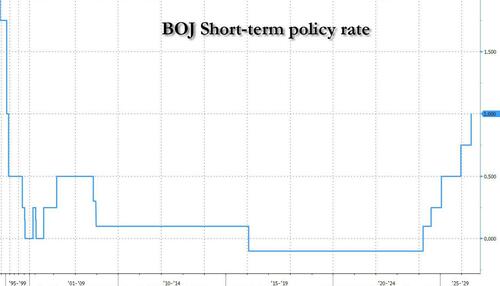
In a statement accompanying the decision, the BoJ signalled that it intended to continue that normalization process, raising the policy interest rate and degree of monetary accommodation “in response to developments in economic activity and prices as well as financial conditions”.
The policy statement showed no material change other than the view that the major downside risks to the economy have “decreased compared with a while ago”. On inflation, it pointed to “a risk of underlying CPI inflation deviating upward to a level above the price stability target of 2%”, but this is not new information given that the April Outlook Report’s BoJ core inflation forecast (ex. fresh food and energy) already implies inflation above 2% throughout the projection period through FY2028. As Deputy Governor Uchida also noted at the press conference, in terms of what has changed since the April meeting, the decline in downside growth risks appears to have been the backdrop to the decision to proceed with a rate hike this time.
Offsetting the hawkish taste of the rate hike, the BoJ also said that from April 2027 it would stop reducing its monthly purchases of Japanese government bonds, leveling off at a pace of about ¥2tn ($12.5bn) per month. That move was also widely expected by the market. The Bank noted that this decision could be changed depending on circumstances; however, if this policy is maintained, the BoJ’s balance sheet will continue to shrink, though the pace of contraction will ease from 2028 onward.
The BoJ said that while higher crude oil prices were weighing on economic activity, “the risk of a significant slowdown in the economy appears to have decreased compared with a while ago”. It also noted that the price pass-through from higher fuel prices had been progressing relatively quickly, and could spread from business-to-business transactions to push underlying consumer price inflation above its target of 2 per cent.
Since lifting Japan out of negative interest rates in 2024, the BoJ raised rates twice last year. It has been expected to settle into a pattern of gradually tightening every six months or so. Some economists believe a further 0.25% rise could come as soon as October.
The decision to raise interest rates this week was reached by a 7-1 vote of the Monetary Policy Committee, which was down to eight members after governor Kazuo Ueda was admitted to hospital last week. The dissenting member, Toichiro Asada – the first member appointed under the dovish Takaichi administration – argued that the situation in the Middle East presented Japan with greater downside risks to production and employment than the upside risks to prices.
“The distribution of votes is interesting and reflects that the board is a bit more balanced now when previously it skewed comfortably hawkish,” said Stefan Angrick, head of Japan at Moody’s Analytics. “The fact is also that the BoJ has no good choices,” he added. “They can hike to stem inflationary pressure by strengthening the yen, but that would hurt the economy.”
As reported previously, BOJ governor Ueda is receiving treatment for a liver condition and did not attend the meeting or cast a vote. This week’s meeting, the first held without the governor since 2010, was chaired by one of the BoJ’s deputy governors, Ryozo Himino. In Ueda’s absence, the afternoon press conference was presented by the BoJ’s other deputy governor, Shinichi Uchida. He noted that the major difference between this week’s meeting and the one in April, when the BoJ held rates, was the memorandum agreed between the US and Iran to extend their ceasefire
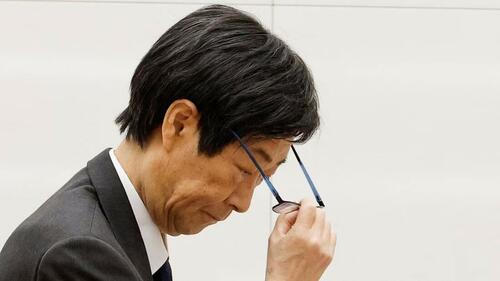
“That is a welcome move,” Uchida said. “Having said that, there is uncertainty on the pace of improvement in [oil] distribution.”
Deputy Governor Uchida chose his words carefully throughout the press conference, but most questions focused on the Bank’s assessment of upside inflation risks and the implications for future rate hikes. He reiterated the policy of continuing rate hikes as underlying inflation approaches 2%, reinforcing that stance by emphasizing the perceived upside risks to inflation. He also stated that going forward, “keeping inflation stable at around 2% will be important”.
That said, differences of opinion were evident within the Board regarding the state of underlying inflation. While the statement and the press conference conveyed the view that underlying inflation is now in the process of moving toward 2%, Takada and Tamura objected, indicating that they believe it has already reached that level. In contrast, Deputy Governor Uchida said at the press conference that many of the remaining members think it will be achieved between the second half of FY2026 and the first half of FY2027.
Another notable point was Deputy Governor Uchida’s remark that “the neutral rate estimates have too wide a range to be usable for actual policy decisions”, clearly downplaying the Bank’s published estimates of the neutral rate. Governor Ueda has long pointed to the uncertainty surrounding the estimates, but Uchida made this point more explicit. He characterized the current rate hikes as “policy adjustments toward a neutral level”, while adding that “it is not clear at what point we can judge the stance to be neutral; we won’t know until we reach it”. This likely implies that, although the policy rate has now reached the lower bound of the BoJ’s published estimates of the neutral rate, that fact does not mean the Bank will become materially more cautious about further rate hikes.
Deputy Governor Uchida avoided answering a question about consistency with the fiscal policy pursued by the Takaichi administration. Still, despite his otherwise rigorous focus on logic, his explanation for JGB purchases remained somewhat coarse – namely, that “market functioning has been steadily improving, so we decided to continue with this for the time being”. Moreover, even though the decision was made after substantial prior coordination and was almost fully priced in by the market, the fact that a member appointed under the Takaichi administration cast a dissenting vote may suggest that strong resistance to the BoJ’s policy normalization may remain within the administration.
Finally, he was also asked why Governor Ueda did not have voting rights this time, even though Deputy Governor Uchida retained voting rights when he participated remotely during his hospitalization through the previous meeting. Uchida limited his response to saying it was “for reasons related to medical treatment”.
According to JPM, this rate hike will not exert significant downward pressure on the economy, and the bank continues to expect the BoJ to deliver an additional rate hike in October in response to inflationary pressures that are likely to become more apparent towards the summer.
The yen held steady at about ¥160.2 versus the dollar following the announcement, while the Nikkei 225 stock average breached 70,000 points, a record level, before falling back.
“Traders were content that there were no overtly hawkish surprises” from the BOJ, said Tim Waterer, chief market analyst at KCM Trade. “The rate hike was fully anticipated and priced in.”
Tyler Durden Tue, 06/16/2026 – 10:40
Source: https://freedombunker.com/2026/06/16/bank-of-japan-raises-rates-to-1-for-the-first-time-in-31-years-will-stop-reducing-bond-purchases/
Anyone can join.
Anyone can contribute.
Anyone can become informed about their world.
"United We Stand" Click Here To Create Your Personal Citizen Journalist Account Today, Be Sure To Invite Your Friends.
Before It’s News® is a community of individuals who report on what’s going on around them, from all around the world. Anyone can join. Anyone can contribute. Anyone can become informed about their world. "United We Stand" Click Here To Create Your Personal Citizen Journalist Account Today, Be Sure To Invite Your Friends.
LION'S MANE PRODUCT
Try Our Lion’s Mane WHOLE MIND Nootropic Blend 60 Capsules
Mushrooms are having a moment. One fabulous fungus in particular, lion’s mane, may help improve memory, depression and anxiety symptoms. They are also an excellent source of nutrients that show promise as a therapy for dementia, and other neurodegenerative diseases. If you’re living with anxiety or depression, you may be curious about all the therapy options out there — including the natural ones.Our Lion’s Mane WHOLE MIND Nootropic Blend has been formulated to utilize the potency of Lion’s mane but also include the benefits of four other Highly Beneficial Mushrooms. Synergistically, they work together to Build your health through improving cognitive function and immunity regardless of your age. Our Nootropic not only improves your Cognitive Function and Activates your Immune System, but it benefits growth of Essential Gut Flora, further enhancing your Vitality.

Our Formula includes: Lion’s Mane Mushrooms which Increase Brain Power through nerve growth, lessen anxiety, reduce depression, and improve concentration. Its an excellent adaptogen, promotes sleep and improves immunity. Shiitake Mushrooms which Fight cancer cells and infectious disease, boost the immune system, promotes brain function, and serves as a source of B vitamins. Maitake Mushrooms which regulate blood sugar levels of diabetics, reduce hypertension and boosts the immune system. Reishi Mushrooms which Fight inflammation, liver disease, fatigue, tumor growth and cancer. They Improve skin disorders and soothes digestive problems, stomach ulcers and leaky gut syndrome. Chaga Mushrooms which have anti-aging effects, boost immune function, improve stamina and athletic performance, even act as a natural aphrodisiac, fighting diabetes and improving liver function. Try Our Lion’s Mane WHOLE MIND Nootropic Blend 60 Capsules Today. Be 100% Satisfied or Receive a Full Money Back Guarantee. Order Yours Today by Following This Link.


| Visits: | 1,822,049,522 |
| Stories: | 8,673,551 |
Whistler Blowers, Insiders

